What Is a Solar Radiation Test Chamber and How Does It Prove a Solar Panel Will Last 25 Years?
Solar panels promise decades of reliable energy generation, but how can manufacturers ensure their modules withstand years of intense sunlight, temperature swings, and environmental stress? The answer lies in solar radiation test chambers — precision-engineered systems that replicate the harshest conditions nature can deliver. This article covers how these chambers work, the IEC standards they support, the degradation mechanisms they expose, and how LIB Industry's DHPV-04 chamber helps photovoltaic (PV) manufacturers validate performance and shorten certification timelines.
What Is Solar Radiation Testing in Photovoltaic Validation?
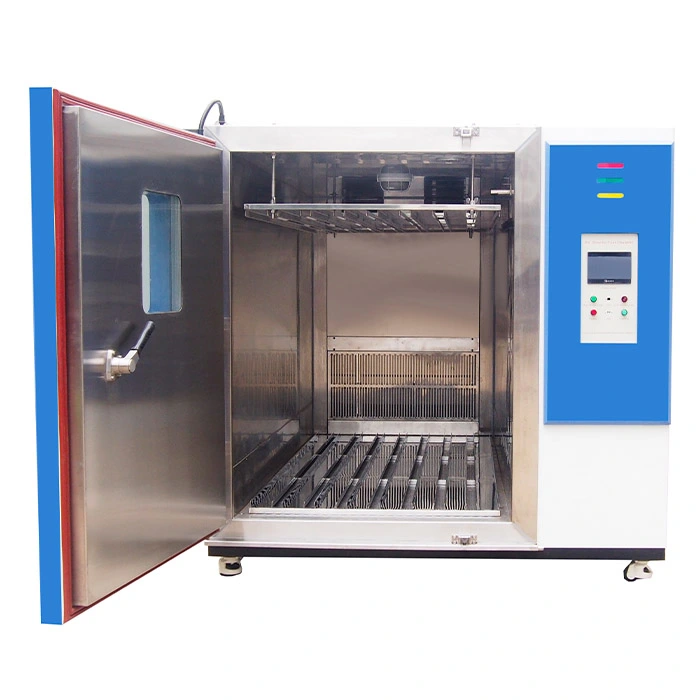 Direct answer: Solar radiation testing exposes PV modules to precisely regulated light, thermal, and humidity conditions to measure electrical degradation, material stability, and structural integrity under conditions that mirror real-world deployment. Rather than simply confirming that a module produces power on day one, this validation process tracks how that power output, mechanical strength, and material appearance change as the module accumulates simulated years of sun, heat, and moisture exposure.
Accelerated testing condenses multiple years of outdoor exposure into concentrated periods, typically 1,000 to 2,000 hours, applying intensified stress while maintaining scientifically accurate environmental ratios between light intensity, temperature, and humidity. This lets manufacturers predict long-term performance without waiting decades for field data, shortening development cycles from years to weeks. It also gives R&D teams a fast feedback loop: a new encapsulant formulation or backsheet material can be benchmarked against an established baseline within a single test campaign rather than through years of outdoor monitoring.
Properly calibrated chambers can predict field degradation with strong accuracy, letting manufacturers confidently warranty products for 25–30 years based on concentrated lab evidence rather than extended field trials. This correlation between accelerated chamber results and real-world outdoor performance is what underpins the entire PV certification ecosystem — without it, IEC standards bodies, insurers, and financiers would have no reliable way to assess long-term product risk before installation.
How Do UV, Heat, and Light Spectrum Affect PV Module Performance?
UV and encapsulants. UV exposure triggers photochemical reactions in EVA encapsulants, causing yellowing and transmittance loss that reduces usable light reaching the cells. Chambers control UV wavelengths between 280–400 nm to replicate stratospheric ozone-filtered radiation reaching Earth's surface, avoiding the unrealistically harsh shortwave UV that unfiltered lamp sources can produce.
Thermal cycling and efficiency. Temperature fluctuations create expansion-contraction cycles that stress solder joints, interconnects, and lamination bonds. Silicon cell efficiency typically declines 0.4–0.5% per °C above standard test conditions, so chambers spanning −70℃ to +150℃ are needed for full thermal stress evaluation. Repeated cycling between extremes reveals fatigue failures — cracked solder joints or delaminated interconnect ribbons — that a single exposure test would never uncover.
Spectral matching. Authentic simulation requires matching the AM1.5 global spectral distribution, which represents sunlight passing through 1.5 atmospheric thickness equivalents. Xenon arc lamps give the closest match to natural sunlight across UV, visible, and infrared wavelengths, and precise spectral calibration ensures lab results translate meaningfully to how a module will actually perform once installed outdoors.
Key Degradation Mechanisms Exposed by Radiation Testing
| Mechanism | Primary Cause | Detection Method | Test Duration |
|---|---|---|---|
| PID (Potential-Induced Degradation) | Voltage difference + humidity causes ion migration, cutting output up to 30%+ | IV curve measurement | 96–192 hours |
| Delamination | Moisture through backsheet/edge seals, compromising insulation | Visual + IR imaging | 1,000 hours |
| Hot-spot damage | Shaded/defective cells act as resistors, heating 100°C+ above ambient | Thermal imaging | 50–100 cycles |
Chambers with integrated high-voltage bias systems and controlled humidity (85% RH at 85°C) accelerate PID for evaluation, while damp-heat protocols and partial-shading scenarios expose delamination risk and hot-spot-prone designs before deployment.
Simulating Real-World Sunlight Conditions
Professional chambers hold irradiance uniformity within ±5% across the test plane using engineered lamp arrays and reflector geometries, which matters because uneven exposure across a large test batch can produce inconsistent degradation results between otherwise identical panels. Advanced systems program sequential exposure profiles that replicate specific climates — from Arizona's dry heat to Singapore's humid tropics to coastal salt-fog environments — letting manufacturers optimize product formulations for the specific markets they plan to ship into, rather than relying on a single generic stress profile.
Natural solar exposure also includes nighttime cooling that affects thermal expansion and moisture equilibrium inside the module. Sophisticated protocols incorporate dark periods with controlled cooling rates rather than continuous exposure, better replicating the daily cyclic stress pattern panels experience outdoors and revealing fatigue mechanisms that a purely static, always-on exposure test would miss entirely.
Which IEC Standards Govern Photovoltaic Solar Simulation Testing?
| Standard | Focus Area | Key Parameters | Pass Criteria |
|---|---|---|---|
| IEC 61215 | Design qualification | −40°C to +85°C, 200 cycles | <5% power loss |
| IEC 61730 | Safety qualification | Environmental + electrical stress | No safety hazards |
| IEC 62804 | PID resistance | 85°C, 85% RH, ±1000V | <5% degradation |
IEC 61215 covers crystalline silicon module design qualification, including thermal cycling, humidity-freeze cycling, damp-heat exposure, and UV preconditioning, requiring chamber temperature fluctuation within ±0.5°C. IEC 61730 evaluates electrical, mechanical, and fire hazards. IEC 62804 defines PID testing at 85°C with applied system voltage for 96–192 hours.
How Radiation Test Data Improves PV Module Design
Material selection: comparative testing between encapsulant, backsheet, and antireflective coating variants quantifies which materials hold up best under prolonged radiation exposure, letting manufacturers weigh the performance premium of higher-cost materials against cheaper alternatives with real degradation data instead of supplier claims.
Junction box and connector durability: radiation testing exposes weaknesses in junction box sealing, connector weatherability, and cable insulation integrity, since UV degrades polymeric components while thermal cycling stresses mechanical connections — guiding improvements to adhesive formulations, gasket materials, and housing designs.
Frame design for thermal management: module frames serve both structural and thermal management roles. Testing different frame geometries and materials across climate profiles reveals configurations that lower operating temperature by several degrees, directly improving long-term power output.
Quality control: periodic testing of production samples verifies manufacturing consistency and catches process variations early. Trending results across batches flags when a material supplier quietly changes a formulation or when production parameters drift, preventing defective products from reaching customers.
LIB Industry Solar Radiation Chambers: The DHPV-04
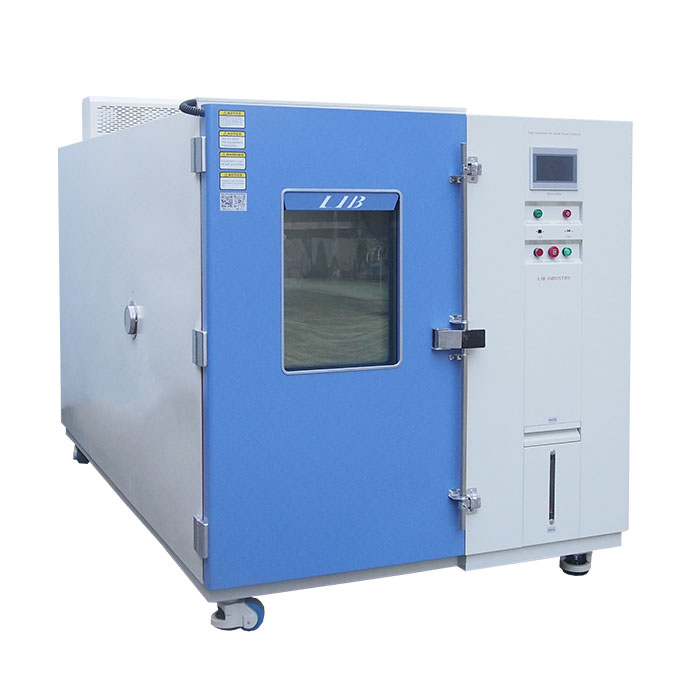
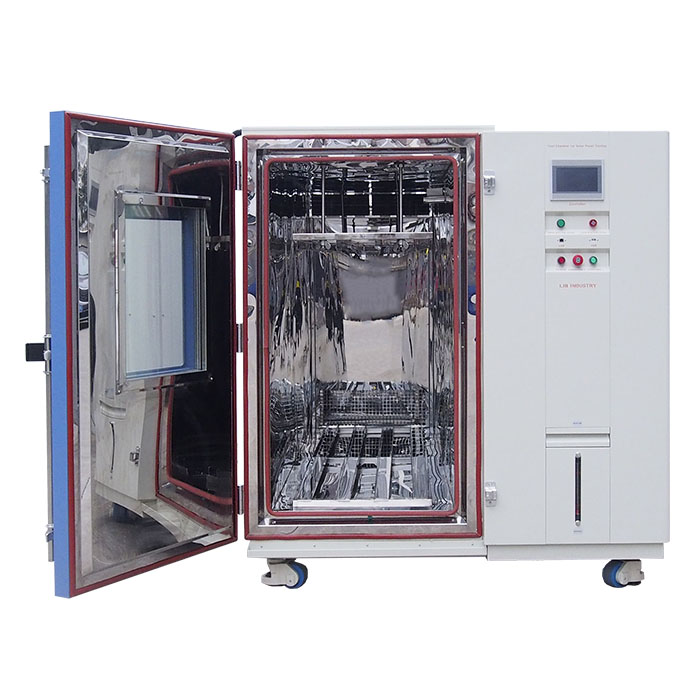
LIB Industry's chambers integrate temperature control from −70℃ to +150℃ with humidity regulation from 10% to 98% RH — enough range to simulate desert, tropical, and arctic conditions in one system. The DHPV-04 is purpose-built for the 85°C/85% RH damp-heat protocol, supporting test durations up to 1,000+ hours.
PT-100 Class A sensors measure temperature to 0.001°C accuracy, with temperature deviation within ±0.5–2.0℃ and humidity deviation at ±2.5% RH, meeting IEC requirements. Chambers accommodate 4–12 panels per cycle (internal volume 1220L; 1300 x 700 x 1350 mm), with panel sizes up to 2M x 1M, adjustable SUS304 stainless shelves, and cable holes of 50mm, 100mm, or 200mm.
| Feature | DHPV-04 Specification | Testing Benefit |
|---|---|---|
| Internal dimensions | 1300 x 700 x 1350 mm | Fits standard module sizes |
| Temperature precision | ±0.5℃ fluctuation | Meets IEC requirements |
| Humidity control | 85% RH ±2.5% | Accurate damp-heat testing |
| Test duration | 1,000+ hours | Complete protocol execution |
| Panel capacity | 4–12 pieces | Efficient batch testing |
 |
 |
DHPV-04 vs. Standard Damp-Heat Chamber
| Comparison Point | Standard Chamber | LIB DHPV-04 |
|---|---|---|
| Panel capacity | Typically 1–4 | 4–12 |
| Panel size | Smaller modules only | Up to 2M x 1M |
| Temperature range | Often narrower | −70℃ to +150℃ |
| Humidity precision | ±5% RH typical | ±2.5% RH |
| IEC compliance | Varies | IEC 61215/61730/62804 ready |
LIB Industry provides turn-key service — research, design, production, commissioning, delivery, installation, and training — plus optimized insulation and refrigeration for lower energy costs over long test cycles. Chambers support in-house IEC 61215, IEC 61730, and IEC 62804 testing, reducing dependence on third-party labs. Every chamber ships with a 3-year warranty on core components and workmanship, backed by lifetime after-sales service — spare parts, calibration support, and maintenance guidance for the life of the equipment.
Frequently Asked Questions
How long does a typical solar radiation test cycle take for certification? IEC 61215 qualification requires multiple sequential tests totaling several weeks. The damp-heat protocol alone demands 1,000 hours (about 42 days). Combined with thermal cycling and UV preconditioning, total testing runs roughly 8–12 weeks depending on module type and scope.
Can solar radiation chambers test multiple module types simultaneously? Yes, as long as all samples require identical environmental conditions. LIB Industry's adjustable shelving supports various module dimensions in one cycle, though modules needing different protocols should be tested separately to preserve data integrity.
What maintenance does a solar radiation test chamber require? Lamp replacement after 1,500–2,000 operational hours, quarterly or semi-annual sensor calibration, and refrigeration system inspection. Xenon lamp chambers need annual spectral verification to maintain AM1.5 compliance.
Does LIB Industry provide installation, training, and after-sales support? Yes — a turn-key service covering research, design, production, commissioning, delivery, on-site installation, and operator training, plus ongoing calibration and maintenance support.
What warranty and after-sales service does LIB Industry offer? Every chamber comes with a 3-year warranty covering core components and workmanship, plus lifetime after-sales service — remote troubleshooting, spare parts, and on-site maintenance visits whenever needed, so support continues well beyond the warranty period.
Related LIB Industry Testing Chambers
|
DHPV-04 Damp-Heat Solar Radiation Chamber — built for the 85°C/85% RH damp-heat protocol under IEC 61215, ideal for routine batch qualification. |
Salt Spray / Salt Fog Test Chamber — simulates coastal and marine salt-mist environments to evaluate corrosion resistance of module frames, junction boxes, and connectors, useful for products destined for coastal or offshore installations. |
Thermal Cycling Chamber (−40°C to +85°C) — supports the 200-cycle sequence required under IEC 61215 for solder joint and interconnect durability. |


Conclusion
Solar radiation test chambers turn decades of environmental exposure into actionable data within weeks, letting manufacturers validate encapsulant stability, thermal performance, PID resistance, and safety compliance before modules reach installation sites. As the solar industry pushes toward higher efficiency and longer warranties, chambers like LIB Industry's DHPV-04 give engineering and quality teams a practical way to bring IEC-compliant testing in-house.
Ready to elevate your photovoltaic testing capabilities? Contact LIB Industry's technical team at ellen@lib-industry.com to discuss your testing needs, request a quote, or explore a custom chamber configuration.