Dust Simulation Chamber for IP0X to IP6X Testing
Protecting electronic devices, automotive components, and industrial equipment from dust ingress requires rigorous validation through standardized environmental testing. A dust simulation chamber creates controlled particle environments that replicate real-world exposure scenarios, enabling manufacturers to verify ingress protection (IP) ratings from IP0X through IP6X. These specialized chambers utilize calibrated talcum powder, precision airflow systems, and vacuum capabilities to simulate everything from large debris penetration to complete dust-tight sealing. Compliance with IEC 60529 and ISO 20653 standards ensures product reliability across industries ranging from consumer electronics to defense applications, where certification determines market access and warranty performance.
A testing laboratory in Thailand successfully used a sand and dust test chamber to verify the durability of its outdoor solar monitoring systems. By simulating harsh desert conditions—including severe sandstorms and high temperatures—the team subjected their equipment to extreme environmental stress tests.
Throughout the process, the systems operated steadily without any functional failures. The chamber enabled engineers to thoroughly evaluate key factors such as the effectiveness of enclosure seals, the resilience of connectors, and the overall long-term reliability. As a result, the testing significantly boosted confidence in the equipment’s ability to perform reliably in tough, remote, and arid environments.
What Do IP0X to IP6X Ratings Mean in Dust Testing?
Understanding the IP Code Structure
The International Protection code comprises two characteristic numerals that define enclosure effectiveness against solid particles and liquids. The initial digit addresses solid object protection, ranging from 0 (no special protection) to 6 (dust-tight). This systematic classification enables engineers to specify exact environmental resistance requirements without ambiguity. Manufacturers targeting outdoor deployment must achieve minimum IP5X ratings, while pharmaceutical equipment often demands IP6X certification. The standardized approach facilitates cross-industry communication and regulatory compliance verification.
Regulatory Framework and Standards Authority
IEC 60529 represents the globally recognized standard governing IP rating test procedures and classification criteria. ISO 20653 extends these requirements specifically for road vehicles, incorporating additional mechanical impact provisions. Military specifications like MIL-STD-810 reference IP testing methodologies while adding mission-specific environmental stressors. Testing laboratories must maintain accreditation demonstrating calibration traceability and procedural adherence. Product datasheets citing IP ratings without third-party certification carry limited credibility in regulated markets where liability concerns dominate procurement decisions.
Consequences of Inadequate Dust Protection
Particulate contamination degrades electrical contacts, clogs cooling pathways, and accelerates mechanical wear in moving assemblies. Solar inverters installed in desert environments experience catastrophic failures when dust accumulates on circuit boards, creating conductive pathways that trigger short circuits. Automotive sensors exposed to road debris without proper IP6X sealing generate erroneous data affecting safety systems. The cost differential between IP5X and IP6X enclosure design pales compared to warranty claims and reputation damage from field failures. Proper dust testing during development identifies design vulnerabilities before production commitment.
Dust Ingress Protection Levels and Classification Criteria
IP0X: No Protection Against Dust
This classification indicates enclosures lack deliberate protection against particulate ingress. Indoor electronic equipment operating in controlled environments may accept IP0X ratings when contamination risks remain minimal. Laboratory instruments housed within cleanroom facilities represent typical applications where expensive sealing proves unnecessary. Cost-sensitive consumer products targeting strictly indoor usage sometimes forgo dust protection, accepting limited operational environments as design constraints. The absence of protection requirements simplifies manufacturing but restricts market applicability.
IP1X and IP2X: Protection Against Large Objects
IP1X prevents objects exceeding 50mm diameter from contacting hazardous components, primarily addressing safety rather than operational integrity. IP2X raises the threshold to 12.5mm, blocking fingers and similar-sized items. These ratings rarely appear in dust-related applications since the protective measures target mechanical hazards rather than particulate contamination. Industrial control panels and electrical distribution equipment commonly specify these levels, where human contact prevention supersedes environmental sealing. Testing involves rigid spheres and articulated probes rather than dust particles.
IP3X and IP4X: Mid-Range Particulate Protection
IP3X excludes particles exceeding 2.5mm diameter, providing basic protection against coarse dust and debris. Outdoor lighting fixtures and ventilation equipment frequently target this classification, balancing environmental resistance with cost constraints. IP4X certification requires rejection of particles larger than 1mm, suitable for portable tools and construction-grade electronics. These intermediate ratings accommodate applications where complete dust exclusion proves impractical, yet operational reliability demands exceed IP0X tolerance. Testing employs calibrated wires and rods to verify exclusion thresholds.
|
IP Rating |
Particle Size Exclusion |
Typical Test Duration |
Common Applications |
|
IP0X |
No protection |
N/A |
Indoor-only electronics |
|
IP3X |
> 2.5mm diameter |
8 hours |
Outdoor lighting, industrial fans |
|
IP5X |
Dust protected |
8 hours |
Smartphones, portable devices |
|
IP6X |
Dust-tight |
8 hours |
Automotive sensors, marine equipment |
Test Methods for Different IP Dust Protection Ratings
IP5X Testing Procedures
IP5X certification permits limited dust ingress that must not interfere with equipment operation or compromise safety. The dust simulation chamber circulates talcum powder with particle distribution approximating Arizona road dust, exposing specimens to 2kPa below atmospheric pressure for eight hours. A dust simulation chamber maintains particle concentration at 2 cubic meters per kilogram, creating turbulent conditions that stress sealing effectiveness. Post-test inspection involves disassembly to verify no dust accumulation affects critical components. Weight gain measurements quantify ingress magnitude, with acceptance criteria varying by equipment category.
IP6X Dust-Tight Validation
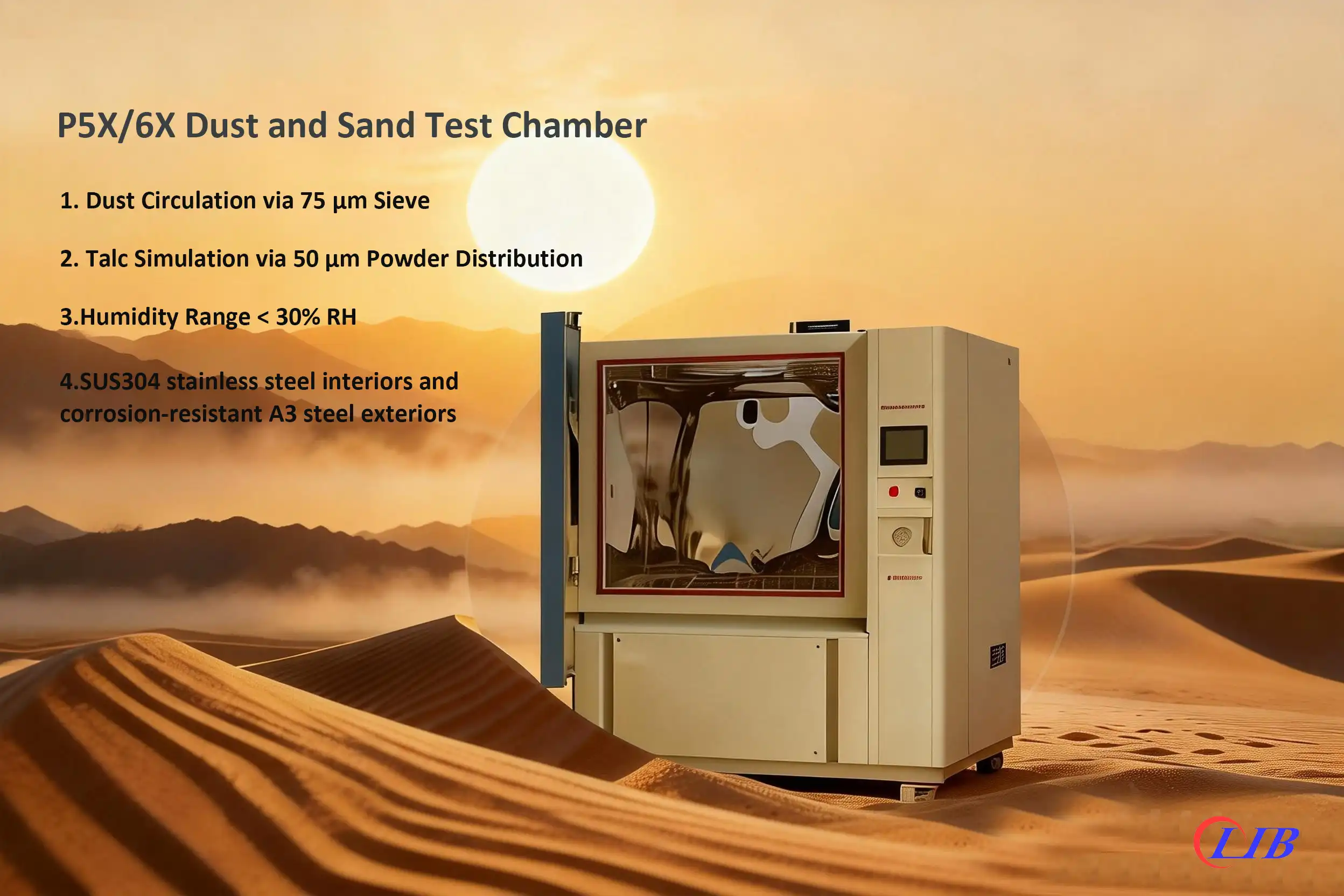
Complete dust exclusion demands rigorous testing under sustained vacuum conditions. Specimens undergo eight-hour exposure within chambers maintaining 20 millibars below ambient pressure while talcum powder circulates continuously. The 75μm mesh filtration system in advanced chambers like LIB's DI Series ensures consistent particle size distribution throughout testing. Visual inspection after exposure must reveal zero dust penetration into sealed enclosures. This stringent requirement necessitates precision gasket selection, surface finish optimization, and assembly process controls that exceed IP5X manufacturing requirements.
Test Specimen Preparation and Mounting
Proper sample orientation within dust chambers significantly impacts test validity. Mounting configurations must replicate installed service positions, as gravity influences dust settlement patterns. Electrical connections through dust-proof ports enable powered operation during testing, revealing dynamic sealing performance under operational conditions. Cable glands, connectors, and interface seals experience different stress profiles when energized components generate internal heat. Multi-specimen testing requires adequate spacing to prevent airflow shadowing that creates non-uniform exposure. Photographic documentation before and after testing provides audit trails for certification bodies.
How Does a Dust Simulation Chamber Achieve IP6X Conditions?
Vacuum System Integration
Generating the 2kPa pressure differential required for IP6X testing demands robust vacuum pumps with precise regulation capabilities. Chambers incorporate pressure gauges with ±0.1 kPa accuracy, air filters preventing pump contamination, and adjustable regulators maintaining setpoint stability throughout extended test cycles. The LIB dust simulation chamber features automatic pressure control that compensates for specimen volume displacement and minor leakage paths. Safety interlocks prevent door opening under vacuum conditions, protecting operators from sudden pressure equalization. Regular calibration verification ensures consistent test conditions across certification campaigns.
Talcum Powder Circulation Dynamics
Maintaining uniform particle suspension throughout large chamber volumes requires sophisticated airflow engineering. Vertical circulation systems utilize heated pathways that prevent moisture absorption, which causes powder clumping and invalidates test results. The 50μm wire mesh sizing combined with 75μm gap specifications creates standardized particle distribution matching IEC 60529 requirements. Fan positioning above the working chamber protects impellers from abrasive wear while generating turbulent mixing. Sloped chamber floors with quick-release drains enable complete powder evacuation between tests, preventing cross-contamination when switching dust types for specialized protocols.
Temperature and Humidity Control
Ambient temperature capability up to +50℃ accommodates heated specimen testing that simulates operational conditions in high-temperature environments. Maintaining humidity below 30% RH proves critical for talcum powder flowability, as moisture creates electrostatic clumping. Heated dust simulation chamber walls prevent condensation that converts dust into abrasive paste damaging both specimens and internal surfaces. Real-time monitoring systems track environmental parameters with data logging capabilities that satisfy auditor documentation requirements. Automatic fault detection alerts operators to deviations before test validity becomes compromised.
|
Chamber Model |
Internal Volume |
Vacuum Capability |
Maximum Load Capacity |
Powder Capacity |
|
DI-800 |
800L (800×1000×1000mm) |
2kPa differential |
50kg |
5kg standard |
|
DI-1000 |
1000L (1000×1000×1000mm) |
2kPa differential |
75kg |
7kg capacity |
|
DI-1500 |
1500L (1000×1500×1000mm) |
2kPa differential |
100kg |
10kg capacity |
|
DI-2000 |
2000L (1000×2000×1000mm) |
2kPa differential |
150kg |
15kg capacity |
Key Parameters: Particle Size, Concentration, and Airflow
Talcum Powder Specifications
IEC 60529 mandates talcum powder conforming to specific particle size distributions with median diameter near 50μm. This fine powder penetrates microscopic gaps while remaining large enough for visual detection during post-test inspection. Chemical composition must avoid corrosive or conductive properties that introduce secondary failure mechanisms unrelated to mechanical sealing. Moisture content below 0.5% ensures free-flowing characteristics throughout multi-hour test durations. The LIB standard configuration includes 5kg pharmaceutical-grade talcum powder meeting international testing standards. Proper storage in sealed containers prevents humidity absorption between test cycles.
Dust Concentration Metrics
Achieving 2 cubic meters per kilogram concentration requires precise powder metering relative to chamber volume. Excessive concentration creates artificial stress exceeding real-world exposure, while insufficient density fails to challenge sealing effectiveness. Gravimetric sampling techniques verify concentration uniformity across the working volume before certification testing commences. Optical particle counters provide real-time monitoring, though manual verification remains the definitive reference method. Chamber design minimizing dead zones and recirculation patterns ensures specimens receive representative exposure regardless of mounting location.
Airflow Velocity and Turbulence
Vertical circulation velocities between 0.5-2.0 meters per second create turbulent mixing without generating destructive particle impacts. Computational fluid dynamics modeling optimizes diffuser geometries that distribute airflow evenly across horizontal planes. Laminar flow regimes allow dust settling that produces non-uniform exposure, particularly in large-volume chambers. The multi-stage circulation system in advanced chambers prevents the common problem of dust stratification where heavier particles concentrate near chamber floors. Variable-speed fans enable protocol customization for specialized testing beyond standard IP certification requirements.
Applications of IP Dust Testing Across Industries
Automotive and Transportation
Modern vehicles incorporate hundreds of electronic control units exposed to severe environmental conditions. Engine compartment sensors endure elevated temperatures combined with dust from brake wear, road debris, and combustion byproducts. IP6X-rated connectors and housings prevent contamination that triggers diagnostic trouble codes or safety system malfunctions. Headlight assemblies require IP5X minimum ratings to maintain optical clarity throughout vehicle service life. Electric vehicle battery enclosures demand IP6X certification ensuring no particulate ingress compromises cell connections or cooling pathways. Dust simulation chambers validate component designs before expensive tooling investments.
Consumer Electronics and Mobile Devices
Smartphone manufacturers advertise IP ratings as premium features differentiating flagship models from budget alternatives. IP5X certification enables beach and outdoor usage scenarios without warranty concerns from sand ingress. Smartwatch designs targeting athletic applications specify IP6X protection against gym dust and environmental particulates. Laptop keyboards incorporate membrane seals achieving IP5X ratings that prevent crumb and debris accumulation beneath keycaps. The marketing value of certified IP ratings drives rigorous testing programs using dust simulation chambers calibrated to international standards.
Industrial Equipment and Instrumentation
Manufacturing environments generate substantial airborne particulates from machining operations, material handling, and process emissions. Programmable logic controllers (PLCs) and variable frequency drives require minimum IP5X enclosures preventing operational failures in factories lacking cleanroom conditions. Pharmaceutical production equipment demands IP6X ratings ensuring product purity remains uncompromised by equipment contamination. Mining and quarrying applications expose instrumentation to extreme dust concentrations necessitating IP6X protection validated through accelerated testing. Solar installations in desert climates specify IP6X junction boxes preventing dust-induced short circuits across 25-year operational lifespans.
Defense and Aerospace Applications
Military equipment undergoes environmental qualification per MIL-STD-810, incorporating dust exposure scenarios simulating desert deployment conditions. Avionic systems despite pressurized cabins require particulate protection during ground operations and maintenance activities. Unmanned aerial vehicles encounter airborne dust during low-altitude flight profiles and landing sequences. Tactical communications equipment must maintain functionality after dust storm exposure without requiring field maintenance. Defense contractors utilize dust simulation chambers demonstrating equipment survivability before acceptance testing at government facilities.
|
Industry Sector |
Typical IP Requirement |
Critical Components |
Failure Consequence |
|
Automotive |
IP6X |
ECUs, sensors, connectors |
Safety system malfunction |
|
Consumer Electronics |
IP5X-IP6X |
Smartphones, wearables |
Device failure, warranty claims |
|
Industrial Automation |
IP5X |
PLCs, drives, HMIs |
Production downtime |
|
Solar Energy |
IP6X |
Junction boxes, inverters |
Power generation loss |
LIB Industry Dust Simulation Chambers for Accurate IP0X–IP6X Compliance Testing
| Name | Dust Proof Tester |
IP6X Dust Test Chamber |
|
Workroom dimension (mm) |
800*800*800 D*W*H |
|
|
External dimension (mm) |
950*3150*1800 D*W*H |
|
|
Interior Volume (L) |
510 |
|
|
Diameter of Turntable (mm) |
600 |
|
|
Turntable loads |
20kgs Max |
|
|
Turntable Rotation Speed |
0~7r/min (Adjustable) |
|
|
Internal Diameter of IPX5 Nozzle |
6.3 mm |
|
|
Internal Diameter of IPX6 Nozzle |
12.5 mm |
|
|
Water Flow Rate IPX5/ IPX6 |
12.5L/min ±5% / 100L/min ±5% |
|
|
Controller |
Programmable color LCD touch screen controller |
|
|
Ethernet connection, PC Link, USB |
||
|
Build-in Water Tank(mm) |
370*375*950 |
|
|
View Window Size(mm) |
475*475 |

 |
 |
|
| Test Area | LAN and USB | Controller |

Engineering Excellence and Global Recognition
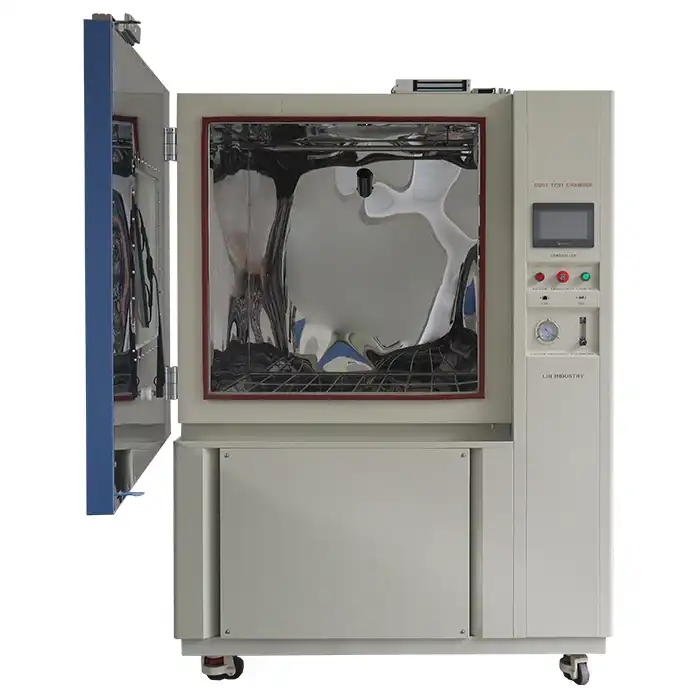
LIB Industry's 16-year track record serving multinational corporations like Apple, Intel, and Mercedes-Benz demonstrates technical competence in precision environmental testing equipment. The DI Series dust simulation chambers incorporate lessons learned from thousands of customer installations worldwide. SUS304 stainless steel construction throughout the working chamber ensures corrosion resistance and easy cleaning between test protocols. A3 steel exterior frames with protective coating provide industrial-grade durability suitable for high-utilization testing laboratories. Double-layer observation windows with silicone rubber sealing enable visual monitoring without environmental compromise.
Advanced Control and Automation
The programmable touchscreen controller eliminates guesswork through one-touch presets for IEC 60529 and ISO 20653 standard protocols. Real-time displays show dust concentration, vacuum pressure levels, and elapsed exposure duration with automatic data logging satisfying auditor requirements. Ethernet connectivity enables remote monitoring and multi-language support streamlines international team collaboration. Automated fault detection monitors electrical current, temperature, phase sequence, and ground conditions preventing equipment damage and test interruptions. The system generates detailed testing reports in formats compatible with certification documentation requirements.
Maintenance Efficiency and Operational Reliability
Traditional dust chambers suffer from fan degradation and circulation blockages compromising test validity. LIB's wear-resistant fan design with strategic positioning above the powder zone protects critical components from abrasive particle damage. The sloped bottom chamber with quick-release drainage allows complete talcum powder changeover in under five minutes without disassembly. Electromagnetic door locks prevent accidental opening during active test cycles while comprehensive safety systems protect operators and specimens. Multi-layer door sealing contains all particles within the chamber, maintaining laboratory cleanliness while providing stable internal environments.
Customization Capabilities and Turnkey Solutions
Standard chamber configurations span 800L to 2000L working volumes, accommodating everything from component-level testing to complete system qualification. Custom engineering services address specialized requirements including oversized specimens, unique mounting configurations, or integrated testing sequences combining dust exposure with thermal cycling. LIB provides comprehensive turnkey solutions encompassing laboratory design, equipment integration, installation, commissioning, and operator training. The global support network ensures responsive technical assistance and spare parts availability minimizing downtime. Three-year warranties with lifetime service support demonstrate confidence in product durability and customer commitment.
Conclusion
Dust ingress protection validation through properly calibrated simulation chambers ensures product reliability across demanding environmental applications. Understanding IP0X through IP6X classification criteria enables appropriate specification selection balancing protection requirements with manufacturing economics. LIB Industry's advanced dust testing chambers deliver precise compliance verification through sophisticated particle control, vacuum regulation, and automated protocols. Whether certifying consumer electronics, automotive components, or industrial equipment, accurate dust testing prevents costly field failures while enabling access to markets requiring third-party IP certification.
FAQ
What is the difference between IP5X and IP6X testing procedures?
IP5X permits limited dust ingress not interfering with operation, while IP6X requires complete dust exclusion. IP6X testing employs sustained vacuum conditions (20 millibars below ambient) for eight hours, whereas IP5X uses standard atmospheric circulation. Post-test inspection criteria differ significantly.
How often should dust simulation chambers undergo calibration verification?
Annual calibration verification ensures pressure gauges, temperature sensors, and particle concentration measurements maintain accuracy. High-utilization laboratories performing certification testing may require semi-annual verification. Calibration records provide audit trails demonstrating test condition validity for regulatory compliance and customer acceptance.
Can dust simulation chambers accommodate powered operation during testing?
Advanced chambers feature dust-proof electrical ports enabling energized specimen testing. This reveals dynamic sealing performance under operational conditions where internal heat generation affects pressure differentials. Cable glands maintain chamber integrity while allowing power and data connections to specimens throughout test duration.
Achieve confident IP rating compliance with precision dust testing solutions. Contact LIB Industry, a trusted dust simulation chamber manufacturer and supplier with global installation experience, for customized environmental testing equipment tailored to your certification needs. Our engineering team delivers complete turnkey solutions from design through operator training. Reach us at ellen@lib-industry.com to discuss your IP testing requirements.