IPX7 IPX8 Immersion Tester: How to Choose the Right Immersion Testing Level?
Need an IPX7/IPX8 immersion test chamber for IEC 60529 testing? Request a quote within 24 hours.
Choosing between IPX7 and IPX8 depends on how a product is expected to perform when exposed to water. IPX7 evaluates protection against temporary immersion under specified conditions, while IPX8 applies to continuous immersion beyond the IPX7 conditions, with the actual depth and duration specified for the product or test agreement.
For manufacturers of electronics, automotive components, outdoor equipment, marine products, and sealed enclosures, the right rating should be determined by the intended application and applicable standard—not simply by choosing the higher rating.
LIB Industry provides IPX7 IPX8 immersion testers for controlled water immersion testing, including customized depth, pressure, and test-duration requirements.
IPX7 vs IPX8: What Is the Difference?
The key difference is the immersion condition used to validate the enclosure.
IPX7: Temporary Immersion
Under IEC 60529 IPX7 requirements, the enclosure is tested under temporary immersion at a water depth of up to 1 meter for 30 minutes, subject to the standard's specified conditions.
This rating is commonly considered for products that may be accidentally submerged but are not designed for prolonged underwater operation.
Typical examples include:
- Smartphones and portable electronics
- Wearable devices
- Outdoor instruments
- Portable sensors
- Small electrical enclosures
IPX8: Continuous Immersion Under Specified Conditions
IPX8 is intended for immersion conditions more severe than those specified for IPX7. The depth and duration are not universally fixed; they are specified according to the product, manufacturer, or applicable test agreement.
This makes IPX8 more flexible, but it also creates a greater equipment-selection challenge. The test chamber must be capable of reproducing the actual pressure and immersion conditions required by the product specification.
Typical applications include:
- Underwater cameras
- Marine electronics
- Diving equipment
- Subsea sensors
- Underwater communication equipment
- Industrial equipment designed for prolonged immersion
IPX7 and IPX8 Comparison
| Parameter | IPX7 | IPX8 |
|---|---|---|
| Immersion Type | Temporary immersion | More severe/continuous immersion |
| Typical Depth | Up to 1 m | Specified by applicable test requirement |
| Typical Duration | 30 minutes | Specified by applicable test requirement |
| Main Challenge | Water ingress during temporary submersion | Water ingress under greater depth/time |
| Typical Applications | Consumer and outdoor products | Marine, underwater, industrial products |
The important point is that IPX8 is not simply “IPX7 but deeper.” Its actual test conditions must be clearly defined and documented.
How Do You Choose Between IPX7 and IPX8?
The correct rating starts with the product's real operating environment.
If a product may be accidentally dropped into shallow water but is not intended for underwater use, IPX7 may be sufficient.
If the product is designed to remain underwater or operate at a defined water depth, IPX8 is generally more appropriate.
Before selecting a testing level, consider:
- Maximum expected water depth
- Expected immersion duration
- Product operating condition during immersion
- Enclosure and sealing structure
- Applicable industry requirements
- Customer or OEM specifications
- Required certification documentation
For automotive products, manufacturers may also need to consider ISO 20653 road-vehicle IP protection requirements, which applies IP protection specifically to electrical equipment used in road vehicles. (https://www.lib-chamber.com/)
LIB Industry provides IPX7/IPX8 immersion testing equipment designed around the required test depth, duration, and product configuration. Check specifications and pricing →IPX7 IPX8 Immersion Tester
Which Products Typically Require IPX7 or IPX8 Testing?
Consumer Electronics
Smartphones, wearables, portable speakers, and other personal electronics may use IPX7 protection when temporary immersion is part of the intended use scenario.
For example, a device may need protection after accidental submersion in a sink, bathtub, or shallow pool.
Outdoor and Recreational Equipment
GPS devices, fitness trackers, action cameras, and portable instruments can encounter rain, splashing, and temporary submersion.
IPX7 may provide the required level of protection when prolonged underwater operation is not part of the product's intended use.
Marine and Underwater Equipment
Marine navigation equipment, underwater cameras, diving computers, subsea sensors, and underwater communication systems may require IPX8 because their operating environment involves longer or deeper immersion.
Automotive Components
Automotive sensors, connectors, electronic modules, lighting components, and sealed enclosures can be exposed to water during rain, flooding, vehicle washing, or other environmental conditions.
Depending on the vehicle specification, manufacturers may need IP testing based on IEC 60529, ISO 20653, or OEM-specific requirements.
What Does an IPX7/IPX8 Immersion Test Chamber Need to Do?
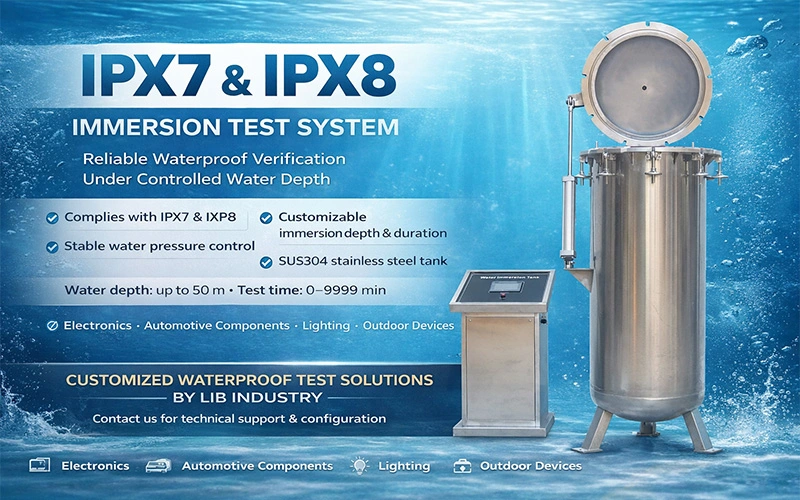
Selecting immersion equipment requires more than checking the maximum tank depth.
Controlled Water Depth
For IPX7, the equipment must allow the specimen to be positioned at the required immersion depth.
For IPX8, the system needs sufficient depth or pressure capability to reproduce the specified test condition.
Stable Pressure Simulation
As immersion depth increases, hydrostatic pressure on the product also increases. This makes pressure control particularly important for IPX8 testing.
A pressure-type immersion system can reproduce deeper-water conditions without requiring an extremely deep physical tank.
Secure Specimen Positioning
The specimen must remain in the required position during testing.
Fixtures should prevent floating, movement, or contact with the tank structure from affecting the test.
Reliable Water Management
Automatic water supply and level control can reduce operator intervention and maintain consistent testing conditions during repeated test cycles.
Programmable Test Control
A programmable controller allows operators to set immersion depth, pressure, duration, and other test parameters according to the applicable procedure.
LIB IndustryIPX7 IPX8 Immersion Tester
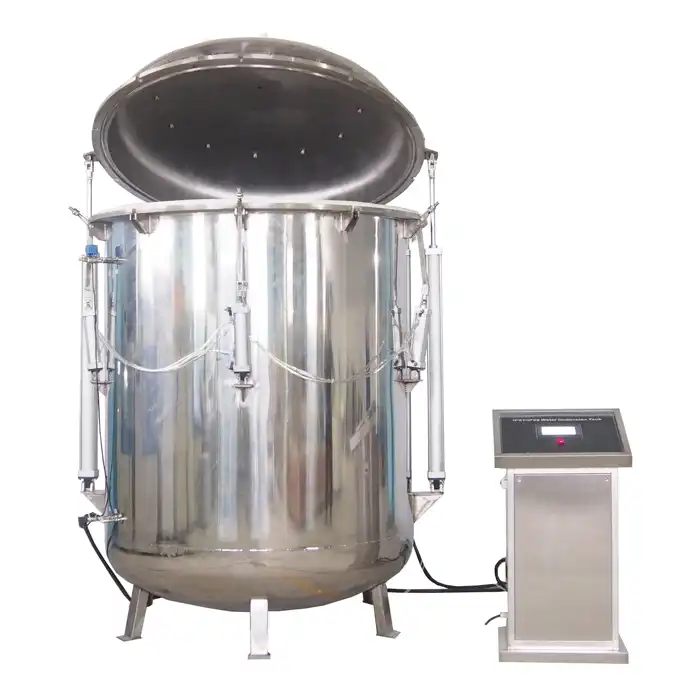
LIB Industry's R78-600 IPX7 IPX8 immersion tester is designed for controlled immersion testing of electronic products, automotive components, sealed enclosures, marine equipment, and other water-resistant products.
The system uses a cylindrical immersion tank with a 600 mm diameter and 1500 mm height, with a design capable of simulating pressure corresponding to 50 m water depth. The equipment uses a pneumatic lid, automatic water supply system, programmable touchscreen controller, and corrosion-resistant components.
Key Features
- IPX7 and IPX8 immersion testing
- Up to 50 m water-depth pressure simulation
- Pneumatic lid operation
- Automatic water supply
- Programmable touchscreen controller
- Cylindrical tank structure
- 15 mm A3 steel pressure vessel
- 304 stainless-steel hydraulic components
- Customized immersion depth and test requirements
The equipment can also be customized for specific product dimensions, pressure conditions, fixtures, control requirements, and testing procedures.
IPX7/IPX8 Testing Equipment Selection Guide
Different products require different immersion configurations.
| Application | Recommended Test | Equipment Consideration |
|---|---|---|
| Smartphones and wearables | IPX7 | 1 m immersion capability |
| Outdoor portable electronics | IPX7 | Stable water-level control |
| Underwater cameras | IPX8 | Specified depth and duration |
| Marine electronics | IPX8 | Higher pressure capability |
| Automotive components | IPX7/IPX8 | IEC 60529 / ISO 20653 compatibility |
| Industrial submerged sensors | IPX8 | Customized depth and duration |
The actual test requirement should always take priority over general application recommendations.
Related IP Water Testing Equipment
IPX7 and IPX8 are only part of the IP water-ingress testing range. Depending on the product, manufacturers may need several water exposure tests.
|
|
|
|
|
IPX1–IPX4 Water Spray Test Chamber For dripping and spraying tests, LIB provides water spray test chambers covering IPX1–IPX4 applications according to IEC 60529 and ISO 20653. |
IPX5/IPX6 Water Jet Test Equipment For products exposed to water jets or powerful water jets, dedicated IPX5/IPX6 equipment provides controlled flow and pressure conditions. |
Combined IP Test Solutions For laboratories that need multiple IP ratings, LIB can configure integrated testing solutions covering spray, jet, immersion, and other IP protection levels. |


FAQ
Can an IPX8-rated product automatically pass IPX7?
Not necessarily. Although IPX8 involves more demanding immersion conditions, the applicable test requirements and documentation should be evaluated separately. Manufacturers should conduct the tests required for the ratings they intend to claim.
Is IPX8 always better than IPX7?
Not necessarily. IPX8 provides protection under more severe specified immersion conditions, but it may require more complex product sealing and testing. If temporary immersion is the actual use case, IPX7 may be sufficient.
How deep is an IPX8 test?
There is no single universal IPX8 depth. The depth and duration are specified according to the product, manufacturer, or applicable test agreement.
Can one immersion tester perform both IPX7 and IPX8 tests?
Yes. A properly configured immersion tester can support both ratings by adjusting the applicable immersion conditions. LIB's R78-600 is designed for IPX7/IPX8 testing and can accommodate customized testing requirements.
Can LIB customize an IPX7/IPX8 immersion tester?
Yes. LIB can customize immersion depth, pressure conditions, fixtures, tank dimensions, control functions, and other test configurations according to customer requirements.
Need an IPX7/IPX8 immersion test chamber for IEC 60529 or ISO 20653?
Send LIB Industry your product dimensions, required immersion depth, test duration, and applicable standard. Our engineers can recommend the appropriate configuration and provide a quotation within 24 hours.
Email: ellen@lib-industry.com
Three-Year Warranty & Lifetime Service