IPX9K vs IPX6: Key Differences in High-Pressure Water Spray Standards
IPX9K vs IPX6: Key Differences in High-Pressure Water Spray Standards
Understanding the distinction between IPX9K and IPX6 waterproof ratings proves essential when selecting protection levels for equipment exposed to water ingress. IPX6 testing involves powerful water jets at 100 kilopascals pressure, while IPX9K testing requires ultra-high pressure water at 8,000-10,000 kilopascals combined with elevated temperatures reaching 80-88°C. These extreme conditions are typically simulated using an IPX9K test chamber, which ensures repeatable and industry-standard high-pressure spray testing. The IPX9K standard represents the pinnacle of water resistance testing, specifically engineered for automotive components and industrial equipment subjected to intensive high-pressure cleaning operations, whereas IPX6 addresses conventional water jet scenarios encountered in outdoor applications.
How Do IPX9K and IPX6 Differ in Pressure, Temperature, and Spray Angle?
Pressure Specifications Comparison
IPX6 certification requires exposure to water jets at 100 kilopascals pressure delivered from 3 meters distance, suitable for equipment facing strong water streams. The ipx9k test chamber operates at dramatically higher thresholds, with water pressure ranging from 8,000 to 10,000 kilopascals (80-100 bar) applied at close proximity of 100-150 millimeters from the specimen. This represents an 80-100 fold increase in pressure intensity, simulating extreme cleaning environments where conventional testing proves inadequate.
Temperature Differential Analysis
Standard IPX6 testing utilizes ambient temperature water without thermal stress considerations. IPX9K evaluation mandates water heated to 80°C (±5°C), introducing thermal shock alongside mechanical pressure. This elevated temperature component tests material thermal expansion coefficients, seal degradation under heat exposure, and composite material delamination risks that ambient water testing cannot reveal.
Multi-Angle Spray Pattern Requirements
IPX6 protocols require omnidirectional water jet exposure ensuring complete surface coverage without prescribed angular specifications. The ipx9k test chamber employs four distinct spray angles - 0°, 30°, 60°, and 90° measured from horizontal axis - with specimens exposed for 30 seconds at each position while rotating at 5 revolutions per minute. This systematic angular approach guarantees comprehensive evaluation of vulnerable mounting points, seal interfaces, and connector assemblies from multiple threat vectors.
|
Parameter |
IPX6 |
IPX9K |
|
Water Pressure |
100 kPa (15 psi) |
8,000-10,000 kPa (80-100 bar) |
|
Water Temperature |
Ambient |
80°C ± 5°C |
|
Spray Distance |
3 meters |
100-150 mm |
|
Flow Rate |
100 L/min |
14-16 L/min |
|
Test Duration |
3 minutes minimum |
2 minutes total (30s per angle) |
|
Spray Angles |
All directions |
0°, 30°, 60°, 90° (systematic) |
Test Conditions Required by ISO 20653 for Each Protection Level
IPX6 Testing Protocol Standards
IPX6 evaluation measures product resistance to powerful water jets by exposing samples to water pressure of 100 kilopascals with flow rates of 100 liters per minute from all angles for minimum three minutes. The specimen must maintain functionality without harmful water ingress affecting performance. Testing apparatus features adjustable nozzle configurations maintaining prescribed distance and pressure parameters throughout the evaluation cycle.
IPX9K Certification Criteria
ISO 20653 establishes comprehensive testing requirements for road vehicle electrical equipment, specifying protection levels based on vehicle type and component mounting location, ranging from passenger compartments to exposed engine areas. Equipment designed for external mounting outside passenger compartments must successfully complete IPX9K testing according to ISO 20653 specifications, validating resistance to extreme cleaning operations encountered in commercial vehicle maintenance.
Standard Compliance Framework
The ipx9k test chamber must comply with multiple international standards ensuring test validity and reproducibility. ISO 20653 replaced the earlier DIN 40050-9 standard, specifically addressing road vehicle degrees of protection while complementing IEC 60529 with enhanced water ingress testing protocols. Testing facilities require calibrated equipment capable of maintaining precise temperature control, pressure regulation, and rotational speed consistency throughout evaluation procedures.
|
Test Aspect |
IPX6 Requirements |
IPX9K Requirements |
|
Governing Standards |
IEC 60529 |
ISO 20653, DIN 40050-9, IEC 60529 |
|
Primary Application |
General outdoor equipment |
Automotive components, industrial machinery |
|
Sample Positioning |
Any orientation |
Rotating turntable at 5 rpm |
|
Water Quality |
Fresh water |
Fresh water with optional detergent (Level 2-4) |
|
Pass/Fail Criteria |
No harmful water ingress |
No ingress affecting safety or function |
|
Certification Scope |
Water jet resistance |
High-pressure, high-temperature steam cleaning |
Application Scenarios: When IPX9K Is Mandatory and IPX6 Is Not
Automotive Industry Requirements
IPX9K testing finds essential application in automotive sectors for components including vehicle lamps, windshield wipers, window motors, waterproof sealing strips, switches, anti-theft systems, locomotive instruments, and automotive locks. Commercial vehicles such as dump trucks, concrete mixers, and refuse collection vehicles undergo frequent intensive washing operations where IPX6 protection proves insufficient. The ipx9k test chamber validates component survival under these aggressive cleaning regimens that combine chemical detergents, elevated temperatures, and extreme pressures.
Industrial Equipment Protection
Food processing machinery, pharmaceutical manufacturing equipment, and commercial kitchen appliances face regular sanitization using high-pressure, high-temperature steam cleaning protocols. These environments demand IPX9K certification ensuring equipment can withstand repeated exposure without compromising electrical safety or operational integrity. IPX6 rating suffices for outdoor lighting fixtures, marine electronics, and recreational equipment where powerful water jets represent maximum anticipated exposure without thermal stress components.
Consumer Electronics Considerations
Most consumer electronics including smartphones, tablets, and audio devices utilize IPX6 or IPX7 ratings addressing typical usage scenarios like rain exposure, shower humidity, or accidental submersion. IPX9K certification remains rare in consumer markets, with only specialized products like certain swimming earbuds carrying this designation. The cost-benefit analysis rarely justifies IPX9K testing for consumer applications where extreme conditions remain unlikely during normal product lifecycles.
Equipment Capabilities Needed for Accurate IPX9K/IPX6 Comparison
Pressure Generation Systems
IPX6 testing chambers require moderate-capacity water pumps delivering 100 kilopascals pressure consistently throughout test duration. The ipx9k test chamber demands industrial-grade high-pressure pump systems capable of generating 8,000-10,000 kilopascals continuously while maintaining flow rate precision. These pumps typically feature Italian or German engineering with reinforced stainless steel components resisting premature wear from constant high-pressure operation.
Temperature Control Infrastructure
Basic IPX6 equipment operates without heating elements, utilizing ambient temperature municipal water supplies. Advanced ipx9k test chamber configurations incorporate rapid water heating systems with nichrome elements or equivalent, maintaining 80°C ± 5°C temperature stability. Programmable controllers monitor temperature sensors, activating heating elements to compensate for thermal losses during extended testing sessions.
Rotational Turntable Mechanisms
IPX9K testing requires specimens mounted on turntables completing one rotation every 12 seconds, equivalent to 5 revolutions per minute. Precision motor assemblies with reduction drive mechanisms ensure consistent rotational speed regardless of specimen weight distribution. Adjustable height platforms accommodate various product dimensions, with typical turntable diameters reaching 600 millimeters supporting substantial component masses.
|
Equipment Component |
IPX6 Chamber |
IPX9K Test Chamber |
|
Pressure Pump Capacity |
Standard (100 kPa) |
Industrial high-pressure (8,000-10,000 kPa) |
|
Heating System |
Not required |
Rapid heating to 80°C with precise control |
|
Spray Nozzles |
Single adjustable nozzle |
Four fan-jet nozzles (0°, 30°, 60°, 90°) |
|
Turntable System |
Optional |
Mandatory (5 rpm precision motor) |
|
Chamber Material |
Standard steel or plastic |
SUS304 stainless steel |
|
Control Interface |
Basic timer controls |
Programmable LCD touchscreen controller |
|
Safety Features |
Basic overload protection |
Multi-layer: over-temperature, water shortage, leakage, phase sequence |
Impact of High-Pressure Spray Testing on Material and Seal Integrity
Mechanical Stress on Sealing Systems
High-pressure water jets exert substantial mechanical forces against gasket materials, O-ring seals, and compression fittings. IPX6 testing at 100 kilopascals generates moderate pressure against seal interfaces, validating basic compression seal effectiveness. IPX9K evaluation combines heat, water ingress, and chemical detergents to measure degradation impacts on seals, connectors, wires, and mounting equipment, revealing vulnerabilities invisible during ambient temperature testing.
Thermal Expansion Coefficient Challenges
Material thermal expansion rates differ significantly between housing components, sealing elastomers, and internal electronics. Sudden exposure to 80°C water creates differential expansion forces potentially compromising seal contact pressure. Thermoplastic housings expand at rates exceeding metallic components, creating temporary gaps where water ingress becomes possible. The ipx9k test chamber identifies these thermal shock vulnerabilities requiring design modifications or material substitutions.
Long-Term Durability Considerations
Repeated exposure cycles accelerate aging processes in protective materials. Silicone and EPDM rubber seals maintain flexibility through broader temperature ranges compared to nitrile alternatives showing premature hardening. IPX9K testing incorporates multiple cleaning detergent levels - from standard water-only exposure through harsh chemical cleaning agents - revealing accelerated degradation pathways. Products passing IPX6 standards may fail IPX9K evaluation when thermal and chemical stressors combine with mechanical pressure.
Selecting the Right Waterproof Level for Harsh-Environment Products
Risk Assessment Methodology
Product development teams should conduct comprehensive environmental analysis identifying maximum credible exposure scenarios. Equipment installed in passenger vehicle interiors rarely encounters pressures exceeding IPX4 water spray requirements. Automotive entertainment systems, navigation displays, ADAS components including radar units and cameras, lighting assemblies, and electronic control modules face varying water exposure based on mounting location, necessitating protection level matching actual operating conditions.
Cost-Benefit Optimization
IPX9K certification requires specialized testing equipment, extended development cycles, and premium sealing materials substantially increasing product costs. Manufacturers must balance protection capabilities against market price sensitivity and competitive positioning. Marine electronics manufacturers specify IPX6 or IPX7 ratings providing adequate protection for recreational boating applications without incurring IPX9K development expenses. Commercial vehicle component suppliers targeting fleet maintenance markets justify IPX9K investment through enhanced reliability and reduced warranty claims.
Regulatory Compliance Requirements
Certain markets mandate specific protection levels through regulatory frameworks. European automotive suppliers face ISO 20653 compliance requirements when delivering exterior-mounted electrical components. Testing facilities must support IEC 60529, ISO 20653, and additional standard parameters, with multi-grade capability testing from IPX6 through IPX9K within single chamber platforms. Products serving multiple geographic markets benefit from testing to highest applicable standard, simplifying certification documentation and expanding market access opportunities.
Master High-Pressure Testing with the LIB Industry IPX9K Test Chamber
Advanced Testing Capabilities
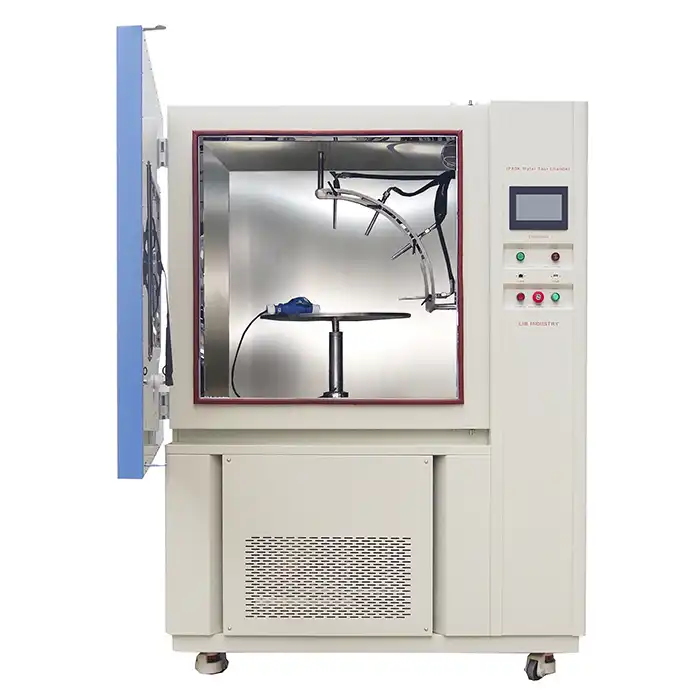
The LIB Industry ipx9k test chamber delivers comprehensive environmental testing solutions meeting international compliance requirements. Our R9K-1200 model features 1000-liter internal volume accommodating diverse component sizes, with programmable color LCD touchscreen controllers providing intuitive operation. Four precision spray nozzles positioned at standardized angles ensure reproducible testing conditions matching ISO 20653 specifications. Adjustable water pressure from 8,000-10,000 kilopascals combined with temperature control reaching 88°C enables complete IPX9K protocol execution.
Quality Engineering Excellence
Our chambers incorporate SUS304 stainless steel construction throughout test chambers and water circulation systems, ensuring corrosion resistance during continuous operation with heated water and chemical detergents. Electromagnetic door locking systems prevent accidental opening during pressurized testing cycles, while double-layer insulating glass observation windows with integrated wipers enable real-time specimen monitoring. Automatic water supply systems with built-in purification maintain consistent water quality, while booster pumps deliver precise pressure regulation eliminating result variability from inconsistent test parameters.
Comprehensive Support Services
LIB Industry provides complete turn-key solutions encompassing research, design, manufacturing, commissioning, delivery, installation, and operator training. Our technical specialists collaborate with clients optimizing test protocols for specific product requirements, ensuring compliance with applicable standards while maximizing testing efficiency. Multi-layer safety protection including over-temperature shutdown, over-current protection, water shortage detection, earth leakage protection, and phase sequence monitoring safeguards both equipment and operators throughout testing operations.
Customization and Integration
Standard configurations support testing platform height adjustment from 200-400 millimeters with 600-millimeter diameter turntables, while custom designs accommodate oversized components or specialized mounting requirements. Our modular chamber architecture enables integration with additional IPX testing capabilities, creating unified platforms supporting comprehensive protection level validation from IPX1 through IPX9K within single installations. This versatility optimizes laboratory space utilization while reducing capital equipment investments for facilities conducting diverse environmental testing programs.
Conclusion
The fundamental differences between IPX9K and IPX6 waterproof ratings reflect distinct application requirements and exposure severity. IPX6 testing validates resistance to powerful ambient-temperature water jets suitable for outdoor equipment, while IPX9K certification confirms survival under extreme high-pressure, high-temperature conditions encountered in automotive and industrial cleaning operations. Selecting appropriate protection levels requires careful analysis of actual operating environments, regulatory obligations, and cost implications. Investment in specialized testing equipment like the ipx9k test chamber ensures accurate validation of protection claims, reducing warranty exposure and enhancing product reputation in demanding applications.
FAQs
Can products with IPX9K certification withstand IPX6 testing conditions automatically?
Products certified to IPX9K standards typically exceed IPX6 requirements given the substantially higher pressure and temperature specifications. However, different test methodologies mean IPX9K certification doesn't automatically guarantee IPX6 compliance. Manufacturers often pursue dual certification when products face varied environmental exposures throughout their service lifecycle.
What maintenance intervals do ipx9k test chambers require for calibration accuracy?
Professional ipx9k test chamber maintenance should occur annually at minimum, with critical parameters including pressure gauge calibration, temperature sensor verification, and flow meter accuracy confirmation. High-volume testing facilities may require semi-annual calibration cycles ensuring consistent results. Documentation of calibration certificates proves essential for ISO 17025 accredited laboratory operations and customer audit requirements.
How do chemical detergents affect IPX9K testing outcomes compared to water-only protocols?
Chemical cleaning agents accelerate seal degradation and surface corrosion, revealing long-term durability issues not apparent in water-only testing. ISO 20653 defines four IPX9K testing levels, with Level 2 incorporating detergents at elevated temperatures and Levels 3-4 adding extreme pressure and steam cleaning. Products passing water-only Level 1 testing may fail when chemical stressors combine with thermal and mechanical challenges in advanced testing protocols.
LIB Industry stands as a premier IPX9K test chamber manufacturer and supplier, delivering precision environmental testing equipment to global markets. Our engineering team brings decades of expertise in environmental simulation technology, supporting clients from initial design consultation through final commissioning and operator certification. Whether you require standard testing platforms or customized solutions addressing unique product geometries, our comprehensive capabilities ensure successful compliance validation.
For detailed specifications, pricing information, or technical consultation regarding your IPX9K testing requirements, contact our specialists. Let LIB Industry's proven reliability and technical excellence advance your product development objectives.