Aerospace component development demands rigorous environmental validation before flight certification - a requirement driving substantial investment in testing infrastructure. Benchtop environmental chambers deliver professional-grade simulation capabilities within compact laboratory footprints, enabling aerospace engineers to accelerate component qualification timelines while minimizing capital expenditure on oversized testing facilities. These specialized systems replicate the extreme temperature ranges encountered at high altitudes (-40°C to +150°C), thermal shock cycles, and humidity variations that components must withstand throughout their operational lifecycles. A benchtop environmental chamber provides space-efficient solutions for validating electronics, sensors, structural materials, and mechanical assemblies without requiring dedicated large-format testing laboratories. With temperature fluctuation precision (±0.5°C), programmable multi-segment testing protocols, and remote monitoring capabilities, these compact chambers enable aerospace R&D teams to compress development cycles, reduce prototyping costs, and achieve regulatory compliance through controlled environmental exposure. This comprehensive guide explores how benchtop chamber technology transforms aerospace component development from protracted qualification timelines into accelerated, data-driven validation processes.
Environmental Stress Factors in Aerospace Applications
Temperature Extremes and Altitude-Related Thermal Challenges
Aerospace components operate across extreme temperature ranges unimaginable in terrestrial applications. Cabin pressurization systems experience -60°C temperatures at 43,000-foot cruising altitudes, while hydraulic components simultaneously endure +150°C fluid temperatures. Electronic control units transition rapidly between these extremes during climb and descent phases - creating thermal shock stresses that static testing cannot adequately evaluate. Benchtop environmental chambers with temperature ranges from -40°C to +150°C (expandable to -86°C for specialized applications) replicate these authentic thermal profiles. The rapid cooling rates (1°C per minute) and heating rates (3°C per minute) simulate real transient conditions, revealing material fatigue, seal degradation, and electronic component performance limitations before field deployment.
Humidity and Moisture Ingress Prevention
High-altitude atmospheric conditions create paradoxical moisture challenges - extreme dryness at cruise altitude transitions to high-humidity ground conditions during maintenance operations. Component seals, connector interfaces, and electrical pathways prove vulnerable to moisture condensation during thermal cycling. Benchtop chambers offering humidity control across 20-98% RH enable comprehensive moisture ingress testing. Engineers can program cycling sequences alternating between dry cabin conditions and humid ground environment exposure, evaluating seal performance, coating integrity, and electrical isolation across moisture gradients.
Vibration Integration and Combined Stress Simulation
While benchtop chambers primarily address thermal-humidity environments, advanced configurations integrate vibration excitation systems simulating aircraft operational stresses. Components experiencing simultaneous thermal cycling and mechanical vibration undergo accelerated degradation compared to single-stress testing. This combined-stress methodology reveals failure modes invisible under isolated thermal or vibration evaluation, enabling design modifications before expensive aerospace qualification programs commence.
Simulating High-Altitude Temperature Variations in the Lab

Rapid Thermal Transients and Shock Testing Protocols
Aircraft experience extreme thermal transients during climb phases - fuselage surfaces transition from -60°C at cruise to +80°C during ground operation within 30-minute intervals. Engine inlet components experience even more severe thermal shock, transitioning from -50°C to +250°C across seconds during thrust changes. Benchtop environmental chambers enable programmable thermal shock testing, with controllers managing rapid temperature transitions across programmable multi-segment protocols. The advanced PID (Proportional-Integral-Derivative) control systems maintain temperature stability (±0.5°C deviation) even during rapid cycling, providing empirical data on component thermal stress tolerance.
Long-Duration Environmental Exposure Protocols
Aerospace regulations often mandate 1000+ hour environmental exposure testing demonstrating component durability across extended service life. Benchtop chambers with Ethernet connectivity and remote monitoring enable unattended operation across extended test campaigns. Engineers program 120 test segments within comprehensive testing scenarios, simulating seasonal temperature variations, altitude cycling, and maintenance ground-time environmental exposures. This extended testing capability reduces laboratory personnel requirements while generating continuous performance data throughout qualification timelines.
Altitude-Specific Environmental Profiling
Different aerospace altitudes present distinct thermal-humidity profiles requiring mission-specific testing protocols. Low-altitude helicopters experience different environmental stresses compared to high-altitude fighters or commercial transports. Benchtop chambers enable custom profiling matching specific aircraft mission parameters - rapid climb profiles, constant-altitude cruise conditions, or ground storage environments. This customization ensures environmental testing directly correlates with actual component operational exposure, enhancing predictive accuracy regarding field performance.
Reliability Testing for Aerospace Electronics and Sensors
Thermal Cycling Endurance for Circuit Board Assemblies
Electronic control systems represent critical aerospace components where thermal cycling-induced solder joint fatigue directly threatens flight safety. Lead-free solder compounds demonstrate superior high-temperature performance but heightened vulnerability to thermal cycling damage at low temperatures. Benchtop environmental chambers enable automated thermal cycling sequences - transitioning between -40°C and +125°C across 500+ cycles within contained test protocols. Electrical continuity monitoring integrated with temperature profiling reveals solder joint degradation patterns, identifying design vulnerabilities enabling pre-flight correction.
Sensor Performance Validation Across Environmental Ranges
Aerospace sensors (pressure transducers, accelerometers, temperature probes, optical devices) require validation across complete operational temperature ranges with characterized performance degradation curves. Benchtop chamber stability (±2.0°C deviation) ensures precise sensor output measurement at discrete temperature setpoints. Engineers obtain sensor calibration data across -40°C to +150°C, identifying temperature-dependent drift characteristics and establishing compensation algorithms for flight control systems. This empirical calibration eliminates guesswork from sensor performance prediction, enhancing system-level flight control accuracy.
Connector Interface and Hermetic Sealing Assessment
Aerospace connectors undergo extreme thermal cycling that challenges gasket integrity, pin retention force, and electrical isolation characteristics. Benchtop environmental chambers with integrated electrical continuity monitoring detect intermittent contact failures developing during temperature extremes. High-pressure connector designs employed in fluid systems (hydraulic, fuel, pneumatic) undergo pressure-temperature combined testing, revealing seal degradation patterns under simultaneous thermal and mechanical loading. This comprehensive connector validation prevents mid-flight electrical failures and fluid system leakage hazards.
|
Testing Application |
Temperature Range |
Humidity Control |
Duration |
Key Metrics |
|
Engine Control Unit |
-40°C to +150°C |
20-98% RH |
1000+ hours |
Thermal shock cycles, electrical continuity |
|
Pressure Sensor |
-60°C to +100°C |
50% RH (dry) |
500+ hours |
Calibration drift, hysteresis, response time |
|
Hydraulic Connector |
-40°C to +85°C |
Variable |
200+ cycles |
Seal leakage rate, pressure integrity |
|
Avionics Display |
-55°C to +70°C |
20-98% RH |
500+ hours |
Display functionality, thermal stress cracks |
|
Battery Management Electronics |
-40°C to +60°C |
20-98% RH |
1000+ hours |
Charging performance, cell balancing stability |
Accelerated Environmental Testing for Material Qualification
Composite Degradation Assessment Under Environmental Stress
Aerospace composites encounter moisture absorption and resin matrix degradation during extended environmental exposure. Benchtop chambers enable controlled humidity exposure protocols quantifying moisture ingress rates and mechanical property degradation (tensile strength, shear modulus, interlaminar strength) following environmental conditioning. Specimens saturated to equilibrium moisture content at elevated temperatures followed by low-temperature exposure reveal resin embrittlement characteristics. This environmental preconditioning combined with mechanical testing validates composite structural reliability across service-life environmental exposures.
Coating and Adhesive Bond-Line Durability Evaluation
Aerospace adhesive bonds and protective coatings undergo severe degradation under combined thermal cycling and moisture exposure. Benchtop chambers with precise humidity control enable coating adhesion testing following standardized environmental preconditioning protocols (ASTM B117, SAE AMS-C-8841). Specimens experiencing 1000-hour thermal-humidity cycling followed by adhesive pull-strength evaluation reveal bond-line degradation rates. Engineers quantify adhesive performance degradation versus temperature range, identifying formulation improvements or alternative adhesive systems before full-scale manufacturing qualification.
Elastomer Seal Material Performance Characterization
Hydraulic and pneumatic system seals experience extreme thermal ranges combined with fluid immersion and dynamic cycling. Benchtop environmental chamber conditioning of elastomer specimens across -40°C to +100°C temperature ranges followed by mechanical property measurement (durometer hardness, tensile strength, elongation-at-break) characterizes temperature-dependent property evolution. This data enables engineers to select seal materials optimized for actual aircraft environmental profiles, preventing premature seal degradation and system leakage failures.
Reducing Development Risks Through Controlled Testing
Failure Mode Identification and Root-Cause Analysis
Environmental chamber testing reveals failure modes invisible during bench-top testing or static analysis. Thermal cycling induces subtle material property degradation - elastomer hardening at low temperatures, adhesive weakening at elevated temperatures, coefficient-of-thermal-expansion (CTE) mismatch stresses at material interfaces. Systematic environmental exposure followed by failure analysis (fractography, material property measurement, microscopy) identifies degradation mechanisms. Engineers implement design modifications - material changes, stress-relief features, protective coatings - preventing recurring field failures before aerospace certification programs commence.
Risk Mitigation for Critical Flight Safety Components
Aerospace regulations require comprehensive environmental qualification for components affecting flight safety. Benchtop chambers enable preliminary environmental validation during early development phases, identifying design vulnerabilities before expensive formal certification testing. This staged approach compresses overall development timelines - early-stage benchtop testing eliminates high-risk designs, enabling focused formal qualification efforts on optimized components. Risk reduction translates to faster aerospace certification approval and accelerated market introduction.
Supply Chain Component Qualification
Aerospace suppliers introduce new materials, fasteners, connectors, and electronic components requiring environmental validation before integration into flight systems. Benchtop chambers provide rapid qualification infrastructure enabling suppliers to validate component environmental compatibility with minimal capital investment. Suppliers developing components for extreme-environment aerospace applications (hypersonic vehicles, space systems, deep-submersible aircraft) employ benchtop chambers for preliminary validation before progressing to larger-scale facilities.
Choosing Benchtop Chambers for Aerospace Research Efficiency
Compact Laboratory Integration and Space Efficiency
Modern aerospace R&D facilities operate under space and budget constraints limiting large-chamber deployment. Benchtop environmental chambers (50L-80L capacity) occupy desktop or small-laboratory-bench footprints while delivering aerospace-grade environmental control. Multiple benchtop units can occupy laboratory space consuming a single large chamber's floor area, enabling parallel environmental testing of diverse component populations. This spatial efficiency proves particularly valuable for distributed R&D organizations operating multiple development sites with limited facility infrastructure.
Cost-Effective Component Validation Without Oversizing
Large walk-in environmental chambers command six-figure capital investments and substantial facility infrastructure (electrical, HVAC integration, foundation requirements). Benchtop chambers priced at fraction of large-chamber costs enable budget-conscious R&D teams to access professional-grade environmental testing without capital expenditure barrier. The cost-efficiency enables aerospace suppliers and smaller development organizations to perform rigorous environmental qualification, previously accessible only to large-budget prime contractors. This democratization of environmental testing capability accelerates innovation across the aerospace supply chain.
Remote Monitoring and Automated Testing Convenience
Benchtop environmental chambers with Ethernet connectivity, web-based monitoring interfaces, and smartphone alerting enable unattended operation across extended test campaigns. Engineers program complex thermal-humidity profiles - 120 test segments across 100-segment sequential protocols - then monitor progress remotely. Automated data logging provides comprehensive time-stamped environmental conditions and component performance metrics. This remote-monitoring capability enables efficient resource allocation - engineers focus on data analysis rather than chamber observation, maximizing testing productivity.
|
Benchtop Chamber Feature |
Aerospace R&D Benefit |
Implementation Value |
|
Compact footprint (50L-80L) |
Multiple units in single lab location |
Parallel testing of diverse components |
|
Temperature range -40°C to +150°C |
Altitude + ground environment simulation |
Comprehensive operational profile testing |
|
±0.5°C temperature stability |
Precise sensor calibration requirements |
Elimination of performance uncertainty |
|
Programmable 120-segment protocols |
Custom mission-profile replication |
Mission-specific component validation |
|
1000W heat load capacity |
Rapid thermal transients (3°C/min heating) |
Thermal shock testing simulation |
|
Ethernet remote monitoring |
Unattended extended testing campaigns |
Labor efficiency across test duration |
|
Humidity control 20-98% RH |
Moisture ingress and seal performance |
Real-world environmental exposure replication |
LIB Industry Provides Stable Aerospace Environmental Test Performance
|
|
|
||||||
| Model | TH-50 | TH-80 | |||||
| Internal dimension (mm) |
320x350x450 |
400x400x500 | |||||
| Overall dimension (mm) | 800x1050x950 | 900×1100×1000 | |||||
| Temperature range | -86 ℃ ~+150 ℃ | ||||||
| Temperature fluctuations | ± 0.5 ℃ | ||||||
| Humidity Range | 10%/20%~95 % | ||||||
| Temperature deviation | ± 2.0 ℃ | ||||||
| Temperature Sensor | PTR Platinum Resistance PT100Ω/MV A-class | ||||||
| Temperature Resolution | ± 0.001 ℃ | ||||||
| Exterior Material | Steel Plate with A protective coating | ||||||
| Interior Material | SUS 304 stainless steel | ||||||


Professional-Grade Environmental Control Systems
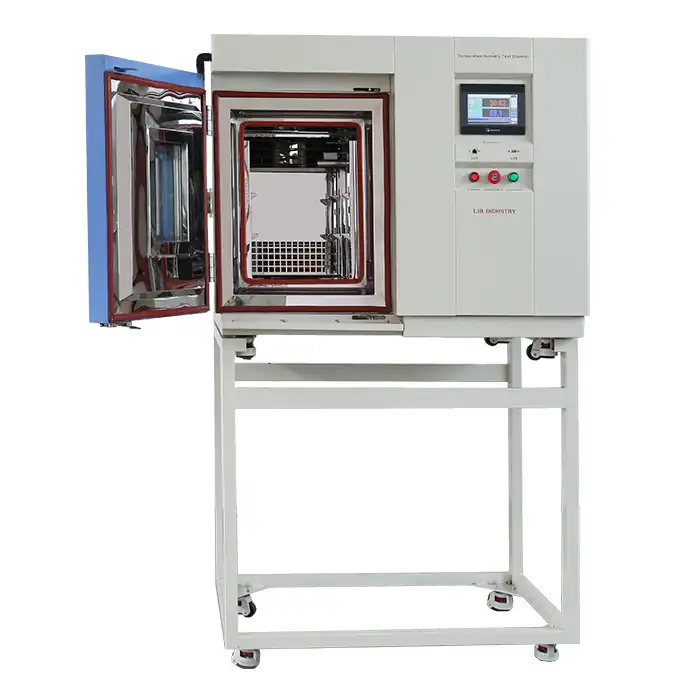
LIB Industry's benchtop environmental chambers (Models TH-50, TH-80) deliver aerospace-specified environmental precision through PID programmable controllers with color LCD touchscreen interfaces. Temperature fluctuation specifications (±0.5°C) and humidity deviation management (±2.5% RH) satisfy demanding aerospace qualification requirements. Multiple safety protection systems - over-temperature shutdown, refrigerant high-pressure protection, water shortage detection - ensure unattended operation safety across extended testing campaigns. Built-in LED observation lighting enables visual component inspection throughout environmental cycling without temperature-chamber disruption.
Comprehensive Aerospace Testing Capability
Interior SUS304 stainless steel construction resists corrosion from extended humidity exposure and aggressive testing environments. Adjustable shelving accommodates diverse component geometries - circuit board assemblies, connectors, sensor packages, small mechanical components. The 50L-80L chamber sizes enable simultaneous testing of multiple component variants, expediting comparative performance evaluation. Cable feedthrough provisions (Φ50mm ports with sealed plugs) accommodate external electrical connections, enabling real-time component performance monitoring during environmental exposure - critical for sensors, actuators, and electronic control units.
Customization Expertise for Specialized Aerospace Applications
LIB Industry's engineering team specializes in custom configurations accommodating non-standard aerospace testing requirements. Vibration integration systems can augment benchtop chambers for combined thermal-vibration testing. Specialized specimen fixtures accommodate large component assemblies or complex geometric configurations. Pressure-chamber integration enables simultaneous altitude-pressure and temperature-humidity exposure simulation for altitude-sensitive components. This customization capability transforms benchtop chambers from standard laboratory instruments into application-specific aerospace development platforms.
Conclusion
Benchtop environmental chambers revolutionize aerospace component R&D through accessible, cost-effective validation infrastructure enabling rigorous environmental qualification without large-scale facility investments. Temperature precision (±0.5°C), programmable multi-segment testing protocols, and remote monitoring capabilities compress development timelines while generating comprehensive performance data across operational environmental ranges. From thermal shock testing of avionics assemblies to moisture-ingress validation of composite structures, benchtop chambers address diverse aerospace qualification requirements. LIB Industry's professional-grade systems deliver aerospace-specified environmental control, customization expertise, and comprehensive support enabling organizations to accelerate component development while maintaining rigorous qualification standards. Investment in benchtop environmental testing infrastructure establishes competitive advantage through faster development cycles and superior component reliability
FAQ
Can benchtop environmental chambers achieve the -60°C temperatures required for high-altitude aerospace component testing?
Standard benchtop models operate to -40°C, accommodating most aerospace applications. Specialized low-temperature variants achieve -86°C for extreme high-altitude component testing (reconnaissance aircraft, stratospheric balloons). Custom configurations expand temperature ranges, though advanced refrigeration systems increase equipment complexity and operating costs. Consult with LIB Industry's engineering team regarding specific low-temperature requirements.
How do I ensure accurate sensor calibration data when using benchtop chambers for avionics sensor qualification?
Temperature stability (±0.5°C deviation) supports precise multi-point sensor calibration across operating ranges. Integrate external data acquisition systems monitoring sensor outputs during chamber-controlled temperature transitions. Document chamber temperature profiles simultaneously with sensor measurements, enabling temperature-performance correlation analysis. Regular chamber temperature calibration against certified reference thermometers ensures measurement traceability throughout testing campaigns.
What electrical monitoring capabilities enable real-time component performance assessment during thermal cycling exposure?
Benchtop chambers accommodate up to four cable feedthroughs for external connections. Integrate external data loggers, multimeters, or component-specific test equipment measuring electrical continuity, insulation resistance, or operational performance parameters during chamber operation. Ethernet connectivity enables remote monitoring of both chamber conditions and external component performance metrics, facilitating automated failure detection and testing protocol termination upon specified fault conditions.
LIB Industry: Your Trusted Benchtop Environmental Chamber Manufacturer and Supplier
Accelerate your aerospace component R&D with LIB Industry's professional-grade benchtop environmental chambers. As a global manufacturer and supplier of environmental test chambers, we provide comprehensive turn-key solutions including design consultation, equipment production, facility commissioning, installation support, and technical training. Our compact yet powerful benchtop systems deliver aerospace-grade environmental precision within laboratory-efficient footprints. With 3-year comprehensive warranty, lifetime service support through our 24/7 global technical network, and customization expertise for specialized aerospace applications, LIB Industry partners with your development team to achieve faster qualification timelines. Contact our aerospace specialists at ellen@lib-industry.com to discuss your environmental testing requirements and discover how benchtop chamber investment accelerates your component development velocity.