 Tell us your industry and standard requirements.
Get a recommended equipment solution in 30 seconds.
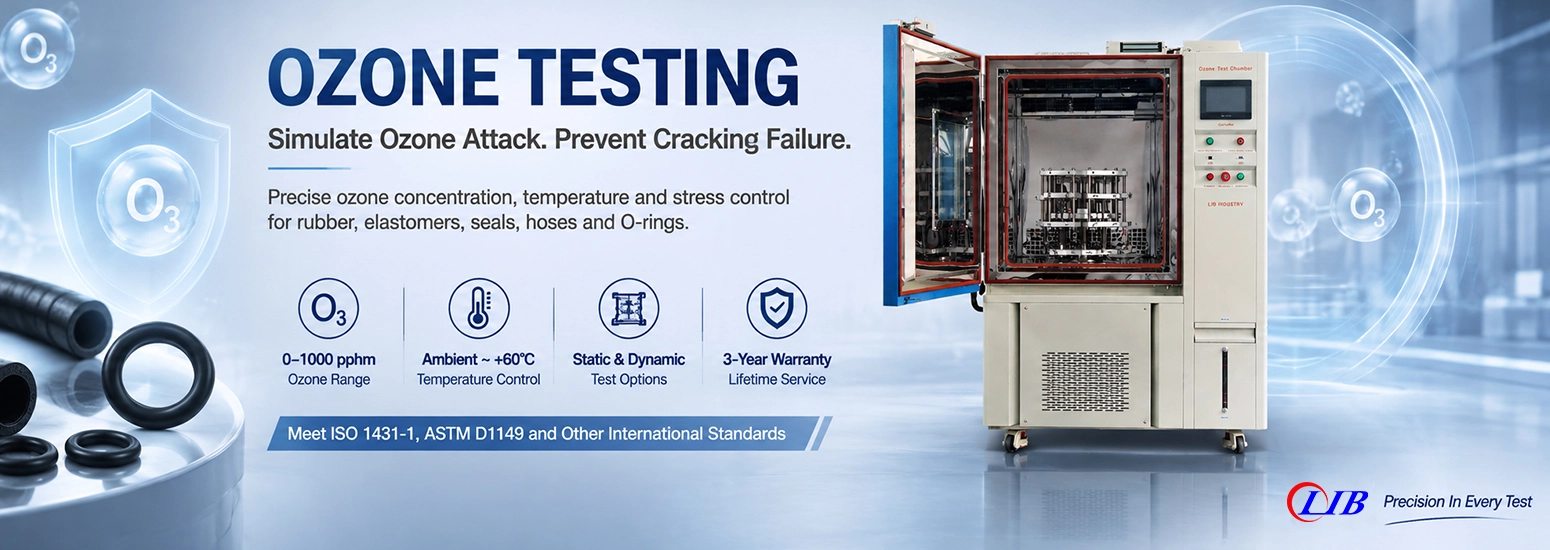
Ozone is one of the most damaging environmental factors for rubber, elastomers, and other polymer-based products, attacking materials under tensile stress and causing surface cracking — even at very low atmospheric concentrations. LIB ozone testing solutions help manufacturers identify cracking risks before products reach the market.
Reproduce precise ozone concentration, temperature, and mechanical stress conditions to evaluate seals, gaskets, hoses, and O-rings — meeting ISO 1431-1, ASTM D1149, and other international standards.
3-Year Warranty29Global Agents4Overseas Service Centers Lifetime Maintenance · Engineering Consultation
Which Test Standard Does Your Industry Need?
Find the right standard and recommended equipment for your industry, or use the selector tool above.
|
Industry / Application |
Common Standards |
Recommended Test |
Recommended Equipment |
|
Automotive Seals & Hoses |
ISO 1431-1 / ASTM D1149 |
Dynamic ozone test |
|
|
Cable & Wire |
ISO 1431-1 / ASTM D1149 |
Ozone aging test |
|
|
Industrial Sealing (O-Rings) |
ISO 1431-1 / ASTM D1149 |
Combined ozone & temp. |
|
|
High-Volume Rubber Manufacturing |
ISO 1431-1 / ASTM D1149 |
Batch static / dynamic |
|
|
Aerospace |
ISO 1431-1 / ASTM D1149 |
Combined ozone & temp. |
|
|
Construction (Weatherstripping) |
ISO 1431-1 / ASTM D1149 |
Static ozone test |
LIB provides environmental simulation solutions for the following ozone-related tests:
Static Ozone Test
Static ozone testing exposes stretched or statically strained rubber specimens to a controlled ozone concentration for a fixed period, evaluating surface crack resistance under constant deformation.
Common standards:
·ISO 1431-1
·ASTM D1149
Dynamic Ozone Test
Dynamic ozone testing exposes specimens to ozone while undergoing repeated flexing or cyclic deformation, simulating rubber components that experience continuous movement during service, such as seals and hoses.
Common standards:
·ISO 1431-1
·ASTM D1149
Recommended Equipment
|
What you're afraid of: a seal that cracks in the field, not the lab Rubber seals and hoses that pass a quick visual check can still fail months later once ozone attacks the polymer chains under tensile stress. This chamber holds a stable, uniform 0–1000 pphm concentration with static and dynamic mounting frames included, so cracking risk shows up on the bench, not in a warranty claim, and results comply directly with ISO 1431-1 and ASTM D1149. 0–1000 pphm adjustable · Static + dynamic frames · ISO 1431-1 / ASTM D1149 |

Ozone Aging Test
Ozone aging testing combines extended ozone exposure with elevated temperature to accelerate material degradation and estimate long-term product lifetime under ozone attack.
Common standards:
·ISO 1431-1
·ASTM D1149
Combined Ozone and Temperature Test
Ozone resistance can vary significantly with temperature, so many test programs combine ozone exposure with controlled temperature conditions to better simulate real operating environments.
Applicable standards:
·ISO 1431-1
·ASTM D1149
Recommended Equipment
|
What you're afraid of: mixed sample geometries slowing your lab down Labs juggling seals, cables, O-rings, and gaskets of different shapes and sizes lose real time running them one geometry at a time. This chamber's customizable multi-tier rack accommodates mixed sample geometries and quantities in a single run, with temperature control from ambient to +60℃, so high sample volumes and multiple product lines move through testing together instead of in sequence. Multi-tier, multi-position rack · Ambient~+60℃ · 0–1000 pphm adjustable |
 |

Batch / High-Volume Ozone Test
Application-dependent
Manufacturers running multiple product lines or high sample volumes often can't afford to test one specimen at a time, or to outsource batch testing to a third-party lab.
Recommended Equipment
|
What you're afraid of: batch volume forcing you to outsource testing High-volume rubber manufacturers running multiple product lines can't afford to test one specimen at a time or ship samples out to a third-party lab. This chamber offers a customized internal volume with uniform ozone distribution across the full space and support for multiple mounting racks, letting you validate a whole production batch in a single run instead of a queue. Customized internal volume · 0–1000 pphm adjustable · Multiple mounting racks |
|


Choosing the Right Chamber
Selecting the correct ozone chamber depends on required ozone concentration range, temperature requirements, specimen mounting method (static or dynamic), sample size, test standard, industry application, and test duration. Our engineers can recommend the most suitable equipment based on your product requirements and testing objectives.
Frequently Asked Questions
What equipment is used for ozone testing?
Ozone testing is usually performed using an ozone test chamber, also called an ozone aging chamber or ozone resistance test chamber. LIB provides static, dynamic, and combined ozone-temperature chambers for different testing requirements.
What is the difference between static and dynamic ozone testing?
Static ozone testing exposes specimens held under constant strain to ozone, evaluating crack resistance under fixed deformation. Dynamic ozone testing exposes specimens to ozone while they undergo repeated flexing, better simulating components that move continuously during service, such as hoses and seals.
Why does rubber crack when exposed to ozone?
Ozone reacts with the double bonds present in many rubber polymer chains, particularly in materials under tensile stress. This reaction breaks down the polymer structure at the surface, forming small cracks that grow perpendicular to the direction of stress over time.
What industries need ozone testing?
Ozone testing is widely used in automotive, cable and wire, rubber and elastomer manufacturing, industrial sealing components, aerospace, and construction.
What warranty and service does LIB provide?
LIB provides a 3-year warranty, lifetime maintenance support, technical assistance, and engineering consultation — backed by 29 agents and 4 overseas service centers worldwide, so support is never far away.
Need an Ozone Testing Solution?
Whether you need an ozone test chamber, ozone aging test chamber, ozone resistance test chamber, ozone testing chamber, static ozone testing, dynamic ozone testing, combined ozone and temperature testing, or a customized ozone simulation chamber, LIB can provide the right solution.
Our engineers can recommend the most suitable ozone aging test equipment based on your product requirements, industry standards, and testing objectives.
Need to evaluate ozone resistance and aging performance? Contact LIB today for a customized ozone testing solution, technical recommendation, and fast quote.
Contact LIB today to discuss your ozone testing requirements.