Tell us your industry and standard requirements.
Get a recommended equipment solution in 30 seconds.
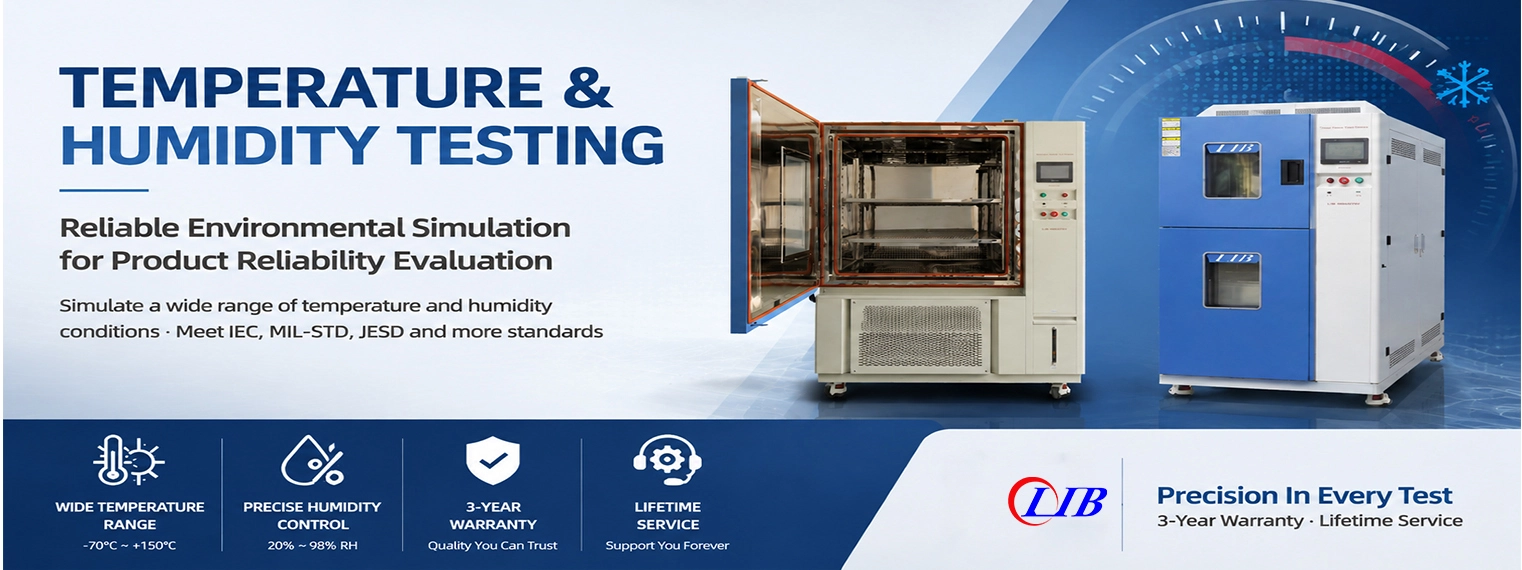
Temperature and humidity changes are among the most common environmental stresses products face across manufacturing, transport, storage, and operation. LIB environmental chambers help manufacturers identify potential failures before products reach the market — with precise temperature control, customizable configurations, and complete after-sales support.
Simulate high temperature, low temperature, humidity, thermal shock, and combined stress conditions — meeting IEC, MIL-STD-810H, JESD, and other international standards.
3-Year Warranty 29 Global Agents 4 Overseas Service Centers Lifetime Maintenance · Engineering Consultation
Which Test Standard Does Your Industry Need?
Find the right standard and recommended equipment for your industry, or use the selector tool above.
|
Industry / Application |
Common Standards |
Recommended Test |
Recommended Equipment |
|
Automotive Electronics |
IEC 60068-2-14 / MIL-STD-810H |
Thermal cycling / shock |
|
|
Lithium Battery / Pack |
UN 38.3 / IEC 62133 |
Battery safety & abuse |
|
|
Aerospace |
IEC 60068-2-13 / MIL-STD-810H |
Altitude / low pressure |
|
|
Consumer Electronics |
IEC 60068-2-78 / MIL-STD-2164 |
Constant T/H · ESS |
|
|
PV Modules |
IEC 61215 (MQT 13) |
Damp heat cyclic |
|
|
Coatings / Adhesives |
IEC 60068-2-2 / J-STD-033 |
Drying test |
|
|
Large Assemblies / Vehicles |
Application-dependent |
Composite / custom |
Different products require different environmental tests depending on their application, materials, and industry standards.LIB industry provides environmental simulation solutions for the following temperature and humidity related tests:
High Temperature Test
High temperature testing evaluates whether products can maintain their mechanical, electrical, and functional performance when exposed to elevated temperatures.
Common standards:
· IEC 60068-2-2
· MIL-STD-810H Method 501
Low Temperature Test
Low temperature testing evaluates product reliability under cold conditions.
Common standards:
· IEC 60068-2-1
· MIL-STD-810H Method 502
Recommended Equipment
|
Available in -20℃~+150℃, -40℃~+150℃, or -70℃~+150℃ range options with capacities from 100L to 1000L, this chamber holds temperature fluctuation within ±0.5℃ and uniformity within ±2℃. It covers high temperature, low temperature, and thermal cycling tests in a single unit, and can also run extended high-temperature aging cycles without needing a separate piece of equipment for long-duration material degradation studies. -20~+150℃ / -40~+150℃ / -70~+150℃ · 100L–1000L |
|


Constant Temperature and Humidity Test
Constant temperature and humidity testing exposes products to controlled temperature and moisture conditions for extended periods.
Common standards:
· IEC 60068-2-78
Recommended Equipment
|
Spanning -20℃~+150℃ to -70℃~+150℃ with humidity control from 20% to 98% RH, this chamber maintains temperature fluctuation within ±0.5℃ and humidity fluctuation within ±2.5% RH. Designed for stable long-term operation, it supports both constant temperature-humidity exposure and repeated damp heat cyclic profiles, giving manufacturers one chamber for climate reliability testing across multiple standard requirements.
|

Temperature Cycling Test
Temperature cycling testing evaluates how products withstand repeated changes between high and low temperature conditions. During real-world operation, many products experience continuous temperature fluctuations.
Common standards:
· IEC 60068-2-14
· JESD22-A104
· MIL-STD-810H
Rapid Temperature Change Test
Rapid temperature change testing evaluates product reliability when exposed to fast temperature transitions.
Common standards:
· IEC 60068-2-14
· ISO 16750-4
Recommended Equipment
| Operating across -70℃ to +150℃ with a temperature change rate of up to 15℃/min, customizable to match specific test protocols, this chamber drives products through fast, repeated temperature transitions. It's built to surface the kind of material fatigue and component-level failures that only emerge under accelerated thermal stress, making it a core tool for reliability and accelerated life testing programs. |
|


Thermal Shock Test
Thermal shock testing is designed to expose products to sudden temperature changes between two extreme conditions. Unlike temperature cycling, which gradually changes temperature, thermal shock transfers the test specimen rapidly between hot and cold zones.
Common standards:
· IEC 60068-2-14
· MIL-STD-810H Method 503
Recommended Equipment
|
With hot zone temperatures reaching ambient to +220℃ and cold zone temperatures down to ambient to -70℃ (configuration dependent), this chamber transfers specimens rapidly between extremes rather than ramping gradually. That rapid transfer reproduces the harshest thermal stress a product may encounter, making it especially suited to automotive and electronic components facing abrupt real-world temperature swings. |
|


Combined Temperature and Vibration Test
Vehicles, aircraft, industrial equipment, and transportation systems often expose components to combined environmental stresses.
Applicable standards:
· IEC 60068 series
· MIL-STD-810H
· ISO 16750
Recommended Equipment
| This system combines a -50°C to +150°C temperature range, 30%–98% RH humidity control, and vibration frequencies from 2 Hz to 4000 Hz in one integrated platform. By running temperature and vibration simulation simultaneously rather than sequentially, it reproduces the compound stress products actually experience during transportation and operation, catching interaction failures that single-factor testing would miss. |

Drying Test (Industrial Oven / Vacuum Oven)
Drying testing removes moisture from materials and components, or cures coatings and adhesives, using either standard industrial hot-air drying ovens or vacuum drying ovens for heat-sensitive or moisture-critical materials that require low-oxygen or low-pressure drying conditions.
Common standards:
· IEC 60068-2-2
· JEDEC J-STD-033 (moisture sensitivity bake)
Recommended Equipment
|
Industrial Drying Oven |
Available in three temperature range options — A: Ambient~+250℃, B: Ambient~+400℃, C: Ambient~+900℃ — with uniform heat circulation for consistent drying. Offered in benchtop and cabinet sizes, suitable for coatings, adhesives, and moisture-sensitive components. |
|
| Operates from +35℃ to +350℃ with a heating rate of 6℃/ min and vacuum degree of -133 Pa. Uniform heat circulation under vacuum makes it suitable for coatings, adhesives, and moisture- or oxidation-sensitive components. |  |


Altitude / Low Pressure Test
Altitude testing evaluates product performance under reduced atmospheric pressure, simulating high-altitude operation, air transportation, or aerospace conditions where pressure differences can affect sealing, electrical insulation, and mechanical structures.
Common standards:
· IEC 60068-2-13
· MIL-STD-810H Method 500
Recommended Equipment
| Simulating altitudes up to 30,000+ meters and pressures from atmospheric down to 0.5kPa, this chamber can also combine temperature and altitude testing in a single run. It's designed to expose sealing, insulation, and structural weaknesses that only appear under reduced atmospheric pressure — conditions ground-level testing simply cannot reveal — making it essential for aerospace and avionics validation. |
|


Battery Safety & Abuse Test
Battery safety and abuse testing evaluates the behavior of lithium batteries and battery packs under extreme or abusive conditions, including overcharge, external short circuit, crush, nail penetration, and thermal runaway, to verify safety performance before market release.
Common standards:
· UN 38.3
· IEC 62133
· UL 2580
Recommended Equipment
|
Constructed from reinforced, explosion-proof steel and fitted with integrated crush, nail penetration, and short-circuit test fixtures, this chamber is purpose-built for conditions that can trigger fire or thermal runaway. Exhaust and fire suppression systems, combined with remote monitoring and data logging, allow safety testing to proceed under control while meeting UN 38.3, IEC 62133 and UL 2580. |

Environmental Stress Screening (ESS) Test
Environmental Stress Screening testing applies rapid temperature cycling, often combined with random vibration, to precipitate latent manufacturing defects in electronic assemblies before they are shipped, without damaging good units. It is commonly used as a production-line screening process rather than a design qualification test.
Common standards:
· MIL-STD-2164
· IEST-RP-PRC-001
Recommended Equipment
| Capable of temperature change rates up to 20℃/min or higher, with an optional integrated vibration table for combined stress screening, this chamber is built for production-line use rather than design qualification. Programmable multi-cycle profiles precipitate latent manufacturing defects before shipment, catching weak units early without damaging the good ones passing through the same line. |
|


Damp Heat Cyclic Test
Damp heat cyclic testing exposes products to repeated 24-hour cycles of high humidity combined with temperature variation, including condensation during the temperature drop phase. It is distinct from steady-state humidity testing and is used to evaluate corrosion, insulation degradation, and material swelling under fluctuating humid conditions.
Common standards:
· IEC 60068-2-30
Recommended Equipment
|
The same chamber used for constant T/H testing (see above) can run damp heat cyclic profiles, precisely controlling temperature and humidity fluctuation through repeated high-humidity/condensation cycles. For full-size photovoltaic panels specifically, the PV Module Damp Heat Test Chamber provides continuous, uninterrupted 1000-hour testing with custom fixtures for panel mounting and positioning, complying with IEC 61215 (MQT 13). |
 |

Large-Scale Environmental Test
Battery packs, vehicles, and other large or oversized assemblies often exceed the capacity of standard environmental chambers, requiring disassembly or third-party testing.
Common standards:
Application-dependent
Recommended Equipment
| Custom-built to the customer's actual sample dimensions, with a large internal space for oversized samples. Suitable for battery packs, vehicles, and large assemblies, supporting fully customized testing solutions without disassembly or outsourcing to a third-party lab. |  |

Choosing the Right Chamber
Selecting the correct environmental chamber depends on required temperature range, humidity requirements, temperature change rate, sample size, test standard, industry application, and test duration. Our engineers can recommend the most suitable equipment based on your product requirements and testing objectives — not just match you to a standard, but confirm the chamber will actually reproduce the failure conditions your product needs to survive.
FAQ
|
What equipment is used for temperature and humidity testing?
|
Temperature and humidity testing is usually performed using an environmental test chamber, also called a temperature humidity chamber or climatic chamber. LIB provides TH Series, TR Series, TS Series, THV Series, and customized walk-in chambers for different testing requirements.
|
|
What is the difference between temperature cycling and thermal shock testing?
|
Temperature cycling gradually changes temperature between high and low conditions over repeated cycles. Thermal shock testing creates rapid transitions between hot and cold zones, producing more severe thermal stress — used for extreme transition testing rather than general reliability evaluation.
|
|
Can one chamber perform both temperature and humidity tests?
|
Yes. LIB temperature humidity chambers can perform combined testing. Applications requiring extremely fast temperature changes, thermal shock, altitude simulation, or battery abuse testing usually require dedicated equipment. |
|
Why is battery safety testing performed separately from standard T/H testing?
|
Battery safety and abuse testing involves conditions that can trigger fire, venting, or explosion — such as overcharge, short circuit, or crush. This requires purpose-built, explosion-proof chambers with fire suppression and exhaust systems. |
|
What warranty and service does LIB provide?
|
LIB provides a 3-year warranty, lifetime maintenance support, technical assistance, and engineering consultation — backed by 29 agents and 4 overseas service centers worldwide, so support is never far away. |
Need a Temperature and Humidity Testing Solution?
Whether you need a temperature and humidity test chamber, temperature and humidity cabinet, industry oven, temperature controlled test chambers, battery test chamber, high temperature testing, humidity testing, altitude testing, battery safety testing, or a customized environmental simulation chamber, LIB can provide the right solution.
Our engineers can recommend the most suitable test equipment based on your product requirements, industry standards, and testing objectives.
Contact LIB today to discuss your environmental testing requirements.