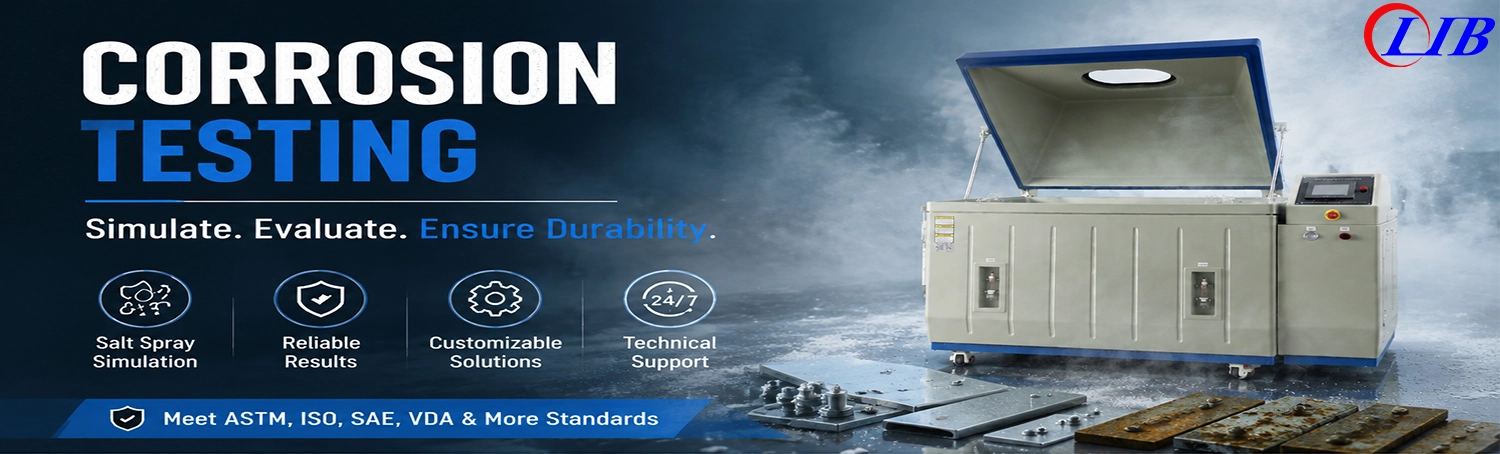
 Corrosion is one of the leading causes of material degradation and product failure in industries exposed to moisture, salt, chemicals, and harsh environments. LIB industry corrosion testing solutions help manufacturers evaluate corrosion resistance, coating durability, and long-term reliability — with advanced simulation technology, customizable configurations, and full technical support to meet international standards and extend product service life.
Tell us your industry and standard requirements.
Get a recommended equipment solution in 30 seconds.
Simulate salt spray, humidity, SO₂, and composite atmospheric corrosion to evaluate the durability and service life of materials and products — meeting ASTM, ISO, SAE, VDA, and other international standards.
Different products require different corrosion tests, depending on material type, protective coating, application environment, and industry standard.
Which Corrosion Test Standard Does Your Industry Need?
|
Industry / Application |
Common Standards |
Recommended Test Method |
Recommended Equipment |
|
Automotive components |
SAE J2334 / ASTM G85 / VDA 621-415 |
Cyclic corrosion test |
|
|
Electronics / control cabinets |
ISO 6988 / DIN 50018 / IEC 60068-2-42 |
SO₂ salt spray composite test |
|
|
Hardware / general coatings |
ASTM B117 / ISO 9227 NSS |
Neutral salt spray (NSS) test |
|
|
Decorative plating / export products |
ASTM B368 / ISO 9227 CASS |
CASS test |
|
|
Painted / coated panels |
ISO 4623-1/2 / ASTM D2803 |
Filiform corrosion test |
|
|
Large assemblies / irregular parts |
Application-dependent |
Composite / custom test |
Find the right standard and recommended equipment for your industry, or contact LIB industry directly.
LIB provides corrosion testing solutions for the following tests:
Neutral Salt Spray (NSS) Test
Neutral Salt Spray testing uses a neutral sodium chloride solution to create a controlled corrosive environment.
-
Common standards
ASTM B117
ISO 9227 NSS
Recommended Equipment
|
|
Using a 5% NaCl solution, the temperature is controlled at 35℃ ±2℃, and the spray deposition volume is precisely controlled at 1-2ml/80cm²/h. The cabin body is made of FRP, anti-haze material. Long-term use will not affect the stability of the test environment due to corrosion, and the test data can be directly used for routine quality comparison assessment. |
|

CASS Test (Copper Accelerated Acetic Acid Salt Spray)
CASS testing is a more aggressive salt spray method that uses copper chloride and acetic acid to accelerate corrosion.Compared with NSS testing, CASS provides faster corrosion evaluation and is commonly used for advanced surface coatings.
-
Common standards:
ASTM B368
ISO 9227 CASS
Recommended Equipment
|
The LIB CASS test chamber operates at 50℃ ±2℃ and can provide results 3-8 times faster than the neutral salt spray test. Controlled by PLC/touch screen,, it supports precise pH value and copper ion concentration control, avoiding unstable test results due to errors in reagent ratio and being questioned by customers about the credibility of the data. |
|


Cyclic Corrosion Test
Traditional salt spray tests provide continuous salt exposure, while cyclic corrosion testing combines multiple environmental conditions to better simulate real service environments.
-
Common standards:
ASTM G85
SAE J2334
VDA 621-415
Composite Corrosion Test
Composite corrosion testing combines different corrosion factors including Salt atmosphere, Industrial pollution,High humidity,Chemical environment to simulate complex environments.
-
Common standards:
ASTM G85
IEC 60068 series
Recommended Equipment
|
|
The LIB corrosion test chamber precisely replicates the salt spray-humidity-drying multi-stage cycle. The temperature and humidity uniformity is controlled within ±2%. Combined with programmable multi-stage programs and automatic data recording, the test report can be directly used for the certification audit of the supplier system. |

Filiform Corrosion Test
Filiform corrosion testing evaluates the resistance of coated metal materials against filament-shaped corrosion that develops beneath protective coatings.
-
Common standards:
ISO 4623-1
ISO 4623-2
ASTM D2803
Recommended Equipment
|
|
The LIB Filiform corrosion testing chamber precisely controls a high humidity environment (humidity 82% ±3%). It enables early identification of coating adhesion and the risk of corrosion expansion beneath the film, thus preventing problems from being discovered only after reaching the end customers. |
|


SO₂ Salt Spray Corrosion Test
Evaluates material, coating, and component resistance to combined SO₂ and salt spray exposure, replicating industrial and coastal atmospheric conditions. Precise control of SO₂ concentration, temperature, and humidity alongside salt spray enables accurate simulation of real-world combined corrosive environments.
-
Common standards:
ISO 6988
DIN 50018
IEC 60068-2-42
Recommended Equipment
|
|
The LIB SO₂ salt fog combined test chamber can precisely control the SO₂ concentration, temperature and humidity simultaneously. It truly reproduces the combined corrosive environment of industrial atmosphere and salt fog. |
 |

Large-Scale Corrosion Test
Large assemblies and irregular-shaped parts often exceed the capacity of standard corrosion chambers, requiring disassembly or third-party testing.
-
Common standards:
Application-dependent
Recommended Equipment
|
|
The LIB industry walk-in corrosion chamber is custom-built to the customer's actual sample dimensions, with internal volumes ranging from a few cubic meters up to several dozen cubic meters. It can run salt spray, cyclic, or composite corrosion programs in one chamber, letting manufacturers test full-size assemblies without disassembly or outsourcing to a third-party lab. |
|

FAQs On Salt Spray Testing
Q: How do I choose between a standard Salt Spray Chamber and a Cyclic Corrosion Chamber?
Standard Salt Spray Chambers expose samples to continuous salt fog—ideal for basic quality control and benchmark comparisons. Cyclic Corrosion Chambers alternate between salt spray, humidity, and dry cycles, providing a much closer simulation of real-world outdoor weather variations.
Q: Can LIB chambers be calibrated to comply with local ISO 17025 audit requirements?
Yes. All LIB chambers are designed and pre-tested to meet strict international calibration standards. We provide factory calibration certificates, and local 3rd-party calibration (e.g., SGS, TUV) can be easily performed on-site.
Q: What is the typical lead time for standard and customized chambers?
Standard models (Salt Spray / CASS) are usually available in stock or take 7-10 days. Customized or Walk-In corrosion chambers typically require 3-4 weeks depending on specific engineering requirements.
Q: How should the volume of the salt fog corrosion test chamber be estimated?
Based on the quantity and size of the test samples in a single batch, it is recommended to reserve a 20%-30% margin to accommodate future increases in test batch size. If you are unsure, please contact us and we will provide suggestions based on your sample situation.
Q: Can LIB industry customize the corrosion testing chamber?
OK. LIB industry offers customized corrosion testing solutions based on sample size, testing methods, standard requirements, corrosive environments, and production capacity needs.
Q:What quality guarantees and services does LIB industry provide?
LIB industry offers a 3-year warranty, lifetime maintenance support, technical assistance and engineering consulting services. It has 29 global agents and 4 overseas service centers, which can respond to after-sales demands promptly.
Request a Custom Salt Spray Testing Quote & Technical Proposal
Fill out the form below to receive a detailed specification sheet, pricing, and testing advice for your salt spray test chamber, salt corrosion test cabinet, salt spray corrosion test chamber, cyclic corrosion test chamber, or salt fog chamber from our application engineers within 2 hours.
Whether you need ASTM B117, ISO 9227, or customized salt spray testing, LIB can recommend the right chamber configuration for your corrosion testing requirements. Request a quote today and get a customized testing solution, technical proposal, and fast response from LIB Industry.