How Constant Temperature Chambers Support Long-Term Aging Tests?
Long-term aging tests rely on constant temperature chambers to simulate years of environmental exposure within compressed timeframes. These specialized chambers maintain precise thermal conditions - ranging from -70°C to +180°C - allowing researchers to accelerate material degradation processes while preserving the authenticity of real-world aging patterns. By controlling temperature stability within ±0.5°C and enabling continuous operation over extended periods, these chambers generate reliable data on product lifespan, performance deterioration, and failure mechanisms. This controlled acceleration helps manufacturers predict warranty claims, optimize formulations, and validate quality standards before market release.
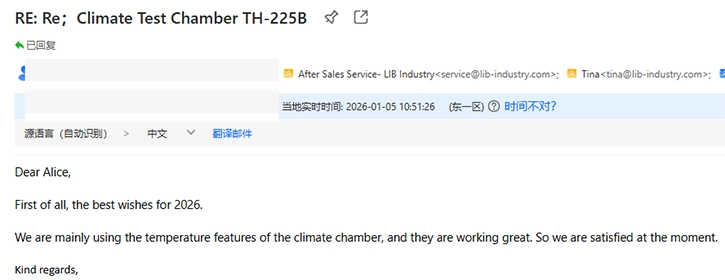
The reliability of constant temperature chambers is best reflected in real-world laboratory applications. A research team in Belgium specializing in advanced electronic product development selected the LIB industry TH-2258 climate test chamber to support their long-term thermal evaluation programs. Their primary focus has been on utilizing the chamber’s precise temperature control capabilities for component reliability studies. After extended use, the team reported stable performance, accurate temperature regulation, and overall satisfaction with the system’s operation. The consistent thermal output and dependable control system have enabled them to conduct continuous testing with confidence, supporting their electronic research and validation processes.
What Is Long-Term Aging Testing and Its Purpose?
Defining Accelerated Aging Protocols
Accelerated aging simulates extended environmental exposure by intensifying stress factors like temperature, humidity, or thermal cycling. Unlike real-time observation, these protocols compress decades into months, revealing degradation mechanisms that remain invisible during standard quality checks. Temperature chambers create reproducible conditions that follow international standards such as IEC 60068 or ASTM D1499.
Predicting Product Lifespan Through Controlled Stress
Manufacturers use aging data to estimate product durability under typical usage conditions. The Arrhenius equation correlates elevated test temperatures with accelerated chemical reactions, enabling engineers to extrapolate results from 90-day chamber tests to 10-year field performance. This mathematical relationship forms the foundation of shelf-life predictions for pharmaceuticals, polymers, and electronic components.
Validating Quality Standards Before Market Entry
Regulatory bodies require aging verification for safety-critical products. Medical devices, automotive parts, and aerospace components undergo mandatory aging protocols to demonstrate compliance with performance specifications. Constant temperature chambers provide the audit trail documentation needed for FDA submissions, CE marking, and ISO certifications through programmable controllers with data logging capabilities.
Materials and Products Commonly Tested in Aging Studies
Polymers and Elastomers Under Thermal Stress
Rubber seals, plastic housings, and composite materials experience chain scission and cross-linking when exposed to sustained temperatures. Chambers operating at 70°C to 125°C accelerate oxidative degradation, revealing brittleness, discoloration, and dimensional changes. Battery separator films undergo similar testing to ensure lithium-ion cell safety across temperature extremes.
Electronics and Semiconductor Reliability Assessment
Solder joints, capacitors, and integrated circuits fail through thermomechanical fatigue when subjected to temperature cycling. Chambers programmed with -40°C to +85°C profiles simulate automotive underhood conditions, identifying weak die attach bonds or metallization failures. Data centers use these results to specify component derating factors for extended operational lifetimes.
Pharmaceutical Stability and Biomedical Applications
Drug formulations require stability testing at 25°C/60% RH and accelerated conditions of 40°C/75% RH per ICH guidelines. Constant climate chambers with integrated humidity control monitor active ingredient potency, excipient interactions, and packaging integrity. Implantable medical devices undergo similar protocols to verify biocompatibility after simulated body temperature exposure.
|
Product Category |
Typical Test Temperature |
Duration Range |
Key Degradation Metrics |
|
Polymer Seals |
70°C - 125°C |
1000 - 5000 hours |
Hardness, elongation, compression set |
|
Li-ion Batteries |
45°C - 60°C |
500 - 2000 cycles |
Capacity retention, internal resistance |
|
Electronic Assemblies |
-40°C to +125°C |
200 - 1000 cycles |
Solder joint integrity, insulation resistance |
|
Pharmaceuticals |
40°C / 75% RH |
6 - 12 months |
API concentration, dissolution rate |
Setting Test Profiles for Extended Duration Exposure
Programming Multi-Step Temperature Sequences
Modern touchscreen controllers enable engineers to design complex profiles combining isothermal holds, temperature ramps, and cyclic patterns. A typical automotive validation might include 8 hours at 85°C, followed by 4 hours at -40°C, repeated for 500 cycles. These programmable sequences replicate seasonal variations or usage patterns more accurately than single-setpoint tests.
Balancing Acceleration Factors with Real-World Correlation
Excessive temperatures risk introducing unrealistic failure modes that never occur during normal service. The acceleration factor must remain within boundaries where degradation mechanisms stay consistent with field conditions. Battery manufacturers typically limit aging temperatures to 60°C despite chamber capabilities reaching 150°C, preserving electrolyte chemistry relevance.
Incorporating Dwell Times and Recovery Periods
Materials require time to reach thermal equilibrium throughout their mass. Thick-walled components or low-conductivity polymers may need 2-4 hour soak periods before chemical reactions stabilize at target rates. Recovery intervals between temperature extremes allow stress relaxation, preventing artifact failures from instantaneous thermal shock rather than cumulative aging.
Monitoring Degradation and Performance Changes Over Time
Non-Destructive Intermediate Measurements
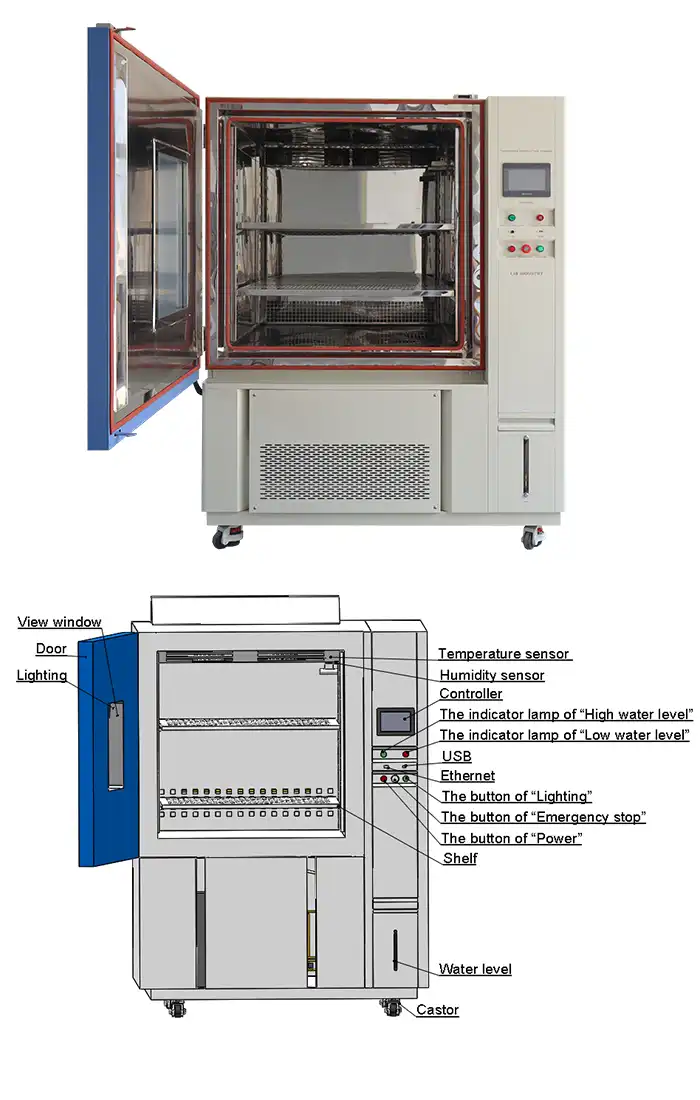
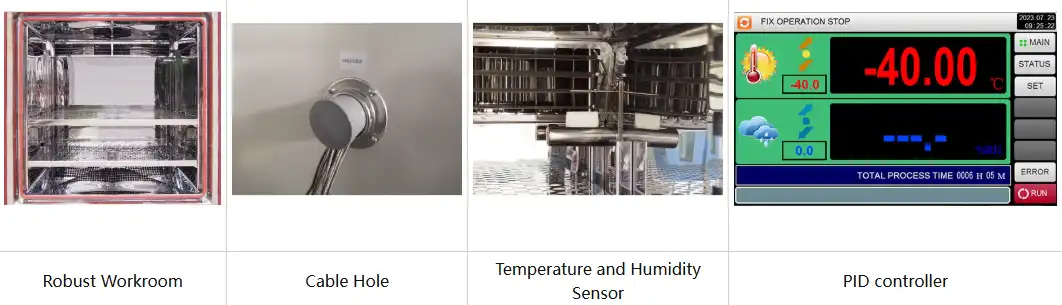
Chamber cable ports with 50mm to 200mm diameters accommodate sensor feedthroughs for real-time monitoring. Thermocouples embedded in test specimens track core temperatures, while resistance measurements detect conductor degradation in wire insulation. Removable shelves allow periodic extraction for dimensional inspection without terminating the entire test sequence.
Tracking Physical Property Evolution
Mechanical properties shift predictably during aging: polymers lose elasticity, adhesives weaken, and coatings crack. Tensile strength testing at 500-hour intervals creates degradation curves that reveal inflection points where rapid failure onset begins. Color spectrophotometry quantifies UV-resistant coating performance through Lab coordinate changes documented via observation windows.
Data Acquisition Through Ethernet Connectivity
Controllers with PC link functionality stream temperature logs, alarm events, and chamber status to laboratory information management systems. This continuous archiving supports statistical process control and enables early intervention when deviations occur. USB ports provide backup data export for regulatory submissions requiring complete test history documentation.
|
Monitoring Method |
Measurement Interval |
Parameters Tracked |
Equipment Requirements |
|
Embedded Sensors |
Continuous (1-min logging) |
Core temperature, voltage, resistance |
Cable port, data logger |
|
Periodic Extraction |
Weekly to monthly |
Tensile strength, hardness, weight loss |
Removable shelving system |
|
Visual Inspection |
Daily to weekly |
Cracking, discoloration, delamination |
Observation window, LED lighting |
Correlating Accelerated Aging with Real-World Lifespan
Applying Arrhenius Kinetics to Temperature Data
The Arrhenius relationship states that reaction rates double approximately every 10°C increase. Testing rubber at 100°C for 1000 hours equates to roughly 8000 hours at 70°C field conditions, depending on activation energy. Chamber temperature uniformity within ±2.0°C ensures all specimens experience identical acceleration factors, reducing statistical scatter in lifespan predictions.
Validating Models Through Field Return Analysis
Correlation accuracy improves when constant temperature and humidity chamber predictions match actual warranty claim data. Engineers compare aged sample properties to components retrieved from customer returns, adjusting acceleration factors or test conditions to eliminate discrepancies. This iterative refinement transforms chamber testing from theoretical estimates into validated design tools.
Accounting for Multi-Stress Synergistic Effects
Real environments combine temperature with humidity, vibration, and chemical exposure. While constant temperature chambers isolate thermal effects, true lifespan prediction requires integrating multiple test datasets. UV exposure accelerates polymer oxidation at rates not predicted by temperature alone, necessitating supplementary testing in specialized weathering chambers.
Using Test Data to Optimize Product Reliability and Longevity
Identifying Weak Links in Component Design
Aging tests reveal which subsystem fails first under sustained stress. Capacitor electrolyte evaporation might limit power supply lifespan to 50,000 hours at 85°C, while surrounding resistors remain stable for 100,000 hours. Design teams reallocate resources toward strengthening these bottlenecks through material upgrades or thermal management improvements.
Guiding Material Selection and Formulation Changes
Comparative aging of candidate polymers determines optimal elastomer compounds for specific applications. A silicone seal retaining 80% compression set after 5000 hours at 150°C outperforms fluorocarbon alternatives showing 50% degradation. These quantitative comparisons justify material cost differences through documented performance advantages.
Establishing Warranty Periods and Service Intervals
Reliable aging data supports evidence-based warranty policies and maintenance schedules. If LED drivers demonstrate 90% survival after simulated 15-year operation, manufacturers confidently offer 10-year warranties with known failure rate margins. Preventive replacement intervals for wear items derive from chamber-tested degradation curves rather than arbitrary guesses.
|
Application |
Chamber Test Duration |
Predicted Field Life |
Design Modification |
|
EV Battery Pack Seal |
3000 hrs @ 80°C |
12 years thermal exposure |
Switched to EPDM compound |
|
Industrial Relay Contact |
10,000 cycles @ 125°C |
2M operations @ rated load |
Added gold flash plating |
|
Implant Coating |
1000 hrs @ 37°C saline |
25 years body fluid exposure |
Increased oxide layer thickness |
Reliable Continuous Operation with LIB Industry Constant Temperature Chambers
|
|
Name | Constant Temperature Chambers | ||||
|
Model |
TH-100 |
|||||
|
Temperature range |
-20℃ ~+150 ℃ |
|||||
|
Low type |
A: -40℃ B:-70℃ C -86℃ |
|||||
|
Humidity Range |
20%-98%RH |
|||||
|
Temperature deviation |
± 2.0 ℃ |
|||||
|
Heating rate |
3 ℃ / min |
|||||
|
Cooling rate |
1 ℃ / min |
|||||
|
Controller |
Programmable color LCD touch screen controller, Multi-language interface, Ethernet , USB |
|||||
|
Exterior material |
Steel Plate with protective coating |
|||||
|
Interior material |
SUS304 stainless steel |
|||||
|
Standard configuration |
1 Cable hole (Φ 50) with plug; 2 shelves |
|||||
|
Timing Function |
0.1~999.9 (S,M,H) settable |
|||||
 Robust Refrigeration Systems for Uninterrupted Testing
French TECUMSEH compressors deliver consistent cooling performance across thousands of operational hours. Mechanical compression refrigeration using environmentally compliant refrigerants achieves 3°C/min cooling rates while maintaining energy efficiency. Dual-stage cascade systems in -70°C models prevent moisture intrusion that would compromise long-duration test integrity.
Safety Interlocks Protecting Valuable Test Specimens
Over-temperature protection, refrigerant high-pressure cutoffs, and earth leakage detection prevent catastrophic failures during unattended operation. Independent temperature limiters shut down heating elements before specimens exceed damage thresholds. These redundant safeguards protect months of accumulated aging data from single-point failures.
Scalable Capacity Options for Diverse Testing Needs
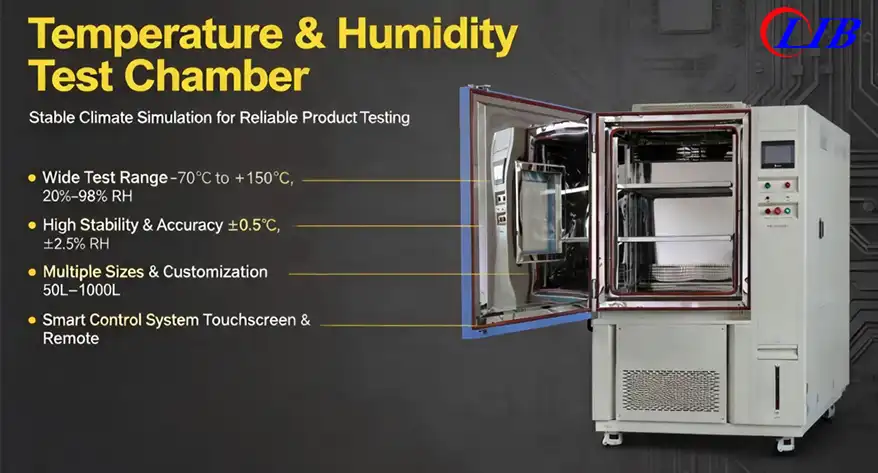
Interior volumes from 100L to 1000L accommodate everything from small material coupons to full product assemblies. A 500L chamber with 700×800×900mm internal dimensions houses complete automotive control modules, while 100L units efficiently test material sample sets. This range allows laboratories to match chamber investment with specific project requirements rather than over-purchasing capacity.
LIB Industry constant temperature chambers combine PTR platinum resistance PT100Ω sensors, programmable LCD touchscreen controllers, and SUS304 stainless steel construction to deliver measurement accuracy and contamination resistance essential for multi-month aging protocols. Polyurethane foam insulation and forced air circulation via centrifugal fans maintain the thermal stability that transforms accelerated testing from rough approximation into precision engineering tool.
Conclusion
Constant temperature chambers transform aging prediction from guesswork into quantitative science through precise thermal control and programmable endurance testing. These systems accelerate degradation mechanisms while preserving real-world relevance, generating lifespan data that informs material selection, design optimization, and warranty decisions. Continuous operation reliability, safety interlocks, and comprehensive monitoring capabilities make chambers indispensable for validating product longevity across industries from automotive to biomedical applications.
FAQ
How long should aging tests run to predict 10-year product life?
Test duration depends on acceleration factors from elevated temperatures. Using the Arrhenius equation with typical activation energies, 1000-2000 hours at 60-80°C above operating temperature often correlates to 10-year field exposure. Validation against real-world data refines these estimates.
Can constant temperature chambers handle both heating and cooling cycles?
Advanced models integrate nichrome heating elements with mechanical refrigeration systems, enabling temperature ranges from -70°C to +180°C. Programmable controllers automate transitions between extremes, supporting thermal shock and cycling protocols without manual intervention throughout extended tests.
What maintenance ensures chamber reliability during multi-month tests?
Quarterly compressor inspection, annual refrigerant charge verification, and semi-annual sensor calibration prevent mid-test failures. Controller firmware updates and door seal replacement maintain measurement accuracy. Preventive schedules minimize unplanned downtime that would invalidate accumulated aging data.
Contact LIB Industry for Advanced Testing Solutions
As a leading constant temperature chamber manufacturer and supplier, LIB Industry delivers customized environmental testing solutions worldwide. Our experienced team provides complete turnkey services from design through installation and training. Reach our experts at ellen@lib-industry.com to discuss your aging test requirements.