Blowing Rain Test Chambers in Renewable Energy Equipment Testing
Renewable energy equipment faces relentless exposure to harsh weather conditions throughout its operational lifetime. Wind-driven rain presents one of the most significant challenges to solar panels, wind turbines, and outdoor power electronics. A blowing rain test chamber replicates these extreme conditions in a controlled laboratory environment, enabling manufacturers to validate ingress protection, assess seal integrity, and verify long-term durability before deployment. These specialized chambers simulate rainfall rates exceeding 1.7 mm/min combined with wind velocities reaching 9 m/s, matching MIL-STD-810 specifications. By subjecting equipment to accelerated weathering cycles, engineers identify design vulnerabilities, optimize protective coatings, and ensure compliance with international standards - ultimately reducing field failures and warranty claims while extending service life in demanding outdoor installations.
Why Renewable Energy Systems Are Vulnerable to Wind-Driven Rain?
Geographic Exposure Patterns Increase Risk
Renewable installations typically occupy exposed locations where energy generation potential peaks - coastal areas for offshore wind farms, desert regions for concentrated solar arrays, and elevated terrain for onshore turbines. These sites experience intensified weather phenomena including tropical storms, monsoons, and persistent maritime conditions. Equipment positioned at height or in open terrain encounters wind-driven precipitation at angles and velocities rarely experienced at ground level, creating penetration pathways through ventilation openings, cable glands, and panel junctions.
Material Degradation Mechanisms
Repeated wetting and drying cycles accelerate corrosion in metallic components, degrade polymer seals through hydrolysis, and compromise adhesive bonds in laminated structures. Water ingress initiates electrical tracking across insulator surfaces, creates conductive pathways through contaminated moisture films, and promotes galvanic corrosion where dissimilar metals interface. Temperature differentials between heated components and cold rainwater induce thermal shock, generating microcracks in protective coatings and glazing materials.
Extended Service Life Requirements
Unlike consumer electronics with typical replacement cycles of 3-5 years, renewable energy systems must maintain performance over 20-30 year operational periods. Solar photovoltaic modules carry 25-year power output warranties, while wind turbine manufacturers guarantee availability ratings exceeding 95% throughout multi-decade service contracts. This extended exposure multiplies the cumulative effect of weather-related degradation, making thorough validation through simulated rain testing essential during product development.
Testing Solar Panels, Wind Turbines, and Outdoor Inverters
Photovoltaic Module Evaluation
Solar panels undergo blowing rain assessment to verify junction box sealing, frame drainage effectiveness, and laminate delamination resistance. Test protocols examine whether driving rain penetrates the aluminum frame channels where moisture could corrode electrical connections or create ground faults. The chamber's rotating turntable exposes modules to precipitation from all orientations, simulating installation angles from horizontal ground-mounted arrays to steep rooftop configurations. Engineers monitor electrical isolation resistance throughout exposure, detecting any degradation indicating moisture intrusion into the cell matrix.
|
Equipment Type |
Critical Test Areas |
Typical Failure Modes |
|
Solar Panels |
Junction boxes, frame seals, laminate edges |
Corrosion of bypass diodes, delamination, ground faults |
|
Wind Turbines |
Nacelle enclosures, blade root connections, tower access ports |
Bearing contamination, control system shorts, structural corrosion |
|
Inverters |
Cooling vents, cable entries, display panels |
Electronic component failure, arc tracking, enclosure breaching |
Wind Turbine Component Testing
Nacelle housings, blade attachment assemblies, and tower base enclosures require validation against horizontal rain propelled by sustained winds. The rain test chamber's high-velocity spray configuration - achieving 9 m/s droplet impact - replicates the conditions experienced by turbines operating during storm events. Particular attention focuses on dynamic seals around rotating shafts, ventilation pathways that balance pressure while excluding moisture, and the integrity of composite material joints where blade sections connect.
Power Electronics Protection
String inverters, central inverters, and battery management systems installed in outdoor enclosures must resist water penetration while dissipating internal heat through ventilation. Testing reveals whether labyrinth vent designs effectively block driving rain while maintaining adequate airflow, and whether cable entry systems prevent capillary action from drawing moisture along conductor strands into terminal compartments. The chamber's heated water capability simulates condensation challenges when cold rain contacts warm electronics.
Test Parameters for Extreme Weather Exposure
Rainfall Intensity Configuration
Standard procedures specify minimum precipitation rates of 1.7 mm/min measured at the test surface, though exaggerated testing employs rates up to 20.8 L/min through high-pressure nozzles. These accelerated conditions compress months of cumulative rainfall into hours of laboratory exposure, revealing marginal seal designs that might pass less stringent evaluations. The droplet size distribution spanning 0.5-4.5 mm diameter matches natural raindrop characteristics, ensuring realistic impact dynamics and surface wetting behavior.
Wind Velocity Settings
Chamber specifications call for terminal droplet velocities of 9 m/s upon striking the test specimen, achieved through coordinated fan operation and spray trajectory calculation. Variable frequency drives enable precise wind speed adjustment from gentle precipitation to hurricane-force conditions, accommodating product-specific exposure profiles based on intended deployment environments. The multi-directional air movement prevents artificial protection from fixed-angle spraying, better representing chaotic natural storm patterns.
Temperature Differential Control
MIL-STD-810 methodology requires water temperature at least 10°C above the test specimen surface temperature, with capability extending to 55°C water temperature. This differential generates thermal stress mimicking real operational scenarios where solar panels heat to 60-70°C during daytime operation before sudden cooling during rain events. The temperature shock challenges seal materials, reveals differential expansion issues, and accelerates aging processes that develop over years of field service.
|
Test Parameter |
Standard Setting |
Exaggerated Setting |
Application |
|
Rainfall Rate |
≥1.7 mm/min |
20.8 L/min |
Moderate vs. extreme weather validation |
|
Wind Velocity |
9 m/s at specimen |
Up to 25 m/s |
Standard exposure vs. hurricane conditions |
|
Water Temperature |
Ambient +10°C |
Up to 55°C |
Normal operation vs. maximum thermal stress |
|
Test Duration |
30 min per orientation |
Up to 999 min programmable |
Quick screening vs. endurance evaluation |
Evaluating Material and Seal Performance Under Rain and Wind
Elastomeric Seal Degradation Assessment
Gaskets fabricated from EPDM, silicone, or fluoroelastomers exhibit varying resistance to continuous water exposure and mechanical stress from repeated compression cycles. Rain test chamber testing quantifies seal performance through tracer gas detection, electrical continuity monitoring, or visual inspection following disassembly. The combination of sustained water pressure and temperature cycling reveals whether seal material maintains sufficient compression set resistance and chemical stability throughout expected service intervals.
Coating System Verification
Protective finishes applied to aluminum frames, steel support structures, and composite surfaces undergo validation for adhesion maintenance when subjected to erosive water impact. High-velocity droplets create mechanical stress at coating interfaces, while temperature differentials induce expansion mismatches between substrate and finish layers. Post-exposure adhesion testing through pull-off measurements or cross-hatch evaluation quantifies any degradation relative to unexposed control samples.
Drainage Path Optimization
Well-designed enclosures incorporate weep holes, drainage channels, and sloped surfaces to evacuate water that penetrates outer defenses before reaching sensitive components. Chamber testing with dye-traced water reveals actual drainage pathways, identifies locations where pooling occurs, and demonstrates whether drainage capacity exceeds water ingress rates under worst-case conditions. The rotating turntable function proves particularly valuable for evaluating drainage effectiveness across all installation orientations.
Correlating Test Data With Field Reliability
Accelerated Life Prediction Models
Engineers develop mathematical relationships between chamber exposure duration and equivalent field service time based on comparative rainfall intensity, wind loading, and temperature cycling frequency. A typical correlation might equate 30 minutes of exaggerated chamber testing to 6 months of coastal deployment, enabling rapid screening of design iterations. These models incorporate safety factors accounting for variability in natural weather patterns and differences between controlled laboratory conditions and complex outdoor environments.
Failure Mode Reproduction
Chamber testing aims to replicate actual field failure mechanisms rather than simply achieving pass/fail binary outcomes. When warranty returns reveal specific corrosion patterns, seal breaches, or electrical degradation, test protocols are adjusted to recreate those conditions. Successfully reproducing field failures in the laboratory validates test methodology and enables root cause investigation under controlled observation impossible during actual outdoor operation.
Standard Compliance Verification
International specifications including IEC 61215 for photovoltaic modules, IEC 61400 for wind turbines, and various IP rating classifications define minimum performance thresholds. The rain test machine provides documented evidence of compliance through detailed test reports capturing all environmental parameters, exposure durations, and pass/fail criteria evaluations. Third-party certification bodies rely on this data when issuing product approvals required for market access in different jurisdictions.
Improving Longevity of Renewable Energy Equipment Through Rain Testing
Design Iteration Acceleration
Traditional product development cycles requiring years of outdoor exposure testing can compress to months through intensive chamber evaluation. Engineers test multiple seal configurations, drainage improvements, and material alternatives in rapid succession, gathering performance data that would otherwise require deploying prototypes to field sites and waiting through multiple weather seasons. This acceleration reduces time-to-market while improving first-generation product reliability.
Material Selection Optimization
Comparative testing of candidate materials under identical exposure conditions eliminates confounding variables present in field trials. Evaluating three different gasket compounds simultaneously in the same chamber run ensures that performance differences reflect material properties rather than weather variability. Cost-benefit analysis becomes more precise when material performance data comes from controlled testing rather than anecdotal field observations.
Quality Assurance Integration
Production validation testing samples random units from manufacturing batches, subjecting them to abbreviated chamber exposure as a final verification before shipment. This quality gate catches assembly errors, material substitutions, or process variations that might compromise weather resistance. Manufacturers establish baseline performance from qualification testing, then use production testing to confirm ongoing conformance to those standards.
|
Testing Phase |
Objective |
Typical Duration |
Output |
|
Design Qualification |
Validate initial design meets specifications |
3-10 hours per configuration |
Design approval, specification conformance |
|
Design Validation |
Confirm performance under worst-case conditions |
10-50 hours accelerated exposure |
Lifetime prediction, failure mode identification |
|
Production Acceptance |
Verify manufacturing consistency |
15-60 minutes per sample |
Batch release, process control data |
Ensure Outdoor Durability with LIB Industry Blowing Rain Test Chambers
|
|
|
|
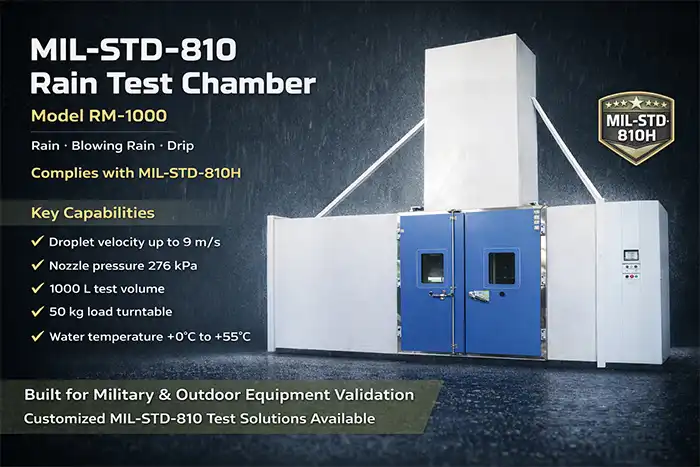
Model: RIM-1000 Interior Volume: 1000 L Turntable Load: 50 kg Turntable Diameter: 800 mm Door Lock: Electromagnetic lock Interior Material: SUS304 stainless steel Test Standard: MIL-STD-810H Test Time: 0 – 999 min, adjustable |
|
|
Rain & Blowing Rain Final Rain Droplet Velocity: 9 m/s on test item Rainfall Rate≥ 1.7 mm/min Droplet Size: 0.5 – 4.5 mm Water Temperature: +10°C to max. +55°C |
|
|
Drip Drip Area Dimensions: 1600 × 1000 mm, height adjustable Drip Hole Diameter: 20 – 25.4 mm Distance Between Holes: 25 mm Water Volume: ≥ 280 L/m²/h Water Temperature: +10°C to max. +55°C |
|
|
Exaggerated Rain Nozzle Pressure: 276 kPa Rainfall Rate: 20.8 L/min Nozzle Arrangement: One nozzle per 0.56 m² of surface area, approx. 48 cm from test surface Droplet Size:0.5 – 4.5 mm |
|
Comprehensive Testing Capability
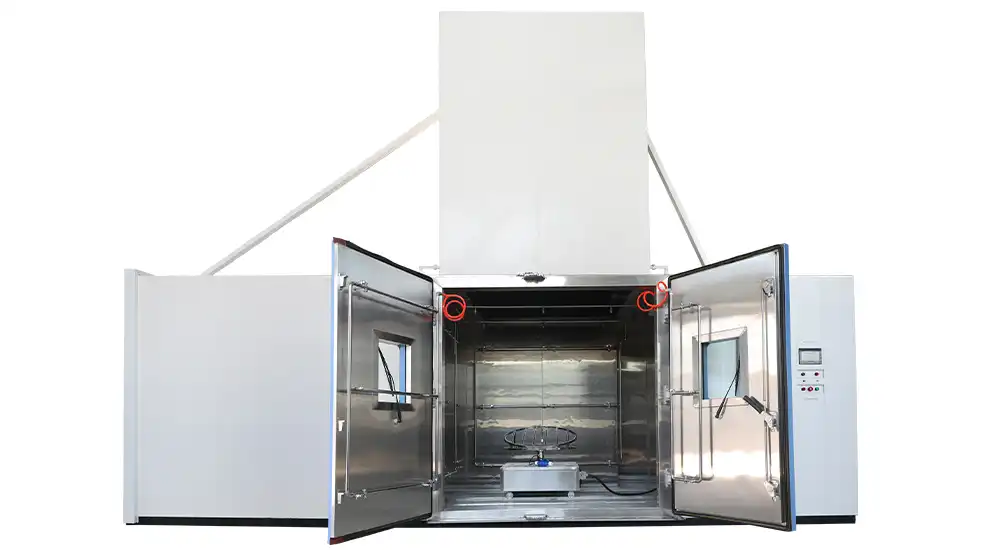
The LIB RIM-1000 model offers 1000-liter internal volume accommodating full-size solar panels up to 2 meters in length, complete wind turbine nacelle components, and multiple inverter units tested simultaneously. The 800mm diameter turntable supports 50kg specimen loads while rotating at programmable speeds from 1-7 rpm, ensuring uniform exposure across all surfaces. Multi-mode operation supports drip testing, standard rain simulation, and exaggerated high-intensity exposure through different spray head configurations.
Precision Environmental Control
Advanced instrumentation monitors and maintains rainfall rate within ±5% tolerance, wind velocity within ±0.5 m/s accuracy, and water temperature within ±2°C stability. Real-time data logging captures all parameters at user-defined intervals, creating comprehensive records for compliance documentation and statistical process control. The touchscreen HMI enables operators to program complex test sequences combining varying intensities, wind directions, and temperature profiles matching specific climate zone characteristics.
Long-Term Partnership Value
Every blowing rain test chamber includes comprehensive commissioning at the customer facility, operator training covering routine maintenance and advanced troubleshooting, and unlimited technical consultation throughout the 3-year warranty period. The lifetime service commitment ensures spare parts availability, software updates incorporating evolving test standards, and remote diagnostic support minimizing downtime. Custom development services adapt standard chambers to unique requirements including oversized specimens, specialized instrumentation integration, or modified environmental parameters.
|
|
|
|
| Workroom
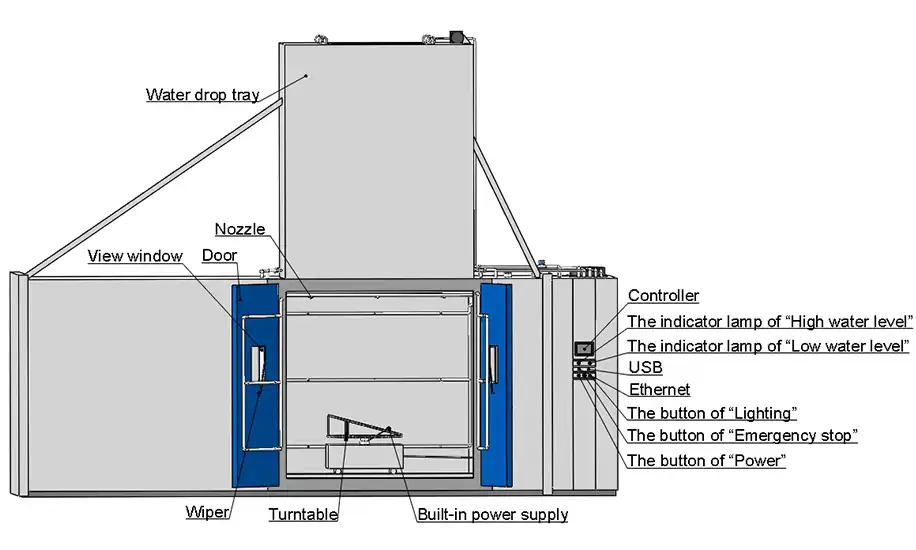
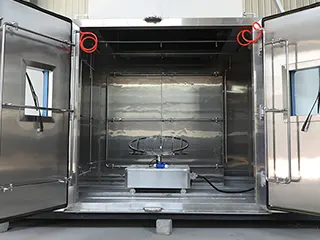
The internal material is 304 stainless steel, mirror surface, rust-proof to high and low temperature and moisture corrosion |
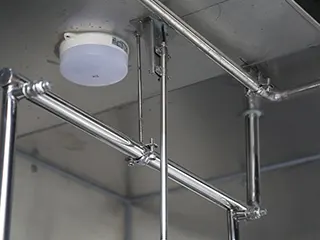
Build-in lighting
The built-in dustproof LED lighting inside the workroom. The light can be turned on and off at the control panel button |
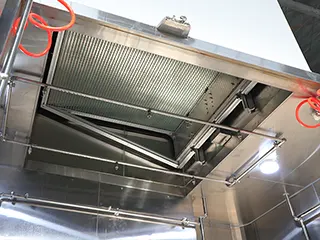
Drip Tray
The drip tray is made of stainless steel Drip holes are evenly distributed |
Conclusion
Blowing rain test chambers deliver essential validation capabilities for renewable energy equipment facing decades of outdoor exposure to wind-driven precipitation. Through precise control of rainfall intensity, wind velocity, and thermal conditions, these systems replicate years of weathering within compressed laboratory timeframes. The resulting data guides material selection, optimizes seal designs, and verifies compliance with international durability standards - directly translating to reduced field failures, lower maintenance costs, and enhanced customer confidence in long-term system reliability.
FAQ
What rainfall rate should I use when testing solar panels for coastal installations?
Standard testing employs 1.7 mm/min minimum, but coastal deployments benefit from exaggerated 20.8 L/min rates simulating tropical storm conditions. This accelerated approach reveals marginal sealing that passes moderate testing but fails under severe weather exposure typical of maritime environments.
How does chamber testing correlate to actual field service life?
Correlation depends on deployment location climate data and test intensity. A common relationship equates 1 hour of exaggerated chamber exposure to 3-6 months of moderate climate service, though coastal or tropical installations require adjusted factors. Manufacturers develop specific correlations validated through parallel field monitoring.
Can blowing rain chambers test complete wind turbine assemblies?
Chamber dimensions limit testing to nacelle components, blade root sections, and control cabinets rather than complete turbines. The RIM-1000's 1000mm cubic workspace accommodates most subsystems requiring weather protection validation. Custom larger chambers address full-assembly testing needs for specialized applications.
Contact LIB Industry, a leading blowing rain test chamber manufacturer and supplier, to discuss your renewable energy testing requirements. Our engineering team designs customized solutions meeting your specific validation needs. Reach us at ellen@lib-industry.com to request detailed specifications and quotations.