Automotive component validation demands rigorous testing protocols to ensure parts withstand harsh environmental conditions throughout their service life. Dust test chambers play a pivotal role in this validation process by simulating real-world dust exposure scenarios that vehicles encounter across diverse operating environments. These specialized chambers replicate conditions ranging from desert sandstorms to urban particulate matter, enabling manufacturers to verify component sealing effectiveness, evaluate material durability, and validate ingress protection ratings before production. Through controlled dust testing, automotive engineers identify potential failure points, optimize design parameters, and ensure components meet stringent quality standards mandated by international regulations and customer expectations.
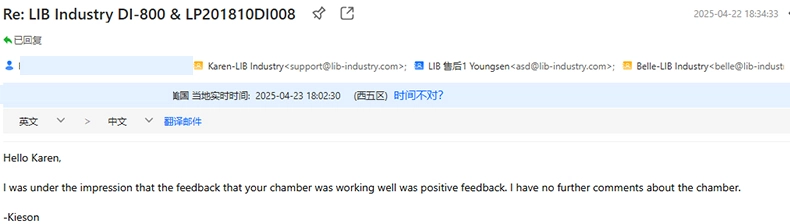
This reliability is reflected in customer applications as well. A U.S.-based lighting manufacturer utilizes a dust test chamber to conduct enclosure sealing and ingress protection verification on automotive lighting assemblies. During routine and extended test cycles, the chamber delivered stable airflow control and consistent dust concentration, allowing engineers to confidently assess sealing performance without operational interruptions. The customer confirmed satisfactory performance and indicated no outstanding concerns during ongoing use.
Through controlled dust testing, automotive engineers identify potential failure points, optimize design parameters, and ensure components meet stringent quality standards mandated by international regulations and customer expectations.
Which Automotive Components Require Dust Resistance Testing?
Critical Electrical and Electronic Systems
Modern vehicles contain sophisticated electronic control units (ECUs), sensor arrays, and wiring harnesses that demand superior dust protection. Engine management systems, transmission controllers, and safety-critical components like ABS modules must maintain operational integrity despite exposure to fine particulates. Connectors, terminals, and circuit boards face particular vulnerability, as even microscopic dust infiltration can cause electrical bridging, corrosion acceleration, or signal interference that compromises system functionality.
Mechanical Assemblies and Moving Parts
Bearings, gears, actuators, and brake components require validated dust resistance to prevent premature wear and mechanical failure. Dust infiltration into bearing assemblies accelerates abrasive wear, reducing service life and potentially causing catastrophic failures. Brake calipers, wheel speed sensors, and suspension components operate in high-dust environments where road debris, brake dust, and environmental particulates constantly challenge protective seals.
Lighting and Optical Components
Headlamp assemblies, camera systems, and LiDAR sensors demand exceptional dust protection to maintain optical clarity and performance. Dust accumulation on lens surfaces degrades illumination quality, reduces sensor accuracy, and impairs driver visibility. Testing these components in dust chambers validates seal designs and ensures long-term optical performance under demanding conditions.
Automotive Dust Exposure Scenarios and Failure Risks
Geographic and Operational Environments
Vehicles operate across dramatically different dust exposure profiles depending on geographic location and application. Desert regions subject components to fine talc-like particles that penetrate microscopic gaps, while agricultural areas generate coarser organic dust. Off-road vehicles experience extreme dust ingress scenarios during high-speed travel over unpaved surfaces, where suspension movement and pressure differentials actively draw particulates into component housings.
Temperature and Humidity Interactions
Dust exposure rarely occurs in isolation - temperature fluctuations and humidity variations compound contamination risks. Thermal cycling creates breathing effects as components heat and cool, drawing dust-laden air through imperfect seals. Moisture combines with dust to form abrasive paste that accelerates wear, while hygroscopic particles absorb humidity and promote corrosion on electrical contacts.
Vibration-Induced Infiltration
Automotive vibration creates dynamic stress on seals and gaskets, potentially compromising dust barriers over time. Resonant frequencies can cause seal degradation, micro-cracking, or fastener loosening that permits progressive dust infiltration. Testing must account for vibration-dust interaction effects that may not manifest in static exposure scenarios.
Dust Test Standards Applicable to Automotive Components
International Electrotechnical Commission (IEC) Standards
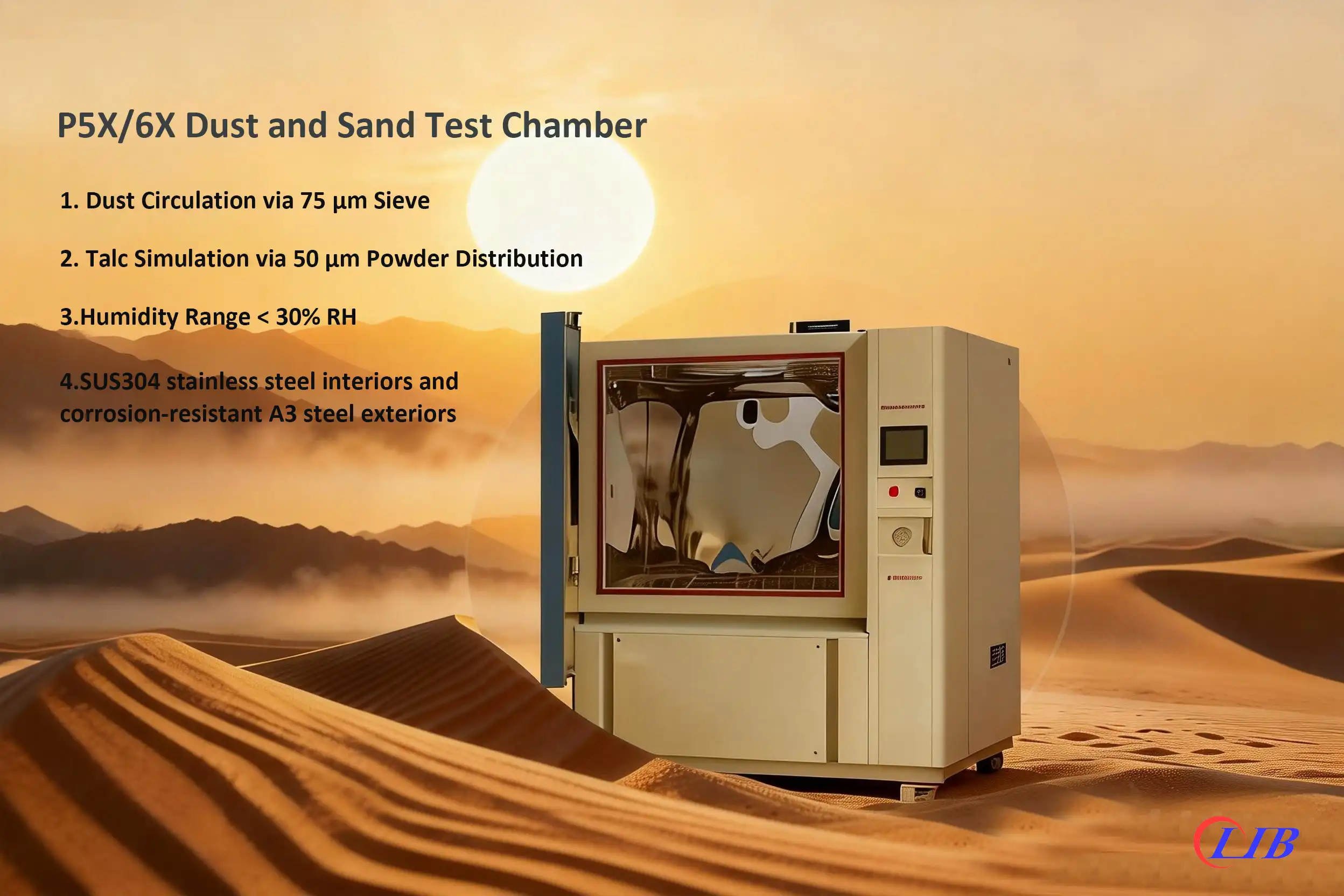
IEC 60529 establishes the Ingress Protection (IP) rating system that defines dust resistance levels through standardized testing protocols. IP5X certification indicates protection against dust ingress with limited quantity permitted, while IP6X denotes complete dust-tight performance. Automotive components typically target IP6X classification for critical applications, requiring validation in a dust chamber using talcum powder with 75-micron mesh screening to ensure particle size consistency.
|
IP Rating |
Dust Protection Level |
Test Duration |
Application Examples |
|
IP5X |
Dust-protected |
8 hours |
General electronic housings |
|
IP6X |
Dust-tight |
8 hours |
ECUs, sensors, critical connectors |
|
IP6KX |
Enhanced dust-tight |
8 hours |
High-pressure wash environments |
Military and Automotive-Specific Standards
MIL-STD-810 Method 510 provides comprehensive dust testing protocols developed for military equipment but widely adopted in automotive validation. This standard specifies various dust compositions, concentrations, and exposure durations tailored to different operational environments. ISO 20653 extends IEC 60529 specifically for road vehicles, incorporating additional test severity levels and automotive-relevant exposure scenarios.
Original Equipment Manufacturer (OEM) Requirements
Major automotive manufacturers supplement international standards with proprietary testing protocols addressing specific vehicle platforms and market requirements. These specifications may mandate extended test durations, elevated temperatures during dust exposure, or combined environmental stressors that exceed baseline standard requirements. Component suppliers must validate against both general standards and customer-specific criteria to secure production contracts.
Validating Seals, Connectors, and Housings Using Dust Chambers
Seal Performance Verification
Effective dust testing evaluates seal compression, material compatibility, and design geometry under realistic conditions. Test chambers create negative pressure differentials that simulate vehicle operational breathing, actively drawing dust toward potential infiltration paths. Engineers monitor dust accumulation inside housings to quantify seal effectiveness and identify design weaknesses requiring modification.
Connector Interface Testing
Automotive connectors face unique challenges balancing environmental protection with reliable electrical contact and serviceability. Dust chambers validate connector mating interface designs, terminal plating effectiveness, and seal groove geometry. Testing reveals whether dust particles bridge electrical contacts, interfere with mechanical latching, or compromise waterproof seal integrity that often accompanies dust protection.
Housing Design Optimization
Component housing designs incorporate labyrinth seals, pressure equalization membranes, and drain provisions that require validation through dust exposure testing. Chambers enable iterative design refinement by exposing prototypes to controlled dust environments, measuring infiltration rates, and verifying that modifications achieve target protection levels. This testing identifies optimal vent membrane sizing, drain hole positioning, and seal compression requirements.
|
Test Parameter |
Standard Range |
Critical Consideration |
|
Dust Concentration |
2-10 kg/m³ |
Replicates severe exposure scenarios |
|
Test Duration |
2-8 hours |
Simulates extended operational periods |
|
Temperature |
Ambient to 80°C |
Validates seal performance across thermal range |
|
Vacuum Level |
2-20 mbar below ambient |
Creates realistic pressure differentials |
Integrating Dust Testing into Automotive Qualification Programs
Early Development Phase Testing
Introducing dust validation during concept and prototype phases prevents costly redesigns during production preparation. Early testing identifies fundamental design limitations, material incompatibilities, or manufacturing challenges that require resolution before tooling investment. Engineers leverage rapid prototyping technologies to evaluate multiple design iterations quickly, converging on optimal solutions through accelerated dust exposure testing.
Production Validation and Quality Assurance
Production-intent components undergo rigorous dust testing to verify manufacturing consistency and quality control effectiveness, typically conducted in a dust proof chamber. Statistical sampling programs subject production parts to validation testing, ensuring that manufacturing processes maintain design-validated performance levels. Chambers equipped with automated data logging capture test parameters, enabling traceability and compliance documentation required by automotive quality management systems.
Accelerated Life Testing Programs
Dust exposure testing contributes to broader accelerated life validation programs that compress years of field exposure into weeks of laboratory testing. Combined environmental testing protocols expose components to sequential or simultaneous dust, temperature, humidity, and vibration stressors that replicate real-world degradation mechanisms. These programs validate component durability claims and support warranty analysis.
Improving Component Durability Through Early Dust Testing
Design Iteration and Optimization
Systematic dust testing enables data-driven design refinement that balances protection, cost, and manufacturing feasibility. Engineers quantify how seal material changes, housing geometry modifications, or manufacturing process adjustments impact dust resistance. This empirical approach replaces conservative over-engineering with optimized designs that meet requirements without unnecessary cost or complexity.
Material Selection and Compatibility
Dust chambers validate material performance under realistic exposure conditions, revealing degradation mechanisms that may not manifest during isolated material testing. Seal materials demonstrate varying resistance to dust particle abrasion, while housing materials exhibit different electrostatic properties affecting dust attraction. Testing guides material selection decisions based on validated performance rather than theoretical properties.
Manufacturing Process Validation
Dust testing verifies that manufacturing processes achieve design-intent performance levels. Assembly sequence optimization, fastener torque specifications, and seal installation procedures all impact dust resistance. Testing production-representative samples validates that manufacturing documentation translates design requirements into consistent production outcomes.
|
Failure Mode |
Root Cause |
Testing Benefit |
|
Seal compression set |
Material aging, temperature exposure |
Validates seal material selection |
|
Fastener loosening |
Vibration, thermal cycling |
Confirms assembly torque specifications |
|
Coating degradation |
Abrasive wear, UV exposure |
Identifies suitable protective finishes |
Enhancing Automotive Durability with LIB Industry Dust Test Chambers
|
|
|
| Name | dust proof test chamber |
|
Workroom dimension (mm) |
800*800*800 D*W*H |
|
External dimension (mm) |
950*3150*1800 D*W*H |
|
Interior Volume (L) |
510 |
|
Diameter of Turntable (mm) |
600 |
|
Turntable loads |
20kgs Max |
|
Turntable Rotation Speed |
0~7r/min (Adjustable) |
|
Internal Diameter of IPX5 Nozzle |
6.3 mm |
|
Internal Diameter of IPX6 Nozzle |
12.5 mm |
|
Water Flow Rate IPX5/ IPX6 |
12.5L/min ±5% / 100L/min ±5% |
|
Controller |
Programmable color LCD touch screen controller |
|
Ethernet connection, PC Link, USB |
|
|
Build-in Water Tank(mm) |
370*375*950 |
|
View Window Size(mm) |
475*475 |
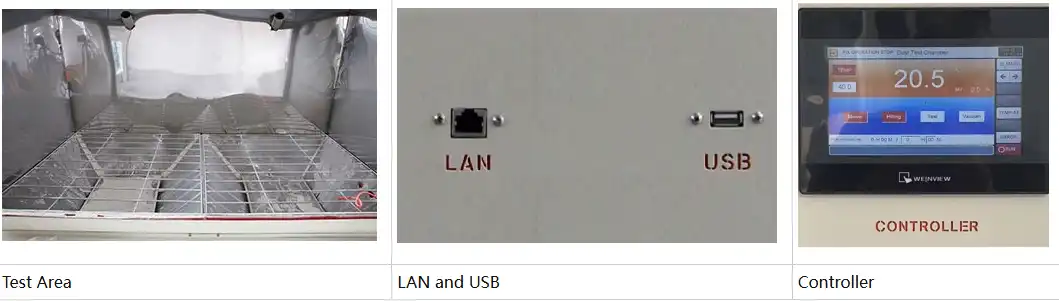
Advanced Chamber Technology
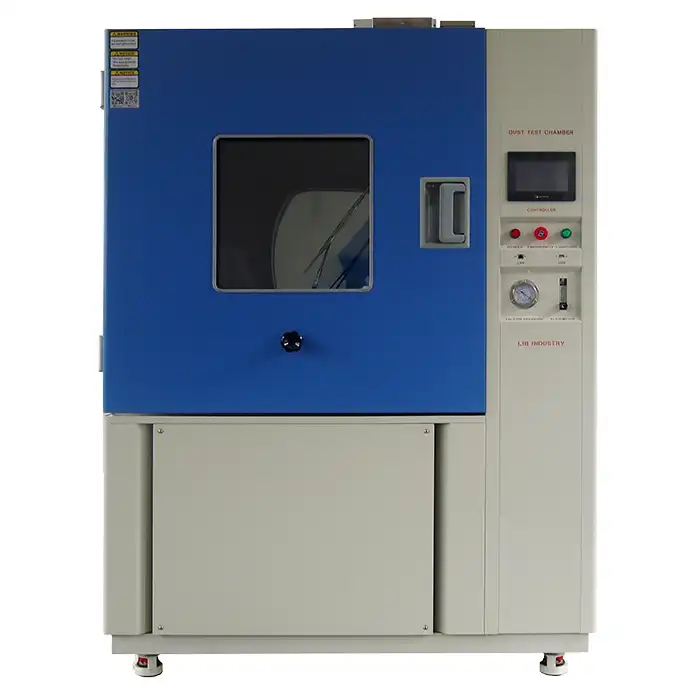
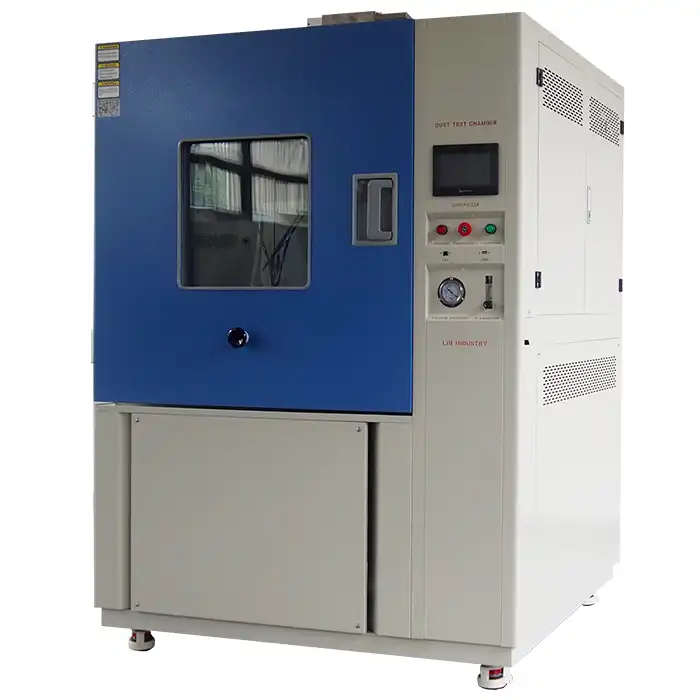
LIB Industry dust test chambers incorporate sophisticated powder management systems that prevent accumulation and ensure consistent test conditions. The funnel-shaped bottom design facilitates complete talcum powder recovery, while integrated heating systems maintain optimal powder moisture content throughout testing cycles. Uniform dust distribution systems create consistent particle clouds across the entire chamber volume, ensuring repeatable test results regardless of specimen positioning.
Precision Environmental Control
Modern automotive validation demands precise control over test parameters to ensure repeatability and correlation with field performance. LIB chambers feature programmable temperature control to 80°C with ±0.5°C accuracy, enabling validation across automotive operational temperature ranges. The PID control system manages dust circulation, vacuum pressure, and heating simultaneously, maintaining stable conditions throughout extended test durations.
Comprehensive Safety and Monitoring
Testing potentially hazardous dust environments requires robust safety features protecting operators and equipment. Electromagnetic door locks prevent inadvertent chamber access during testing, while multiple emergency stop controls enable rapid shutdown if required. Clear observation windows equipped with automatic wipers allow continuous specimen monitoring, and interior LED lighting ensures visibility throughout testing cycles.
Flexible Configuration and Support
LIB Industry provides dust test chambers ranging from 800 to 2000 liters as standard configurations, with custom solutions available for unique testing requirements. Every chamber includes comprehensive warranty coverage, global technical support, and application engineering assistance. This turnkey approach ensures customers achieve validated testing capabilities supporting automotive qualification programs worldwide.
Conclusion
Dust test chambers constitute essential infrastructure for automotive component validation, enabling manufacturers to verify protection levels, optimize designs, and ensure long-term durability across diverse operating environments. Through systematic testing aligned with international standards and OEM requirements, engineers validate seal performance, identify failure mechanisms, and refine components before production commitment. Advanced chamber technologies featuring precise environmental control, uniform dust distribution, and comprehensive monitoring capabilities support rigorous validation programs that reduce warranty costs and enhance customer satisfaction. Integrating dust testing throughout development cycles accelerates product optimization while ensuring components meet demanding automotive quality standards.
FAQ
What dust particle size and composition are used in automotive component testing?
Automotive dust testing typically employs talcum powder filtered through 75-micron mesh screens to achieve standardized particle size distribution. This composition replicates fine environmental dust that poses the greatest infiltration risk to automotive components, ensuring test results correlate with real-world exposure scenarios across diverse geographic regions.
How long does typical automotive dust resistance testing require?
Standard IP5X and IP6X testing protocols specify eight-hour continuous dust exposure under negative pressure conditions. Automotive OEM specifications may extend durations to 24 hours or incorporate multiple exposure cycles separated by thermal cycling to simulate extended service life and validate seal durability under realistic operational conditions.
Can dust testing be combined with other environmental stressors?
Modern dust test chambers support sequential or simultaneous exposure to temperature extremes, humidity variations, and vibration loading that replicate real-world automotive operating conditions. Combined environmental testing accelerates failure mechanism identification and validates component performance under complex stressor interactions that single-parameter testing cannot reveal.
Looking for a reliable dust test chamber manufacturer to support your automotive validation programs? LIB Industry specializes in designing and manufacturing precision environmental test chambers that meet international automotive standards. Our engineering team provides customized solutions tailored to your specific testing requirements. Contact us today at ellen@lib-industry.com to discuss how our dust test chambers can enhance your component qualification processes.