IPX9K Equipment for High-Pressure Hot Water Resistance Tests
High-pressure hot water resistance testing represents a critical validation process for products facing extreme environmental challenges. IEC 60529 IPX9K equipment delivers specialized testing capabilities, subjecting enclosures and components to pressurized water jets reaching 10,000 kPa at temperatures up to 88°C. This rigorous evaluation method proves essential for automotive underbody components, industrial machinery housings, and outdoor electrical installations. The IPX9K rating stands as the most demanding water ingress protection classification, simulating intensive cleaning operations and harsh operational environments. Manufacturers seeking market acceptance and regulatory compliance increasingly rely on this advanced testing protocol to validate product durability and establish customer confidence in challenging application scenarios.
Understanding High-Temperature Water Jet Test Parameters
Pressure Specifications and Their Practical Implications
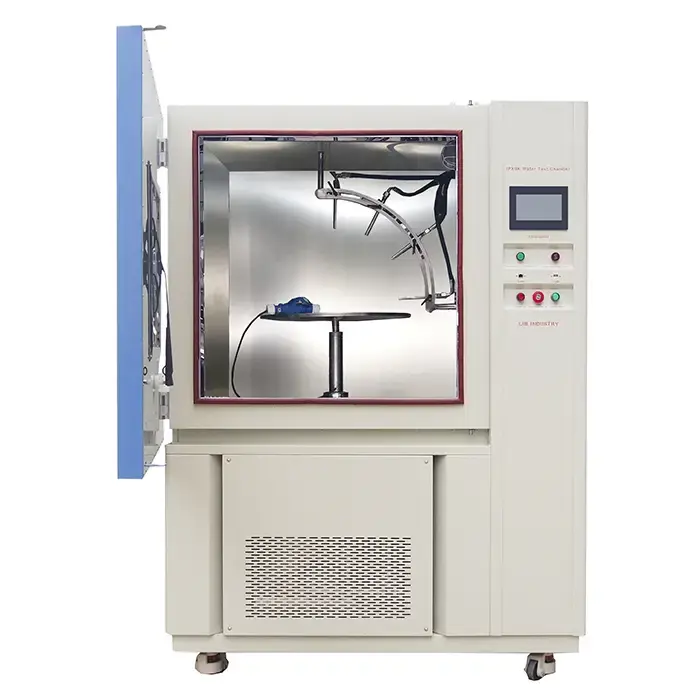
Water pressure parameters between 8,000-10,000 kPa create mechanical forces that reveal vulnerable design features. This pressure range simulates commercial vehicle wash systems and industrial cleaning equipment, exposing weaknesses in seal designs, gasket materials, and joint configurations. The adjustable pressure capability allows progressive testing, identifying the exact threshold where protection fails.
Temperature Control Requirements
Maintaining water temperature at 88°C throughout testing cycles challenges inferior equipment. Thermal expansion affects seal compression, material flexibility, and adhesive bonds differently than ambient temperature testing. Precise temperature regulation prevents false negatives from inconsistent heating, ensuring test validity meets certification body scrutiny and international standard requirements.
Flow Rate and Coverage Dynamics
The standardized 14-16 L/min flow rate ensures consistent water volume delivery across test specimens. Combined with four-position spray nozzles operating 30 seconds each, complete surface coverage occurs systematically. This methodical approach prevents untested areas while maintaining reproducible conditions across multiple test runs and different laboratory facilities worldwide.
Material Performance Under Extreme Thermal and Water Stress
Elastomer Degradation Patterns
Rubber seals and gaskets experience accelerated aging under combined thermal and pressure stress. Hot water penetration exploits microscopic surface irregularities, creating pathways through compression-set materials. Testing reveals how different elastomer compounds - EPDM, silicone, fluoroelastomers - perform when thermal expansion conflicts with compressive loading, information critical for material selection decisions.
Metal Housing Integrity Assessment
Stainless steel, aluminum alloy, and coated steel enclosures respond differently to high-temperature water impact. Protective coatings may delaminate under pressure differentials, while welded joints face thermal stress concentration. The test exposes corrosion initiation points and coating adhesion failures that ambient testing overlooks, providing manufacturers data for protective treatment optimization.
Composite Material Behavior
Advanced polymer composites used in automotive and aerospace applications exhibit complex responses to simultaneous thermal and mechanical loading. Fiber-matrix interfaces weaken under hot water infiltration, while layered structures may delaminate. IPX9K testing performed using IEC 60529 IPX9K equipment quantifies these failure modes, enabling engineers to refine composite formulations and manufacturing processes for enhanced environmental resistance.
Evaluating Industrial Enclosures for IPX9K Compliance
Automotive Component Validation
Vehicle underbody components, engine bay electronics, and sensor housings require IPX9K certification for European market access. High-pressure wash systems in commercial vehicle maintenance facilities generate conditions matching test parameters. Manufacturers validate connector sealing systems, cable gland performance, and housing joint integrity before production release, avoiding costly field failures.
Outdoor Electrical Equipment Testing
Electrical distribution cabinets, junction boxes, and control panels installed in exposed locations face precipitation, cleaning operations, and thermal cycling. The IPX9K protocol confirms protection against moisture ingress that could cause short circuits, corrosion, or insulation breakdown. Utilities and infrastructure operators specify this rating for critical installations requiring uninterrupted service.
Food Processing Machinery Requirements
Sanitation protocols in food manufacturing demand frequent high-pressure, high-temperature washdowns. Motors, drives, sensors, and control components need IPX9K protection to survive daily cleaning cycles without maintenance interventions. Testing validates bearing seals, connector systems, and housing designs against chemical cleaners delivered at elevated temperatures and pressures.
|
Industry Sector |
Typical Applications |
Key Validation Focus |
|
Automotive |
Engine components, lighting systems, sensors |
Seal integrity, connector reliability |
|
Industrial Equipment |
Motor housings, control panels, junction boxes |
Gasket compression, coating adhesion |
|
Food Processing |
Conveyor drives, weighing systems, controllers |
Bearing protection, cable entry sealing |
Standards Governing High-Pressure Hot Water Testing Methods
IEC 60529 Classification Framework
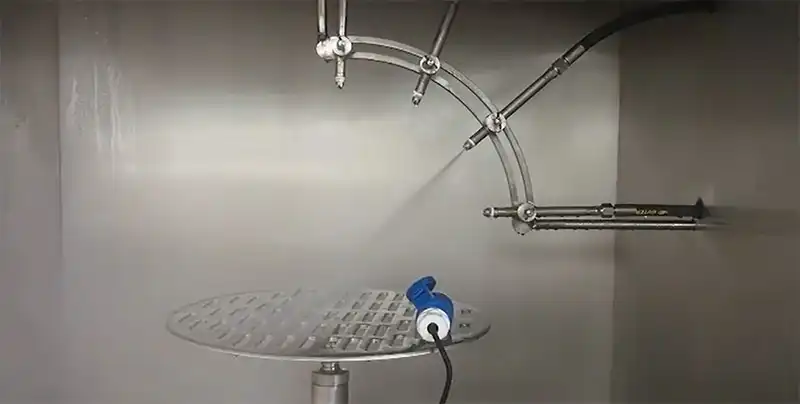
The International Electrotechnical Commission established the IP Code system defining ingress protection levels. IPX9K represents an extension addressing high-pressure, high-temperature water jets specifically. The standard specifies nozzle distance (100-150mm), spray angles (0°, 30°, 60°, 90°), rotation speed (5±1 rpm), and duration parameters ensuring consistent implementation across global testing laboratories.
ISO 20653 Automotive Applications
Road vehicles face unique environmental challenges requiring specialized testing protocols. ISO 20653 adapts IEC 60529 principles for automotive contexts, incorporating IPX9K requirements tested with IEC 60529 IPX9K equipment alongside dust ingress and mechanical impact resistance. Manufacturers targeting European markets must demonstrate compliance through certified testing, making standardized equipment and procedures essential.
Regional Regulatory Requirements
Different markets impose varying certification requirements. European Union automotive directives reference IPX9K for specific component categories, while food processing regulations mandate equivalent protection levels. Understanding these regional variations helps manufacturers plan testing strategies that satisfy multiple market requirements simultaneously, optimizing certification investment.
Test Documentation and Traceability
Certification bodies require comprehensive test records demonstrating parameter compliance throughout testing sequences. Temperature curves, pressure logs, rotation verification, and photographic documentation establish test validity. Modern IEC 60529 IPX9K equipment incorporates data acquisition systems capturing this information automatically, simplifying certification submission and audit processes.
|
Standard |
Primary Application |
Key Differentiation |
|
IEC 60529 |
General electrical equipment |
Universal ingress protection classification |
|
ISO 20653 |
Automotive components |
Vehicle-specific environmental conditions |
|
DIN 40050-9 |
German automotive market |
Historical predecessor to IPX9K specification |
Common Failure Mechanisms in Extreme Waterproof Testing
Seal Compression Set Limitations
Prolonged compression causes elastomeric seals to lose recovery capability, creating gaps when thermal expansion occurs. Hot water accelerates this degradation, revealing marginal designs that pass ambient testing. Failures typically manifest at corners, fastener locations, and material transitions where stress concentration exceeds recovery capability under elevated temperatures.
Capillary Action Through Threading
Fine-pitch threaded connections create capillary pathways when seal designs prove inadequate. High-pressure water forces liquid into thread roots, bypassing primary sealing surfaces. Temperature elevation reduces water viscosity, enhancing penetration rates. Thread sealants, O-ring grooves, and coating applications mitigate this mechanism, but validation requires actual testing under specified conditions.
Vent Membrane Saturation
Pressure-equalizing vents prevent condensation and maintain seal integrity during thermal cycling. However, hydrophobic membranes face challenges under high-pressure hot water impact. Membrane saturation allows water ingress while thermal gradients create pressure differentials forcing moisture past protective barriers. Testing reveals membrane selection appropriateness and installation effectiveness.
Coating Delamination Progression
Protective coatings applied to metal housings may exhibit adequate adhesion under static conditions but fail under dynamic thermal and pressure loading. Water infiltration at coating defects propagates delamination through thermal cycling and pressure pulsation. IPX9K testing accelerates this failure mode, identifying coating systems requiring reformulation or application process modification.
Cable Gland Compromise
Cable entries represent inherent weak points in enclosure designs. Compression glands rely on elastomer deformation creating sealing pressure around cable jackets. Hot water softens both gland materials and cable insulation, reducing sealing effectiveness. Multi-cable entries and cable diameter variations complicate sealing, making validation testing essential before production release.
Enhancing Product Durability with IPX9K Validation Processes
Design Iteration and Optimization
Testing prototypes under IPX9K conditions using IEC 60529 IPX9K equipment reveals design vulnerabilities early in development cycles. Engineers identify seal placement improvements, material substitutions, and structural reinforcements before tooling investment. This iterative approach reduces warranty costs and field failures while accelerating time-to-market through confident design validation.
Manufacturing Process Validation
Production techniques significantly impact sealing performance - gasket compression forces, adhesive cure conditions, welding parameters, and coating thickness all influence IPX9K compliance. Testing production samples verifies process control adequacy and establishes acceptance criteria for quality assurance programs. Statistical process control data combined with periodic validation testing ensures ongoing compliance.
Supplier Quality Assurance
Component suppliers providing seals, gaskets, coatings, and hardware directly affect final product IPX9K performance. Establishing supplier qualification requirements based on test results creates traceable quality chains. Material certification documents, process capability studies, and incoming inspection protocols reference IPX9K validation data, preventing substandard components from entering production streams.
|
Validation Stage |
Testing Frequency |
Decision Outcome |
|
Prototype Development |
Every design iteration |
Design modification or advancement |
|
Pre-Production |
100% of pilot run |
Manufacturing process approval |
|
Production |
Statistical sampling per quality plan |
Batch release or containment action |
Accelerated Life Testing Integration
Combining IPX9K exposure with thermal cycling, vibration, and chemical exposure creates accelerated aging protocols. Sequential or simultaneous multi-stress testing reveals interaction effects between environmental factors. This approach predicts long-term field performance from compressed laboratory testing, supporting warranty period determination and maintenance interval establishment.
Competitive Benchmarking
Testing competitor products under identical IPX9K conditions provides objective performance comparisons. Understanding competitive protection levels guides product positioning and marketing claims. Documented superiority in ingress protection supports premium pricing strategies and specification advantage in competitive bidding situations.
LIB Industry Supports Advanced High-Temperature IPX9K Testing Solutions
 |
 |
Comprehensive Equipment Capabilities
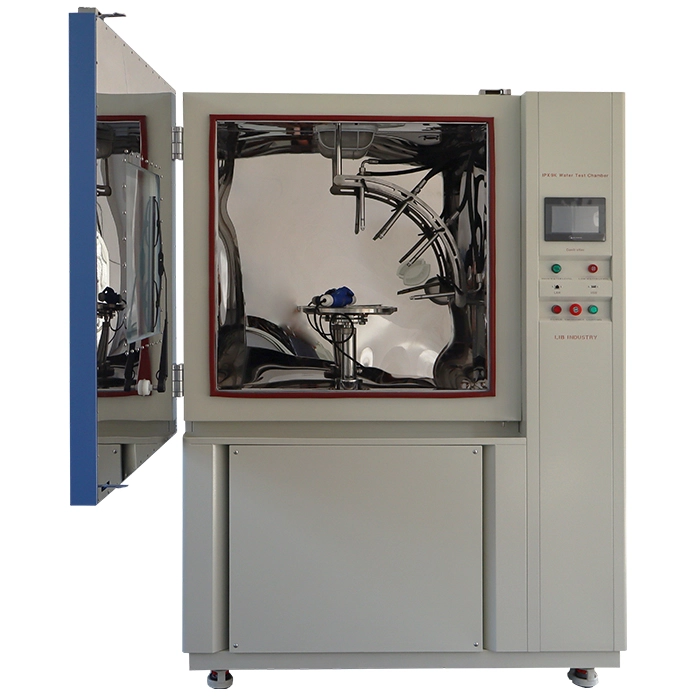
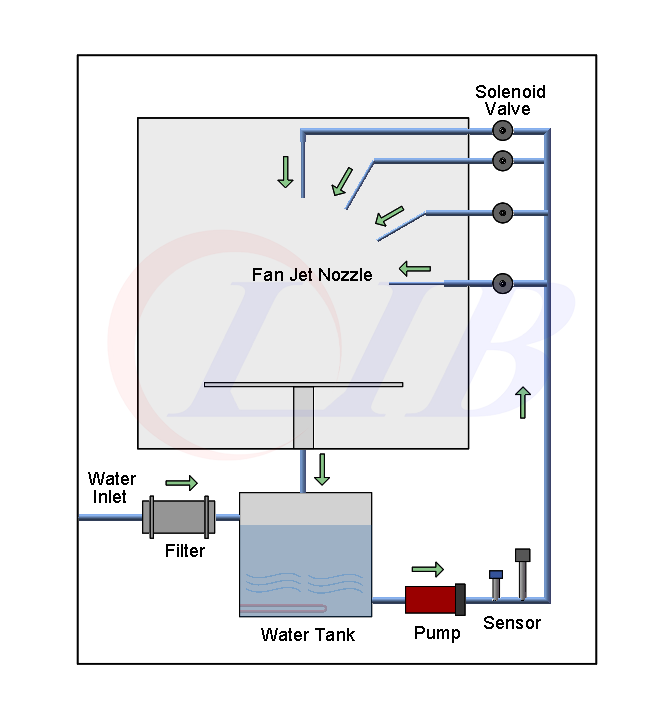
The R9K-1200 chamber delivers precise parameter control across pressure, temperature, flow, and rotation requirements. The 1,000-liter capacity accommodates automotive components, industrial enclosures, and equipment assemblies requiring full-scale validation. Programmable touch-screen control simplifies test setup while ensuring repeatability across multiple operators and shifts.
Customization for Unique Requirements
Standard testing protocols serve most applications, but specialized products may require modified spray patterns, extended temperature ranges, or custom fixturing. LIB Industry's engineering team collaborates with customers developing non-standard solutions addressing unique validation challenges. Custom chamber dimensions, additional spray positions, and integrated data acquisition systems adapt equipment to specific testing needs.
Quality Assurance and Certification
Every IEC 60529 IPX9K equipment undergoes factory acceptance testing verifying parameter compliance before shipment. CE certification confirms electrical safety and electromagnetic compatibility standards. Third-party validation from SGS and TUV provides independent verification of performance claims, giving customers confidence in measurement accuracy and regulatory compliance capability.
Global Support Infrastructure
The 24/7 technical support network addresses operational questions, troubleshooting assistance, and application guidance regardless of installation location. Video conferencing capabilities enable remote diagnostics, reducing downtime from technical issues. Spare parts inventory at regional distribution centers ensures rapid replacement component availability, minimizing testing schedule disruptions.
Long-Term Partnership Approach
Equipment purchases represent the beginning of ongoing relationships. Calibration services, operator training updates, and application development assistance continue throughout equipment service life. Annual performance verification programs maintain measurement accuracy and certification body acceptance, protecting customers' testing investment value over decades of operation.
LIB R9K-1200 Technical Specifications:
|
Parameter |
Specification |
Significance |
|
Chamber Volume |
1,000 liters |
Accommodates large automotive and industrial components |
|
Pressure Range |
8,000-10,000 kPa |
Fully compliant with IEC 60529 IPX9K requirements |
|
Temperature Control |
Ambient to 88°C |
Precise thermal regulation throughout test duration |
|
Spray Nozzles |
Four positions, 30 seconds each |
Complete coverage per standard methodology |
|
Turntable Speed |
5±1 rpm |
Synchronized rotation ensuring uniform exposure |
|
Controller |
Programmable LCD touchscreen |
Intuitive operation with comprehensive data logging |
|
Safety Systems |
Over-temperature, over-current, water shortage, earth leakage |
Multi-layer protection for operator and equipment safety |
Installation and Commissioning Services
Turnkey solutions include site preparation guidance, equipment installation, performance verification, and operator training. Factory technicians ensure proper utility connections - water supply, drainage, electrical power - meet equipment requirements. Commissioning testing demonstrates specification compliance at customer facilities, establishing baseline performance documentation.
Conclusion
IPX9K testing provides essential validation for products facing high-pressure, high-temperature water exposure in automotive, industrial, and food processing applications. Understanding test parameters, material responses, and failure mechanisms enables engineers to design robust protection systems meeting regulatory requirements and customer expectations. Standardized testing protocols ensure consistent evaluation across global markets, while advanced equipment capabilities support development, production, and quality assurance programs. Investing in proper validation infrastructure protects brand reputation and reduces warranty costs through confident product release decisions.
FAQ
What distinguishes IPX9K from lower IP ratings like IPX7 or IPX8?
IPX9K involves high-pressure (8,000-10,000 kPa) hot water jets at 88°C, simulating industrial cleaning operations. IPX7 tests submersion at 1 meter depth, while IPX8 addresses continuous submersion. IPX9K represents the most demanding water ingress protection classification, essential for automotive and food processing applications.
How often should production samples undergo IPX9K validation testing?
Testing frequency depends on production volume and process stability. Statistical sampling plans typically require periodic validation per quality management system requirements. Design changes, material substitutions, or supplier modifications necessitate immediate revalidation to confirm continued compliance with protection specifications.
Can IPX9K equipment accommodate both small electronic components and large assemblies?
Chamber selection depends on specimen dimensions and weight. The R9K-1200 model accommodates components up to 1,000mm dimensions with standard 50kg load capacity, expandable to 200kg. Custom fixturing solutions enable testing of various sizes within chamber volume constraints while maintaining standard spray distances.
Partner with LIB Industry for Your IPX9K Testing Needs
As a leading IEC 60529 IPX9K equipment manufacturer and supplier, LIB Industry delivers comprehensive testing solutions backed by global support and customization expertise. Contact our technical team at ellen@lib-industry.com to discuss your specific validation requirements and discover how our advanced testing systems enhance product development success.