ASTM G154 UV Test Machines for Outdoor Material Testing
Outdoor materials face relentless attack from environmental forces, with ultraviolet radiation standing as one of the most destructive elements. ASTM G154 UV test machines provide manufacturers and researchers with a controlled laboratory environment to simulate years of outdoor weathering in weeks or months. These specialized chambers combine UV light exposure with temperature cycling and moisture conditioning to predict material performance under real-world conditions. By accelerating degradation processes, UV testing equipment enables product developers to identify weaknesses, compare formulations, and validate durability claims before market introduction. Understanding how these machines replicate natural weathering helps industries from automotive to construction make informed material selection decisions that protect both product integrity and consumer safety.
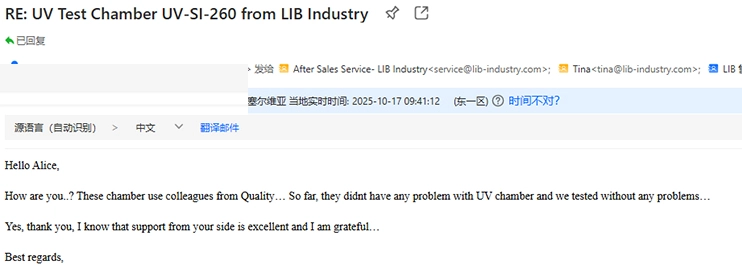
In real-world applications, performance consistency and after-sales support are just as critical as technical specifications. A manufacturing customer in Serbia who recently implemented the UV-SI-260 reported smooth operation from the start of installation. According to their quality team, the system has been running reliably during testing, with no operational issues encountered throughout initial validation cycles. The client also emphasized their appreciation for the responsive technical support provided, noting that professional service and timely communication contributed significantly to their positive experience. Feedback like this reflects not only the stability of the UV testing system itself, but also the importance of dependable support throughout the product lifecycle.
What Environmental Factors Affect Outdoor Material Durability?
Solar Radiation Intensity and Spectrum
Ultraviolet wavelengths between 290 and 400 nanometers possess sufficient energy to break chemical bonds in polymers, coatings, and composites. Materials absorb specific wavelength ranges based on their molecular structure, triggering photodegradation reactions that cause color fading, surface chalking, and mechanical property loss. Geographic location determines the intensity of UV exposure, with equatorial regions receiving approximately 40% more UV radiation than higher latitudes.
Moisture and Humidity Cycles
Water acts as both a catalyst and reactant in weathering processes. Morning dew creates extended periods of surface wetness that enables hydrolysis reactions, while rapid drying generates stress from dimensional changes. Humidity levels above 95% promote condensation on cooler surfaces during nighttime hours, creating conditions where moisture and UV exposure work synergistically to accelerate degradation rates beyond what either factor produces independently.
Temperature Fluctuations
Thermal energy drives the kinetic rate of chemical reactions, with degradation processes typically doubling for every 10-degree Celsius increase in temperature. Outdoor materials experience daily temperature swings that create expansion-contraction cycles, generating mechanical stress at interfaces between dissimilar materials. Black panel temperatures on exposed surfaces often exceed ambient air temperature by 20-30 degrees, creating localized hotspots where degradation accelerates dramatically.
Simulating Sunlight Exposure Using ASTM G154 UV Testing
Lamp Technology and Spectral Output
Fluorescent UV lamps designated UVA-340 reproduce the critical short-wavelength portion of terrestrial sunlight between 295 and 365 nanometers with remarkable accuracy. These lamps generate peak irradiance at 340 nanometers, matching the wavelength region most responsible for outdoor polymer degradation. UVB-313 lamps produce shorter, more aggressive wavelengths that accelerate testing but may introduce failure modes not observed in actual outdoor exposure, making lamp selection critical for test validity.
|
Lamp Type |
Peak Wavelength |
Primary Application |
Acceleration Factor |
|
UVA-340 |
340 nm |
General outdoor exposure simulation |
3-8x natural weathering |
|
UVB-313 |
313 nm |
Rapid screening and comparative testing |
8-20x natural weathering |
|
UVA-351 |
351 nm |
Window glass filtered exposure |
2-5x natural weathering |
Irradiance Control and Monitoring
Maintaining consistent irradiance levels throughout testing in a UV test machine ensures reproducible results across different laboratories and test runs. Automated feedback systems continuously measure UV intensity at the specimen plane and adjust lamp power to compensate for lamp aging. Irradiance calibration typically targets 0.89 W/m² at 340 nanometers for UVA-340 lamps, replicating midday summer sunlight at subtropical latitudes during clear sky conditions.
Chamber Configuration and Sample Positioning
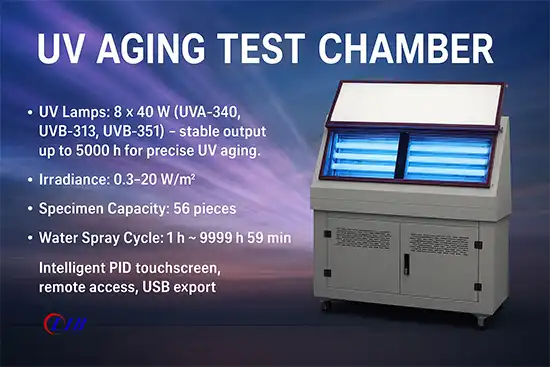
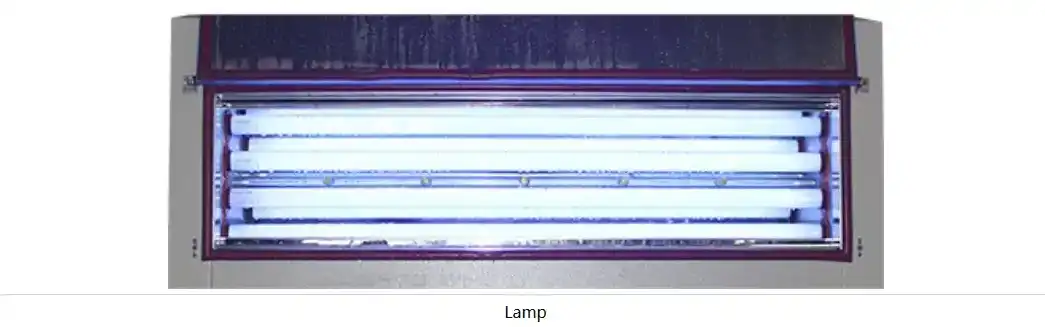
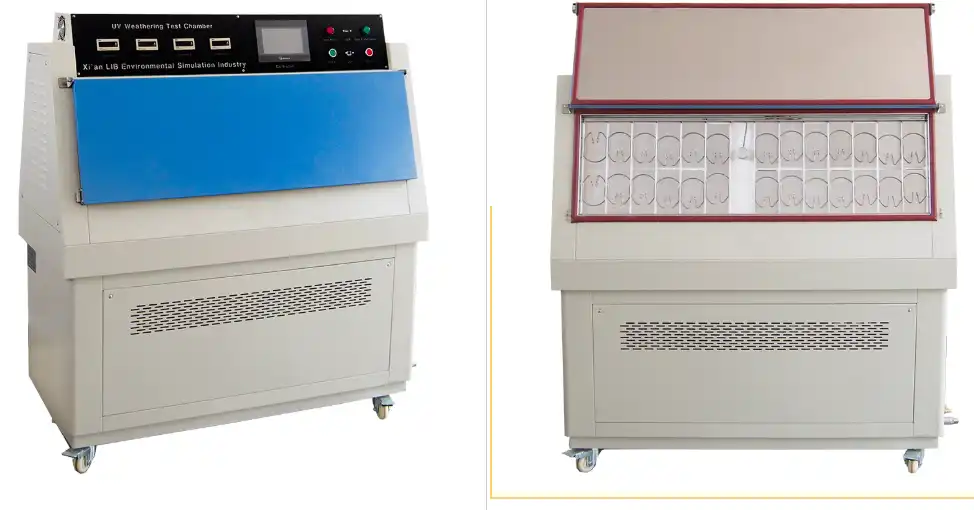
Eight fluorescent lamps arranged in a parallel configuration create a uniform irradiance field across the specimen area. Samples mount on flat or three-dimensional holders positioned 50 millimeters from the lamp centerline, ensuring consistent exposure geometry. Removable specimen racks accommodate 56 standard test panels measuring 75 by 150 millimeters, allowing simultaneous evaluation of multiple materials or replicate specimens for statistical analysis.
Selecting UV Exposure Cycles for Outdoor Applications
Standard Weathering Cycles
ASTM G154 defines multiple exposure cycles tailored to different environmental conditions and material types. Cycle 1 alternates 8 hours of UV exposure at 60°C with 4 hours of condensation at 50°C, simulating typical outdoor weathering with daytime radiation followed by nighttime moisture. Cycle 6 incorporates water spray to create thermal shock effects, replicating sudden rainfall on sun-heated surfaces that generates unique stress patterns.
|
Test Cycle |
UV Phase |
Moisture Phase |
Target Environment |
|
Cycle 1 |
8h at 60°C |
4h condensation at 50°C |
General outdoor exposure |
|
Cycle 4 |
4h at 60°C |
4h condensation at 50°C |
High moisture environments |
|
Cycle 6 |
3.5h at 60°C + 0.5h spray |
3.5h condensation + 0.5h spray |
Tropical and coastal regions |
Customizing Test Parameters
Material composition and end-use environment dictate appropriate test modifications. Automotive exterior components benefit from elevated black panel temperatures reaching 70-80°C to replicate desert parking conditions. Architectural coatings tested for coastal applications require increased spray frequency to simulate salt-laden moisture exposure. Irradiance levels may be reduced to 0.55 W/m² for materials destined for shaded or indirect light exposure applications.
Determining Exposure Duration
Accelerated weathering condenses months or years of outdoor exposure into practical laboratory timeframes. A typical automotive coating undergoes 1000-2000 hours of ASTM G154 testing to validate two-year outdoor durability. Research correlations between accelerated and natural weathering establish equivalency factors, though these relationships remain material-specific and require validation through parallel outdoor exposure trials conducted at representative geographic locations.
Performance Evaluation Criteria After UV Weathering
Visual Appearance Changes
Color shift measurements using spectrophotometry quantify the magnitude of fading or yellowing through Delta E calculations. Gloss retention assessed at 60-degree geometry reveals surface erosion and chalking development that affect aesthetic appeal and cleanability. Cracking, checking, and delamination visible through microscopic examination indicate cohesive or adhesive failure that compromises protective barrier properties.
Mechanical Property Degradation
Tensile testing of aged specimens measures strength and elongation retention, with acceptable performance typically requiring maintenance of 50% or more of original properties. Impact resistance evaluated through dart drop or pendulum methods identifies embrittlement that leaves materials vulnerable to mechanical damage. Flexural testing on rigid plastics quantifies modulus changes that affect dimensional stability and load-bearing capacity under service conditions.
Chemical and Barrier Properties
Water absorption measurements after weathering reveal increased permeability from surface microcracking or matrix degradation. Adhesion testing using cross-hatch or pull-off methods evaluates coating integrity on substrates, with failure often concentrated at the weathered interface. Chemical resistance spot tests determine whether UV exposure has compromised the material's ability to withstand cleaning agents, fuels, or environmental contaminants encountered during normal use, typically assessed using UV testing equipment.
Comparing Accelerated UV Testing and Natural Outdoor Exposure
Correlation Studies and Validation
Parallel testing programs expose identical materials to both accelerated laboratory conditions and outdoor weathering at designated sites. Analysis of property changes versus exposure time establishes mathematical relationships that predict long-term outdoor performance from short-term laboratory results. Correlation quality depends on selecting appropriate test cycles, irradiance levels, and temperature conditions that reproduce the dominant failure mechanisms observed in actual service environments.
Advantages of Laboratory Testing
Controlled chamber conditions eliminate weather variability that creates inconsistent results in outdoor exposure. Testing proceeds continuously without interruption from nighttime, cloudy periods, or seasonal changes, reducing total test duration by factors ranging from three to twenty times natural weathering. Multiple test conditions operate simultaneously in different chambers, enabling systematic material optimization studies impossible with limited outdoor exposure capacity.
Limitations and Considerations
Accelerated testing may activate degradation pathways absent in real-world exposure, particularly when using aggressive UVB-313 lamps or extreme temperatures. Outdoor weathering includes pollutants, biological growth, and mechanical wear factors not replicated in standard UV chambers. Geographic specificity of outdoor exposure means materials perform differently in Arizona versus Florida climates, requiring careful selection of test parameters to match the intended service location.
Applications of ASTM G154 Data in Material Qualification
Product Development and Formulation Optimization
Polymer scientists utilize UV testing to screen stabilizer packages, comparing different UV absorbers and hindered amine light stabilizers for protection efficiency. Coating formulators adjust resin types, pigment levels, and film thickness based on weathering performance data that guides formulation modifications. Fiber manufacturers evaluate dye lightfastness and finish durability, ensuring textile products maintain appearance throughout their expected service life.
Quality Control and Batch Verification
Production facilities incorporate periodic UV testing to verify that manufacturing process changes or raw material supplier modifications have not compromised weathering resistance. Incoming material certification may require UV exposure data demonstrating compliance with established performance specifications. Statistical process control charts track weathering test results over time, triggering investigations when results exceed predetermined control limits.
Regulatory Compliance and Industry Standards
Building codes reference ASTM G154 testing for roofing membranes, siding materials, and window components intended for outdoor applications. Automotive industry specifications mandate UV exposure followed by specific performance testing to ensure exterior components withstand warranty periods. Consumer product safety regulations may require UV aging studies demonstrating that plastics maintain structural integrity and do not release hazardous degradation products throughout their anticipated lifespan.
Replicate Real-World Conditions with LIB Industry UV Test Machines
Precision Engineering for Reliable Results
LIB Industry ASTM G154 UV test machines incorporate eight 40-watt fluorescent lamps arranged to deliver uniform irradiance distribution across all specimen positions. Temperature control achieves ±0.5°C accuracy throughout the ambient to 90°C range, with programmable ramping rates up to 5°C per minute enabling rapid cycle transitions. Black panel temperature monitoring maintains surface temperatures between 35 and 80°C, matching conditions measured on actual outdoor materials under solar loading.
Advanced Environmental Control Systems
Automatic water purification systems provide consistent condensation humidity above 95% RH, replicating early morning dew formation that drives moisture-related degradation. Ten programmable spray nozzles deliver controlled water application rates of 0.8-1.0 milliliters per 80 square centimeters per hour, creating reproducible thermal shock conditions. Touchscreen controllers with Ethernet connectivity enable remote monitoring and data logging, supporting compliance with ISO 9001 quality management requirements.
Comprehensive Support and Customization
Three-year warranty coverage with lifetime technical support ensures continued operation and performance validation throughout equipment service life. Custom chamber configurations accommodate specialized specimen geometries, temperature ranges, or environmental conditions beyond standard specifications. CE certification and third-party verification by SGS and TUV provide documentation supporting global regulatory compliance and laboratory accreditation requirements.
|
|
|
 |


|
Feature |
Specification |
Benefit |
|
Internal Dimensions |
450 × 1170 × 500 mm |
Accommodates 56 standard test panels |
|
Irradiance Range |
0.3-20 W/m² |
Flexible testing from low-level to accelerated exposure |
|
Temperature Accuracy |
±0.5°C |
Ensures reproducible thermal conditions |
|
Lamp Configuration |
Eight 40W fluorescent UV |
Uniform irradiance distribution |
|
Control System |
Programmable LCD touchscreen with Ethernet |
Remote monitoring and data export capability |
Conclusion
ASTM G154 UV test machines transform material durability assessment from uncertain outdoor waiting to controlled laboratory analysis. These chambers reproduce the combined effects of ultraviolet radiation, moisture, and temperature that degrade outdoor products, condensing years of natural weathering into practical testing timeframes. Selecting appropriate exposure cycles, evaluation methods, and correlation studies enables manufacturers to predict real-world performance with confidence. LIB Industry equipment delivers the precision, reliability, and support necessary for generating defensible weathering data that guides material selection and product qualification decisions.
FAQ
How long should materials be tested in an ASTM G154 UV chamber to predict outdoor durability?
Exposure duration depends on the desired outdoor equivalency and correlation factor established for your specific material. Typical testing ranges from 500 to 2000 hours, with correlation studies comparing laboratory and outdoor results determining appropriate test lengths for reliability predictions.
Can ASTM G154 testing replace natural outdoor weathering completely?
While accelerated testing provides rapid screening and comparative data, validation through parallel outdoor exposure at representative geographic locations remains essential. Laboratory conditions cannot perfectly replicate all environmental factors, making combined testing approaches most reliable for critical applications.
What is the difference between UVA-340 and UVB-313 lamps for weathering tests?
UVA-340 lamps accurately simulate natural sunlight's UV spectrum, providing realistic degradation mechanisms. UVB-313 lamps produce shorter, more aggressive wavelengths that accelerate testing but may cause failure modes not observed outdoors, making them suitable for comparative screening rather than absolute durability prediction.
Partner with LIB Industry, your trusted UV test chamber manufacturer, for comprehensive environmental testing solutions. Our engineering team provides customized equipment design, installation support, and operator training tailored to your specific application requirements. Contact us at ellen@lib-industry.com to discuss how our ASTM G154 UV test machines can accelerate your material development and quality assurance programs.