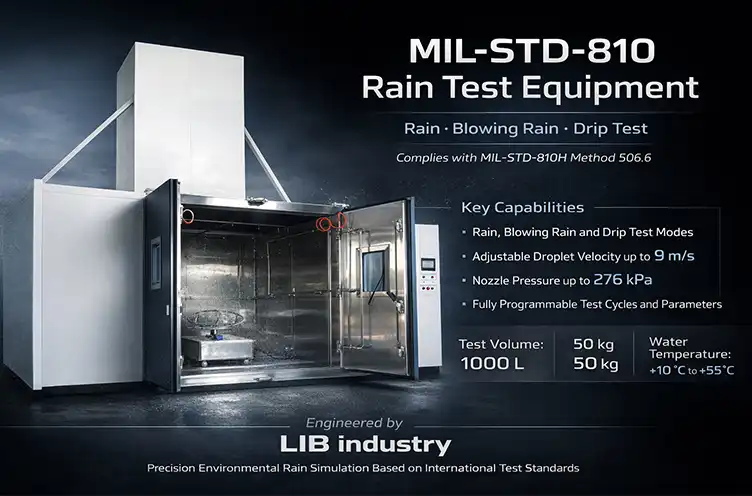
Blowing rain testing recreates the destructive force of wind-driven precipitation by combining high-velocity water droplets with powerful airflow systems inside a blowing rain test chamber. These specialized facilities generate rainfall rates exceeding 1.7 mm per minute while propelling water at speeds up to 9 meters per second against test specimens. Through precise calibration of spray nozzles, fan systems, and rotating platforms, engineers expose products to conditions matching tropical storms, monsoons, and severe weather events. This methodology validates whether electronic enclosures, military equipment, automotive components, and outdoor infrastructure can maintain functionality when subjected to nature's harshest precipitation scenarios.
What Is Blowing Rain Testing and Why It Matters?
Understanding Environmental Stress Validation
Products deployed outdoors face relentless assault from weather elements. Rain alone presents challenges, yet wind-driven precipitation penetrates seals, overwhelms drainage systems, and compromises electrical components far more effectively than vertical rainfall. Testing protocols must replicate these compound stresses to reveal vulnerabilities before field deployment.
Military and Commercial Applications
Defense contractors rely on MIL-STD-810H methodology to qualify equipment for hostile environments. Commercial manufacturers utilize similar approaches for telecommunications infrastructure, transportation systems, and building materials. The testing ensures mission-critical reliability across diverse operating conditions.
Failure Prevention Through Controlled Exposure
Detecting weaknesses during development costs substantially less than warranty claims or catastrophic failures. Systematic exposure to calibrated rain and wind conditions identifies design flaws in gaskets, coatings, vent systems, and structural joints. Engineers then implement corrections before production scaling.
Mechanisms of Wind-Driven Water Impact on Products
Aerodynamic Water Propulsion
Wind converts rainfall into horizontal projectiles rather than vertical droplets. This transformation increases kinetic energy at impact points and forces water into openings that would normally shed vertical precipitation. Rain test chambers employ centrifugal fans generating airflows matching regional storm patterns documented in meteorological databases.
Pressure Differential Exploitation
Hurricane-force winds create low-pressure zones on leeward surfaces while maintaining high pressure on windward faces. These differentials draw moisture through microscopic gaps in assemblies. Chamber systems replicate pressure gradients by coordinating spray patterns with airflow vectors.
Thermal Stress Amplification
Temperature differences between water and test surfaces accelerate material degradation. Cold rain on heated equipment induces thermal shock in polymers and composites. Advanced chambers incorporate water heating systems maintaining precise differentials specified in testing standards, ensuring accurate material response assessment.
Key Parameters: Rain Intensity, Wind Speed, and Angle
Calibrated Precipitation Rates
Standard testing protocols define rainfall intensity ranging from light drizzle (1.7mm/minute) to tropical downpour conditions (20.8 liters/minute exaggerated mode). Nozzle configurations determine droplet size distribution between 0.5mm and 4.5mm diameter, matching natural raindrop characteristics observed during various storm classifications.
|
Test Mode |
Rainfall Rate |
Nozzle Pressure |
Application Scenario |
|
Rain & Blowing Rain |
≥1.7 mm/min |
Standard |
General environmental exposure |
|
Exaggerated Mode |
20.8 L/min |
276 kPa |
Severe storm simulation |
|
Drip Testing |
≥280 L/m²/h |
Gravity-fed |
Standing water assessment |
Wind Velocity Specifications
Equipment encounters wind speeds from gentle breezes to Category 5 hurricane conditions. Test chambers generate controlled airflows reaching 25 meters per second through variable frequency drives. This adjustability allows engineers to match specific geographical threat profiles or recreate documented failure scenarios.
Incidence Angle Variations
Rain seldom approaches purely vertical trajectories during storms. Rain test machine designs incorporate adjustable spray heads delivering water at angles from 0 to 90 degrees relative to test surfaces. Rotating turntables operating between 1-7 revolutions per minute expose all product faces to angled precipitation.
Test Profile Design for Realistic Extreme Weather Simulation
Geographic Threat Modeling
Regional climate data informs test parameter selection. Coastal installations face salt-laden winds and driving rain, while mountainous terrain presents freezing precipitation concerns. Engineers consult meteorological records identifying worst-case combinations of wind speed, rainfall intensity, duration, and temperature for target deployment locations.
Cyclic Exposure Protocols
Natural storms feature intensity fluctuations rather than constant conditions. Sophisticated test profiles incorporate ramping sequences where rainfall and wind gradually increase to peak values, sustain maximum stress periods, then decrease to simulate storm passage. This cyclic approach reveals cumulative damage mechanisms.
Multi-Directional Assault Sequences
Products rarely face threats from single directions. Comprehensive testing exposes specimens to sequential bombardment from multiple angles. The 360-degree ring nozzle arrays in advanced rain test machines deliver uniform coverage while turntable rotation ensures complete surface evaluation during programmed test durations.
|
Parameter |
Standard Range |
Typical Test Duration |
|
Wind Speed |
0-25 m/s |
30-480 minutes |
|
Water Temperature |
Ambient +10°C to +55°C |
Per test phase |
|
Rotation Speed |
1-7 RPM |
Continuous during exposure |
Monitoring Product Performance During Blowing Rain Exposure
Real-Time Sensor Integration
Modern chambers incorporate instrumentation tracking water penetration, electrical continuity, mechanical stress, and thermal response simultaneously. Humidity sensors inside sealed enclosures detect moisture ingress immediately. Resistance measurements across electrical contacts reveal corrosion initiation before visible damage occurs.
Visual Documentation Systems
High-resolution cameras with protective housings capture specimen response throughout test sequences. Time-lapse photography reveals progressive seal degradation, surface coating breakdown, and water pathway development. This visual evidence supports failure analysis and design optimization efforts.
Data Acquisition Architecture
Comprehensive monitoring systems record parameters at one-second intervals, generating datasets for statistical analysis. Wind speed, water flow rates, chamber pressure, specimen temperature, and environmental humidity streams feed into analysis software identifying correlation between exposure conditions and performance degradation.
Using Test Data to Improve Environmental Robustness
Failure Mode Characterization
Post-test inspection combined with continuous monitoring data reveals exactly how products fail under specific conditions. Water may penetrate through seal compression failures, capillary action along threaded joints, or pressure-driven ingress through vent paths. Understanding failure mechanisms guides targeted redesign efforts.
Material Selection Optimization
Comparative testing of candidate materials under identical exposure conditions quantifies relative performance. Elastomer formulations, coating systems, and fastener treatments undergo parallel evaluation. Engineers select solutions demonstrating superior resistance to specific threat combinations relevant to application environments.
Design Iteration Validation
Each design modification requires verification through repeated exposure testing. Progressive improvements in gasket geometry, drainage channel efficiency, or vent labyrinth complexity undergo quantitative assessment. The iterative process continues until products consistently meet or exceed performance criteria across all specified conditions.
|
Performance Metric |
Acceptable Threshold |
Measurement Method |
|
Water Penetration |
Zero intrusion into sealed zones |
Visual inspection + humidity monitoring |
|
Electrical Function |
100% operational continuity |
Resistance measurement during exposure |
|
Structural Integrity |
No deformation or cracking |
Dimensional verification post-test |
Replicate Real-World Storms with LIB Industry Blowing Rain Test Chambers
Comprehensive Testing Capability
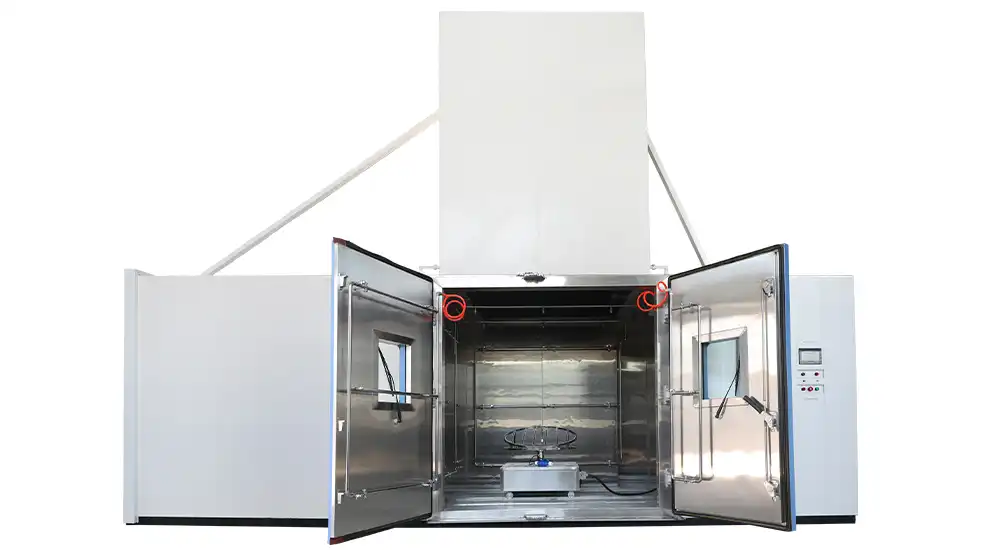
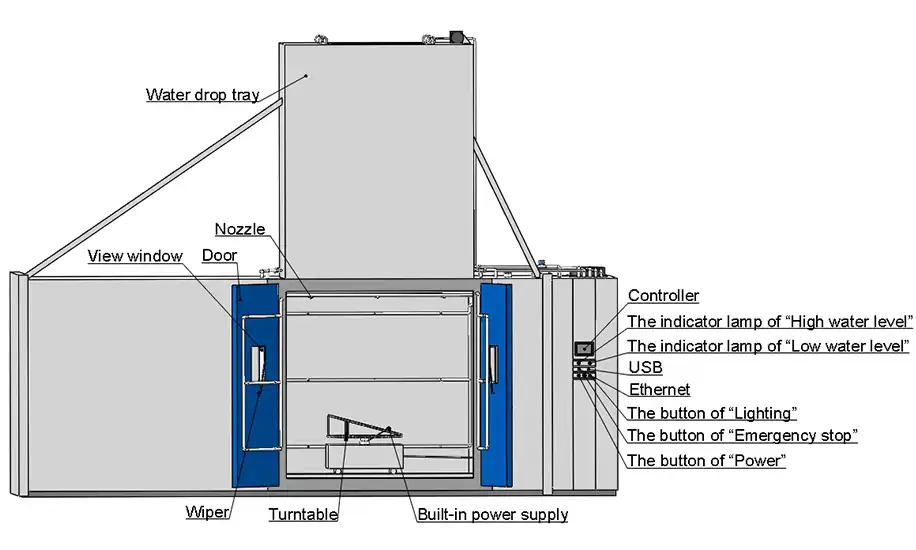
The RIM-1000 blowing rain test chamber delivers cubic meter working volume with 800mm diameter turntables supporting 50kg test loads. The 304 stainless steel interior resists corrosion from extended exposure to water and chemical treatments. Electromagnetic door locks ensure safety during high-pressure spray operations.
Standards-Compliant Operation
Full compliance with MIL-STD-810H Method 506.6 procedures ensures test results meet defense acquisition requirements. The equipment accurately reproduces specified rainfall rates, droplet size distributions, wind velocities, and temperature conditions demanded by military and commercial testing protocols.
Advanced Control Architecture
Human-machine interfaces display simultaneous tracking of wind speed, water flow, pressure, and temperature parameters. Pre-programmed profiles accelerate workflow for routine testing while custom programming accommodates specialized evaluation requirements. The system records comprehensive datasets supporting detailed analysis and regulatory documentation.
Global Support Infrastructure
ISO 9001 certification and CE marking demonstrate commitment to quality management and international safety standards. Three-year warranties backed by 24/7 technical support ensure operational continuity. Replacement equipment provisions during warranty periods minimize testing schedule disruptions for time-sensitive qualification programs.
e water intrusion. Cycle programming accommodates intermittent exposure scenarios where equipment experiences repeated wetting and drying cycles common in operational environments.
|
|
|
|
Model: RIM-1000 Interior Volume: 1000 L Turntable Load: 50 kg Turntable Diameter: 800 mm Door Lock: Electromagnetic lock Interior Material: SUS304 stainless steel Test Standard: MIL-STD-810H Test Time: 0 – 999 min, adjustable |
|
|
Rain & Blowing Rain Final Rain Droplet Velocity: 9 m/s on test item Rainfall Rate≥ 1.7 mm/min Droplet Size: 0.5 – 4.5 mm Water Temperature: +10°C to max. +55°C |
|
|
Drip Drip Area Dimensions: 1600 × 1000 mm, height adjustable Drip Hole Diameter: 20 – 25.4 mm Distance Between Holes: 25 mm Water Volume: ≥ 280 L/m²/h Water Temperature: +10°C to max. +55°C |
|
|
Exaggerated Rain Nozzle Pressure: 276 kPa Rainfall Rate: 20.8 L/min Nozzle Arrangement: One nozzle per 0.56 m² of surface area, approx. 48 cm from test surface Droplet Size:0.5 – 4.5 mm |
|
Conclusion
Blowing rain testing provides irreplaceable validation of product resilience against combined precipitation and wind assault. Through controlled replication of extreme weather parameters, manufacturers identify vulnerabilities, optimize protective designs, and demonstrate compliance with rigorous environmental standards. Investment in comprehensive testing infrastructure prevents costly field failures while building confidence in product reliability across harsh deployment conditions.
FAQ
How does blowing rain testing differ from standard water ingress testing?
Blowing rain testing combines high-velocity wind with precipitation to simulate realistic storm conditions where water impacts surfaces horizontally rather than vertically. This reveals vulnerabilities in seals, joints, and drainage systems that simple spray or immersion tests cannot detect.
What industries require blowing rain test chamber validation?
Defense contractors, telecommunications providers, automotive manufacturers, aerospace companies, and building materials producers utilize blowing rain testing. Any organization deploying equipment or products outdoors benefits from validation against wind-driven precipitation threats documented in environmental exposure standards.
Can test chambers simulate different geographical storm profiles?
Advanced chambers offer programmable control over rainfall intensity, wind velocity, water temperature, and spray angles. Engineers configure these parameters based on meteorological data from target deployment regions, accurately replicating conditions from tropical monsoons to desert thunderstorms.
Partner with LIB Industry, your trusted blowing rain test chamber manufacturer and supplier, for turn-key environmental testing solutions. Our engineering team delivers custom chamber designs, installation support, and ongoing technical service worldwide. Contact us at ellen@lib-industry.com to discuss your specific testing requirements.