JIS Z 2371 Salt Spray Chambers for Industrial Corrosion Tests
A JIS Z 2371 salt spray test chamber replicates aggressive saline environments inside a controlled enclosure, enabling engineers to gauge how metals, coatings, and composite assemblies withstand prolonged corrosion exposure. Governed by the Japanese Industrial Standard Z 2371, the methodology encompasses Neutral Salt Spray (NSS), Acetic Acid Salt Spray (AASS), and Copper-Accelerated Acetic Acid Salt Spray (CASS) protocols. Manufacturers across automotive, aerospace, marine, and electronics sectors rely on these chambers to validate anti-corrosion treatments before products reach the field. The accelerated nature of salt fog testing compresses years of real-world degradation into measurable laboratory hours, providing actionable data for material selection, quality assurance, and regulatory compliance.
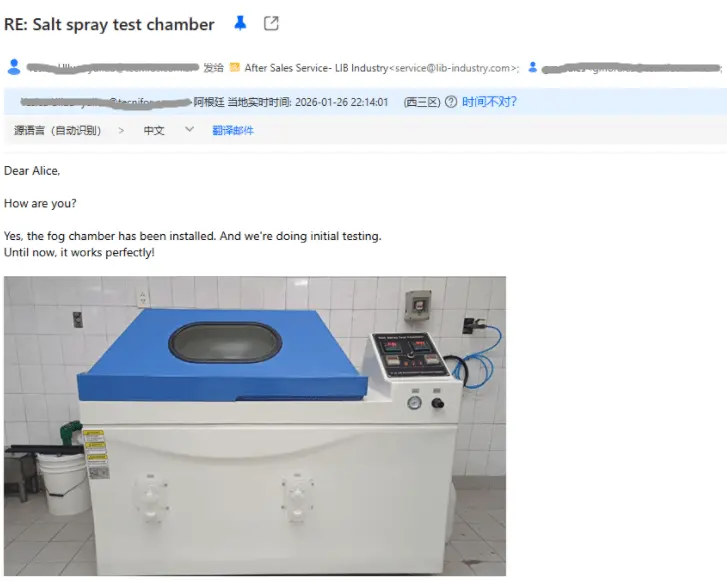
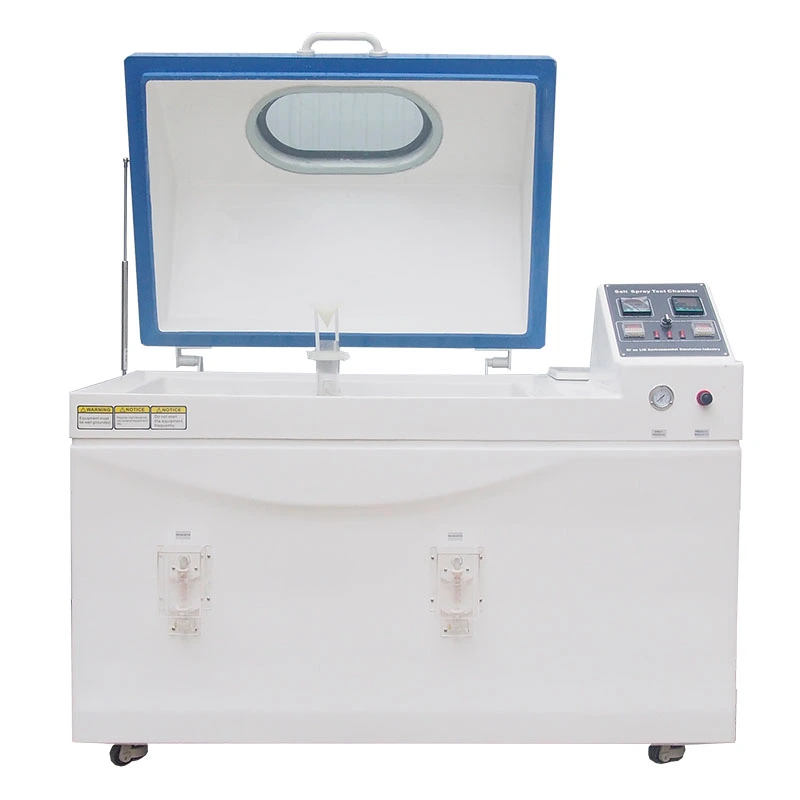
An Argentine paint coating manufacturer recently reported on their experience with the LIB industry S-150 salt fog test machine: “Dear Alice, how are you? Yes, the fog chamber has been installed. We are running initial tests. So far, it is working perfectly!” They are currently testing their coatings for durability and corrosion resistance under continuous salt fog conditions. The team praised the chamber for its reliable performance and precise environmental control, which allow for detailed and accurate observation of coating behavior over time. Their feedback highlights the machine’s effectiveness in producing consistent, real-world corrosion test results and supporting laboratories in maintaining dependable daily testing.
Which Industries Require JIS Z 2371 Corrosion Testing?
Automotive and Transportation Manufacturing
Vehicle bodies, brake components, and fasteners face road salt, humidity, and coastal air during their service lives. OEMs and tier-one suppliers use JIS Z 2371 salt spray testing to certify that electroplated bolts, painted panels, and underbody coatings meet durability benchmarks. Failing to validate corrosion resistance can trigger warranty claims, recalls, and reputational damage that far exceed the cost of laboratory evaluation.
Marine and Offshore Engineering
Ships, offshore platforms, and port equipment operate in perpetual contact with chloride-rich seawater. Salt spray chambers let naval architects and coating formulators compare zinc-rich primers, epoxy barriers, and thermal-sprayed aluminum layers under standardized conditions. JIS Z 2371 protocols deliver repeatable pH, temperature, and fog deposition rates so that results remain comparable across different testing laboratories worldwide.
Electronics and Semiconductor Packaging
Miniaturized connectors, lead frames, and PCB surface finishes corrode rapidly when exposed to ionic contamination. A JIS Z 2371 salt spray test chamber helps electronics manufacturers screen tin-whisker mitigation coatings, conformal sprays, and hermetic seals. The controlled humidity range of 95 %-98 % RH inside the chamber mirrors the micro-climates found inside sealed enclosures during thermal cycling.
Industrial Components Vulnerable to Salt-Induced Corrosion
Ferrous Alloys and Carbon Steel Structures
Bare carbon steel corrodes at rates exceeding 0.1 mm per year in marine atmospheres. Salt fog testing quantifies the protective value of galvanizing, phosphating, or powder-coating applied to structural beams, storage tanks, and piping. The data helps specifying engineers choose the most cost-effective treatment tier without over-engineering.
Non-Ferrous Metals and Light Alloys
Aluminum, magnesium, and copper alloys exhibit pitting, intergranular attack, or dezincification under chloride exposure. CASS testing - one of the three JIS Z 2371 methods - accelerates these failure modes by introducing copper chloride into the spray solution, making it an indispensable tool for alloy developers and heat-treatment specialists.
Polymeric and Composite Substrates With Metallic Interfaces
Carbon-fiber-reinforced polymers bonded to aluminum inserts create galvanic couples that accelerate localized corrosion. Salt spray evaluation conducted in a salt spray test machine reveals delamination, blister formation, and adhesion loss at bonded interfaces. Results guide adhesive selection and surface-preparation protocols for hybrid structures used in aerospace and sporting goods.
Salt Spray Test Chambers for Accelerated Corrosion Simulation
Operating Principle of Fog Generation
Compressed air passes through a saturated air barrel, reaching near-100 % relative humidity before entering atomizer nozzles. The nozzles disperse a 5 % NaCl solution into a fine, uniform fog that settles on specimens at a rate of 1-2 ml per 80 cm² per hour. This deposition rate, specified by JIS Z 2371, ensures consistent chloride loading across the entire test zone.
Chamber Temperature and Humidity Regulation
A dual-loop PID controller maintains the enclosure between ambient temperature and +60 °C with a fluctuation of ±0.5 °C and a deviation of ±2.0 °C. Independent heating of the air saturator and the chamber interior eliminates condensation artifacts that could skew settlement measurements. The humidity band of 95 %-98 % RH stays stable even during door-opening events.
Continuous Versus Cyclic Spray Modes
JIS Z 2371 permits both uninterrupted and periodic spray schedules. Continuous mode suits NSS baseline screening, while cyclic programs - alternating spray, dry-off, and humidity-soak phases - better replicate outdoor weathering patterns. Programmable controllers supporting 120 programs with 100 steps each allow operators to build complex profiles without manual intervention.
|
Test Method |
Solution Composition |
pH Range |
Typical Duration |
|
NSS |
5 % NaCl |
6.5-7.2 |
24-1 000 h |
|
AASS |
5 % NaCl + Acetic Acid |
3.1-3.3 |
24-720 h |
|
CASS |
5 % NaCl + CuCl₂ + Acetic Acid |
3.1-3.3 |
24-720 h |
Testing Surface Coatings, Plating, and Anti-Corrosion Treatments
Electroplated and Electroless Nickel Finishes
Nickel plating thickness, porosity, and post-plate sealing each influence time-to-first-corrosion. A JIS Z 2371 salt spray test chamber exposes plated coupons under tightly controlled fog conditions, allowing quality teams to compare supplier lots, plating-bath chemistries, and bake cycles. Rating scales such as ASTM D 1654 or ISO 4628 complement the JIS exposure protocol by standardizing defect evaluation.
Organic Coatings and Powder-Coat Systems
Scribed-panel testing inside salt fog chambers reveals cathodic disbondment, creep-back from the scribe line, and osmotic blistering. Coating formulators use these observations to optimize resin chemistry, pigment loading, and crosslink density. The V-shaped transparent lid on modern chambers prevents condensate drips from contaminating scribed areas, preserving data integrity over multi-hundred-hour runs.
Anodized and Conversion-Coated Aluminum
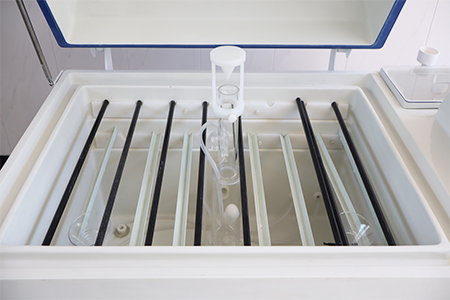
Chromate conversion, trivalent chromium passivation, and sulfuric-acid anodizing each produce distinct barrier-layer architectures. Salt spray exposure differentiates their protective performance under identical conditions. The pre-calibrated 15° and 20° sample holders inside the chamber ensure consistent drainage angles, eliminating a common source of inter-laboratory variability.
|
Coating Type |
Common Substrate |
Typical NSS Hours to White Rust |
|
Hot-Dip Galvanizing |
Carbon Steel |
200-500 h |
|
Zinc-Nickel Plating |
High-Strength Steel |
500-1 000 h |
|
Powder Coat (Polyester) |
Aluminum Extrusion |
500-1 500 h |
|
Anodize + Seal |
Aluminum Sheet |
336-750 h |
Performance Evaluation of Industrial Materials and Components
Fasteners, Springs, and Precision Hardware
Bolted joints in outdoor structures endure salt-laden precipitation, de-icing chemicals, and condensation cycling. Salt spray testing per JIS Z 2371 conducted in a salt fog chamber ranks the durability of zinc-flake, mechanical zinc, and dacromet finishes applied to high-tensile fasteners. Results feed directly into torque-tension specifications and joint-design software.
Heat Exchangers and HVAC Assemblies
Fin-and-tube evaporators and condensers made from copper-aluminum couples are prone to galvanic attack. Exposing prototype heat exchangers inside a salt spray chamber identifies leakage paths and fin-erosion rates before field trials. This upstream testing shortens development timelines and reduces warranty exposure.
Electrical Enclosures and Junction Boxes
IP-rated enclosures for outdoor switchgear must resist salt fog ingress over their rated service life. The movable funnel collectors inside the chamber allow engineers to map deposition uniformity around complex enclosure geometries, ensuring that gasket seals and cable glands meet NEMA 4X or IEC 60529 expectations.
Enhancing Product Reliability Through Standardized Corrosion Testing
Establishing Accelerated-to-Field Correlation
Linking salt spray hours to years of atmospheric exposure requires documented correlation studies. By running parallel outdoor-exposure racks and chamber tests, materials engineers build regression models that translate laboratory data into service-life predictions. Consistent chamber performance - tight temperature deviation, repeatable fog settlement - is the foundation of trustworthy correlation.
Integrating Salt Spray Data Into Quality Management Systems
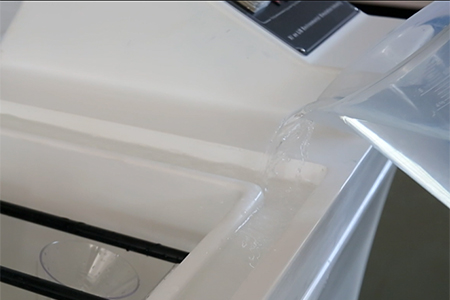
Audit-ready reports generated by programmable controllers record temperature, spray duration, and settlement volume with timestamps. These digital records slot into ISO 9001 or IATF 16949 documentation frameworks, providing traceability from raw-material incoming inspection through final product release. Automatic water-refill and dry-combustion protection safeguards ensure uninterrupted data capture during extended runs.
Driving Continuous Improvement With Comparative Benchmarking
Periodic re-testing of legacy coatings alongside new formulations highlights performance gains or regressions. Storing historical salt spray results in a centralized database empowers cross-functional teams to track improvement trajectories, justify capital investments in coating-line upgrades, and benchmark against competitor products.
Durable Chamber Construction for Heavy-Duty Industrial Applications - LIB Industry
FRP Body and Corrosion-Resistant Internals
LIB Industry salt fog test chambers use fiberglass-reinforced plastic (FRP) throughout the interior, resisting continuous contact with 5 % NaCl under elevated temperature and humidity. SUS304/316 stainless steel components in the air saturator and plumbing circuits eliminate metallic contamination of the test solution. This material strategy ensures reliable operation across tests spanning hundreds or thousands of hours.
Flexible Model Range for Diverse Testing Volumes
LIB offers six standard models from 110 L to 1 600 L, accommodating everything from small coupon racks to full-size automotive assemblies. Custom dimensions and specialized sample holders are available for unique test articles.
|
Model |
Internal Dimensions (mm) |
Interior Volume (L) |
|
S-150 |
590 × 470 × 400 |
110 |
|
S-250 |
1000 × 640 × 500 |
320 |
|
S-750 |
1100 × 750 × 500 |
410 |
|
S-010 |
1000 × 1300 × 600 |
780 |
|
S-016 |
900 × 1600 × 720 |
1030 |
|
S-020 |
1000 × 2000 × 800 |
1600 |
 |
 |
|
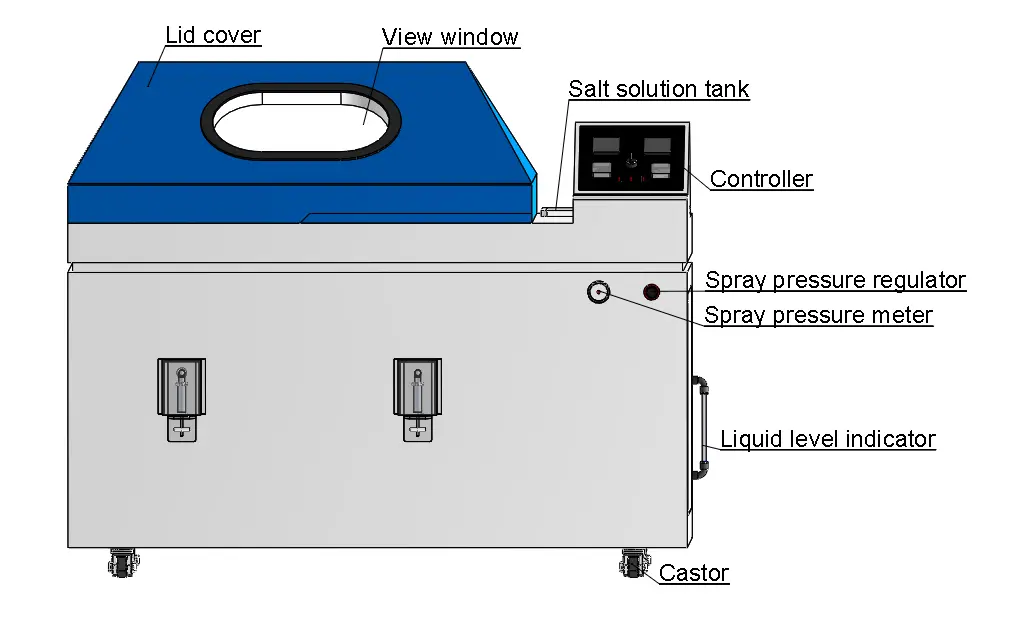
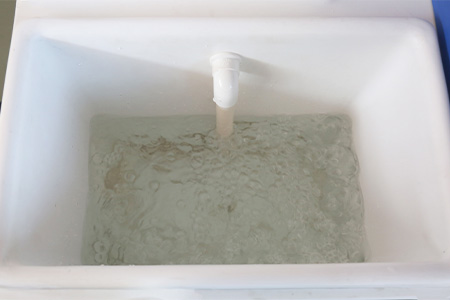
Durable, Leak-Resistant Workspace |
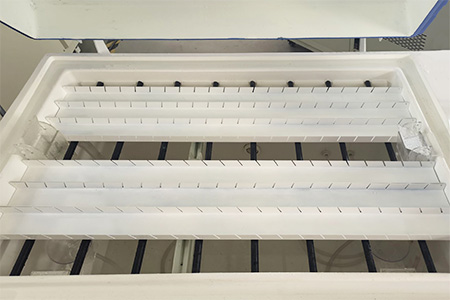
Flexible Sample Rack System |
|
Water-Sealed Lid Design |
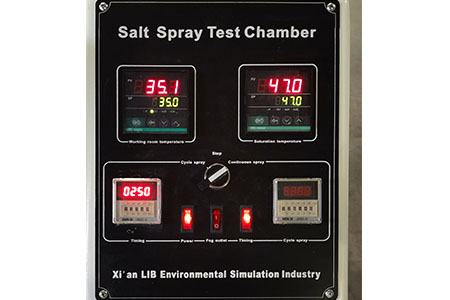
Intelligent Controller |
|
Uniform Salt Solution Agitation |
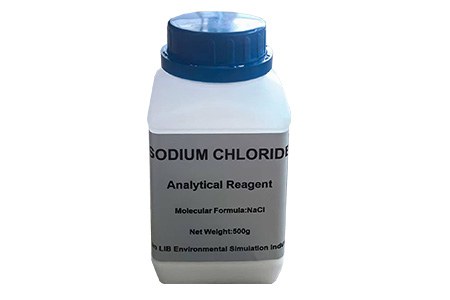
Included Industrial-Grade Salt |
Comprehensive Safety and Global Certification
Every unit ships with over-temperature, over-current, water-shortage, and earth-leakage protection circuits. CE certification and third-party validation by SGS and TÜV confirm compliance with international safety directives. A three-year warranty backed by lifetime technical support and 24/7 global service response underscores LIB Industry's commitment to long-term partnership.
Conclusion
JIS Z 2371 salt spray testing remains one of the most widely adopted accelerated corrosion evaluation methods across automotive, marine, electronics, and general manufacturing sectors. Selecting a chamber that delivers precise fog deposition, stable temperature control, and robust FRP construction directly influences the reliability of test outcomes. By pairing standardized protocols with advanced programmable controls, engineers gain the data they need to specify coatings, validate materials, and protect products against field failures. Investing in a well-engineered salt spray chamber is an investment in product quality and customer confidence.
FAQ
What is the standard salt concentration used in a JIS Z 2371 salt spray test chamber?
The standard solution is 5 % sodium chloride (NaCl) by mass, dissolved in purified water and maintained at a pH of 6.5-7.2 for Neutral Salt Spray testing.
How long does a typical JIS Z 2371 salt spray test last?
Test duration varies by coating type and specification requirements, ranging from 24 hours for quick screening to over 1 000 hours for high-performance anti-corrosion systems.
Can one chamber perform NSS, AASS, and CASS tests?
Yes. A properly equipped JIS Z 2371 salt spray chamber supports all three methods by adjusting solution chemistry, pH level, and temperature settings through its programmable controller.
Looking for a dependable JIS Z 2371 salt spray test chamber manufacturer and supplier? LIB Industry delivers turnkey corrosion testing solutions - from design and production to installation and training. Contact us at ellen@lib-industry.com to discuss standard or custom configurations for your facility.