The maritime sector faces relentless corrosion challenges that threaten vessel integrity, offshore infrastructure, and marine equipment performance. Salt spray test chambers provide controlled laboratory environments where manufacturers and operators can evaluate material resilience against seawater exposure before deployment. These specialized systems replicate accelerated corrosion conditions, allowing engineers to validate protective 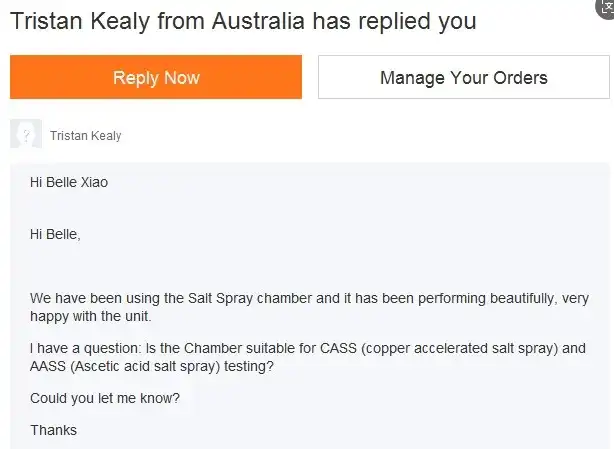 strategies, compare coating effectiveness, and predict service longevity. By subjecting components to concentrated saline mist under regulated temperature and humidity parameters, marine industry professionals gain critical insights that inform material selection, maintenance scheduling, and quality assurance protocols essential for operational safety and cost management.
Many marine industry clients have reported excellent results with LIB industry’s salt spray test chambers. For instance, a customer from Australia recently shared that their unit has been operating flawlessly, delivering reliable performance and consistent testing results. Feedback like this reinforces the chamber’s practicality for real-world applications and highlights its role in helping engineers evaluate corrosion resistance and optimize protective strategies before components are deployed in harsh maritime environments.
The maritime sector faces relentless corrosion challenges that threaten vessel integrity, offshore infrastructure, and marine equipment performance. Salt spray test chambers provide controlled laboratory environments where manufacturers and operators can evaluate material resilience against seawater exposure before deployment. These specialized systems replicate accelerated corrosion conditions, allowing engineers to validate protective strategies, compare coating effectiveness, and predict service longevity. By subjecting components to concentrated saline mist under regulated temperature and humidity parameters, marine industry professionals gain critical insights that inform material selection, maintenance scheduling, and quality assurance protocols essential for operational safety and cost management.
Why the Marine Environment Accelerates Corrosion?
Chloride Ion Penetration Mechanisms
Seawater contains approximately 35,000 parts per million of dissolved salts, with chloride ions acting as primary corrosion catalysts. These aggressive anions penetrate protective oxide layers on metal surfaces, disrupting passivation films that normally resist degradation. The chloride concentration in ocean environments creates electrochemical cells where metals undergo rapid oxidation, particularly affecting iron-based alloys commonly used in shipbuilding and offshore construction.
Oxygen Availability and Moisture Cycling
Constant exposure to oxygenated saltwater sustains cathodic reactions necessary for corrosion propagation. Marine structures experience continuous wet-dry cycles as waves splash surfaces, tides fluctuate, and humidity varies. These moisture transitions concentrate salt deposits in crevices and joints, establishing localized corrosion cells that intensify metal degradation far beyond what terrestrial environments produce.
Temperature Variations in Maritime Zones
Tropical waters reaching 30°C accelerate chemical reaction rates compared to colder seas, while temperature gradients between submerged hulls and exposed superstructures create differential corrosion patterns. Arctic operations introduce thermal cycling that stresses protective coatings through expansion-contraction sequences. Salt spray test chambers address these variables by offering temperature control from ambient to 60°C, enabling simulation of diverse maritime climates.
Typical Marine Components Requiring Salt Spray Testing
Propulsion and Steering Systems
Propeller shafts, rudder assemblies, and thruster housings endure direct seawater contact combined with mechanical stresses. Bronze and stainless steel alloys used in these applications undergo validation through extended salt fog exposure to ensure galvanic compatibility and surface treatment durability. Manufacturers test fasteners, bearings, and seals to prevent premature failure that could compromise vessel maneuverability.
Deck Hardware and Rigging Equipment
Winches, cleats, anchor chains, and wire rope fittings face intermittent seawater spray during normal operations. These components require robust corrosion resistance since replacement involves significant downtime and safety risks. Salt spray evaluation confirms that hot-dip galvanizing, electroplating, or specialized marine-grade stainless steels meet anticipated service demands across decades of exposure.
Electronic Enclosures and Instrumentation
Navigation systems, communication equipment, and monitoring sensors housed in marine-rated enclosures must withstand salt-laden atmospheres without performance degradation. Gasket materials, connector seals, and chassis coatings undergo rigorous testing to validate ingress protection ratings. Corrosion-induced failures in electronic systems present catastrophic risks, making pre-deployment validation through salt spray test machine essential for maritime electronics manufacturers.
Salt Spray Test Standards for Marine and Offshore Applications
ASTM B117 Neutral Salt Spray Protocol
This widely adopted standard specifies continuous exposure to 5% sodium chloride solution atomized at 35°C with precise deposition rates between 1-2 ml per 80 cm² hourly. Test durations range from 24 hours for preliminary screening to 3000+ hours for marine-grade certifications. The neutral pH (6.5-7.2) mimics seawater chemistry while providing reproducible conditions for comparative material assessment.
ISO 9227 Acetic Acid and Copper-Accelerated Variants
Marine applications sometimes employ ISO 9227 NSS (neutral salt spray), AASS (acetic acid salt spray), or CASS (copper-accelerated acetic acid salt spray) protocols depending on substrate materials. Acetic acid additions reduce solution pH to 3.1-3.3, intensifying corrosion on zinc and aluminum coatings common in maritime hardware. These accelerated methods compress months of field exposure into weeks of laboratory testing.
Classification Society Requirements
Organizations including Lloyd's Register, DNV-GL, and Bureau Veritas mandate specific corrosion resistance thresholds for marine equipment certifications. These specifications often reference ASTM or ISO standards while adding supplementary criteria for coating thickness, adhesion retention, and rust creep limits. Compliance verification through accredited salt spray testing facilities becomes prerequisite for equipment approval and insurance qualification.
|
Standard |
Solution |
Temperature |
pH Range |
Typical Application |
|
ASTM B117 |
5% NaCl |
35°C |
6.5-7.2 |
General marine components |
|
ISO 9227 NSS |
5% NaCl |
35°C |
6.5-7.2 |
Equivalent to ASTM B117 |
|
ISO 9227 AASS |
5% NaCl + Acetic Acid |
35°C |
3.1-3.3 |
Zinc/aluminum coatings |
Simulating Seawater Exposure Using Salt Spray Test Chambers
Chamber Configuration and Fog Generation
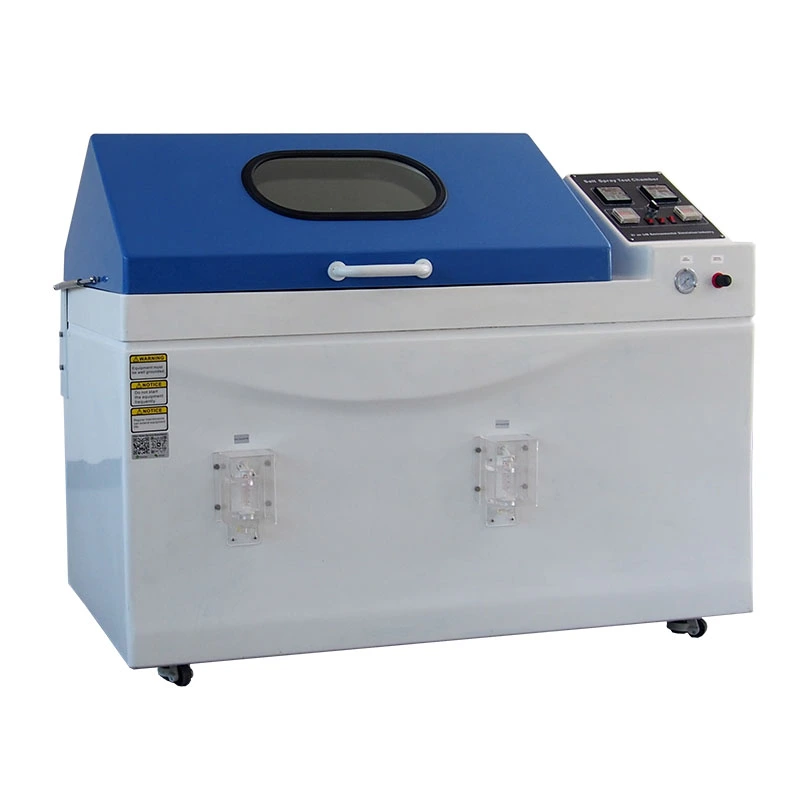
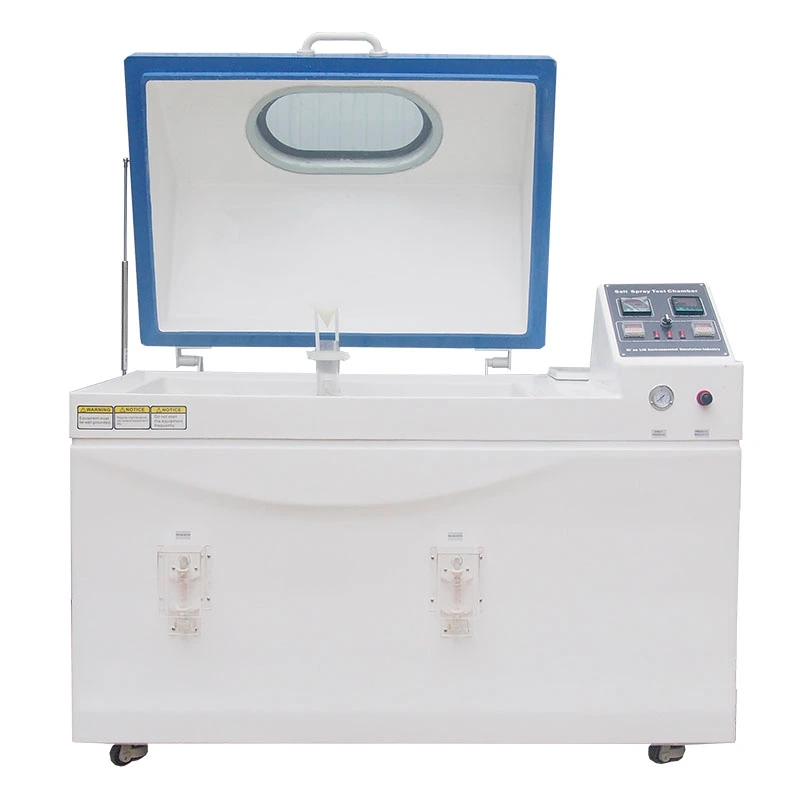
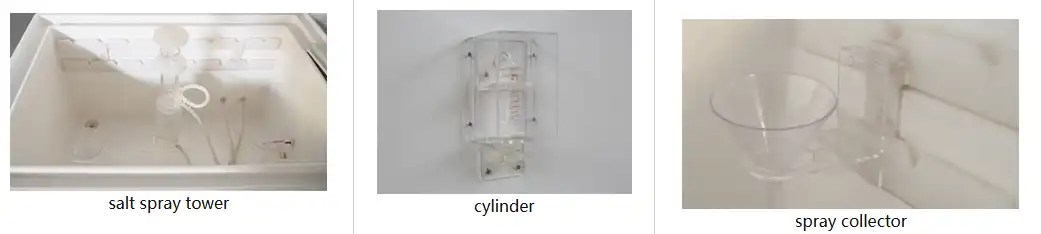
Modern salt fog chamber utilizes glass fiber reinforced plastic construction to resist internal corrosion while maintaining structural integrity. Atomizer towers generate fine mist particles (10-40 microns) that settle uniformly across test specimens positioned on adjustable racks. Saturated air barrels preheat compressed air to prevent temperature fluctuations that could compromise test validity, ensuring conditions remain stable throughout multi-week exposure cycles.
Controlled Environmental Parameters
Precise regulation maintains chamber temperatures within ±0.5°C fluctuation and ±2.0°C overall deviation across the testing zone. Humidity levels sustained between 95-98% RH prevent salt solution evaporation that would alter concentration ratios. Collection cups positioned at opposite chamber locations verify deposition uniformity, with automated monitoring systems alerting operators to parameter drift requiring intervention.
Continuous Versus Cyclic Testing Protocols
Continuous spray protocols subject specimens to uninterrupted salt fog exposure, simulating permanent immersion or constant splash zone conditions. Cyclic testing alternates between spray periods, ambient drying, and humidity soaking phases to replicate tidal environments or tropical rain-sun cycles. PID controllers manage these complex sequences, executing programmable routines that mirror specific operational scenarios vessels encounter during service.
Evaluating Protective Coatings and Materials for Marine Use
Epoxy and Polyurethane Coating Systems
Multi-layer protective schemes combining epoxy primers with polyurethane topcoats dominate marine applications due to excellent adhesion and UV resistance. Salt spray chambers validate intercoat compatibility, cure effectiveness, and barrier properties by comparing scribe creep distances after standardized exposure durations. Qualified systems demonstrate less than 3mm corrosion spread from artificial defects following 1000+ hour tests.
Hot-Dip Galvanizing Performance
Zinc coatings applied through molten bath immersion provide sacrificial protection that extends steel substrate life substantially. Testing in a salt fog test chamber evaluates coating thickness uniformity, alloy layer formation, and white rust formation rates under continuous salt fog exposure. Marine-grade galvanizing specifications typically require a minimum 85-micron thickness and demonstrate protective capability beyond 1500 hours before substrate corrosion initiation.
Advanced Ceramic and Polymer Matrix Composites
Emerging materials including aluminum oxide coatings, fluoropolymer films, and fiber-reinforced polymers undergo comparative evaluation against traditional metallic protection methods. Salt spray exposure reveals susceptibility to osmotic blistering, delamination, or chemical degradation that might not manifest during shorter field trials. These assessments guide material selection for specialized applications like submarine components or autonomous underwater vehicle housings.
|
Coating Type |
Typical Thickness |
Expected Salt Spray Performance |
Primary Application |
|
Epoxy Primer |
80-150 microns |
500-1000 hours |
Base layer for steel structures |
|
Polyurethane Topcoat |
50-80 microns |
1000-2000 hours |
Weather/UV protection |
|
Hot-Dip Galvanizing |
85-150 microns |
1500-3000 hours |
Structural steel, fasteners |
Extending Service Life of Marine Equipment Through Corrosion Testing
Predictive Maintenance Planning
Correlation between accelerated laboratory exposure and real-world degradation rates enables asset managers to forecast coating renewal intervals accurately. Historical data from salt spray tests combined with field performance monitoring establishes baseline expectations for drydock scheduling, reducing unexpected failures and optimizing maintenance budgets across vessel fleets.
Material Qualification for Harsh Environments
Offshore oil platforms, desalination plants, and tidal energy installations face extreme corrosion conditions exceeding typical shipping industry exposure. Extended salt spray protocols running 5000+ hours validate material selections for these demanding applications, confirming that specialized super-duplex stainless steels, nickel-copper alloys, or titanium components justify premium costs through extended operational lifespans.
Quality Control in Manufacturing
Production facilities incorporate salt spray testing into batch validation procedures, sampling representative components from coating lines to detect process deviations. Automated chambers accommodate multiple test specimens simultaneously, enabling parallel evaluation of different suppliers, coating formulations, or surface preparation methods. Statistical analysis of test results drives continuous improvement initiatives that enhance product reliability.
Simulate Harsh Marine Environments with LIB Industry Salt Spray Test Chambers
Comprehensive Model Range
LIB Industry offers salt spray test chambers spanning 110L to 1600L internal volumes, accommodating everything from small fastener samples to large structural assemblies. Models S-150 through S-020 feature internal dimensions ranging from 590×470×400mm to 1000×2000×800mm, providing configuration flexibility for diverse marine component geometries. This scalability ensures manufacturers can validate parts at actual size rather than relying on coupon testing alone.
|
Model |
Internal Dimensions (mm) |
Volume (L) |
Application Suitability |
|
S-150 |
590×470×400 |
110 |
Small components, fasteners |
|
S-250 |
1000×640×500 |
320 |
Medium assemblies, panels |
|
S-010 |
1000×1300×600 |
780 |
Large structural elements |
|
S-020 |
1000×2000×800 |
1600 |
Full-scale equipment validation |
Advanced Control and Monitoring
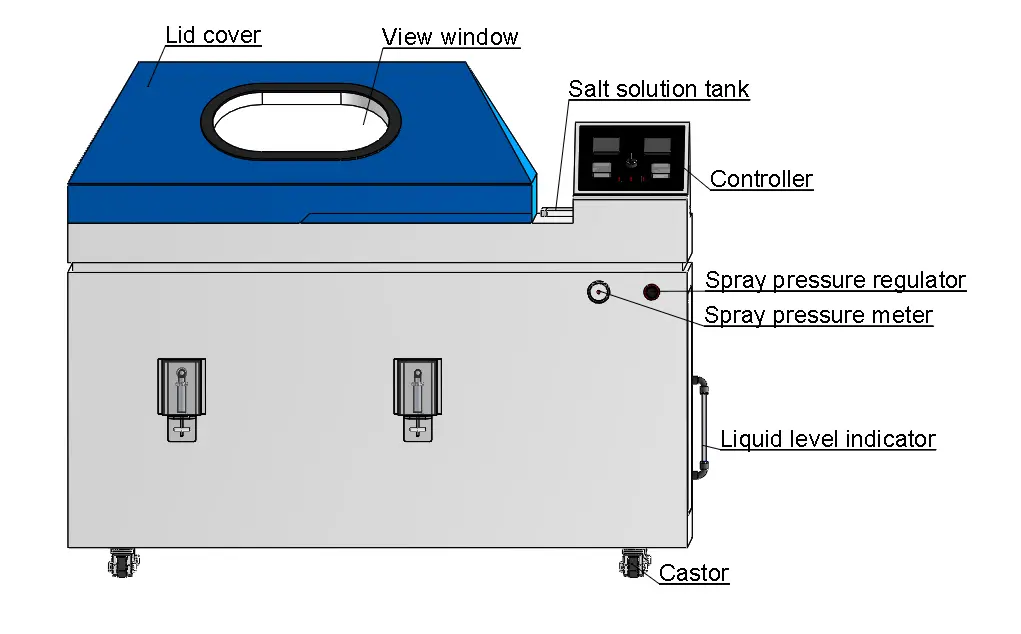
Network-connected PID controllers enable remote operation and data logging in multiple languages including English, French, Spanish, German, and Russian. Integrated safety systems provide humidifier dry-combustion protection, over-temperature shutdown, over-current protection, water shortage alerts, and earth leakage protection. These features ensure unattended operation during extended test sequences while maintaining operator safety and equipment integrity.
Compliance with International Standards
All LIB Industry salt spray test equipment conforms to ASTM B117 and ISO 9227 specifications through calibrated atomizer systems, precision temperature regulation, and validated deposition uniformity. Adjustable spray towers and cleanable nozzles facilitate maintenance while ensuring consistent fog characteristics across chamber volumes. Glass fiber reinforced plastic construction provides decades of reliable service without internal corrosion degradation.
|
|
Model |
S-150 |
|
|
Internal dimensions (mm) |
470*590*400 |
||
|
Overall dimensions (mm) |
620*1400*1050 |
||
|
Temp. Range |
Ambient ~ +60 degree |
||
|
Temp. Fluctuation |
± 0.5 ℃ |
||
|
Temp. Deviation |
± 2.0℃ |
||
|
Humidity Range |
95 % ~ 98 % RH |
||
|
Salt Fog Deposition |
1~2ml / 80cm2 · h |
||
|
Spray Type |
Continuous / Periodic |
||
|
Heating Element |
Nichrome heater |
||
|
Salt Fog Collected |
Fog collector and fog measure cylinder |
||
|
Controller |
PID controller |
||
|
Material |
Glass fiber reinforced plastics |
||
|
Standard Configuration |
8 round bars and 7 V-shaped grooves |
||
Conclusion
Salt spray test chambers represent indispensable tools for marine industry quality assurance, enabling systematic evaluation of materials and coatings before oceanic deployment. Through controlled replication of aggressive saline environments, these systems compress years of field exposure into manageable laboratory timeframes, guiding engineering decisions that optimize equipment longevity and operational reliability. As maritime operations expand into increasingly harsh environments, rigorous corrosion testing becomes fundamental to achieving sustainable asset management and maintaining safety standards that protect both personnel and capital investments.
FAQ
What duration of salt spray testing adequately predicts marine component performance?
Basic screening typically requires 240-500 hours, while marine-grade certifications demand 1000-3000+ hours depending on exposure severity. Extended protocols correlating with field data provide most reliable service life predictions for critical applications.
Can salt spray chambers replicate specific ocean conditions like Arctic or tropical environments?
Temperature control from ambient to 60°C enables simulation of tropical waters, though Arctic conditions requiring sub-zero temperatures need specialized corrosion chambers. Cyclic protocols can approximate freeze-thaw sequences affecting protective coatings in polar regions.
How do accelerated salt spray results translate to actual ocean exposure timeframes?
Correlation ratios vary significantly based on component geometry, coating systems, and deployment location. Conservative estimates suggest 1000 hours laboratory exposure approximates 1-3 years moderate marine service, requiring field validation for precise relationships.
Contact LIB Industry for Your Salt Spray Testing Solutions
As a leading salt spray test chamber manufacturer and supplier, LIB Industry delivers customized environmental testing equipment backed by comprehensive technical support. Contact our specialists at ellen@lib-industry.com to discuss your marine corrosion testing requirements and explore chamber configurations optimized for your quality assurance objectives.