Rain Penetration Testing Using MIL-STD-810G Standards
Rain penetration testing under MIL-STD-810G standards provides a systematic approach to evaluating product resilience against water ingress. This military specification establishes rigorous protocols for simulating real-world precipitation conditions, from gentle drizzle to wind-driven storms. Using a MIL STD 810 G rain test chamber, manufacturers validate enclosure integrity, assess sealing effectiveness, and identify vulnerabilities before deployment. The standard outlines three distinct procedures - rain and blowing rain, exaggerated precipitation, and drip testing - each tailored to specific environmental challenges. By implementing these protocols, organizations ensure their equipment maintains operational reliability in harsh weather conditions, protecting sensitive electronics and mechanical components from moisture-related failures that could compromise mission-critical functionality.
What Are the Key MIL-STD-810G Rain Test Procedures?
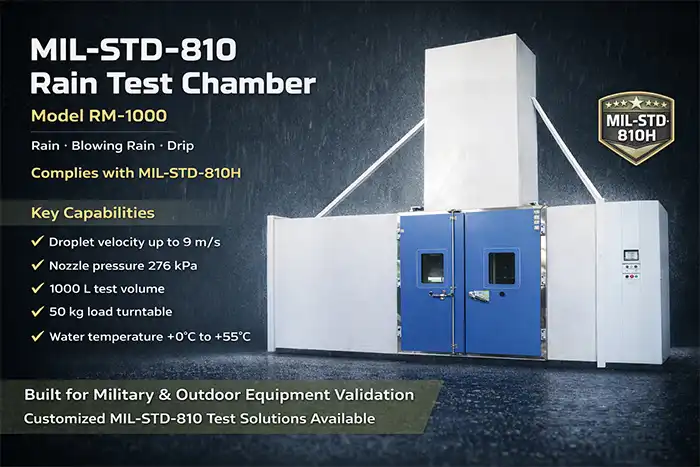 MIL-STD-810G defines three fundamental procedures for evaluating water penetration resistance, each addressing distinct environmental exposure scenarios that equipment may encounter during service life.
Procedure I: Rain and Blowing Rain Simulation
This procedure replicates wind-driven precipitation conditions where products face simultaneous exposure to rainfall and airflow. The test configuration generates droplet velocities reaching 9 m/s upon impact with the specimen surface, mimicking natural storm conditions. Wind speeds can escalate to 18 m/s, creating lateral water forces that challenge vertical surfaces and seam interfaces. The rainfall rate maintains a minimum threshold of 1.7 mm/min, ensuring consistent moisture delivery throughout the evaluation period.
Procedure II: Exaggerated Rain Testing
Exaggerated rain protocols simulate extreme precipitation events that exceed typical meteorological patterns. This accelerated testing approach applies rainfall rates of 20.8 L/min through specialized nozzles positioned approximately 48 cm from the test surface. Operating at 276 kPa pressure, the system delivers concentrated water exposure that compresses months of natural weathering into hours of laboratory testing, revealing marginal seal designs and material weaknesses.
Procedure III: Drip Configuration Assessment
Drip testing focuses on stationary equipment vulnerability to overhead water accumulation and gravity-fed penetration. The configuration utilizes a perforated panel spanning 1600×1000 mm with holes ranging from 20 to 25.4 mm diameter, spaced 25 mm apart. This arrangement delivers over 280 L/m²/h, targeting horizontal surfaces, cable entries, and ventilation openings where water pooling occurs.
Types of Rain Exposure: Drizzle, Showers, and Downpour Simulation
Environmental testing chambers replicate diverse precipitation intensities to match anticipated field conditions, providing comprehensive validation across the moisture exposure spectrum.
Light Drizzle Characteristics
Light precipitation simulation employs fine droplet generation between 0.5 and 1.5 mm diameter, representing prolonged exposure to mist and light rain. This configuration tests long-term seal degradation and capillary action through microscopic pathways. The extended duration approach reveals progressive water intrusion through porous materials and compression-set gaskets.
Moderate Shower Conditions
Moderate rainfall testing balances droplet size, velocity, and duration to mirror typical storm events. Droplets ranging from 1.5 to 3.0 mm travel at intermediate velocities, creating realistic impact forces on enclosure surfaces. This regime evaluates standard sealing solutions and coating performance under common environmental stress.
Intense Downpour Replication
Severe precipitation scenarios utilize maximum droplet dimensions approaching 4.5 mm combined with elevated delivery rates. These conditions stress-test critical sealing junctions, door interfaces, and connector assemblies. The high-impact forces expose design weaknesses that only manifest during extreme weather events, preventing field failures in tropical or monsoon environments.
Test Setup and Sealing Requirements for Accurate Results
Proper chamber configuration and specimen preparation directly influence test validity and repeatability, requiring meticulous attention to setup parameters and operational procedures.
Chamber Calibration Protocols
Testing accuracy depends on verified rainfall distribution, droplet sizing, and velocity measurements traceable to national standards. Flow meters and rain gauges provide closed-loop feedback, maintaining programmed precipitation rates within ±5% tolerance. Temperature differential between water supply and test specimens requires monitoring, as thermal gradients affect condensation patterns and seal compliance.
Specimen Mounting Considerations
Product orientation within the test volume determines exposure patterns and stress distribution across vulnerable surfaces. The rotating turntable operating between 1-7 rpm ensures comprehensive coverage, eliminating shadowing effects from stationary nozzle arrays. Load capacity specifications permit testing of assemblies up to 50 kg on the 800 mm diameter platform.
Sealing Verification Methods
Pre-test inspection confirms gasket seating, fastener torque compliance, and cable gland installation according to manufacturer specifications. Baseline moisture detection using absorbent indicators or electronic sensors establishes reference conditions before water exposure. Testing in a blowing rain test chamber enables accurate simulation of wind-driven precipitation, while documentation of seal types, materials, and installation techniques enables correlation between design features and penetration resistance.
|
Test Parameter |
Procedure I |
Procedure II |
Procedure III |
|
Rainfall Rate |
≥1.7 mm/min |
20.8 L/min |
280 L/m²/h |
|
Droplet Velocity |
9 m/s |
Nozzle-dependent |
Gravity-fed |
|
Wind Speed |
Up to 18 m/s |
Not applicable |
Not applicable |
|
Nozzle Pressure |
Variable |
276 kPa |
Atmospheric |
Evaluating Water Ingress in Enclosures and Housings
Post-exposure examination employs multiple detection methods to identify penetration pathways, quantify intrusion volumes, and classify severity according to functional impact criteria.
Visual Inspection Techniques
External examination documents surface wetting patterns, water accumulation zones, and drainage effectiveness. Internal assessment requires disassembly to reveal moisture presence on circuit boards, connector pins, and mechanical assemblies. Photography under controlled lighting conditions preserves evidence of water tracks, corrosion initiation, and material degradation.
Moisture Detection Instrumentation
Electronic moisture meters provide quantitative readings of material saturation levels, detecting residual humidity in absorbent components. Moisture-sensitive papers placed at strategic locations change color upon contact with liquid water, mapping intrusion paths. Desiccant cartridges weighed before and after testing measure total water mass entering sealed volumes.
Penetration Classification Systems
Severity rankings differentiate between cosmetic wetting, performance degradation, and catastrophic failure. Minor surface condensation on non-critical components may constitute acceptable outcomes, while liquid contact with energized circuits represents test failure. Classification criteria align with operational requirements, recognizing that external equipment tolerates greater exposure than sealed electronics.
|
Ingress Level |
Description |
Functional Impact |
|
IP0 |
Complete penetration |
Total system failure |
|
IP1-3 |
Partial intrusion |
Performance degradation |
|
IP4-6 |
Surface wetting only |
No functional impact |
Reporting and Interpreting Penetration Test Data
Comprehensive documentation transforms raw test observations into actionable intelligence for design refinement, quality assurance, and regulatory compliance demonstration.
Data Acquisition Systems
Automated recording captures time-stamped measurements of rainfall intensity, chamber temperature, specimen heating levels, and test duration. Sensor arrays monitoring internal conditions detect moisture intrusion in real-time, correlating penetration events with specific exposure phases. Digital logging eliminates transcription errors and provides audit trails for certification processes.
Statistical Analysis Methods
Multiple specimen testing generates datasets supporting statistical confidence calculations. Mean penetration volumes, standard deviations, and failure rate distributions inform reliability predictions. Comparison between production lots identifies manufacturing variations affecting seal consistency.
Corrective Action Documentation
Test reports specify observed deficiencies with photographic evidence, dimensional measurements of gaps or cracks, and recommendations for seal enhancement. Engineering change proposals reference specific test data, justifying material substitutions, design modifications, or assembly process improvements. Follow-up validation confirms corrective effectiveness.
Ensuring Compliance and Reliability Through Standardized Testing
Adherence to MIL-STD-810G protocols provides objective evidence of environmental durability, supporting procurement decisions, warranty claims, and field performance predictions.
Regulatory Acceptance Criteria
Military acquisitions mandate compliance documentation demonstrating test execution according to prescribed methods. Using a blowing rain test machine, civilian industries adopt these standards for products deployed in challenging environments, leveraging the specification's comprehensiveness. Third-party certification bodies recognize MIL-STD-810G results when accompanied by accredited laboratory calibration certificates.
Quality System Integration
Environmental testing data feeds continuous improvement cycles, trending seal performance across product generations. Failure mode analysis identifies systemic weaknesses, driving supplier qualification requirements and incoming inspection criteria. Statistical process control charts monitor test result consistency, detecting calibration drift or procedural deviations.
Long-Term Reliability Predictions
Accelerated testing correlation models extrapolate chamber results to field service lifespans. By comparing exaggerated exposure doses with regional meteorological data, engineers estimate seal degradation rates and maintenance intervals. Warranty cost reductions validate the investment in rigorous preproduction testing.
|
Compliance Aspect |
Requirement |
Verification Method |
|
Calibration Traceability |
CNAS/ILAC accredited |
Certificate review |
|
Test Procedure |
Per MIL-STD-810H Method 506 |
Audit observation |
|
Documentation |
Complete test report |
Record examination |
Precise Water Ingress Detection with LIB Industry MIL STD 810 G Rain Test Chambers
IB Industry Blowing Rain Test Chambers
|
|
|
|
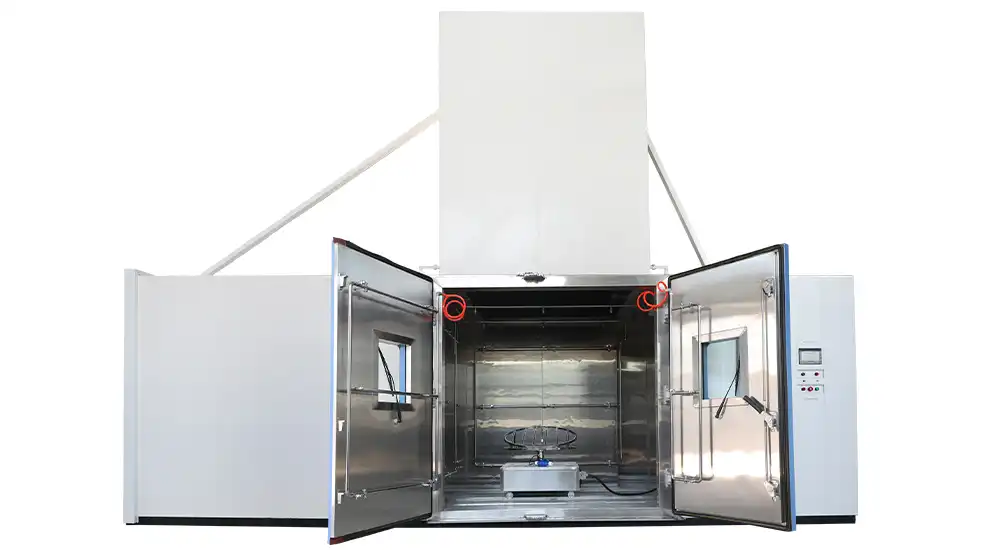
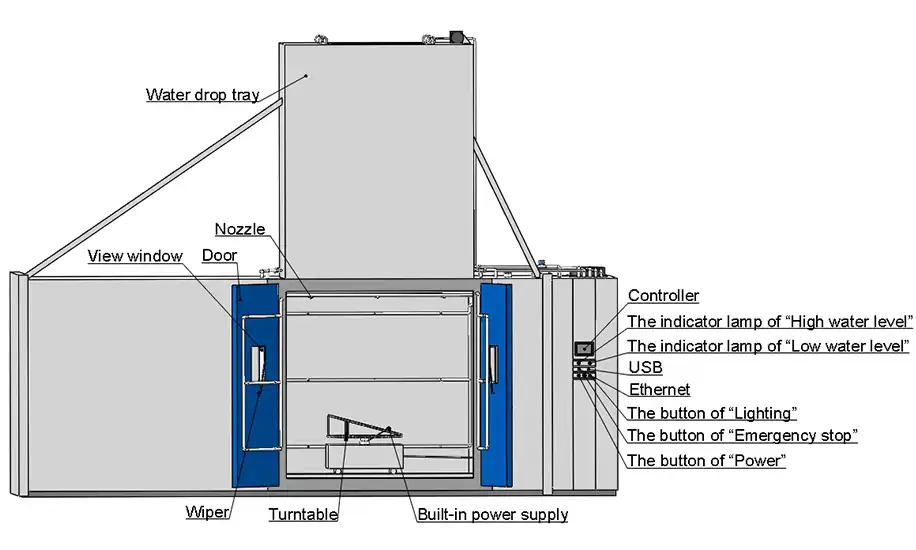
Model: RIM-1000 Interior Volume: 1000 L Turntable Load: 50 kg Turntable Diameter: 800 mm Door Lock: Electromagnetic lock Interior Material: SUS304 stainless steel Test Standard: MIL-STD-810H Test Time: 0 – 999 min, adjustable |
|
|
Rain & Blowing Rain Final Rain Droplet Velocity: 9 m/s on test item Rainfall Rate≥ 1.7 mm/min Droplet Size: 0.5 – 4.5 mm Water Temperature: +10°C to max. +55°C |
|
|
Drip Drip Area Dimensions: 1600 × 1000 mm, height adjustable Drip Hole Diameter: 20 – 25.4 mm Distance Between Holes: 25 mm Water Volume: ≥ 280 L/m²/h Water Temperature: +10°C to max. +55°C |
|
|
Exaggerated Rain Nozzle Pressure: 276 kPa Rainfall Rate: 20.8 L/min Nozzle Arrangement: One nozzle per 0.56 m² of surface area, approx. 48 cm from test surface Droplet Size:0.5 – 4.5 mm |
|
Comprehensive Testing Capability
Advanced testing equipment combines automation, precision control, and comprehensive monitoring to deliver repeatable results that inform confident design decisions.
Multi-Procedure Capability
Integrated chamber systems accommodate all three MIL-STD procedures within a single platform, eliminating transfer operations between specialized units. Programmable logic controllers store test profiles, enabling rapid reconfiguration between drip, shower, and blowing rain modes. This versatility maximizes laboratory throughput while maintaining protocol fidelity.
Precision Environmental Control
Closed-loop rainfall rate monitoring adjusts pump speeds and valve positions to maintain programmed precipitation levels regardless of water pressure fluctuations. Temperature regulation systems heat test water to specified differentials above specimen temperature, replicating thermal stress conditions. The 360-degree nozzle array ensures uniform exposure across the rotating test platform.
Professional Support Infrastructure
CNAS/ILAC traceable calibration certificates accompany each chamber, documenting measurement accuracy for rainfall intensity, wind velocity, and temperature sensors. Global service networks provide local technical assistance, replacement components, and periodic recertification. Comprehensive documentation packages include operation manuals, maintenance schedules, and validation protocols supporting ISO 9001 quality systems.
Conclusion
Rain penetration testing under MIL-STD-810G standards delivers objective evidence of enclosure integrity through rigorous simulation of natural precipitation conditions. The three-procedure framework addresses diverse environmental challenges, from gentle drizzle to violent storms, enabling manufacturers to validate designs before field deployment. Proper test execution, accurate data interpretation, and systematic compliance verification ensure products withstand moisture intrusion throughout their operational lifespan, protecting investments in equipment reliability and customer satisfaction.
FAQ
How long does a typical MIL-STD-810G rain penetration test last?
Test duration varies by procedure and exposure severity, ranging from 30 minutes for basic drip testing to several hours for exaggerated rain protocols. Specific timeframes align with anticipated field conditions and equipment operational profiles, with programmable controllers enabling tests up to 999 minutes.
What droplet size range does MIL-STD-810G rain testing specify?
The standard requires droplet diameters between 0.5 and 4.5 mm to replicate natural precipitation characteristics. Smaller droplets simulate mist and drizzle, while larger sizes represent heavy rain and storm conditions. Nozzle design and operating pressure control distribution within this specification range.
Can MIL-STD-810G rain testing predict real-world seal longevity?
Accelerated exposure protocols compress years of environmental stress into hours of laboratory testing. Correlation models comparing test doses with regional climate data enable engineers to estimate seal degradation rates, maintenance intervals, and warranty periods based on controlled chamber results.
Contact LIB Industry Today
As a leading environmental test chamber manufacturer and supplier, LIB Industry delivers turnkey rain testing solutions backed by global support. Our MIL STD 810 G rain test chambers provide precise water ingress detection for mission-critical applications. Contact our team at ellen@lib-industry.com to discuss your testing requirements.


