UV Test Machines in Coating and Paint Aging Applications
UV test machines in coating and paint aging applications simulate real-world weathering conditions to evaluate protective performance and longevity. These specialized chambers expose coated samples to ultraviolet radiation, moisture, and controlled temperature cycles, accelerating months or years of outdoor deterioration into weeks of testing. ASTM G154 UV test machines help coating manufacturers predict color stability, gloss retention, and film integrity before products reach the market, reducing costly field failures and ensuring formulations meet demanding architectural, automotive, and industrial performance standards.
Why Coatings and Paints Require UV Aging Evaluation?
Understanding Photodegradation in Coating Systems
Coatings face relentless environmental assault from ultraviolet radiation, which triggers photochemical reactions within polymer binders. UV radiation absorbed by chromophores releases energy that cleaves bonds in paint films and generates free radicals, initiating a cascade of degradation mechanisms. These free radicals attack polymer chains, progressively weakening the coating matrix and compromising protective functions. Photodegradation represents the primary failure mode for exterior coatings, making UV aging evaluation essential during formulation development.
Economic Impact of Premature Coating Failure
Unexpected coating failures generate substantial costs across industries. Building facades requiring premature repainting disrupt operations and drain maintenance budgets. Automotive manufacturers face warranty claims when vehicle finishes deteriorate prematurely. Industrial equipment exposed to harsh environments demands reliable protective coatings to prevent corrosion and maintain operational integrity. UV aging testing using ASTM G154 UV test machines enables manufacturers to identify weaknesses before production, significantly reducing these financial risks while building customer confidence through proven durability claims.
Regulatory and Performance Standards
Modern coating applications must satisfy rigorous industry specifications. Architectural coatings face AAMA standards requiring demonstrated weatherability. Automotive finishes must meet OEM performance criteria. Industrial coatings need verification against NACE and ISO requirements. ASTM G154 is integral to various test methods, including ASTM D1248, ASTM D5208, and ASTM D5894. These standards mandate accelerated aging validation, making UV test equipment indispensable for compliance documentation and market acceptance.
Common UV-Induced Failures in Coating Systems
Chalking and Surface Degradation
Chalking occurs when polymeric chains degrade and break apart when exposed to UV rays, leaving residue that forms white dust on the paint film's surface. This phenomenon results from binder photodegradation, where polymer fragments migrate to the coating surface as loose powder. Chalking not only compromises aesthetics but also exposes underlying layers to accelerated deterioration. Different resin chemistries exhibit varying susceptibility - acrylics generally resist chalking better than alkyds or polyesters. ASTM G154 UV test machines replicate this degradation pathway through controlled UV exposure cycles, enabling quantitative assessment of chalk resistance.
Gloss Loss and Surface Roughness
UV radiations can split polymer chains into smaller fragments until they disappear, eventually resulting in loss of gloss and the release of free pigment on the paint surface. Gloss retention serves as a sensitive indicator of coating degradation. As binder polymers fragment, surface microtopography roughens, scattering reflected light and diminishing the characteristic shine. High-performance coatings maintain gloss levels above threshold values specified by manufacturers. Testing protocols measure gloss at standardized angles throughout exposure periods, tracking degradation rates that predict service life expectations.
Color Shift and Fading
Pigment photostability determines coating color retention under UV exposure. Organic pigments vary dramatically in lightfastness - yellows and reds typically fade faster than blues and earth tones. UV degradation can lead to sharp changes in color in paints with high colorant loading, such as when green turns into blue as yellow fades. Inorganic pigments generally demonstrate superior UV stability. Color change measurements quantified through spectrophotometry provide objective data on appearance retention. ASTM G154 UV test machines accelerate color degradation processes, enabling comparative evaluation of pigment systems and binder chemistries.
|
Failure Mode |
Primary Cause |
Visual Indicators |
Performance Impact |
|
Chalking |
Polymer chain scission |
White powder surface |
Reduced gloss, barrier loss |
|
Gloss Loss |
Binder degradation |
Dull, matte appearance |
Surface roughness increase |
|
Color Fading |
Pigment photodegradation |
Hue shift, lightening |
Aesthetic failure |
|
Cracking |
Cross-link density changes |
Surface fissures |
Moisture penetration pathway |
|
Delamination |
Adhesion loss |
Coating separation |
Complete protective failure |
ASTM G154 Test Cycles for Coating and Paint PerformanceUnderstanding Standardized Exposure Cycles
Most ASTM G154 cycles alternate between 4-hour or 8-hour periods of light and 4-hour periods of condensation, though variations exist for specific applications. Cycle 1 employs UVA-340 lamps with 8 hours of light at 60°C black panel temperature followed by 4 hours of condensation at 50°C. Cycle 4 uses similar UVA-340 lamps but with 4-hour light periods alternating with 4-hour condensation. Cycle 5 extends light exposure to 20 continuous hours. These standardized protocols ensure reproducibility across laboratories and enable meaningful performance comparisons between coating systems.
Selecting Appropriate UV Lamp Types
The ASTM G154 UV test machine accepts different fluorescent lamp types matching specific weathering simulation needs. UVA-340 lamps simulate the UV portion of sunlight in the 295-365 nm range, closely replicating the spectrum that causes most polymer degradation. UVB-313 lamps deliver shorter wavelengths for accelerated stress testing, revealing potential weaknesses faster than natural exposure. For architectural coatings requiring realistic weathering simulation, UVA-340 lamps provide optimal spectral matching. Automotive and industrial applications may employ UVB-313 for comparative screening during formulation optimization.
Moisture Cycling Mechanisms
Condensation cycles represent the most common moisture delivery method in ASTM G154 testing. Warm, saturated air generated within the chamber causes condensation to form directly and reform continuously on the material's surface because cool laboratory air across the back side of specimens creates a temperature differential. This mechanism realistically simulates overnight dew formation. Spray cycles deliver direct water impingement, creating thermal shock effects similar to sudden rainfall. These moisture exposures synergize with UV radiation, accelerating hydrolytic degradation pathways that occur in actual outdoor environments.
Assessing Gloss Retention, Color Change, and CrackingGloss Measurement Methodologies
The gloss of a protective coating changes over time due to aging and exposure to ultraviolet light from the sun. Standardized gloss measurements employ specular reflectance at 20°, 60°, or 85° angles depending on initial gloss levels. High-gloss coatings benefit from 20° measurements providing superior differentiation. Low-gloss finishes require 85° geometry for meaningful resolution. Gloss retention calculations express final measurements as percentages of initial values. Tracking gloss decline curves throughout exposure enables prediction of performance thresholds and comparison between competitive formulations tested under identical ASTM G154 UV test machine conditions.
Quantifying Color Change
Spectrophotometric analysis provides objective color change data through CIE Lab color space measurements. Delta E calculations quantify total color difference between original and aged specimens, with values above 3.0 generally considered perceptible to human observers. Breaking down color shifts into lightness, chroma, and hue components reveals specific degradation mechanisms. Lightness increases indicate pigment loss or binder degradation. Chroma reductions reflect color saturation decline. Hue shifts demonstrate selective pigment fading. ASTM G154 testing generates comprehensive color change data supporting formulation decisions and performance claims.
Crack Detection and Propagation Analysis
Surface cracking manifests when polymer cross-link density changes exceed coating flexibility limits. Film embrittlement occurs due to polymer changes from thermal cycles of day and night, eventually breaking down polymer chains and deteriorating physical properties. Visual crack assessment employs standardized rating scales documenting crack density, width, and pattern distribution. Microscopic examination reveals crack initiation sites and propagation pathways. Advanced techniques including digital image analysis quantify crack networks objectively. Identifying crack onset during ASTM G154 UV testing equipment exposures establishes formulation robustness boundaries and predicts service life expectations.
|
Assessment Method |
Measurement Equipment |
Key Parameters |
Acceptance Criteria |
|
Gloss Retention |
Glossmeter (20°/60°/85°) |
Initial vs. final gloss units |
>80% retention typical |
|
Color Change |
Spectrophotometer |
ΔE, ΔL, Δa, Δb values |
ΔE <3.0 for high performance |
|
Chalk Rating |
ASTM velvet cloth method |
0-10 scale |
Grade 8 minimum standard |
|
Crack Assessment |
Visual inspection/microscopy |
Crack density and width |
No cracking benchmark |
|
Adhesion |
Cross-hatch or pull-off test |
Post-exposure bond strength |
>80% retention required |
Influence of Substrate and Pretreatment on Aging ResultsSubstrate Material Effects
Coating performance during ASTM G154 UV test machine exposure varies significantly with substrate composition. Metal substrates conduct heat differently than plastic panels, affecting temperature gradients within coating films. Aluminum exhibits high thermal conductivity while composites provide insulation. These thermal differences influence cure kinetics, cross-link density development, and stress distribution during temperature cycling. Wood substrates introduce moisture transport variables and dimensional stability considerations. Testing on representative substrates ensures aging results accurately predict field performance across intended application environments.
Surface Preparation Impact
Exterior paints and coatings are evaluated for color retention, chalking resistance, and overall durability, with surface preparation playing a crucial role. Proper substrate cleaning removes contaminants interfering with adhesion. Surface roughness influences mechanical interlocking between coatings and substrates. Chemical conversion treatments on metals create protective layers enhancing corrosion resistance. Primers establish uniform surfaces promoting topcoat adhesion and barrier properties. ASTM G154 testing protocols specify substrate preparation requirements ensuring consistency across test specimens. Variations in pretreatment procedures can dramatically alter UV aging outcomes, necessitating careful standardization during comparative evaluations.
Coating Thickness Considerations
Film thickness influences UV degradation rates through several mechanisms. Thinner coatings concentrate UV radiation across smaller material volumes, accelerating photodegradation. Thicker films provide greater UV absorption depth, protecting underlying layers. However, excessive thickness increases internal stress during temperature cycling, potentially promoting cracking. Optimal film thickness balances UV protection, mechanical properties, and economic considerations. ASTM G154 UV test machine evaluation across thickness ranges identifies performance sweet spots and establishes application specifications for field use.
Using UV Aging Data to Optimize Coating Formulations
Resin System Selection
UV aging data generated through ASTM G154 testing guides resin chemistry selection for specific applications. Acrylics are often used in the most demanding applications where outdoor weatherability is essential because when synthesized properly, acrylics are essentially transparent to UV radiation. Polyurethanes deliver excellent abrasion resistance and gloss retention. Fluoropolymers provide exceptional long-term weatherability for architectural applications. Epoxies offer strong adhesion and chemical resistance but limited UV stability. Comprehensive aging databases comparing resin systems under standardized conditions enable formulation scientists to balance performance requirements, cost constraints, and processing characteristics.
Pigment and Additive Optimization
UV absorbers and hindered amine light stabilizers (HALS) protect coatings through complementary mechanisms. UV absorbers preferentially absorb damaging radiation, dissipating energy harmlessly as heat. HALS scavenge free radicals generated during photodegradation, interrupting degradation cascades. Optimizing stabilizer packages requires systematic ASTM G154 UV test machine evaluation across concentration ranges and additive combinations. Pigment selection balances color requirements with UV stability characteristics. Inorganic pigments typically demonstrate superior lightfastness compared to organic alternatives. Testing guides pigment choices for color-critical applications where appearance retention justifies premium formulation costs.
Formulation Iteration Strategies
Accelerated UV aging testing enables rapid formulation iteration cycles impossible through outdoor exposure alone. Material selection assists in identifying appropriate materials for outdoor or UV-exposed environments, with iterative testing refining candidate formulations systematically. Screening experiments compare multiple variables simultaneously, identifying promising directions efficiently. Subsequent optimization testing fine-tunes successful candidates. Statistical experimental design maximizes information extraction from limited testing resources. ASTM G154 UV test machines operating continuously generate comparative data supporting informed formulation decisions, accelerating development timelines and reducing market introduction costs.
|
Formulation Variable |
Performance Impact |
Testing Strategy |
Optimization Target |
|
Resin Type |
Determines base durability |
Comparative screening |
Best weatherability/cost ratio |
|
UV Stabilizer Level |
Controls degradation rate |
Concentration study |
Minimum effective dose |
|
Pigment Selection |
Affects color retention |
Lightfastness ranking |
Maximum stability in color range |
|
Film Thickness |
Influences protection/stress |
Thickness series |
Optimal performance window |
|
Cross-link Density |
Balances hardness/flexibility |
Cure condition variation |
Crack resistance threshold |
Superior Aging Simulation for Coatings with LIB Industry UV Test Machines
 |
 |
|
Model |
UV-SI-260 |
|
Internal Dimension (mm) |
450*1170*500 |
|
Overall Dimension (mm) |
680*1300*1500 |
|
Irradiation Source |
Fluorescent UV lamps (8) - 40 W |
|
Temperature Range |
Ambient ~ 90 ℃ ±2℃ |
|
Black Panel Temperature (BPT) |
35 ~ 80 ℃ |
|
Humidity Range |
≥95% RH |
|
Bandwidth |
290 ~ 400 nm |
|
Irradiance Control |
0.3~20 W/㎡ |
|
Distance of Specimen and lamp |
50 mm |
|
Heating Element |
Nichrome heater |
|
Controller |
Programmable color LCD touch screen controller |
|
Ethernet connection, PC Link,USB |
|
|
Water Supply System |
Automatic water supply, Water pu |
Advanced Irradiance Control Systems
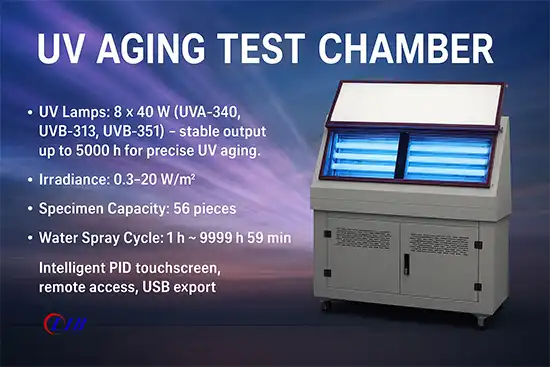
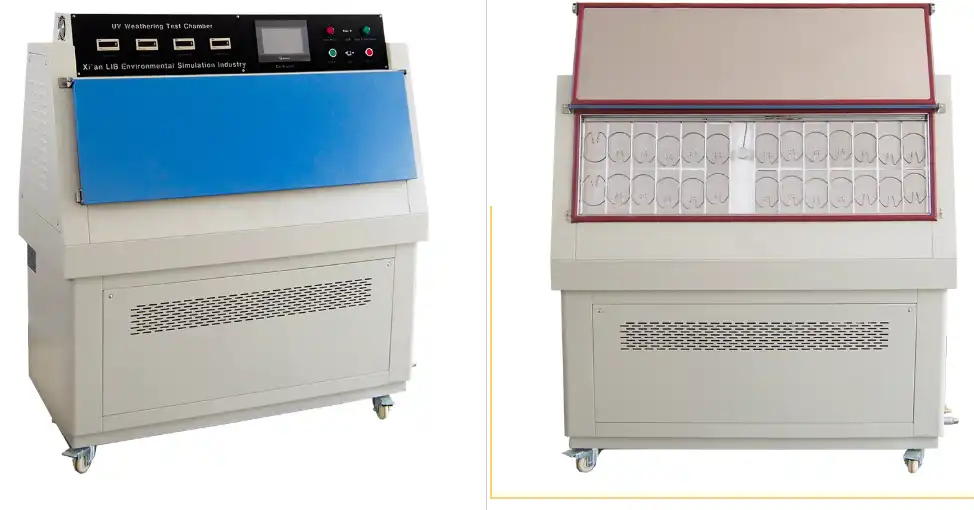
LIB Industry's ASTM G154 UV test machine incorporates genuine UVA-340 and UVB-313 fluorescent lamps reproducing the ultraviolet spectrum accurately across the 290-400 nm bandwidth. Eight evenly distributed lamps ensure uniform irradiance across all specimen positions, eliminating test deviation and improving result repeatability. Adjustable irradiance control spans 0.3 to 20 W/m², with automatic monitoring and feedback maintaining stable light intensity throughout extended testing periods. Precise irradiance control enables correlation between accelerated testing and actual outdoor exposure, supporting confident service life predictions and performance claims.
Comprehensive Environmental Simulation
Temperature control ranging from ambient to 90°C with ±0.5°C accuracy ensures consistent test conditions. Rapid heating and cooling capabilities enable temperature change rates up to 5°C per minute, facilitating efficient cycling between exposure stages. Integrated condensation systems reproduce nighttime moisture and dew formation critical for evaluating material degradation. Programmable water spray nozzles create thermal shock effects simulating sudden rainfall. This multi-factor environmental simulation replicates synergistic weathering mechanisms occurring outdoors, providing realistic degradation patterns that correlate with field performance far better than single-factor exposures.
Operational Excellence and Support
LIB Industry's ASTM G154 UV test machine features pre-programmed test cycles compliant with international standards, minimizing setup time and reducing operator error. Intuitive touchscreen controls enable easy parameter setting and real-time monitoring. Test data exports effortlessly via USB or LAN connectivity for analysis and reporting. Built-in lamp management systems track operating hours, providing automatic replacement reminders maintaining consistent testing performance. Comprehensive three-year warranty coverage and lifetime technical support ensure uninterrupted operation. ISO 9001 quality management certification and third-party testing validation demonstrate commitment to manufacturing excellence and customer satisfaction.
Conclusion
UV test machines represent indispensable tools for coating and paint development, enabling accelerated evaluation of weatherability before market introduction. ASTM G154 UV test machines simulate complex environmental interactions - ultraviolet radiation, moisture cycles, and temperature fluctuations - that govern coating service life. Systematic testing reveals failure mechanisms, guides formulation optimization, and validates performance claims. LIB Industry delivers advanced testing solutions combining precise environmental control, intuitive operation, and comprehensive support, empowering coating manufacturers to develop durable products meeting demanding application requirements.
FAQWhat exposure duration in an ASTM G154 UV test machine equals one year of outdoor weathering?
Correlation between accelerated and natural weathering depends on multiple factors including geography, coating chemistry, and test cycle selection. Through comparison of IR spectrum changes across automotive coatings, 1250 hours of certain test conditions has been shown equivalent to one year in south Florida. Establishing site-specific correlations requires parallel testing with actual outdoor exposure.
Can ASTM G154 UV test machines evaluate both organic and inorganic coatings?
Yes, ASTM G154 protocols accommodate diverse coating systems including organic polymers, hybrid formulations, and inorganic finishes. Different materials exhibit unique photodegradation mechanisms, requiring appropriate assessment techniques. Visual evaluation, spectroscopic analysis, and mechanical property testing capture degradation manifestations specific to each coating type under standardized UV exposure conditions.
How often should UV lamps be replaced in an ASTM G154 UV test machine?
Fluorescent UV lamp output gradually declines with operating hours, affecting irradiance levels and spectral distribution. Most manufacturers recommend lamp replacement after approximately 1,600 to 5,000 operating hours depending on lamp type and operating intensity. Regular irradiance monitoring verifies output consistency, and automated tracking systems alert operators when replacement becomes necessary to maintain testing accuracy.
Ready to elevate your coating development with precision UV aging testing? Contact LIB Industry, a leading UV test chamber manufacturer and supplier, to discuss your specific testing requirements and discover how our ASTM G154 UV test machines can accelerate your formulation optimization. Reach our technical team at ellen@lib-industry.com for detailed specifications and application guidance.