Why Blowing Rain Testing Is Critical for Enclosure Protection?
Enclosure protection against water ingress represents one of the most critical validation processes in product development. When wind-driven precipitation contacts sealed housings at realistic velocities and trajectories, it exposes vulnerabilities that static water tests cannot reveal. A blowing rain test chamber simulates these demanding conditions by combining controlled rainfall rates with directional airflow, allowing engineers to identify seal weaknesses, gasket failures, and drainage system inadequacies before products reach the field. This testing methodology proves essential for outdoor electronics, military equipment, transportation components, and any system expected to maintain operational integrity during severe weather events. Understanding the mechanisms of water penetration under dynamic conditions enables manufacturers to design robust protection systems that withstand years of environmental exposure.
What Defines Effective Enclosure Protection Against Water?
Material Selection and Surface Treatment
Enclosure materials must resist both immediate water contact and long-term moisture exposure. Aluminum alloys with anodized surfaces provide excellent corrosion resistance, while engineered polymers offer lighter weight alternatives with inherent hydrophobic properties. The surface finish directly impacts water behavior - smooth surfaces encourage droplet runoff, whereas textured finishes may trap moisture in microscopic crevices. Engineers evaluate coating adhesion, chemical compatibility with sealing compounds, and thermal expansion characteristics that affect seal compression over temperature cycles.
Seal Design and Compression Ratios
Gasket geometry determines sealing effectiveness under varying water pressures. Compression seals require precise groove dimensions to maintain consistent force distribution across the entire perimeter. O-rings, D-profiles, and custom extruded shapes each offer distinct advantages depending on joint configuration and expected deflection. The compression ratio - typically ranging from 15% to 30% of original gasket height - must balance adequate sealing force against excessive material deformation that causes permanent set. Multi-lip designs provide redundant barriers where single seals prove insufficient.
Drainage Architecture and Water Management
Effective enclosures incorporate intentional drainage pathways that prevent water accumulation near critical seal interfaces. Drainage channels, weep holes, and sloped interior surfaces direct water away from vulnerable components. The drainage rate must exceed the maximum expected water ingress rate during testing. Engineers position drainage exits to prevent water from splashing back toward sealed openings during high wind conditions. Labyrinth-style drain paths provide protection without compromising the enclosure's overall integrity rating.
Common Failure Modes in Sealed Housings Under Rain Exposure
Capillary Action Through Micro-Gaps
Water molecules exhibit strong cohesive forces that enable upward migration through gaps measuring only micrometers in width. This capillary action becomes particularly problematic in threaded fastener assemblies and mating surface irregularities where manufacturing tolerances create unintended pathways. The phenomenon intensifies when surface tension draws water into horizontal joints that appear adequately sealed under static conditions. Engineers must account for surface roughness values and implement secondary barriers where capillary intrusion poses risks.
Pressure Differential-Induced Ingress
Enclosures experience internal pressure changes due to temperature fluctuations, altitude variations, or equipment operation. These pressure differentials create driving forces that push external water through compromised seals, a condition often evaluated in a rain test chamber. A 10°C temperature drop can generate sufficient negative pressure to draw water past gaskets that performed adequately under ambient conditions. Breathing membranes or pressure equalization vents become necessary for enclosures experiencing significant thermal cycling, though these components introduce additional sealing challenges.
Seal Degradation from Environmental Exposure
Ultraviolet radiation, ozone, temperature extremes, and chemical exposure progressively degrade elastomeric seal materials. Hardening occurs as plasticizers migrate from the polymer matrix, reducing the seal's ability to maintain contact pressure. Conversely, excessive softening from hydrocarbon exposure causes extrusion under compression loads. The degradation rate accelerates when multiple stressors act simultaneously - UV exposure combined with thermal cycling produces synergistic effects that standard aging predictions may underestimate.
|
Failure Mode |
Primary Cause |
Detection Method |
Mitigation Strategy |
|
Capillary Ingress |
Micro-gap formation |
Dye penetrant testing |
Surface finishing, sealant application |
|
Pressure-driven Leaks |
Thermal cycling effects |
Pressure decay monitoring |
Equalization vents, flexible seals |
|
Seal Degradation |
UV and chemical exposure |
Material hardness testing |
UV-stable compounds, protective coatings |
Designing Blowing Rain Test Profiles for Enclosures
Matching Test Conditions to Service Environment
Test profile development begins with comprehensive environmental characterization of the product's operational context. Climate data reveals typical and extreme precipitation rates, prevailing wind directions, and concurrent temperature ranges. Military standards like MIL-STD-810H Method 506.6 provide baseline parameters, but custom profiles better represent specific deployment scenarios. A telecommunications enclosure in coastal regions requires different test parameters than industrial equipment in continental climates. Engineers analyze historical weather records to determine appropriate rainfall intensities - ranging from light drizzle at 1.7 mm/min to severe storms exceeding 20 mm/min.
Wind Speed and Trajectory Configuration
Wind-driven rain strikes surfaces at angles far removed from vertical, creating unique infiltration pathways not challenged by overhead spray alone. Test chamber configurations must replicate these oblique impact angles through coordinated fan and nozzle positioning. Wind speeds between 9-25 m/s represent the critical range where droplet momentum overcomes surface tension effects. The rotating turntable functionality ensures exposure from all orientations, revealing direction-dependent vulnerabilities. Engineers program specific dwell times at critical angles where joint configurations appear most susceptible.
Temperature Differential Integration
Water temperature relative to the test specimen creates thermal gradients that affect both seal performance and internal condensation formation. MIL-STD specifications require water temperature to exceed specimen temperature by at least 10°C, with maximum differentials reaching 15°C for certain applications. This heating simulates rain striking sun-warmed enclosures, a condition that accelerates water migration through temperature-induced pressure changes. The blowing rain test chamber's heating system maintains precise water temperatures up to 55°C while monitoring specimen surface temperatures to verify specified differentials.
Monitoring Water Penetration and Seal Integrity
Real-Time Detection Methodologies
Advanced monitoring systems track water ingress as it occurs rather than relying solely on post-test inspection during evaluation in a rain test machine. Moisture sensors positioned at strategic internal locations provide immediate alerts when water breaches primary seals. Conductivity measurements between isolated contact points detect even microscopic water films. High-resolution imaging through transparent test sections allows direct observation of water behavior at seal interfaces. Data logging systems capture sensor outputs continuously throughout the test duration, creating comprehensive records of seal performance under varying conditions.
Pressure Decay Analysis During Testing
Internal pressure monitoring reveals seal integrity through leak detection principles. Technicians pressurize the enclosure interior to a reference value, then monitor pressure changes during rain exposure. Rapid pressure drops indicate significant seal failures, while gradual decay suggests minor permeation or micro-leakage pathways. The decay rate correlates with effective leak size, enabling quantitative comparison between design iterations. This approach proves particularly valuable for large enclosures where visual inspection of all seal surfaces becomes impractical.
Post-Test Qualification Procedures
Systematic inspection protocols ensure thorough evaluation after test completion. Internal surfaces receive examination under bright lighting to identify water trails, droplet accumulation, or corrosion initiation. Moisture meters quantify residual dampness in insulation materials and electronic assemblies. Seals undergo dimensional verification to detect permanent compression set or extrusion damage. Electrical continuity tests on internal components verify continued functionality. Disassembly of critical seal joints reveals subtle intrusion that surface inspection missed. Documentation includes photographic evidence of any observed degradation.
|
Monitoring Parameter |
Measurement Technique |
Acceptable Threshold |
Recording Frequency |
|
Internal Humidity |
Capacitive RH sensors |
<90% RH throughout test |
Every 60 seconds |
|
Surface Conductivity |
Interdigitated electrodes |
No continuous path formation |
Continuous monitoring |
|
Pressure Retention |
Differential transducers |
<5% decay over test duration |
Every 30 seconds |
Data Analysis and Interpretation for Enclosure Qualification
Statistical Evaluation of Seal Performance
Multiple test specimens provide data sets enabling statistical analysis of seal reliability. Engineers calculate mean time to water ingress and construct failure distribution curves. Weibull analysis characterizes seal degradation mechanisms and predicts field performance. Sample sizes typically range from 5-10 units per design configuration, balancing statistical confidence against testing costs. Outlier identification separates manufacturing defects from systematic design weaknesses. This statistical framework supports reliability predictions and warranty coverage decisions.
Correlation with Field Failure Data
Accelerated laboratory testing must correlate with actual field performance to validate test profile appropriateness. Manufacturers collect warranty return data and conduct failure analysis on units experiencing water intrusion. Comparison between laboratory test results and field failure modes confirms whether testing parameters adequately stress seal systems. Discrepancies prompt test profile adjustments or reveal additional environmental factors requiring consideration. This feedback loop continuously improves test methodology relevance.
Design Optimization Through Iterative Testing
Test data guides systematic design improvements targeting identified vulnerabilities. Engineers implement seal geometry modifications, material substitutions, or drainage enhancements based on specific failure observations. Subsequent testing validates effectiveness of these changes and may reveal new secondary failure modes. The iterative process continues until performance meets specifications with adequate margin. Documentation of each design iteration creates knowledge repositories that inform future product development.
Enhancing Product Reliability Through Controlled Rain Simulation
Validating Seal Longevity and Aging Effects
Accelerated aging protocols combined with blowing rain testing predict long-term seal performance. Specimens undergo thermal cycling, UV exposure, or chemical immersion before rain testing to simulate years of service degradation. Comparison between fresh and aged specimens quantifies reliability degradation rates. This approach identifies seal materials requiring replacement intervals or reveals designs maintaining adequate performance throughout product lifetime. Military and aerospace applications particularly benefit from this longevity validation.
Qualification Testing for International Standards
Multiple regulatory frameworks govern water protection requirements across different industries. The IP (Ingress Protection) rating system defines protection levels from IPX0 (no protection) through IPX9K (high-pressure hot water). Automotive standards specify different test parameters than marine equipment certifications. A properly configured blowing rain test chamber accommodates various standard requirements through programmable parameter adjustment. Compliance documentation supports market access and liability protection.
Production Quality Verification Programs
Beyond initial design validation, manufacturers implement ongoing quality verification testing on production units. Statistical sampling of finished goods undergoes abbreviated test protocols confirming manufacturing consistency. This monitoring detects process drift, material substitutions, or assembly variations affecting seal integrity. Early detection prevents field failures and associated warranty costs. The test data contributes to process control charts and continuous improvement initiatives.
|
Application Sector |
Relevant Standard |
Key Test Parameters |
Typical Acceptance Criteria |
|
Military Electronics |
MIL-STD-810H Method 506.6 |
9 m/s wind, 1.7 mm/min rain |
No internal water presence |
|
Outdoor Lighting |
IEC 60529 (IPX6) |
100 L/min @ 100 kPa |
No harmful water ingress |
|
Automotive Enclosures |
ISO 20653 |
Spray pattern per standard |
Maintain functionality |
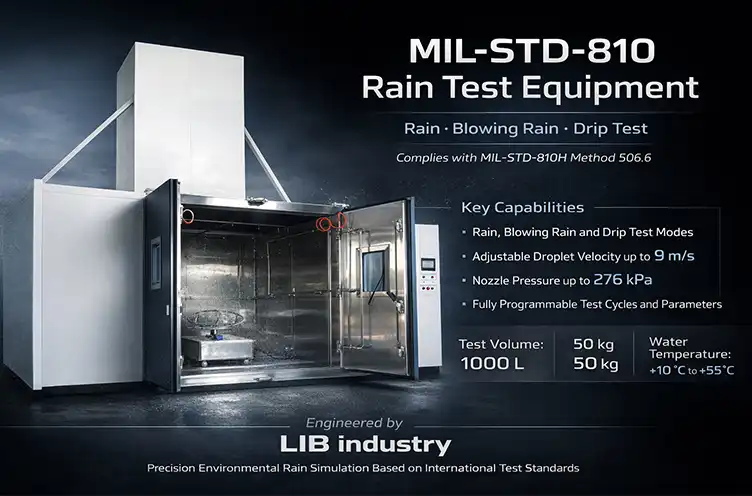
Prevent Water Ingress Failures with LIB Industry Blowing Rain Test Chambers
|
|
|
|
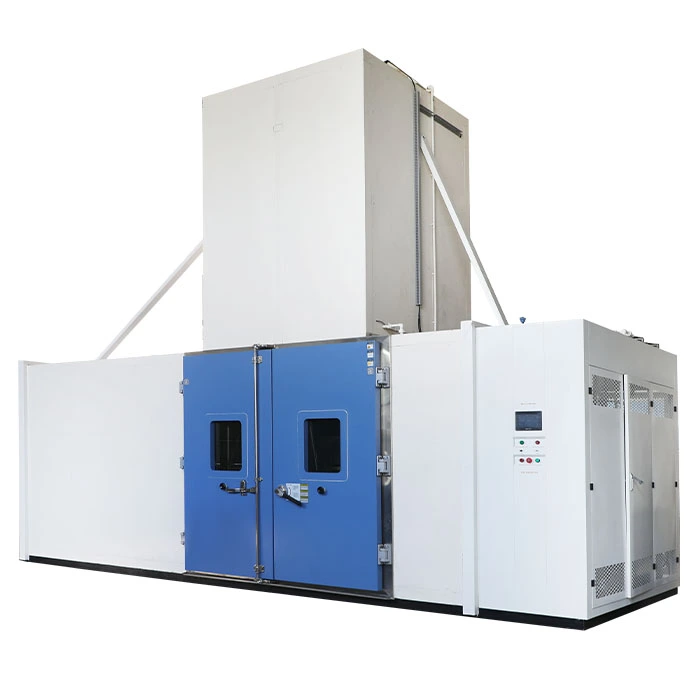
Model: RIM-1000 Interior Volume: 1000 L Turntable Load: 50 kg Turntable Diameter: 800 mm Door Lock: Electromagnetic lock Interior Material: SUS304 stainless steel Test Standard: MIL-STD-810H Test Time: 0 – 999 min, adjustable |
|
|
Rain & Blowing Rain Final Rain Droplet Velocity: 9 m/s on test item Rainfall Rate≥ 1.7 mm/min Droplet Size: 0.5 – 4.5 mm Water Temperature: +10°C to max. +55°C |
|
|
Drip Drip Area Dimensions: 1600 × 1000 mm, height adjustable Drip Hole Diameter: 20 – 25.4 mm Distance Between Holes: 25 mm Water Volume: ≥ 280 L/m²/h Water Temperature: +10°C to max. +55°C |
|
|
Exaggerated Rain Nozzle Pressure: 276 kPa Rainfall Rate: 20.8 L/min Nozzle Arrangement: One nozzle per 0.56 m² of surface area, approx. 48 cm from test surface Droplet Size:0.5 – 4.5 mm |
|
Advanced Multi-Directional Spray Technology
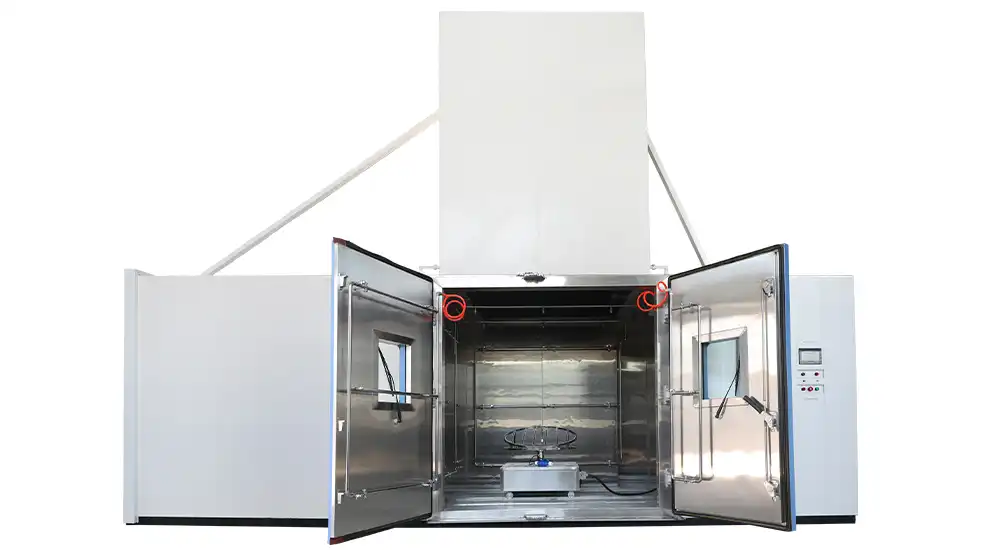
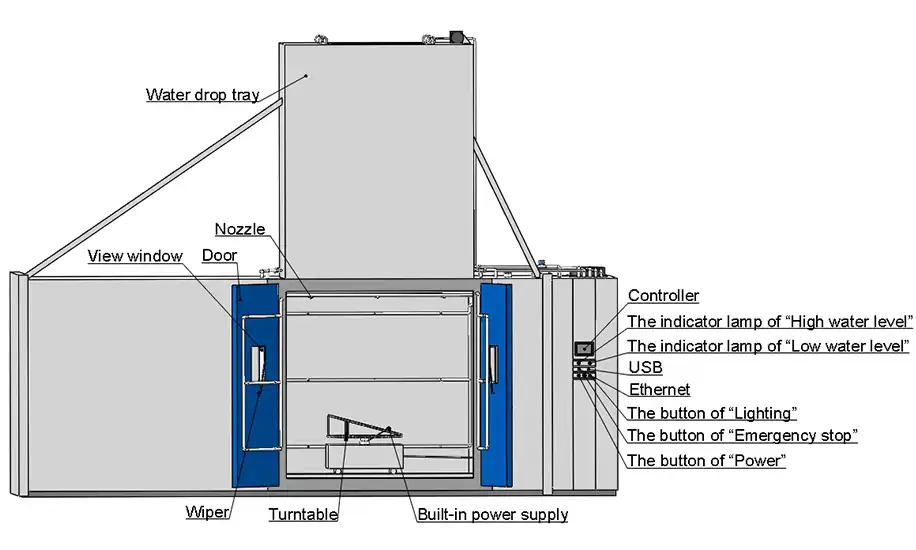
LIB Industry's RIM-1000 model incorporates sophisticated spray nozzle arrays delivering uniform water distribution across test surfaces. The 360-degree ring configuration ensures complete coverage regardless of specimen geometry. Mobile spray heads adjust vertically and horizontally, accommodating enclosures from compact electronics to large equipment assemblies. The rotating turntable operates from 1-7 rpm, providing controlled exposure from all orientations. This comprehensive approach eliminates testing blind spots that single-direction spray systems create.
Comprehensive Testing Capabilities
The system supports three distinct test modes addressing different evaluation requirements. Rain and blowing rain mode delivers 9 m/s droplet velocities at rainfall rates meeting MIL-STD specifications. Exaggerated rain mode increases intensity to 20.8 L/min through nozzles pressurized to 276 kPa, accelerating seal evaluation. Drip mode simulates overhead water accumulation with 280 L/m²/h delivery across the 1600×1000 mm drip plate. Engineers select appropriate modes based on product application and testing objectives. The water heating system maintains temperatures from ambient to 55°C, enabling specified thermal differentials.
Superior Control and Monitoring Systems
The advanced HMI displays simultaneous real-time curves for wind speed, water flow, pressure, and temperature parameters. This multi-parameter monitoring ensures precise test condition maintenance throughout evaluation cycles. Pre-programmed test profiles based on common standards accelerate workflow setup. Custom programming options accommodate unique testing protocols for specialized applications. The control system automatically logs all test data, generating comprehensive reports for qualification documentation. Built-in safety interlocks protect both test specimens and chamber components during operation.
Conclusion
Blowing rain testing provides irreplaceable validation of enclosure water protection under realistic environmental conditions. The combination of controlled rainfall, directional wind, and thermal differentials reveals seal vulnerabilities that simpler tests cannot detect. Systematic test profile development, comprehensive monitoring, and rigorous data analysis ensure products withstand field conditions throughout their service life. Manufacturers investing in proper validation reduce warranty costs and enhance brand reputation through reliable performance.
FAQ
What rainfall rate represents severe storm conditions in blowing rain testing?
Severe storm simulation typically requires rainfall rates between 15-25 mm/min combined with wind speeds exceeding 15 m/s. Standard testing uses 1.7 mm/min as a baseline, while accelerated protocols employ rates up to 20.8 L/min for rapid seal evaluation.
How does water temperature affect enclosure seal performance during testing?
Elevated water temperature creates thermal gradients causing internal pressure changes and accelerated seal material degradation. The temperature differential simulates realistic sun-heated enclosure conditions where warm surfaces contact cool rain, stressing seals beyond ambient temperature testing scenarios.
Can blowing rain chambers test both horizontal and vertical surface orientations?
Modern chambers incorporate rotating turntables enabling 360-degree specimen exposure at programmable rotation speeds. Combined with adjustable spray angles and multi-directional wind generation, these systems evaluate all surface orientations including undersides where drainage effectiveness becomes critical.
Partner with LIB Industry for comprehensive environmental testing solutions. As a leading blowing rain test chamber manufacturer and supplier, we deliver turn-key testing systems backed by ISO 9001 certification and three-year warranties. Our engineering team provides custom chamber designs meeting your specific validation requirements. Contact us at ellen@lib-industry.com to discuss your enclosure testing needs.