What Is a Thermal Cycling Test Chamber and How Do You Choose the Right One for PCB Solder Joint Testing?
If solder joints fail in the field, the cost is never just a replacement part — it's a recall, a warranty claim, or a safety incident. This guide answers the questions engineers and buyers actually ask before purchasing a thermal cycling test chamber: what it does, which standards it needs to meet, how to select the right size and specs, and how LIB Industry helps you get from RFQ to a working test lab. By the end, you'll know exactly what to look for — and how to get a quote that matches your application.
What Is a Thermal Cycling Test Chamber?
A thermal cycling test chamber is environmental test equipment that repeatedly exposes electronic assemblies to controlled high-and-low temperature transitions — typically ranging from -70°C to +150°C — to simulate years of thermal stress in a matter of weeks. For PCB and solder joint testing, this reveals cracks and fatigue failures caused by mismatched thermal expansion between components and substrates, long before the product ships.
In short: it's how you find a weak solder joint in the lab instead of in your customer's product.
Why Does Solder Joint Testing Matter for Your Product?
_1773978265968.jpg "blog-1-1") Solder joints are both the mechanical and electrical connection points on a PCB. A single failed joint — often invisible to the eye under a BGA or CSP package — can cause:
Solder joints are both the mechanical and electrical connection points on a PCB. A single failed joint — often invisible to the eye under a BGA or CSP package — can cause:
Intermittent failures that are nearly impossible to diagnose in the field
Full circuit failure in safety-critical systems (automotive, medical, aerospace)
Costly recalls and warranty claims that far exceed the cost of qualification testing
If your product needs to pass automotive (AEC-Q100), aerospace (MIL-STD-883), or general electronics (JEDEC/IPC) qualification, thermal cycling isn't optional — it's a requirement your customers or regulators will ask about directly.
Which Standards Should Your Testing Meet?
Here's a quick reference so you can confirm what your product needs before you spec a chamber:
| Standard | Applies To | Typical Range | Minimum Cycles |
|---|---|---|---|
| JEDEC JESD22-A104 | Semiconductor packages | -40°C to +125°C (Condition G) | 500–1000 |
| IPC-9701 | BGA / board-level assemblies | Application-specific | Varies by lifetime model |
| AEC-Q100 | Automotive ICs | -40°C to +125°C | 500 (Grade 1) – 1000 (Grade 0) |
| MIL-STD-883 Method 1010/1011 | Military / aerospace | -65°C to +150°C | 500–1000 |
Not sure which standard applies to your product? Send us your application details — LIB's engineers can confirm the right test condition and chamber configuration before you commit to a spec.
How to Choose the Right Thermal Cycling Chamber
Buyers rarely fail because they picked the wrong brand — they fail because they picked the wrong configuration. Before requesting a quote, confirm these five things:
| Selection Factor | Why It Matters |
|---|---|
| Chamber size | Must fit your largest specimen or fixture, plus airflow clearance |
| Temperature range | Match to your required standard (e.g., -40°C to +125°C for automotive) |
| Ramp rate | Faster rates (up to 15°C/min) shorten qualification time |
| Cable ports | Needed if testing requires powered / in-situ resistance monitoring |
| Data logging | Ethernet/PC Link support for pass/fail traceability and reporting |
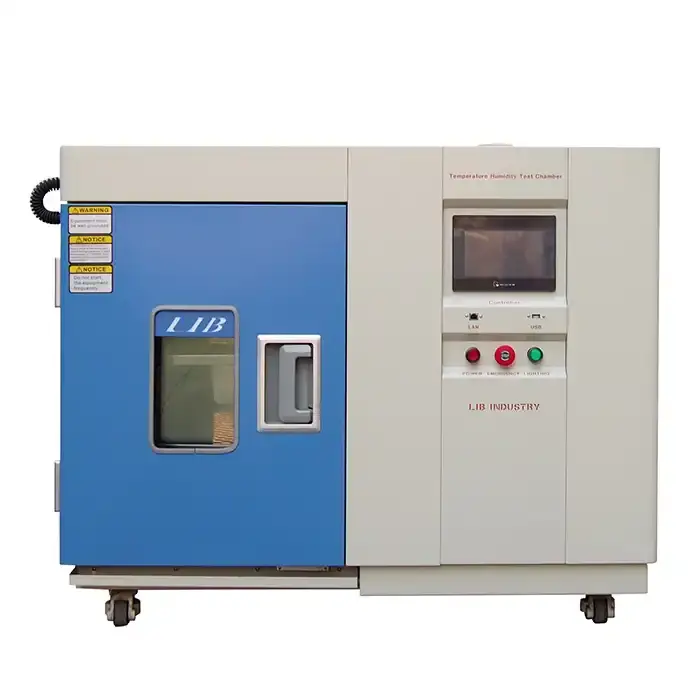
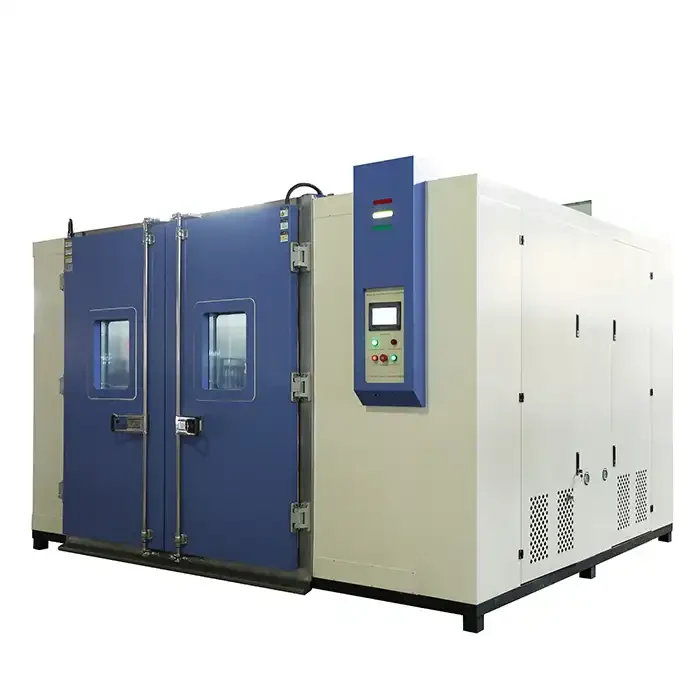
Small Benchtop Chamber vs. Walk-In Chamber: Which Do You Need?
| Benchtop Chamber (100–500L) | Walk-In Chamber (1000–3000L) | |
|---|---|---|
| Best for | Individual components, small PCB assemblies | Full modules, automotive ECUs, aerospace assemblies |
| Lab footprint | Small, fits standard lab bench | Requires dedicated floor space |
| Typical ramp rate | Up to 15°C/min | 10–15°C/min (larger mass, slightly slower) |
| Sample access | Single door, top-loaded fixtures | Walk-in access, multi-shelf loading |
| Common use case | Component-level qualification (JEDEC) | System-level qualification (automotive/aerospace) |
 |
 |
If you're not sure which fits your test plan, tell us your sample size and standard — we'll recommend the right configuration instead of the largest (and most expensive) option.
How LIB Industry Solves This for You
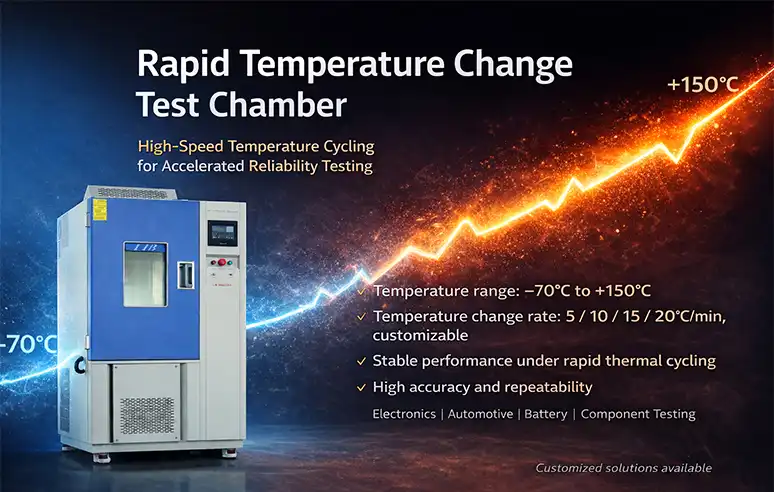
LIB Industry designs and manufactures thermal cycling test chambers built specifically to shorten your qualification cycle and reduce testing risk:
Faster qualification — ramp rates up to 15°C/min mean you complete more cycles in less time, without sacrificing repeatability.
Consistent results across every sample — ±2.0°C uniformity and ±0.5°C stability mean you won't get a false pass or fail from an uneven chamber.
Test powered assemblies safely — integrated anti-condensation control prevents surface moisture from shorting live circuits during power cycling.
Full traceability — Ethernet and PC Link data logging give you a defensible test record for customer audits and internal QA.
Sized to your product — from 100L benchtop units to 3000L walk-in chambers, so you're not paying for capacity you don't need.
Backed for the long term — every chamber comes with a 3-year warranty and lifetime after-sales service, so support doesn't end when the warranty period does.
Every LIB chamber ships as a turnkey solution: chamber design, manufacturing, on-site installation, commissioning, and operator training — so your team is running qualification tests, not troubleshooting equipment.
What to Expect: From Quote to Qualification
One reason buyers hesitate on equipment purchases is uncertainty about the process itself — how long it takes, what's included, and where things can go wrong. Here's what a typical LIB project looks like:
1. Application Review Send us your test standard, specimen size, and any special requirements (power cycling, custom fixtures, specific ramp rates). Our engineers confirm the right chamber configuration before you receive a quote — not after.
2. Configuration & Quotation You receive a detailed spec sheet matching your application, along with pricing and lead time. No generic catalog pricing — the configuration is built around your actual test plan.
3. Manufacturing & Factory Acceptance Test (FAT) Once confirmed, the chamber is built and tested in-house against your specified parameters — temperature range, ramp rate, uniformity — before it ever leaves the factory. You can request FAT documentation or remote witness testing.
4. Installation & Commissioning LIB's team handles on-site installation and commissioning, verifying the chamber performs to spec in your actual lab environment, not just under factory conditions.
5. Operator Training Your team is trained directly on the chamber's controller, programming, and safety systems, so testing can begin immediately rather than waiting on a learning curve.
6. After-Sales Support Every chamber includes a 3-year warranty, and LIB provides lifetime technical support and service for the life of the equipment — the same responsiveness reflected in the customer feedback above.
This process is designed to remove the two biggest risks in equipment purchasing: getting a chamber that doesn't match your actual test requirements, and being left without support once it's installed.
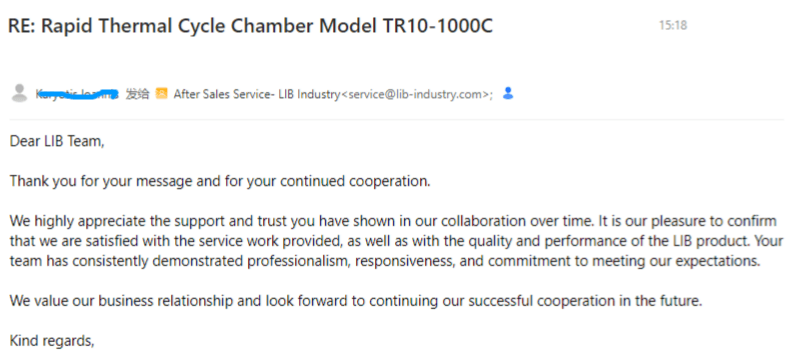
Customer Case: Rapid Thermal Cycle Chamber TR10-1000C in Production Use
LIB Industry supplied a Rapid Thermal Cycle Chamber (Model TR10-1000C) to a leading battery and energy technology manufacturer for use in their engineering test operations. Following installation and after-sales support, the customer's facilities engineering team confirmed the following:
"We are satisfied with the service work provided, as well as with the quality and performance of the LIB product. Your team has consistently demonstrated professionalism, responsiveness, and commitment to meeting our expectations."
This reflects the standard LIB provides across every project: not just a chamber that meets spec on delivery, but ongoing after-sales responsiveness that keeps test operations running.
[Optional: add installation or FAT (factory acceptance test) photos with the chamber only — no customer name, logo, or site-identifying details — to strengthen this section visually while keeping the client anonymous.]
Recommended LIB Chambers for Solder Joint & PCB Testing
| Model | Capacity | Ramp Rate | Best For |
|---|---|---|---|
| TR5-100 | 100L | Up to 15°C/min | Benchtop component-level qualification |
| TR5-500 | 500L (700×800×900mm) | Up to 15°C/min | Standard PCB assemblies, automotive modules |
| TR5-1000W | 1000L Walk-In | 10–15°C/min | Multi-unit or system-level batch testing |
| TR5-3000W | 3000L Walk-In | 10–15°C/min | Full automotive ECU / aerospace chassis qualification |
Not sure which model fits? Send your specimen size and target standard, and we'll confirm the right configuration before you request pricing.
FAQs
How many thermal cycles does my product need to pass qualification?
It depends on your industry and standard. Consumer electronics typically require 500–1000 cycles; automotive components under AEC-Q100 often require 500–1000+ depending on device grade. We can confirm the exact number based on your target standard.
Can I test powered (energized) assemblies in a thermal cycling chamber?
Yes — LIB chambers support cable ports and anti-condensation control specifically for power cycling tests, where the assembly is electrically active during thermal transitions.
What's the difference between thermal cycling and thermal shock testing?
Thermal cycling uses controlled ramp rates (5–15°C/min) with equilibrium dwell periods, closer to real-world conditions. Thermal shock uses much faster transitions (25°C/min+) via liquid immersion, producing more aggressive — but less field-representative — stress.
How long does a full qualification test take?
For 1000 cycles at a 30–60 minute cycle duration, expect roughly 3–4 weeks of continuous testing, depending on dwell time and ramp rate.
Do you provide installation and training, or just the chamber?
LIB provides a full turnkey service — chamber manufacturing, on-site installation, commissioning, and operator training are included, not sold separately.
Ready to Qualify Your Product with Confidence?
Solder joint failures are expensive to discover after shipment and inexpensive to catch in the lab. If you need to validate PCB or component reliability under JEDEC, IPC, AEC-Q100, or MIL-STD conditions, LIB Industry can help you specify the right chamber, standard, and test plan — not just sell you equipment.
Contact our applications engineering team at ellen@lib-industry.com to get a configuration recommendation and quotation for your specific application.