Battery Cell Thermal Testing in Benchtop Environments
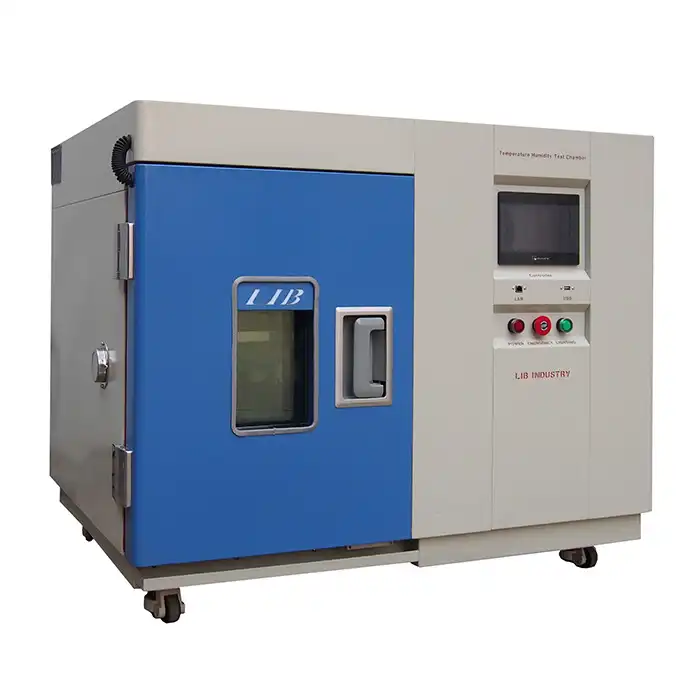
Battery cell thermal testing represents a crucial validation process that determines how lithium-ion cells respond to temperature extremes, charge-discharge cycles, and environmental stress conditions. A benchtop environmental chamber provides researchers and quality engineers with precise temperature and humidity control in a compact, laboratory-friendly format. This space-efficient testing approach enables comprehensive thermal characterization without requiring dedicated testing facilities or extensive floor space. By simulating real-world operating conditions - from sub-zero winter storage to high-temperature summer charging - benchtop chambers reveal performance degradation patterns, safety thresholds, and reliability limitations that inform battery design improvements, manufacturing quality standards, and consumer safety protocols.
Why Temperature Control Is Critical for Battery Safety?
Thermal Runaway Prevention and Risk Mitigation
Lithium-ion batteries generate heat during normal operation, but uncontrolled temperature elevation triggers catastrophic thermal runaway - a chain reaction where internal temperature rise accelerates chemical decomposition, producing additional heat and potentially causing fires or explosions. A benchtop environmental chamber allows controlled observation of temperature thresholds where exothermic reactions initiate. Testing protocols gradually elevate ambient temperature while monitoring cell surface temperature, internal resistance, and voltage behavior, identifying the precise conditions where thermal stability becomes compromised.
Electrolyte Stability and Chemical Reaction Kinetics
Battery electrolytes maintain ionic conductivity within specific temperature ranges, typically -20°C to 60°C depending on formulation. Outside these boundaries, electrolyte viscosity increases at low temperatures, reducing ion mobility and available capacity. Conversely, elevated temperatures accelerate decomposition reactions that form solid-electrolyte interphase (SEI) layer growth, consuming active lithium and permanently degrading capacity. Benchtop chambers equipped with temperature ranges from -40°C to +150°C enable comprehensive evaluation of these temperature-dependent electrochemical processes.
Component Material Expansion and Mechanical Stress
Battery cells comprise multiple materials with differing thermal expansion coefficients - aluminum and copper current collectors, graphite and lithium metal oxide electrodes, polymer separators, and steel or aluminum casings. Temperature variations generate mechanical stress at material interfaces, potentially causing separator tears, electrode delamination, or housing breaches. Thermal cycling in a benchtop environmental chamber subjects cells to repeated expansion-contraction cycles, revealing mechanical weaknesses before they manifest in field failures.
Table 1: Critical Temperature Thresholds in Lithium-Ion Battery Operation
|
Temperature Range |
Battery Behavior |
Safety Concerns |
Testing Objectives |
|
Below -20°C |
Reduced capacity (50-70%), increased impedance |
Lithium plating during charging |
Cold cranking performance validation |
|
-20°C to 0°C |
Limited charge acceptance, slower discharge |
Diminished regenerative braking |
Winter operation characterization |
|
0°C to 45°C |
Optimal performance range |
Minimal degradation |
Baseline performance establishment |
|
45°C to 60°C |
Accelerated aging, capacity fade |
SEI layer growth, gas generation |
Shelf life and calendar aging studies |
|
Above 60°C |
Rapid degradation, thermal runaway risk |
Fire, explosion hazards |
Safety limit determination |
Simulating Charge and Discharge Thermal Conditions
Heat Generation During High-Rate Charging
Fast-charging protocols push current densities beyond standard rates, generating significant resistive heating within battery cells. A benchtop environmental chamber maintains controlled ambient temperatures while cells undergo charge cycling, isolating the thermal contribution from environmental factors versus internal heat generation. Temperature sensors positioned on cell surfaces map heat distribution patterns, identifying hot spots that indicate internal resistance variations or current distribution non-uniformities requiring design optimization.
Discharge Performance Under Temperature Extremes
Electric vehicle batteries must deliver power reliably whether operating in Arizona summers or Minnesota winters. Discharge testing within a benchtop environmental chamber quantifies available capacity and power capability across temperature spectrums. Protocols typically measure discharge curves at -20°C, 0°C, 25°C, 45°C, and 60°C, revealing how voltage, internal resistance, and energy delivery degrade outside optimal temperature ranges - data essential for battery management system calibration.
Thermal Equilibrium Versus Dynamic Temperature Transitions
Real-world applications rarely maintain constant temperatures; vehicles parked in cold garages then driven in heated cabins, or consumer electronics transitioning from air-conditioned offices to outdoor heat. Dynamic testing protocols program temperature ramps within the benchtop environmental chamber - simulating gradual warming or cooling - while simultaneously cycling cells. This approach reveals performance characteristics during thermal transitions that static temperature testing cannot capture, providing insights into how quickly battery management systems must respond to changing conditions.
Thermal Cycling Tests for Battery Cell Reliability
Accelerated Aging Through Temperature Fluctuation
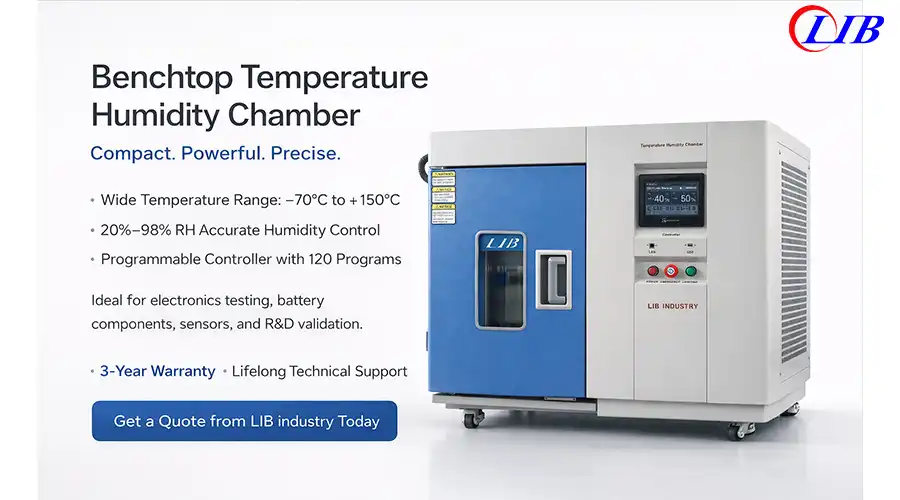
Thermal cycling accelerates degradation mechanisms that occur gradually during normal use, compressing years of calendar aging into weeks of testing. A typical protocol alternates between temperature extremes - such as -40°C for four hours, then +85°C for four hours - repeated for hundreds of cycles. The programmable controller in advanced benchtop chambers stores these complex profiles, executing unattended multi-week tests while logging temperature, humidity, and test duration. Periodic capacity measurements reveal degradation rates that predict field longevity.
Mechanical Integrity and Housing Seal Validation
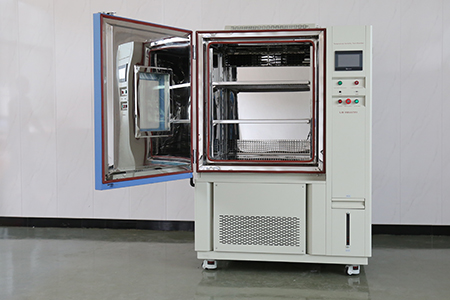
Battery packaging must maintain hermetic seals preventing moisture ingress and electrolyte leakage throughout the product lifecycle. Thermal cycling induces expansion-contraction stresses that challenge crimp seals, weld joints, and polymer gaskets. Post-cycling leak testing using helium mass spectrometry or pressure decay methods identifies seal degradation. The double-layer insulating glass observation window in benchtop chambers enables visual monitoring throughout testing, capturing the exact cycle when physical damage manifests.
Capacity Retention and Internal Resistance Evolution
Quantifying how thermal cycling affects electrical performance requires systematic measurement protocols. Baseline capacity testing establishes initial performance, followed by defined thermal cycling periods - typically 50, 100, 200, and 500 cycles - with intermediate capacity checks. Plotting capacity retention percentage versus cycle count reveals whether degradation follows linear, exponential, or threshold patterns. Internal resistance measurements using AC impedance spectroscopy identify whether capacity loss stems from active material degradation, SEI layer growth, or current collector corrosion.
Table 2: Standard Thermal Cycling Protocols for Battery Reliability Assessment
|
Test Standard |
Temperature Range |
Dwell Time |
Transition Rate |
Total Cycles |
Pass Criteria |
|
IEC 62133 |
-40°C to +75°C |
30 minutes each |
≤ 5°C/min |
10 cycles |
No leakage, venting, or rupture |
|
UN 38.3 T.4.2 |
-40°C to +75°C |
6 hours each |
< 30 min transition |
10 cycles |
No fire, no explosion, voltage > 90% |
|
SAE J2464 |
-40°C to +85°C |
1 hour each |
As fast as possible |
200 cycles |
Capacity > 80% retention |
|
GB/T 31467.3 |
-40°C to +85°C |
30 minutes each |
≤ 5°C/min |
5 cycles |
No abnormal appearance change |
Detecting Performance Degradation Under Environmental Stress
Capacity Fade Mechanisms and Diagnostic Techniques
Battery capacity decreases through multiple degradation pathways: lithium inventory loss from SEI layer formation, active material particle cracking, binder decomposition, and current collector corrosion. Environmental stress testing in a benchtop environmental chamber accelerates these mechanisms, making them observable within practical timeframes. Differential voltage analysis comparing fresh versus aged cells reveals peak shifts indicating structural changes in electrode materials, while incremental capacity analysis quantifies lithium loss mechanisms.
Impedance Spectroscopy for Degradation Characterization
Electrochemical impedance spectroscopy (EIS) measures battery response to small alternating current signals across frequency ranges from millihertz to kilohertz. The resulting Nyquist plots reveal distinct semicircles corresponding to SEI layer resistance, charge-transfer resistance, and diffusion impedance. Periodic EIS measurements during environmental chamber testing track how these resistance components evolve, diagnosing which degradation mechanisms dominate under specific stress conditions - invaluable information guiding material selection and cell design refinements.
Gas Evolution and Pressure Buildup Monitoring
Electrolyte decomposition generates gases - primarily carbon dioxide, carbon monoxide, and hydrocarbons - that increase internal cell pressure. Pouch cells exhibit visible swelling, while cylindrical cells may develop bulging ends or venting through safety mechanisms. Advanced testing protocols incorporate pressure sensors or laser displacement gauges monitoring dimensional changes while cells undergo environmental stress. The benchtop environmental chamber's SUS304 stainless steel interior and safety protection systems enable safe testing of cells approaching failure conditions.
Standards Used in Battery Environmental Testing
International Electrotechnical Commission Requirements
IEC 62133 establishes safety requirements for portable sealed secondary lithium cells and batteries, mandating thermal cycling tests, external short circuit tests at elevated temperatures, and thermal abuse testing. Compliance requires controlled temperature environments precisely maintained within ±2°C - a specification met by quality benchtop chambers featuring PID control algorithms and multiple temperature sensors ensuring uniform chamber conditions. Documentation requirements demand automated data logging, functionality standard in modern touchscreen controllers with Ethernet connectivity.
United Nations Transportation Safety Regulations
UN 38.3 Test Summary specifies eight tests required before lithium batteries can be transported by air, sea, or ground. Test T.4.2 (thermal test) subjects cells to extreme temperature cycling while monitoring for leakage, venting, disassembly, rupture, or fire. The compact footprint of benchtop chambers proves advantageous here, as testing laboratories often process dozens of battery variants simultaneously, requiring multiple chambers operating independent protocols - a scenario where space efficiency directly impacts laboratory throughput capacity.
Society of Automotive Engineers Standards for Electric Vehicles
SAE J2464 outlines electric vehicle battery abuse testing including thermal cycling, mechanical shock, and crush resistance evaluations. Automotive applications demand exceptional reliability given safety-critical functions and 10-15 year lifespans. The extended temperature range capabilities of advanced benchtop environmental chambers (-40°C to +150°C) accommodate the stringent conditions specified in automotive standards, while the 1000W heat load capacity handles the thermal mass of larger-format automotive cells without temperature lag.
Chinese National Standards for Energy Storage Systems
GB/T 31467 series provides comprehensive testing protocols for lithium-ion traction battery packs, including environmental adaptation requirements. These standards specify humidity cycling combined with temperature extremes - conditions requiring simultaneous temperature and humidity control. Benchtop chambers offering 10-98% RH humidity ranges with ±2.5% precision enable compliance testing, while the water purification and recirculation system maintains contamination-free conditions essential for reliable humidity control.
Table 3: Comparison of Battery Testing Standards and Chamber Requirements
|
Standard |
Temperature Range |
Humidity Requirements |
Cycle Requirements |
Chamber Specifications Needed |
|
IEC 62133 |
-40°C to +75°C |
Not specified |
10 cycles minimum |
±2°C uniformity, safety protections |
|
UN 38.3 T.4.2 |
-40°C to +72°C |
Not specified |
10 cycles, 6h dwell |
Automatic cycling, data logging |
|
SAE J2464 |
-40°C to +85°C |
Not specified |
200 cycles |
Fast transition rates, high heat load |
|
GB/T 31467.3 |
-40°C to +85°C |
10% to 98% RH |
Combined temp/humidity |
Simultaneous T&H control, 50mm cable port |
Improving Battery R&D Efficiency with Benchtop Chambers
Rapid Prototyping and Iterative Design Validation
Battery development involves continuous improvement cycles: formulate new electrode chemistries, fabricate prototype cells, test performance, analyze results, and refine designs. Traditional walk-in environmental chambers require scheduling, sample transport, and extended setup procedures that slow iteration cycles. Benchtop chambers positioned directly in research laboratories enable immediate testing following cell fabrication. The plug-and-play convenience - operating on standard 110V/220V single-phase power - eliminates installation delays, accelerating the development timeline from concept to validated design.
Parallel Testing of Multiple Cell Variants
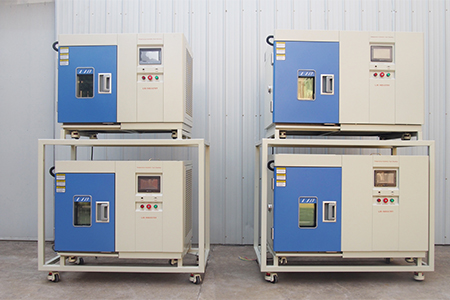
Research programs typically evaluate multiple variables simultaneously: different electrolyte additives, separator materials, electrode loadings, or formation protocols. The compact size and affordable cost of benchtop chambers enable laboratories to operate multiple units simultaneously, each running independent test protocols. This parallel testing approach generates comparative data much faster than sequential testing in shared facilities, while the adjustable SUS304 stainless steel shelving accommodates various cell formats from coin cells to prismatic automotive cells.
Real-Time Monitoring and Remote Data Access
Modern battery research demands continuous data visibility enabling rapid decision-making. Benchtop chambers equipped with Ethernet connectivity and smartphone access allow researchers to monitor test progress from anywhere. Programmable controllers create complex profiles with up to 120 programs containing 100 segments each, executing sophisticated test sequences unattended. Email alerts notify teams when tests complete or anomalies occur, while exported data integrates directly into analysis software - streamlining workflows from testing through reporting.
Discover the Full Range of LIB Industry Environmental Test Chambers
| Product | Application | Key Advantages |
|---|---|---|
|
|
Battery cells, electronic components, laboratory research | Compact design saves laboratory space while providing precise temperature and humidity control. Ideal for R&D and small-sample testing. |
|
|
Product reliability, quality control, environmental simulation | Available from 100L to 1000L with temperature ranges down to -70°C, suitable for most environmental testing requirements. |
|
|
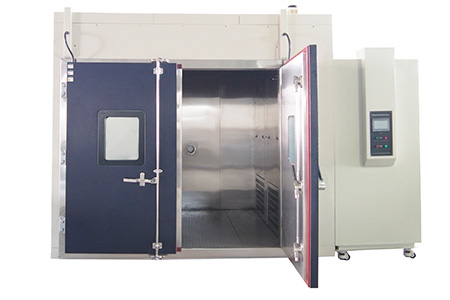
Battery packs, automotive parts, large equipment testing | Customized chamber size allows testing of oversized products and multiple samples simultaneously, improving testing efficiency. |
|
|
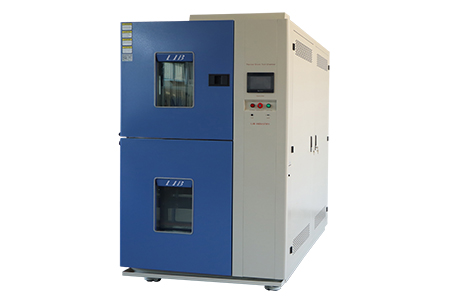
Material durability and reliability verification | Rapid transfer between hot and cold zones creates extreme thermal stress, helping identify potential product failures in a short time. |
LIB Industry Ensures Accurate Battery Thermal Testing and Safety Validation
|
|
|
|||


Precision Temperature Control Across Extreme Ranges
LIB Industry's benchtop environmental chamber delivers exceptional temperature uniformity through advanced refrigeration systems and optimized airflow design. The mechanical compression refrigeration system achieves temperatures as low as -86°C in specialized configurations, while heating elements reach +150°C - covering the full spectrum of battery testing requirements. Temperature fluctuation within ±0.5°C and deviation under ±2.0°C ensure test conditions remain stable, eliminating environmental variability that could confound test results or mask subtle performance differences between cell designs.
Safety-First Design for Lithium-Ion Testing
Testing lithium-ion batteries inherently involves fire and explosion risks, particularly during abuse testing or when evaluating marginal designs. LIB Industry incorporates multiple safety features specifically addressing these hazards: over-temperature protection prevents chamber conditions from exceeding safe limits, earth leakage protection guards against electrical faults, and the reinforced SUS304 stainless steel interior contains potential cell failures. Optional safety configurations for lithium-ion battery testing include explosion-proof venting, fire suppression systems, and reinforced observation windows maintaining visibility while providing blast protection.
Comprehensive Quality Assurance and Global Support
Every benchtop environmental chamber undergoes rigorous factory acceptance testing validated by independent third-party organizations including SGS and TUV, ensuring compliance with ISO 9001 quality management standards and CE safety directives. This certification provides confidence that temperature accuracy, humidity precision, and safety systems perform as specified. The comprehensive 3-year warranty backed by lifetime service commitment demonstrates manufacturing confidence, while the 24/7 global support network ensures technical assistance remains available regardless of time zone or location.
Customization Capabilities for Specialized Applications
Battery research encompasses diverse applications from medical implants requiring miniature cells to grid storage demanding large-format modules. LIB Industry's engineering expertise in custom design enables tailored chamber configurations addressing unique requirements: modified internal dimensions accommodating oversized samples, specialized cable ports for in-situ electrical connections, integrated gas sampling systems for degradation product analysis, or enhanced cooling capacity for high-power cycling tests. This flexibility ensures researchers obtain optimal testing platforms rather than compromising experimental designs to fit standard equipment limitations.
Conclusion
Battery cell thermal testing in benchtop environments delivers the precision, convenience, and safety features essential for modern lithium-ion development and quality validation. Compact chambers bring environmental simulation directly into research laboratories, accelerating development cycles while maintaining the temperature accuracy and humidity control demanded by international safety standards. From thermal runaway characterization to accelerated aging studies, these versatile platforms enable comprehensive battery evaluation without the space requirements or installation complexity of traditional walk-in chambers. Investing in benchtop testing infrastructure enhances research productivity, improves product safety, and ensures regulatory compliance across global battery markets.
FAQ
What chamber volume is needed for testing automotive-format battery cells?
Automotive cells typically measure 100-200mm in length and 50-100mm in width. The 80L benchtop model with 400×400×500mm internal dimensions comfortably accommodates 4-6 automotive pouch cells or 8-12 cylindrical cells simultaneously, with adjustable shelving enabling vertical stacking. Larger modules may require custom internal configurations or multi-chamber testing approaches.
Can benchtop chambers maintain stable conditions during active battery cycling?
The 1000W heat load capacity handles thermal energy generated by cycling cells without destabilizing chamber temperature. Advanced PID control algorithms continuously adjust heating and cooling to compensate for cell heat generation, maintaining setpoint temperature within ±0.5°C even during high-current charge-discharge cycling that produces significant internal heating.
How quickly can benchtop chambers transition between temperature extremes?
Standard configurations achieve 1°C/min cooling rates and 3°C/min heating rates. Transitioning from +25°C to -40°C requires approximately 65 minutes, while heating from -40°C to +85°C takes roughly 40 minutes. These rates satisfy most standard testing protocols, though high-performance configurations with enhanced refrigeration can achieve faster transitions when required.
Optimize Your Battery Testing with LIB Industry Solutions
As a trusted benchtop environmental chamber manufacturer and supplier, LIB Industry provides complete testing solutions tailored to battery research and validation requirements. Discuss your specific testing needs with our technical specialists at ellen@lib-industry.com to explore standard and custom chamber configurations.


