How Much Does a Composite Polymerization Oven Cost to Install?
Key Takeaways
There is no single honest price. Cost depends on chamber size, temperature class and site work, so ask for an itemized quotation.
Site work is the biggest variable. Power upgrades and exhaust ducting often move the budget more than oven size does.
Temperature class drives equipment price. Choose 250 °C, 400 °C or 900 °C by process need, not by the highest spec.
Standard LIB models ship in 7–15 days with a 36-month warranty. See the product overview below.
About LIB Composite Polymerization Ovens
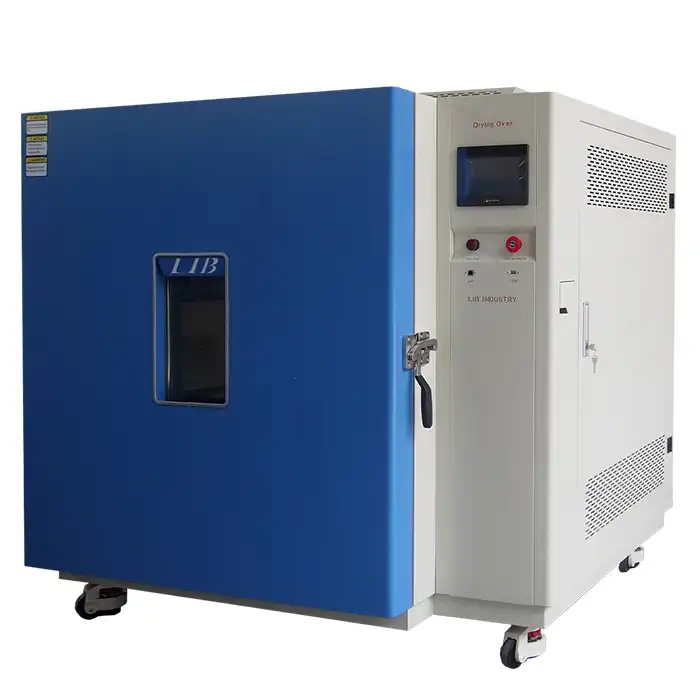 LIB Industry's polymerization ovens are programmable curing ovens for composite materials, available in five chamber sizes from 100 L to 1000 L and three temperature classes up to 900 °C. They are built for repeatable cure and post-cure cycles, where tight temperature control protects part quality.
Key features
Precise control: ±0.5 °C temperature fluctuation and ±2.0 °C deviation across the chamber.
Programmable operation: PID color LCD touch screen controller with Ethernet connection and an optional PC link for remote operation.
Clean, durable chamber: SUS304 stainless steel interior that resists corrosion and wipes clean after resin residue. The exterior is coated steel plate.
Controlled ramp: heating rate of 6 °C/min.
Solvent handling: exhaust port with adjustable flow for resin volatiles.
Scalable range: five models, O-100 to O-1000, plus custom builds for oversize parts.
Model range
|
Model |
Internal size (mm) |
Overall size (mm) |
Volume |
|---|---|---|---|
|
O-100 |
400×500×500 |
750×880×850 |
100 L |
|
O-225 |
500×600×750 |
800×950×1000 |
225 L |
|
O-500 |
700×800×900 |
1100×1100×1300 |
500 L |
|
O-800 |
800×1000×1000 |
1100×1450×1400 |
800 L |
|
O-1000 |
1000×1000×1000 |
1300×1400×1400 |
1000 L |
Temperature classes
|
Class |
Range |
Typical use |
|---|---|---|
|
A |
Ambient to +250 °C |
Most composite cure cycles |
|
B |
Ambient to +400 °C |
High-temperature post-cure |
|
C |
Ambient to +900 °C |
Special processes only |
Power supply is 380 V, 50 Hz. Operating environment is 5–35 °C, ≤85% RH.
Quality, delivery and support
|
Testing |
Every unit runs continuously for 72 hours before shipping |
|
Compliance |
CE and RoHS, with calibration available to ISO/IEC 17025 |
|
Lead time |
Standard models usually ship in 7–15 days |
|
Warranty |
36 months, then lifetime technical support and maintenance guidance |
|
Support |
24/7 English technical support and remote troubleshooting |
|
Service scope |
Design, customization, delivery, installation, commissioning and operator training |
|
Shipping |
Sea, air or door-to-door |
Beyond the standard range, LIB builds custom ovens, including a 6-meter unit for long steel tubing (see the case study below). The next sections explain what it costs to get one of these ovens running on your site.
Installed vs. Equipment Price
The equipment price is what appears on the quotation. The installed price is everything required to run your first production cure: delivery, rigging, electrical connection, exhaust ducting, commissioning, training and acceptance testing.
|
Cost line |
What drives it |
What to ask the supplier |
|---|---|---|
|
Equipment |
Model, temperature class, options |
Itemized quotation |
|
Delivery and rigging |
Weight, crate size, route to the floor |
Crate dimensions, gross weight |
|
Electrical connection |
Power rating, distance to supply |
kW, voltage, phases |
|
Exhaust and ventilation |
Volatile load, duct length |
Port size, flow rate |
|
Commissioning and training |
Days on site, number of operators |
Written scope of work |
|
Acceptance testing |
Test load, measurement points |
Pass/fail criteria |
LIB Industry provides turnkey service: design, manufacture, testing, delivery, installation and training. Utility lines up to the oven (power feed, exhaust duct) usually belong to your facilities team, so write down every task and its owner before you sign.
What Drives Equipment Cost
 Chamber volume. Larger chambers need more steel, heating power and floor space, and cost more to move. Size the chamber from your largest part plus airflow clearance. Extra empty volume costs you at purchase and again in energy every cycle. See the model table above.
Temperature class. Higher classes need different heating elements and insulation (polyurethane foam as standard, refractory brick for the highest class), which raises the price. Most composite cures stay below 250 °C, so pay for a 900 °C unit only if a step truly requires it.
Site Work and Infrastructure
Floor and access. Confirm the slab can carry the loaded oven. Measure doors, corridors and lift clearances against the crated size, because a crane or a removed wall panel can sharply raise delivery cost. Leave working clearance for loading, carts and service panels.
Electrical supply. Confirm the rated kW and phases for your model, then ask an electrician to check panel capacity and cable runs. New panels, long runs or transformer changes can add noticeably to the bill.
Exhaust. Resin systems release volatiles. LIB ovens include an exhaust port with adjustable flow, but you still need ducting to a safe discharge point. Long runs raise material and labor cost.
Safety and Compliance
NFPA 86 is the US standard for ovens and furnaces, covering fire and explosion hazards from flammable volatiles. It is widely used as a reference outside the US as well.
ATEX Directive 2014/34/EU governs equipment in potentially explosive atmospheres in the EU. Explosion-protected builds cost more, and only a hazard assessment shows whether you need one, so do it before ordering.
LIB ovens carry CE and RoHS compliance, with calibration available to ISO/IEC 17025.
When Customization Changes the Budget
Standard models are quicker to quote and ship. Custom builds add engineering time, so compare a standard model that nearly fits against a custom unit that fits exactly, including lead time.
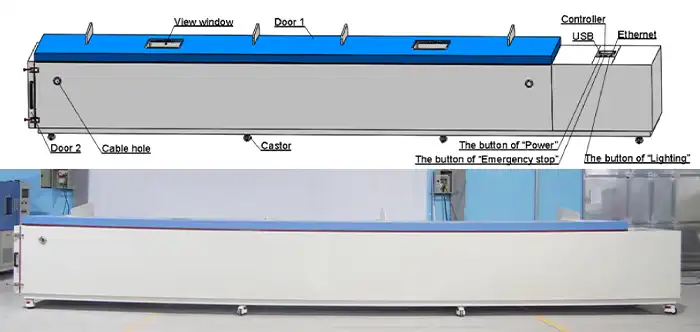
Case study: a 6-meter oven for long steel tubing
An oilfield-equipment customer needed to heat steel casing (170 mm outer diameter) with a heavy tool installed inside, while wires and hydraulic lines ran out of the casing ends for live monitoring. The load was very long, very heavy and hard to load.
LIB proposed a single 6-meter oven rated from ambient to 300 °C, with a top-opening door and a removable side door for placing the casing and connecting the lines. The customer approved the design, placed the purchase order within about a month of the first inquiry, and returned in January 2024 to discuss a second, similar oven with adjusted parameters.
Budget lesson: custom size and access features drive engineering, structural design and rigging cost. State part dimensions, weight and feed-through needs in your first inquiry.
Commissioning, Training and Acceptance
Commissioning covers positioning, wiring checks, control setup and test runs. Suppliers usually charge by engineer-day plus travel, so ask how many days the quote assumes and what happens if your site isn't ready. Finish utilities before engineers arrive to avoid paying for idle time.
Training covers daily checks, recipe entry, loading and alarm handling. It protects expensive composite parts from scrap, so ask for a written plan. LIB's scope includes installation, commissioning, operator training and 24/7 English remote support.
Acceptance testing. Every LIB unit runs continuously for 72 hours before shipping. For your own acceptance, agree in writing on a standard load, multi-point temperature readings, pass criteria matching the specification (±0.5 °C fluctuation, ±2.0 °C deviation) and a payment milestone tied to passing.
Total Cost of Ownership
TCO = purchase and options + installation and site work + (annual running costs × years of use) + downtime and scrap losses − resale value.
|
Line item |
How to estimate it |
|---|---|
|
Purchase and options |
Quoted price |
|
Installation and site work |
Contractor quotations |
|
Energy |
Measured kWh per cure cycle × cycles per year × tariff |
|
Maintenance and spares |
Supplier list plus your own history |
|
Calibration and checks |
Annual temperature uniformity verification |
|
Downtime and scrap |
Cost per lost batch × expected losses |
Ask suppliers for power consumption during ramp, soak and cool-down, since long soaks use the most energy. ISO 50001 gives a framework for setting an energy baseline. Verify uniformity at least annually, because sensors drift. After the 36-month warranty, LIB provides lifetime technical support, spare parts and on-site service when needed.
FAQ
How much does it cost to install a composite polymerization oven? There is no fixed price. Cost depends on chamber size, temperature class and site work. Request an itemized quotation covering equipment, delivery, installation, commissioning and training, then add your own electrical and ventilation work.
How long does delivery take? Standard LIB models usually ship within 7–15 days. Custom builds take longer depending on design and size. Sea, air and door-to-door shipping are available.
Do I need ATEX certification? Only if your process creates a potentially explosive atmosphere. A hazard assessment decides this, so complete it before ordering.
What temperature class do I need? Most composite cures stay below 250 °C. Choose 400 °C or 900 °C only when a post-cure or other step requires it.
Can LIB build an oven for oversize parts? Yes. LIB has built a 6-meter oven for long steel tubing with a removable side door and feed-through access. Send your part dimensions and weight for a design proposal.
Get a Tailored Quotation
Planning a cure line? LIB Industry designs, builds, installs and supports environmental test and curing ovens. Not sure which model fits? Send your part dimensions, cure schedule, power and site details to ellen@lib-industry.com, and our engineers will recommend a model and prepare an itemized quote.