ASTM G154 UV Test Chamber for Automotive Interior Plastics: What Labs Verify
Quick answer: Labs run ASTM G154 on automotive interior plastics to confirm that dashboards, door panels and trim keep their color, gloss and structural integrity after years of sunlight through glass. Specimens are exposed to fluorescent UV light and moisture in a UV test chamber, then measured for color change, gloss loss, cracking and surface defects against the carmaker's acceptance limits. Results feed material approval and supplier qualification long before a part reaches a vehicle line. The LIB UV-SI-260 offers eight 40 W lamps (UVA-340 or UVB-313), 0.3–20 W/m² irradiance control, black panel temperature of 35–80 °C and room for 56 specimens.

Why are automotive interior plastics tested to ASTM G154?
Cabin plastics sit behind glass, yet they still absorb enough UV and heat to fade, chalk and embrittle. Windshields and side glass filter out the shortest wavelengths, but longer UV and visible light pass through. Dashboard tops can reach very high surface temperatures in a parked car, so photodegradation and heat work together on polymers, pigments and stabilizer packages.
Faded trim, sticky surfaces and cracked skins draw warranty claims and hurt perceived quality. A UV weathering test early in development exposes weak formulations in the lab, where fixing them costs far less than a field recall. Carmakers often write their own light-ageing specifications, but a recognized practice such as ASTM G154 gives labs and suppliers a shared reference for apparatus, lamp type and exposure conditions. Always confirm which method the customer specification actually cites.
Which interior parts are tested, and what fails?
Different parts fail in different ways, so specimen selection should follow the component.
| Component | Typical material | Main concern |
|---|---|---|
| Instrument panel and dashboard skin | PVC, TPO, PU skins, PC/ABS | Fading, gloss change, cracking |
| Door panels and armrests | PP, TPO, PVC | Color shift, surface tack |
| Pillar trims and center console | PP, ABS, PC/ABS | Yellowing, gloss change |
| Soft-touch coatings and paints | PU coatings | Chalking, peeling, discoloration |
Flexible skins are sensitive to plasticizer migration and surface degradation, so labs watch for tack, cracking at bends and gloss drift. Rigid PP, ABS and PC/ABS parts often show yellowing or pigment fade first, and molded grain can hide or exaggerate gloss change. Coated trim adds a second failure route, peeling and loss of adhesion at the coating interface, so specimens should carry the real coating system, not bare substrate.
Which ASTM G154 cycles and lamps apply?
Cycle selection is the most consequential decision in the test plan, and it belongs to the customer specification. ASTM G154 defines cycles that alternate UV exposure with moisture at set black panel temperatures. Hours, setpoints and irradiance values differ between cycles and editions, so work from the edition cited in your contract.
| Lamp | Behavior | Best use |
|---|---|---|
| UVA-340 | Reproduces the short-UV end of sunlight | General plastics work, common for interior parts |
| UVA-351 | Simulates sunlight filtered through window glass | Parts that live behind a windshield (ASTM G154 lamp option; check your equipment supports it) |
| UVB-313 | Harsher, includes wavelengths not found in sunlight | Fast screening, not approval testing |
|
|
||
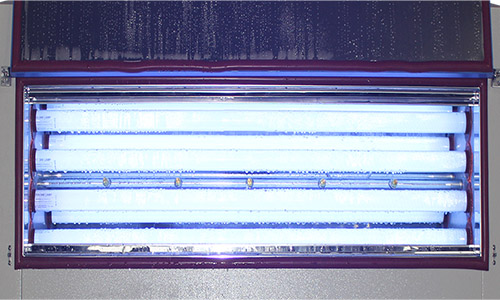
Plastics laboratories often also reference ASTM D4329 and ISO 4892-3, so choose a UV test chamber that stores several programmed cycles.
What do labs measure after exposure?
The UV test chamber only creates the exposure. The verdict comes from measurements taken before, during and after.
| Property | Instrument | What to report |
|---|---|---|
| Color | Spectrophotometer | ΔE, often with lightness and chroma shifts. Dark colors and light beige trims behave very differently, so tolerances are usually set per color family |
| Gloss | Gloss meter | Change at defined angles. Interior surfaces are often low-gloss, and small shifts are visible under cabin lighting, so limits tend to be tight |
| Surface | Visual inspection under agreed magnification | Cracking, crazing, chalking, blistering, tack. Flex specimens after exposure to reveal embrittlement |

How do you prepare specimens and set exposure duration?
Reliable data starts before the door closes: representative specimens, equal exposure and interim readings.
Mounting: many labs mount flat plaques in 75 × 150 mm holders. Retain unexposed reference specimens from the same lot.
Uniformity: fluorescent lamps lose output with use, and no two positions are perfectly equal. Closed-loop irradiance control, scheduled lamp replacement and periodic repositioning keep exposure comparable between runs.
Duration: it follows the customer specification and ranges from days to several weeks. Interim readings show the degradation curve instead of a single endpoint, which is far more useful for comparing formulations.
How do you use results for approval and supplier qualification?
Numbers become decisions only when they are tied to written limits. Approval typically compares measured ΔE, gloss change and visual rating with limits in the carmaker's specification. Reports should list lamp type, cycle, irradiance, black panel temperature, duration and measurement method, so any reviewer can reproduce the test.
New suppliers submit samples for qualification, and periodic retests catch resin, pigment or stabilizer changes. A consistent UV test chamber and fixed procedure make lot-to-lot trends meaningful. Laboratory acceleration does not map to a fixed number of years in a vehicle, so treat results as a ranking and screening tool and compare them with outdoor or in-vehicle data where available.
How do you choose a UV test chamber for automotive plastics?
Mirror the tests you run most: lamps, closed-loop control, capacity, moisture function and data.
| Area | What to request |
|---|---|
| Lamps | UVA-340 and UVB-313 options, with a lamp-hours display |
| Control | Closed-loop irradiance, black panel temperature, programmable cycles |
| Capacity | Number of plaques at your holder size, custom fixtures for molded parts |
| Moisture | Humidity and water spray, with automatic water supply |
| Data and access | Ethernet or PC link, multilingual interface |
| Support | Calibration, installation, training, spare parts |
Count the specimens per test, including replicates and references. For molded or curved parts, ask for custom fixtures so every surface sits at a consistent lamp distance.
LIB Industry UV-SI-260: a UV test chamber built for consistent aging tests
The UV-SI-260 runs UV light, temperature, humidity and water spray in one programmed sequence, with eight 40 W fluorescent UV lamps and a lamp-hours display that keeps exposure consistent. It suits plastics, paints, rubber and textiles.
| Parameter | UV-SI-260 |
|---|---|
| Light source | 8 × 40 W fluorescent UV lamps (UVA-340 or UVB-313), 50 mm from specimens |
| Wavelength / irradiance | 290–400 nm / 0.3–20 W/m² |
| Chamber / black panel temperature | Ambient to 90 °C ±2 °C / 35–80 °C |
| Humidity | ≥ 95% RH |
| Water spray cycle | 1–9999 h 59 min, adjustable |
| Specimen holder / capacity | 75 × 150 mm / 56 pcs, special holders can be customized |
| Controller | Programmable color LCD touch screen, Ethernet, PC link, multilingual |
| Water supply | Automatic, with water purification |
| Safety | Over-temperature, over-current, water shortage, earth leakage, phase sequence |
| Interior / overall size | 450 × 1170 × 500 mm / 610 × 1330 × 1470 mm |
| Materials | SUS304 stainless steel interior, coated steel exterior |
What stands out in daily lab use:
Lamp display: shows lamp service life, so you can replace lamps on time and keep results comparable. Lamp usable time is 5000 hours.
Two lamp options: UVA-340 matches sunlight for most outdoor and interior tests, while UVB-313 ages faster for quick screening.
Four conditions in one program: UV, temperature up to 90 °C, humidity ≥ 95% RH and spray run in a single sequence.
Black panel thermometer: a 150 × 70 mm stainless steel plate measures the sample-plane surface temperature, adjustable from 35 to 80 °C.
Multilingual control: German, French, Russian, Spanish, Portuguese, Polish, Turkish, Korean and more, with Ethernet to your PC.
Corrosion-resistant interior: SUS304 stainless steel stands up to humidity and long runs.
Typical users include automotive suppliers (exterior paint, interior materials, plastic and rubber parts), coatings and paint makers, and textile producers. For xenon arc testing of full-spectrum sunlight, see the LIB Xenon Chamber.
Case study: UV-SI-260 at Premier Products, Thailand
A Thai manufacturer reports that its LIB UV-SI-260 continues to meet its testing requirements. In September 2026, the R&D department of Premier Products Public Co., Ltd. in Thailand followed up with LIB after delivery and confirmed in writing that the UV weathering test chamber (model UV-SI-260) is operating well and continues to meet its requirements. The customer also thanked LIB for its after-sales service and said it looks forward to working with LIB in the future.
Why buy from LIB Industry?
Tested before shipment: every unit runs 72 hours at the factory.
Certified and inspected: CE, RoHS, ISO 9001 and ISO 17025 calibration, with inspection by SGS and TÜV.
3-year (36-month) warranty: if a unit cannot be repaired within the warranty period, we replace it with a new one. Lifetime technical support afterwards.
Global service: local support in the US, UK, Canada and Malaysia, with 24/7 English remote support, plus installation and operator training.
Fast delivery: standard models ship within 7–15 days by sea, air or door-to-door.
FAQ
Which lamp suits automotive interior plastics under ASTM G154?
UVA-340 is common for general plastics work, and UVA-351 simulates sunlight filtered through window glass. Follow the customer specification, and avoid UVB-313 for approval testing because it can create unrealistic failure modes.
What do labs measure after exposure?
Color change (ΔE) with a spectrophotometer, gloss loss with a gloss meter, and visual checks for cracking, chalking and tack. Results are compared with limits in the carmaker's specification.
Does ASTM G154 predict years of vehicle life?
No. Laboratory acceleration does not convert to a fixed number of years. The test ranks materials and screens formulations, and results are best compared with field or in-vehicle data.
How many specimens can the UV-SI-260 hold, and what size?
It holds 56 specimens of 75 × 150 mm, placed 50 mm from the lamps. Special holders can be customized for molded parts.
How long do the UV lamps last?
The usable time is 5000 hours. A lamp current display helps you track service life so you can replace lamps on time.
Can a UV test chamber replace xenon arc testing?
No. Fluorescent UV covers the UV region only and suits fast UV durability screening. Xenon arc reproduces the full solar spectrum and is preferred when color change under visible light matters. Many labs use both.
Contact LIB Industry
LIB Industry is an ASTM G154 UV test chamber manufacturer providing turn-key environmental testing solutions, from design through installation and training. Send your material, standard and test conditions to ellen@lib-industry.com for a tailored quote within 24 hours.