Composite Polymerization Oven Manufacturer: Key Specs to Compare
What are the five things that you should search for in the best oven making composites? What are they? The temperature range and heating rate, how stable and consistent the chamber is, how the airflow is designed, the chamber's size and load grade, and the safety features and controls. You shouldn't use the main idea of the paper. Instead, you should match each number to your own treatment plan. If the chamber moves across a full rack, it doesn't matter how hot the ceiling is. Also, it doesn't matter how big the room is as long as the middle shelf can't get air. Find out more about uniformity in writing and see how the oven works when it's full. A composite polymerization oven manufacturer should also take care of training and setting up. The next parts break down each standard using the public numbers from LIB Industry as a guide.
What Is a Composite Polymerization Oven and How Does It Work?
What a Polymerization Oven Actually Does
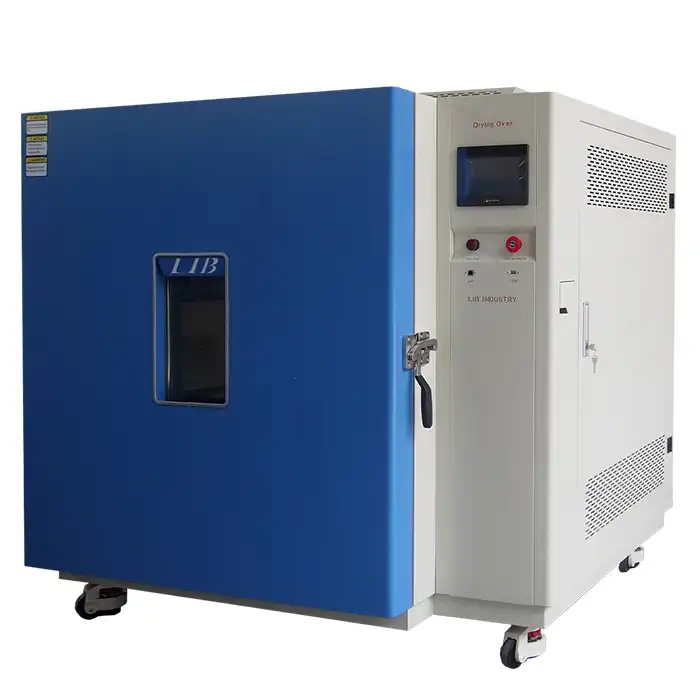
Heat is used in the polymerisation process to connect chemical chains into a strong network. This is how tough polymer plastics get. The polymerisation oven heats up on a set ramp. The part is heated to a "soak" temperature and then left to cool down. If the profile is wrong or the resin doesn't cure enough, the stress could be locked in. Because of this, the oven's job is not to heat, but to steer.
Where Curing Ovens Fit in Composite Work?
At LIB Industry, the oven can be used to heat, dry, cure, and bake things. It can also get rid of water, dry chemicals, and fix plastics. It is also possible to precisely cure carbon fibre and fibreglass parts, which is needed for projects in cars and planes that need to be very regular. For resins that need to dry under pressure, you need pressure tanks like autoclaves. The ovens will work at room temperature and pressure because of how it is set up.
Core Components Worth Knowing
In order to work, you need four things: the heating elements, the air fan, the room with its racks, and the controls. LIB talks about a rotating fan system with air paths that go across, up, and down, and a PID controller that can be set up. The heat is spread out more evenly by heating parts with more than one layer. You can better ask for a quote if you know these parts of it.
Key Temperature and Airflow Specifications to Compare
Temperature Range and Headroom
LIB divides temperatures into three groups: room temperature to +250 °C, 400 °C, and 900 °C. Choose a class based on the hottest weather you can handle plus a little extra. When you heat an oven to its highest level, the parts don't last as long. It's best to look at the whole plan before making a decision, since the steps that come after the main cure are often hotter.
Heating Rate and Ramp Control
It heats up at a rate of 6 °C per minute, and the forms can be set to go through more than one phase. What ramp you can use is written on the fix plan your resin source gives you. In some, you have to move more slowly up. Check the oven's speed every time it's full. A fast oven can never go from fast to slow, but a slow oven can never go from slow to fast.
Airflow Design and Rack Layout
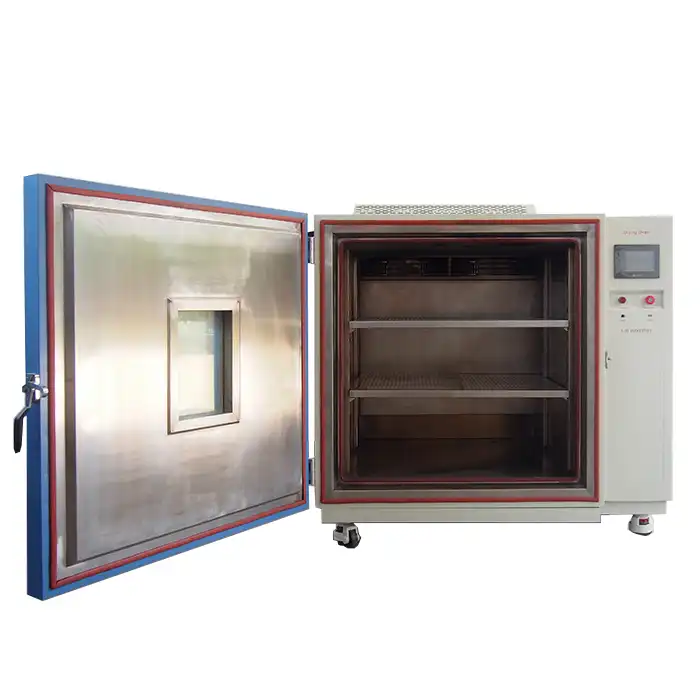
Even heat needs air to move around. The fan in LIB works well, and you can change how fast it runs to keep light parts safe. It also has sample racks with holes in them so air can move through them. How does the room's air get in and out? Does a fast fan hurt light prepreg parts?
| Parameter | LIB listed value | What to ask any supplier |
|---|---|---|
| Temperature range | Ambient to 250 / 400 / 900 °C | Which class covers your post-cure step with margin? |
| Heating rate | 6 °C/min | Is the rate measured empty or loaded? |
| Fluctuation | ±0.5 °C | At which setpoint was it measured? |
| Deviation | ±2.0 °C | Was it surveyed with a load? |
| Airflow | Fan with adjustable speed | How is flow directed across shelves? |
|
|
|
|
How Oven Size and Chamber Capacity Affect Composite Production?
Matching Volume to Part Geometry
Measure your largest part, add clearance for air to flow around it, and compare the result with internal dimensions from a composite polymerization oven manufacturer. LIB offers five models from 100 L to 1000 L. Oversized chambers waste energy on empty space, while cramped ones choke airflow and cause cold spots.
| Model | Internal dimensions (mm) | Volume |
|---|---|---|
| O-100 | 400×500×500 | 100 L |
| O-225 | 500×600×750 | 225 L |
| O-500 | 700×800×900 | 500 L |
| O-800 | 800×1000×1000 | 800 L |
| O-1000 | 1000×1000×1000 | 1000 L |
Load Rating and Shelf Strength
It's heavy to use composite tools. For LIB, each shelf can hold 50 kg by default or 200 kg for heavy-duty use. It may hold up to 2000 kg, but each type is different. You can change the shelf height in 25 mm steps and choose how much space there is between them. You should not only look at how much the part weighs, but also how much the tool weighs.
Loading Access and Throughput
Ask, and people will load carts from the floor. That way, your team won't have to move heavy tools to shelves. A big load also changes how the temperature acts because thick racks stop air from moving. Find out from the seller how long it takes for things to get back to normal after the door shuts.
Control Systems and Temperature Uniformity for Consistent Curing
Fluctuation Versus Deviation
They don't agree on anything. The change, which is shown as ±0.5 °C, shows how stable the room's temperature is over time. This number, ±2.0 °C, shows how far away readings from various parts of the room are from the setpoint. If you want the fix to work well, you should ask for each of these things along with the test settings.
Controller Features That Save Time
LIB works with a colour LCD touch screen that can be set up and managed from a computer. A USB port and Ethernet port are also on it. Engineers don't have to be near the oven to post recipes or check on a long cure. You should see if the program has built-in data logging if there are rules about it.
Proving Uniformity With a Load
There are numbers on notes that tell you how to do things. ASTM E145 says that the temperature has to stay the same for all-purpose air heaters [1]. This book for the AMS2750 shows you how to look into temperature stability and put heaters in groups [3]. If your company wants to heat metals, you should ask them if they have a plan for a study like this one. You can see this check if you build environmental test chambers.
Safety, Energy Efficiency, and Compliance Features to Evaluate
Layers of Protection
Keep an eye on things while they cure with a composite polymerization oven manufacturer because they can get very hot for a long time and solvents can leak out. The LIB says it has two controllers for separate over-temperature protection, an automatic exit port with variable flow, an emergency stop, and it meets ATEX standards. Find out which ones are normal and which ones aren't.
| Safety feature | LIB listed specification | Benefit |
|---|---|---|
| Over-temperature protection | Dual-controller system | Prevents equipment damage |
| Exhaust port | Variable flow control | Safe solvent removal |
| Emergency stop | Instant shutdown | Operator protection |
| Explosion-proof design | ATEX compliance available | Hazardous material processing |
Reading Energy Claims Carefully
You'll need to ask for it because it's not written on the sheet that comes out. You should know what kind of heater it is, how much power it needs to stay warm, and what kind of insulation is used at each temperature. There is a difference between insulation that works in a 250 °C oven and insulation that works in a 900 °C oven. Look at the way your model was made.
Standards Behind the Hardware
2014/34/EU from the EU has rules about safety gear that can be used in dangerous places [4]. This is what the hardware is based on. When there are dangerous fumes or vapours around, what safety rules do you need to follow? They're not in ASTM E145 [1]. Before you decide what to do if your fix's effects are dangerous, do these things.
How to Compare Composite Polymerization Oven Manufacturers?
Ask for Evidence, Not Adjectives
You can use words like "uniform" and "precision" for free. Find out what the load is, what setpoints were tried, and where the thermocouples are written down. People who work for a good company that makes composite polymerisation ovens will be happy to give you this information and explain how the numbers were collected.
Build a Weighted Scorecard
Write down the things that are important to your queue, like how even the load is, whether it can handle hills, the size of the room, any safety features, the settings, the delivery time, and how quickly service responds. Give each item and customer a score on its own, and then add them all up. They won't get extra money if their paper makes the most noise. This is because you wrote down the weights ahead of time.
Count Total Cost, Not Sticker Price
The price to buy is shown on one line. Time how long it takes to fix things, get more parts, use power, and be down. A cheap oven might be less expensive, but the parts that need to be changed could cost a lot more.
Customization, Installation and Training Support to Ask About
Turn-Key Scope
Based on what the customer needs, LIB Industry specialises in providing full solutions for environmental testing. These include research, design, production, commissioning, delivery, installation, and training. That way, you'll know which tasks are done and which ones need to be done by your team. Make a list of what each supplier is going to do.
Customization Options
Standard types aren't always accepted in all stores. Find out how big the room is, how warm it is, how the racks are set up, how far apart the shelves are, and how simple it is to get to the cart. LIB says you decide what goes in the cart and where to put your things on the shelves. Before you place your order, ask for plans. It costs a lot to change an oven that has already been built.
Acceptance Testing and Operator Training
Before you ship, set up an acceptance test. Run your real load a few times, and each time write down the temperature. Then, compare the numbers you were given to the ones you got. They need to learn how to enter recipes, make sure the load is safe, and deal with alarms. Smart people make sure the oven works right even after they set it up.
Conclusion
It's easier to choose between sellers from a composite polymerization oven manufacturer once each spec is linked to a cure need. You should be given a number, a test condition, and a written answer for each of the following: temperature range, ramp rate, load consistency, container size, safety choices, and support. First, use the brochure's values as a guide. Then, check them with a load that is similar to the one you will be using. Keep track of how much each factor costs, add up all the points, and agree on tests of acceptance before you pay. That way, your group will show real success instead of just making things sound good.
FAQ
What temperature uniformity should I expect from a curing oven?
LIB changes by ±0.5 °C and goes up or down by ±2.0 °C. After putting down an average load, time how long it takes for the glue to dry. This is the limit.
How do I pick the right chamber size?
Check to see if there is enough room for your biggest part, and then match those numbers to the inside sizes. O-100 stands for 100 L and O-1000 for 1000 L in the LIB line. Check out the shelf and load weights too.
Do I need an explosion-proof oven?
You decide if your fix gives off powerful smells or not. LIB says it is possible to pass the ATEX test. Look at the risks to make sure you want it, and then ask the seller for papers that covers the setup you chose.
Call to Action
You can talk to a composite polymerization oven manufacturer that makes, sells, or makes composite polymerisation ovens if you do. When you rent a testing and drying oven from lib business, it comes with everything you need, from planning to setting it up and training. Send your part sizes and cure schedule to ellen@lib-industry.com for a tailored recommendation.