How Are Thermal Shock Chambers Used in Medical Manufacturing?
Medical products and packaging can experience sudden temperature changes during shipping, storage, sterilization, and use. Thermal shock chambers reproduce these rapid temperature transitions in a controlled environment, helping manufacturers identify cracking, delamination, seal failure, and other defects before products reach the market.
By automatically transferring specimens between hot and cold chambers, thermal shock testing can reproduce temperature extremes much faster than natural exposure. LIB Industry thermal shock chambers can operate from -75°C to +220°C, making them suitable for demanding medical product and material validation.
Need a thermal shock chamber for medical product testing? Contact LIB Industry for a customized testing solution.
What Role Do Thermal Shock Chambers Play in Medical Device Testing?
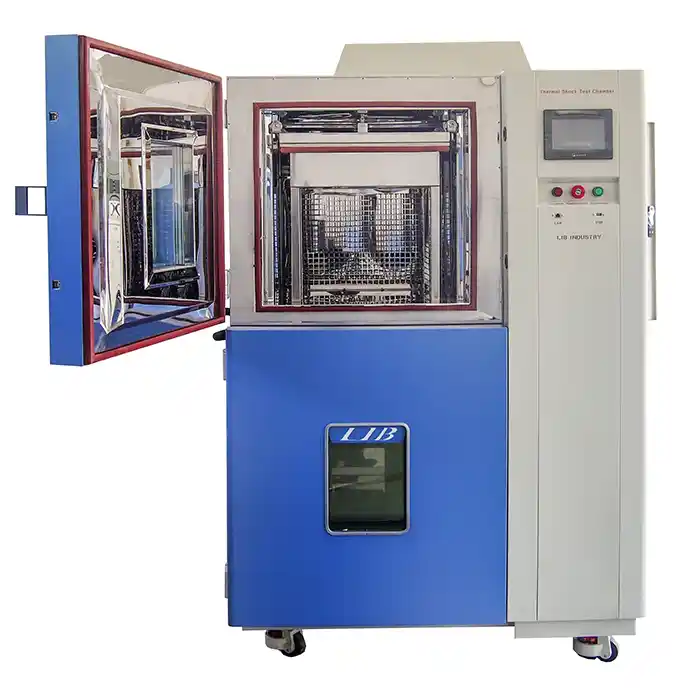 Thermal shock testing helps medical manufacturers evaluate whether products remain structurally and functionally reliable when exposed to rapid temperature changes.
Simulating Temperature Extremes
Medical devices may experience unheated cargo holds, hot transportation environments, refrigerated storage, and controlled laboratory conditions during their lifecycle. A thermal shock chamber reproduces these conditions through rapid basket transfer between hot and cold zones.
Verifying Sterile Barrier Integrity
Rapid temperature changes can create stress in heat-sealed packaging. Differences in thermal expansion may cause micro-cracks, seal separation, or other defects that could compromise the sterile barrier.
Thermal shock testing allows manufacturers to identify these weaknesses before packaging designs enter full-scale production.
Supporting Product Validation
Documented thermal shock results can provide useful evidence during product validation and technical documentation. Test protocols should always be selected according to the applicable product requirements and regulatory framework.
Which Medical Products Need Thermal Shock Testing?
Thermal shock testing can be applied to different medical products, but the failure mechanisms being evaluated vary by product type.
Sterile Packaging and Pouches
Heat-sealed pouches, trays, and other sterile barrier systems can be exposed to repeated temperature cycles to evaluate seal integrity and material stability.
Temperature extremes can make packaging materials brittle or cause different layers to expand and contract at different rates, increasing the risk of seal failure.
Implantable Devices and Components
Medical-grade polymers, metal components, adhesives, and other implant-related materials may require temperature cycling to evaluate dimensional stability and resistance to cracking.
This is particularly important when components must maintain tight dimensional tolerances after manufacturing and sterilization.
Diagnostic and Electronic Medical Equipment
Circuit boards, sensors, housings, solder joints, and electrical connections can experience repeated expansion and contraction during transportation and storage.
Thermal shock testing helps reveal weaknesses that may not appear under normal gradual temperature changes.
Why Does Thermal Shock Cause Product Failure?
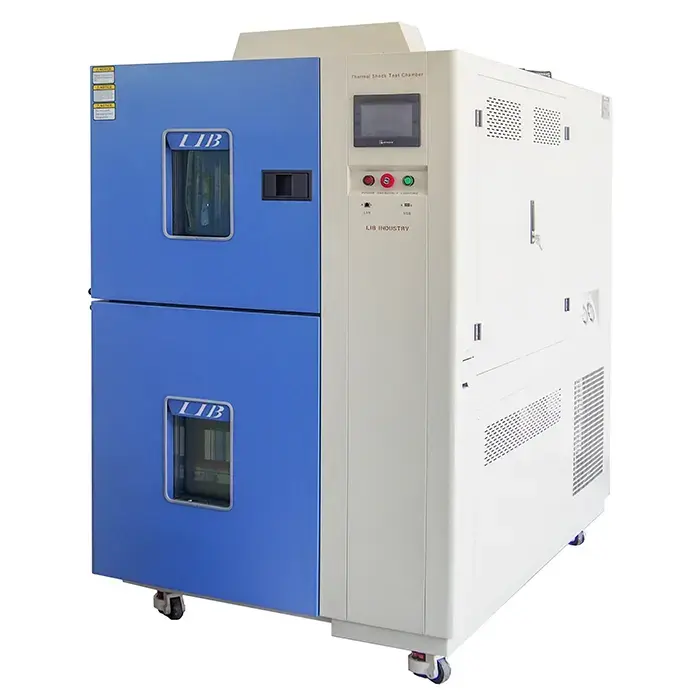 The main difference between thermal shock and conventional temperature testing is the speed of temperature transition.
Coefficient of Thermal Expansion Mismatch
Different materials expand and contract at different rates. When plastic, metal, adhesive, or multilayer packaging materials are joined together, rapid temperature changes can generate internal stress.
Repeated stress may eventually cause micro-cracking, delamination, or seal separation.
Rapid Transition vs. Gradual Temperature Change
A conventional oven or freezer changes temperature relatively slowly, giving materials more time to reach thermal equilibrium.
A thermal shock chamber transfers specimens rapidly between hot and cold zones. This produces a much stronger thermal stress than gradual temperature conditioning.
Repeated Cycle Effects
Thermal shock testing can reproduce many temperature transitions within a practical testing period. LIB Industry chambers can recover to the required temperature conditions in approximately five minutes, helping manufacturers conduct repeated cycles efficiently.
Testing a new medical product or packaging design?
LIB Industry can help match the chamber temperature range, basket capacity, cycle requirements, and control system to your application.
Which Standards Are Relevant to Medical Thermal Shock Testing?
The applicable standard depends on the product, test objective, and regulatory requirements. Standards referenced in medical manufacturing applications include:
| Standard | Focus Area | Typical Application |
|---|---|---|
| ISO 11607 | Sterile packaging integrity | Pouches, trays, sterile barrier systems |
| ASTM F2100 | Medical face mask material performance | Protective medical textiles |
| ASTM D4332 | Conditioning of shipping containers | Packaging distribution testing |
| IEC 60601-1 | Medical electrical equipment safety | Diagnostic and therapeutic devices |
Manufacturers should establish the test protocol according to the specific product classification and applicable requirements rather than assuming that one temperature cycle applies to every medical product.
Test records should typically document key parameters such as maximum and minimum temperature, dwell time, transition conditions, and total cycle count.
How Should You Select a Thermal Shock Chamber for Medical Applications?
Choosing the right chamber requires more than simply checking the maximum and minimum temperature.
1. Temperature Range and Recovery Time
The chamber should reach the required temperature extremes and recover quickly enough to complete the required number of cycles within the planned testing period.
LIB Industry's TS series provides a temperature range of -75°C to +220°C with recovery in approximately five minutes.
2. Basket and Loading Capacity
The basket should provide smooth and reliable movement between hot and cold zones without damaging specimens. Loading capacity should also match the size and quantity of medical packaging or components being tested.
3. Interior Material
A SUS304 stainless steel interior provides corrosion resistance and is suitable for laboratory environments where cleanliness and durability are important.
4. Control and Safety
For repeated automated testing, programmable control, data communication, and safety protection are important. These features help operators maintain consistent test conditions while reducing manual intervention.
Why Choose LIB Industry Thermal Shock Chambers?
LIB Industry designs and manufactures thermal shock chambers for applications requiring rapid and repeatable temperature transitions.
Wide Temperature Range and Fast Recovery
The LIB Industry TS series supports temperatures from -75°C to +220°C and can recover to the required condition in approximately five minutes. This combination is useful for medical manufacturers conducting repeated thermal shock cycles.
Programmable Control and Ethernet Communication
The chamber uses a programmable color LCD touch-screen controller with Ethernet communication, allowing operators to configure and monitor automated multi-cycle test programs.
Integrated Safety Protection
Safety functions include protection against over-temperature, over-current, refrigerant high pressure, and earth leakage, helping protect both specimens and laboratory personnel.
3-Year Warranty & Lifetime Support
Backed by a 3-year warranty, lifetime technical support, and 24/7 English after-sales service. If the chamber cannot be repaired during the warranty period, LIB Industry provides a replacement according to the warranty terms.
LIB Industry provides support covering research, design, production, commissioning, delivery, installation, and training. This allows medical manufacturers to source the chamber and related technical support from one supplier.
Related Environmental Test Chambers
Thermal shock testing is often combined with other environmental reliability tests during medical product development.
|
|
|
|
Temperature & Humidity Test ChamberUsed for controlled temperature and humidity conditioning, aging, and environmental durability testing. |
Thermal Cycling ChamberSuitable for repeated temperature changes at controlled rates when gradual transitions are required instead of the rapid hot-to-cold transfer used in thermal shock testing. |
Walk-in Environmental Test ChamberProvides a larger testing space for medical equipment, packaging batches, production components, or other large assemblies that cannot fit inside a standard chamber. |


FAQ
What temperature range do thermal shock chambers typically cover?
The required range depends on the test protocol and product. LIB Industry's TS series covers -75°C to +220°C, with rapid transfer between hot and cold zones.
Why is thermal shock testing important for medical packaging?
Rapid temperature changes can stress heat-sealed seams and multilayer packaging materials. Thermal shock testing helps reveal cracking, delamination, and seal separation before these problems occur in actual distribution or storage.
How many cycles are required for medical thermal shock testing?
There is no single cycle count for all medical products. The required number depends on the applicable test protocol, product type, and validation objectives. The chamber should therefore support programmable cycle counts and reliable repeatability.
Conclusion
Thermal shock chambers help medical manufacturers evaluate the reliability of sterile packaging, materials, implantable components, and electronic medical equipment under rapid temperature changes.
The key to effective testing is selecting the appropriate temperature range, transition speed, recovery time, basket capacity, control system, and safety features for the application.
With a -75°C to +220°C temperature range, approximately five-minute recovery, programmable control, Ethernet communication, and integrated safety protection, LIB Industry's thermal shock chambers provide a practical solution for demanding medical manufacturing validation.
Looking for a thermal shock chamber for your medical manufacturing application? Contact LIB Industry to discuss your testing requirements and customization options.