How to Choose Weathering Test Equipment for Solar Panel Durability Testing?
Looking to buy accelerated weathering testers for solar panel materials? Get a suitable configuration and quotation from LIB Industry.
Solar panels are designed to operate outdoors for decades, but long-term exposure to UV radiation, temperature changes, moisture, and rain can gradually degrade encapsulants, backsheets, coatings, adhesives, and other components.
For solar manufacturers, waiting years to observe natural aging is not practical. Weathering test equipment accelerates these environmental stresses in a controlled laboratory environment, helping manufacturers identify material degradation and potential failures before products enter the field.
For companies looking to buy accelerated weathering testers, the key is choosing equipment that can reproduce the required solar spectrum, control temperature and humidity accurately, provide uniform specimen exposure, and comply with relevant testing standards.
What Does Weathering Test Equipment Test in Solar Panels?
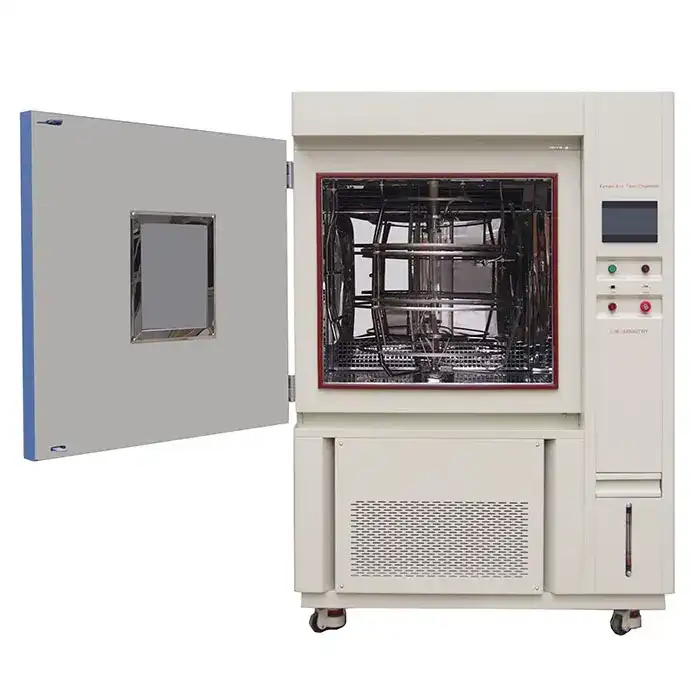 The main purpose of accelerated weathering testing is to reproduce the environmental conditions responsible for long-term material degradation.
PV encapsulants such as EVA and POE, backsheets, coatings, adhesives, and sealants can be exposed to controlled UV radiation, heat, humidity, and water spray. The resulting changes can then be evaluated through indicators such as yellowing, adhesion loss, cracking, delamination, and mechanical property changes.
A well-designed weathering test program helps manufacturers:
- Predict long-term material performance
- Compare different material formulations
- Identify degradation mechanisms earlier
- Support material and module qualification
- Reduce the risk of field failures and warranty claims
Solar panels commonly carry long performance warranties, making reliable accelerated aging data an important part of product development and quality control.
Which Environmental Factors Should a Solar Weathering Tester Simulate?
Solar material degradation is rarely caused by a single environmental factor. UV radiation, temperature, moisture, and water exposure can interact and accelerate deterioration.
UV Radiation and Spectral Irradiance
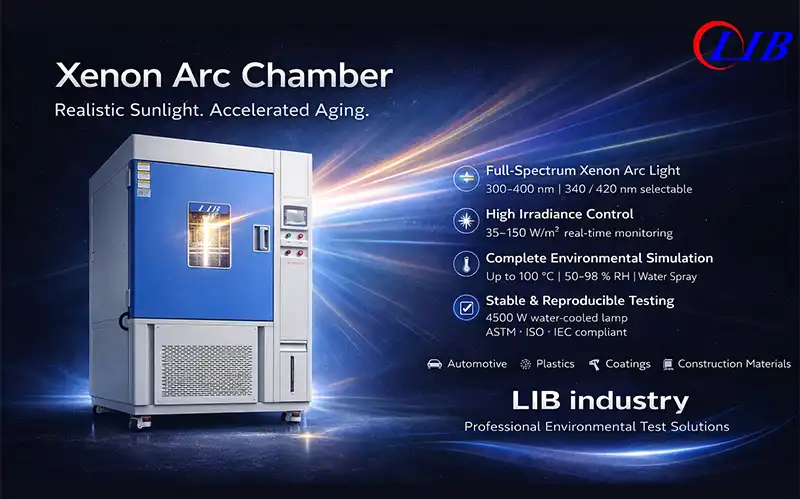
UV radiation is a major driver of degradation in PV encapsulants and backsheet materials. Accelerated weathering equipment can provide controlled irradiation across the 300–400 nm UV range, with testing commonly monitored at wavelengths such as 340 nm and 420 nm for specific material degradation and discoloration evaluations.
LIB Industry's equipment provides an adjustable irradiance range of 35–150 W/m², allowing both standard qualification exposure and higher-intensity screening tests.
Temperature and Black Panel Temperature
Temperature accelerates photochemical and thermal aging. Black Panel Temperature (BPT) represents the heating effect experienced by dark-colored surfaces under radiation.
For repeatable testing, accurate BPT control is important. LIB Industry's equipment provides:
Air temperature: 35–85°C
BPT: 35–85°C
BPT accuracy: ±2°C
Humidity and Water Spray
Moisture can contribute to delamination, corrosion, adhesion loss, and potential-induced degradation (PID). Programmable humidity and water spray cycles allow laboratories to reproduce wet and dry exposure conditions.
LIB Industry's equipment provides 50–98% RH ±5% humidity control with programmable water spray cycles.
| Environmental Factor | Typical Effect | LIB Test Parameter |
|---|---|---|
| UV Radiation | Yellowing, polymer degradation | 35–150 W/m², 300–400 nm |
| Temperature | Accelerated aging | BPT 35–85°C ±2°C |
| Humidity | Delamination, corrosion, PID | 50–98% RH ±5% |
| Water Spray | Adhesion loss, surface erosion | Programmable cycles |
| Thermal Cycling | Interface stress, micro-cracking | Programmable exposure |
What Features Should You Look for When Buying an Accelerated Weathering Tester?
Not every weathering chamber is suitable for photovoltaic material testing. Solar applications often require higher spectral accuracy, stable irradiance, and enough specimen capacity for material screening programs.
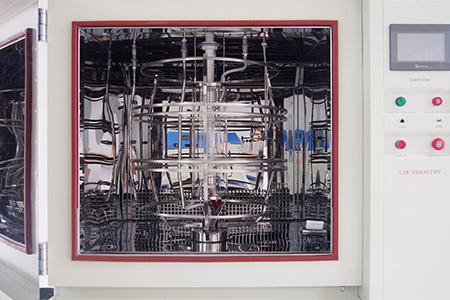
4500W Xenon Arc Lamp
LIB Industry's accelerated weathering tester uses a 4500W water-cooled xenon arc lamp with a 1,600-hour lamp life.
The system supports interchangeable filters, including:
Daylight filter
Window glass filter
UV-extended filter
These options allow the same equipment to support different exposure conditions and test protocols.
The xenon arc system provides a 280–800 nm spectral range, covering the UV, visible, and relevant solar radiation range required for broad weathering evaluation.
42-Specimen Rotating Holder
For solar material development, laboratories may need to compare multiple formulations simultaneously.
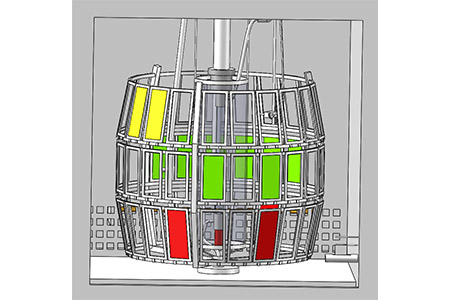
LIB's rotating specimen holder accommodates 42 specimens and continuously rotates around the xenon lamp. This helps improve exposure uniformity and reduce differences between specimen positions.
Intelligent Control and Data Management
The tester uses PID control with real-time irradiance and BPT monitoring to maintain test conditions automatically.
It also supports:
- Ethernet connectivity
- Wi-Fi connectivity
- USB data download
- Remote monitoring
- Automated data logging
These functions are particularly useful for laboratories that need traceable test records and long-duration exposure monitoring.
Which Standards Apply to Solar Weathering Tests?
Choosing equipment according to the applicable standard is essential when purchasing a weathering tester.
ASTM G155
ASTM G155 defines operating procedures for xenon arc weathering apparatus, including requirements related to irradiance, filters, BPT, humidity, and water spray.
ISO 4892-2
ISO 4892-2 provides international guidance for laboratory exposure of plastics to xenon-arc light sources. Together with ASTM G155, it provides a common framework for xenon weathering equipment and exposure conditions.
LIB Industry designs its xenon weathering equipment to support these testing requirements.
IEC 61215
IEC 61215 focuses on photovoltaic module qualification and includes environmental tests such as UV preconditioning, thermal cycling, and damp heat.
For solar manufacturers, a weathering tester can therefore support material-level evaluation, while other environmental chambers can be used for module-level qualification.
How to Choose a Weathering Test Equipment Supplier?
Equipment specifications are only part of the purchasing decision. A reliable supplier should also provide appropriate documentation, technical support, customization, and after-sales service.
Certifications and Compliance
Look for suppliers with recognized quality and safety certifications. LIB Industry provides ISO 9001, CE, and SGS/TÜV-related certifications, supporting testing programs where equipment documentation is required.
Warranty and Global Service
Xenon lamps, filters, and water systems require regular maintenance. LIB Industry provides a 3-year warranty with lifetime service support, as well as service centers in the United States, Canada, the United Kingdom, and Malaysia.
If equipment cannot be repaired during the warranty period, LIB provides replacement support according to its warranty commitment.
Customization and Turnkey Service
Solar testing programs may require customized specimen holders, water spray configurations, or connections to external monitoring systems.
LIB Industry provides customized solutions covering design, production, commissioning, delivery, installation, and operator training, allowing manufacturers to obtain a complete testing solution from one supplier.
Why Choose LIB Industry for Solar Weathering Testing?
LIB Industry has manufactured environmental testing equipment since 2009, providing testing solutions for solar manufacturers, laboratories, and research institutions.
Its accelerated weathering tester combines a 4500W water-cooled xenon arc lamp, 280–800 nm spectral coverage, precision environmental control, 42-specimen capacity, and programmable monitoring functions.
LIB can also provide complementary environmental testing equipment for thermal cycling, damp heat, humidity freeze, and other IEC 61215-related tests, allowing solar manufacturers to build a broader PV testing laboratory from one supplier.
Need to Buy an Accelerated Weathering Tester?
The right equipment depends on your test standard, material type, irradiance requirement, temperature and humidity conditions, specimen quantity, and exposure cycle.
LIB Industry provides customized accelerated weathering solutions for photovoltaic materials and solar panel testing.
Send us your test requirements to get a recommended configuration and quotation.
FAQ
What type of lamp is best for solar material weathering tests?
A xenon arc lamp is suitable when the test requires broad solar-spectrum simulation. LIB's system provides a 280–800 nm spectral range with interchangeable filters.
How many specimens can be tested at one time?
LIB Industry's accelerated weathering tester can accommodate 42 specimens on a rotating holder for more uniform exposure.
Which standards should I consider when buying a weathering tester?
For xenon-arc weathering, commonly referenced standards include ASTM G155 and ISO 4892-2. IEC 61215 is relevant to photovoltaic module qualification and UV preconditioning.