How to Choose a Solar Simulation Chamber Manufacturer in China?
Need a solar simulation chamber for IEC 61215 or IEC 61730 testing? Request a quote in 24 hours.
Sourcing a solar simulation chamber from China can provide access to customized equipment, established manufacturing capabilities, and global export experience. But choosing the right supplier requires more than comparing prices.
For photovoltaic manufacturers, research laboratories, and certification facilities, the key questions are:
Can the chamber meet the required IEC 61215, IEC 61730, or OEM test methods?
Does the manufacturer have proven engineering and production capabilities?
Can the chamber be customized for different module sizes and test sequences?
What are the warranty, installation, and after-sales support arrangements?
A reliable purchasing process should therefore evaluate technical specifications, standards compliance, production capability, customization, and total cost of ownership rather than focusing only on the initial equipment price.
Why Consider a Solar Simulation Chamber Manufacturer in China?
.webp "blog-1-1") China has developed a large environmental test equipment manufacturing sector, including systems for photovoltaic and solar module testing. Leading manufacturers can integrate environmental control with solar simulation systems for applications requiring controlled temperature, humidity, and irradiation conditions.
China has developed a large environmental test equipment manufacturing sector, including systems for photovoltaic and solar module testing. Leading manufacturers can integrate environmental control with solar simulation systems for applications requiring controlled temperature, humidity, and irradiation conditions.
For international buyers, the main advantage is not simply a lower purchase price. It is the ability to combine engineering customization, local component supply, manufacturing, and export services through one supplier.
However, supplier quality varies significantly. Buyers should distinguish between manufacturers with their own engineering and production capabilities and trading companies that outsource most of the equipment.
What Should You Check Before Choosing a Chinese Supplier?
1. Verify Technical Specifications
Start with the actual test requirements rather than the supplier's standard model.
Important parameters include:
- Temperature range
- Humidity range
- Temperature fluctuation
- Humidity deviation
- Temperature ramp rate
- Programmable test sequences
- Solar simulator classification
- Chamber volume and specimen capacity
For example, the LIB Industry PV-04 Series provides the following reference specifications:
| Parameter | Minimum Requirement | LIB PV-04 Series |
|---|---|---|
| Temperature range | -40°C to +85°C | -60°C to +100°C |
| Humidity range | 25–85% RH | 20–98% RH |
| Temperature fluctuation | ±1.0°C | ±0.5°C |
| Humidity deviation | ±5% RH | ±2.5% RH |
| Temperature ramp rate | 1°C/min | 1–3.4°C/min |
| Programmable control | Basic setpoint | 120 programs / 100 segments |
| Solar simulator class | Class A | Class A / Class AAA |
|
|
||

These specifications give buyers a practical basis for comparing different solar simulation chamber suppliers instead of evaluating equipment based only on appearance or price.
2. Check Standards and Quality Certifications
Confirm which standards the proposed chamber is designed to support and whether the supplier can provide the corresponding technical documentation.
Depending on the application, photovoltaic testing may involve standards such as IEC 61215, IEC 61730, and OEM-specific procedures.
You should also check the manufacturer's quality management system, product certifications, factory documentation, and third-party inspection records where applicable. LIB Industry's source materials identify ISO 9001 and CE certifications, together with third-party verification from organizations such as SGS and TÜV.
3. Evaluate Manufacturing and Engineering Capability
A supplier's website does not necessarily prove that it manufactures the equipment itself.
Before placing an order, ask for:
- Factory photos or video inspection
- Production and assembly information
- Previous export experience
- Technical drawings
- Test reports
- Reference projects
- Typical manufacturing lead time
Trade shows, B2B platforms, industry referrals, and published customer cases can all help with initial supplier screening.
Need help comparing solar simulation chamber specifications?
LIB Industry provides solar simulation chambers for photovoltaic testing with configurable temperature, humidity, solar simulation, chamber dimensions, and specimen capacity. Contact us for a technical recommendation based on your test standard and module size.
How Much Does the Total Cost of a Solar Simulation Chamber Include?
The equipment quotation is only one part of the purchasing decision.
For imported equipment, calculate the complete total cost of ownership, including:
| Cost Factor | What to Evaluate |
|---|---|
| Equipment | FOB/CIF price and payment terms |
| Shipping | Freight, insurance, container requirements |
| Installation | Factory commissioning and on-site setup |
| Training | Operator training and documentation |
| Warranty | Coverage period and included services |
| Spare parts | Availability and replacement lead time |
| Energy | Compressor and system power consumption |
| Consumables | Lamps, filters, sensors, and replacement intervals |
A lower initial quotation may not be the lowest-cost solution if installation, maintenance, spare parts, or energy consumption are significantly higher over the equipment's service life.
Can a Solar Simulation Chamber Be Customized?
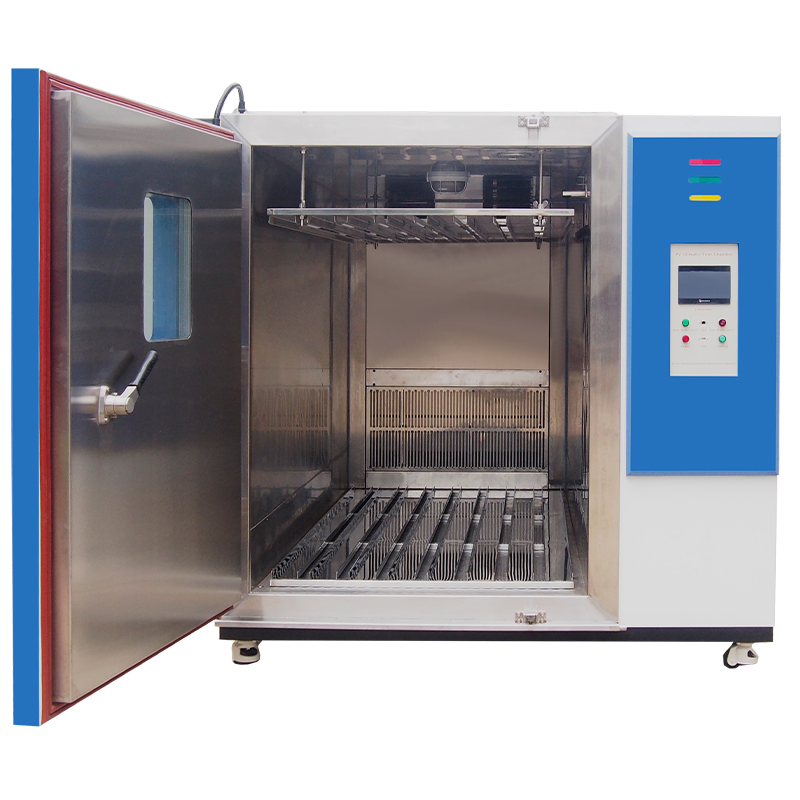 Yes. Customization is particularly important when testing non-standard photovoltaic modules or when laboratory space is limited.
Different applications may require customized:
- Chamber dimensions
- Specimen racks
- Door configurations
- Module capacity
- Cable ports
- Test fixtures
- Programmable test sequences
For example, the LIB Industry PV-04 line can accommodate panels up to 1 m × 2 m and configurations for 4, 6, 8, 10, or 12 specimens, with other configurations available according to testing requirements.
For laboratories running long automated sequences, the controller can also support 120 programs with 100 segments each, allowing complex environmental test procedures to run automatically.
Why Choose LIB Industry as Your Solar Simulation Chamber Supplier?
LIB Industry provides environmental test equipment for photovoltaic research, quality control, and certification applications.
The PV-04 Series combines controlled temperature and humidity with solar simulation capabilities and can be configured according to specimen dimensions and testing requirements.
LIB Industry can also provide a turnkey process covering:
Technical consultation → System design → Manufacturing → Factory testing → Shipping → Installation → Operator training → Lifetime technical support
For international buyers, this single-supplier approach reduces the need to coordinate separate equipment, installation, and service providers.
LIB Industry also provides a 3-year warranty and lifetime service support, helping laboratories maintain equipment after installation.
Related Solar and Environmental Test Equipment
If your photovoltaic laboratory requires more than solar simulation, consider these related systems:
|
|
|
|
Temperature & Humidity ChamberUsed for controlled temperature, humidity, damp heat, and environmental aging tests. It can complement solar simulation testing when separate environmental preconditioning is required. |
Temperature Cycling ChamberDesigned for repeated high/low-temperature cycling to evaluate thermal stress, solder joints, encapsulation, and module durability. |
Accelerated Weathering TesterUseful for evaluating the long-term effects of UV radiation, temperature, humidity, and other outdoor environmental stresses on photovoltaic materials and components. |


FAQ
What standards can a solar simulation chamber support?
The required standards depend on the application and chamber configuration. The source article identifies IEC 61215, IEC 61730, and UL 1703 as relevant photovoltaic testing standards. Always confirm the exact test sequence and equipment configuration with the manufacturer before ordering.
Can Chinese manufacturers customize solar simulation chambers?
Yes. Established manufacturers can customize chamber dimensions, specimen racks, access configurations, and other components for non-standard photovoltaic modules.
What should I compare when choosing a solar simulation chamber supplier?
Compare standards compliance, solar simulator classification, temperature and humidity performance, chamber capacity, customization capability, production lead time, warranty, spare parts, installation, and technical support—not just the equipment price.
Is a Chinese solar simulation chamber suitable for an international laboratory?
It can be, provided the equipment configuration matches the laboratory's required standards and the supplier can provide appropriate documentation, testing, installation, and after-sales support. For international projects, evaluate the manufacturer's export experience and service capability as carefully as its technical specifications.
Get a Solar Simulation Chamber Configuration for Your Test Requirements
Choosing the right solar simulation chamber manufacturer in China starts with your test standard, specimen dimensions, environmental conditions, and required solar simulator classification.
LIB Industry can help you determine the appropriate chamber configuration and provide a complete solution from manufacturing to installation and long-term service.
Tell us your test standard, module size, specimen quantity, and required temperature/humidity range to get a customized recommendation and quotation.