How Benchtop Test Chambers Support PCB Thermal Cycling Tests
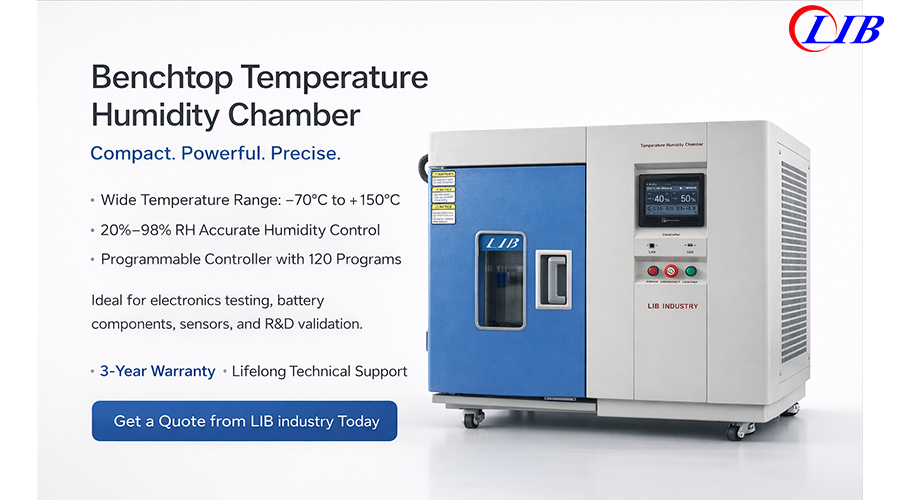
Quick answer: A benchtop test chamber runs PCB thermal cycling by moving boards between programmed hot and cold setpoints, holding at each dwell, and repeating the loop for hundreds of cycles under repeatable conditions. This exposes weak solder joints and vias before field use. LIB’s TH-50 and TH-80 cover -70 °C to +150 °C (three versions), with ±0.5 °C fluctuation, 3 °C/min heating and 1 °C/min cooling. That suits slow thermal cycling. Sudden thermal shock needs a dedicated thermal shock chamber.
Why does temperature cycling matter for PCB reliability?
Copper, FR-4 laminate, solder and ceramic components expand at different rates, so every temperature swing strains solder joints and plated through-holes. Cycling compresses years of field stress into weeks. Automotive control units, outdoor telecom gear and industrial drives all go from cold starts to warm operation, and lab cycling lets engineers compare designs, laminates and solder pastes before launch. A joint that fails after 800 cycles in the lab costs far less to fix than one that fails in a customer’s vehicle.
How do benchtop test chambers create controlled cycling conditions?
They combine closed-loop temperature control with programmable profiles in a compact, bench-friendly size. Set a low setpoint, a high setpoint, dwell times and a repeat count on the color LCD touch screen. Stored profiles repeat exactly, so results stay consistent across batches and technicians. Two standard shelves hold boards, and a sealed cable port carries monitoring leads.
| Parameter | TH-50 / TH-80 |
|---|---|
| Temperature range | -20 / -40 / -70 °C to +150 °C (versions A / B / C) |
| Humidity range (humidity versions) | 20% to 98% RH |
| Fluctuation / deviation | ±0.5 °C / ±2.0 °C |
| Heating / cooling rate | 3 °C/min / 1 °C/min |
| Interior size | TH-50: 320 × 350 × 450 mm; TH-80: 400 × 400 × 500 mm |
| Cable port | 50 / 100 / 200 mm, soft silicone plug |
| Controller | Programmable color LCD touch screen, Ethernet; English, French, Spanish, German and Russian interface |
| Protections | Over-temperature, over-current, refrigerant high-pressure, earth leakage |
|
|
|

Which parameters matter most?
Setpoints, dwell time, ramp rate and cycle count together decide how long a test runs and how much stress the board sees.
Setpoints: your industry standard sets the limits, for example IPC-9701, IEC 60068-2-14 or JEDEC JESD22-A104. Always follow the latest edition and the test condition your product requires. Choose version B or C for deep cold.
Dwell time: long enough for the board and its heaviest component to reach the setpoint, not just the air. Prove it with a thermocouple on the board.
Ramp rate and cycle count: slower ramps reduce thermal gradients but lengthen each cycle. Qualification can need anywhere from a few dozen to thousands of cycles.
Worked example (for planning only): cooling from +125 °C to -40 °C at 1 °C/min takes 165 min, heating back at 3 °C/min takes 55 min, and two 15 min dwells add 30 min. One cycle takes about 250 min (4.2 h), so 500 cycles take roughly 87 days. If you need faster turnaround, tell us the ramp rate before you order.
What failures does thermal cycling reveal?
The most common findings are cracked solder joints, via fractures and delamination.
| Failure | Typical cause | How to find it |
|---|---|---|
| Cracked solder joints | Large packages (BGAs, ceramic capacitors, connectors) expand differently from the board. Joints under big packages usually fail first | Resistance monitoring during the run |
| Via and barrel fractures | FR-4 expands far more through its thickness than copper, stretching plated through-holes, especially near or above Tg | Cross-sectioning failed boards |
| Delamination and component cracking | Board flexing, worsened by absorbed moisture | Acoustic microscopy, visual inspection, electrical test |
|
|
 |
|

Record the cycle count at first failure for every sample. LIB temperature humidity versions also let you cycle boards under humidity or hold a damp-heat condition such as 85 °C / 85% RH.
How do you set up a PCB thermal cycling test?
Prepare samples: label each board, record baseline resistance and attach a thermocouple to the heaviest component. Route leads through the cable port and keep the plug seated.
Load for airflow: leave space between boards, because a heavy load widens the gap between air and board temperature.
Run and document: watch the first few cycles to confirm the ramp, then record results at set intervals. Keep the profile file, settings and failure data together for audits.
Choosing a model: match interior volume to your largest board or fixture and leave room for airflow. Version A suits mild ranges, while B and C suit deeper cold. Ask about training, warranty and calibration too.

Case study: Apple orders from LIB Industry, 2019 to 2023
Apple has bought from LIB Industry twice: waterproof testing equipment in 2019 and benchtop temperature humidity test chambers in 2023.
On September 5, 2019, Apple first consulted LIB about the [R9K-1200] ipx9k test equipment for waterproof testing of electronic products. The purchase order followed on October 6, 2019, and Apple gave good feedback on the fast production and delivery.
In December 2023, Apple placed a repeat order for two [TH-80A benchtop temperature humidity test chambers], installed at its Seattle, USA office. In March 2024, LIB engineers visited Apple’s laboratory, and Apple staff praised LIB’s quality and service.
Why buy from LIB Industry?
Tested before shipment: every unit runs 72 hours continuously.
Certified and inspected: CE, RoHS, ISO 9001 and ISO 17025 calibration, with inspection by SGS and TÜV.
3-year (36-month) warranty: if a unit cannot be repaired within the warranty period, we replace it with a new one. Lifetime technical support afterwards.
Global service: local support in the US, UK, Canada and Malaysia, with 24/7 English support and on-site service when necessary.
One-stop project service: solution design, customization, delivery, installation and training.
Not sure which version fits your boards? Send your temperature range, ramp rate and board size, and our engineers will recommend a configuration.
FAQ
Can the TH-50 or TH-80 perform thermal shock testing?
No. Heating at 3 °C/min and cooling at 1 °C/min suit slow thermal cycling. Quick changes between extremes need a dedicated thermal shock chamber.
Which temperature version suits PCB cycling?
All versions go up to +150 °C. Version A reaches -20 °C, B reaches -40 °C and C reaches -70 °C. Choose by the lowest setpoint in your requirements, add a safety margin, and confirm with LIB engineers.
How do I monitor a board during cycling?
Route sensor or resistance-monitoring leads through the cable port (50, 100 or 200 mm) and keep the soft silicone plug seated. Log data externally and record the cycle count at first failure.
Can I run humidity together with thermal cycling?
Yes, on LIB temperature humidity versions, which control humidity from 20% to 98% RH.
Contact LIB Industry
LIB Industry is a benchtop test chamber manufacturer providing turn-key environmental testing solutions, from design through installation and training. Email ellen@lib-industry.com with your temperature range, ramp rate and board sizes, or use the quote form: [link].