How to Choose Benchtop Test Chambers for Battery Cell Temperature Testing?
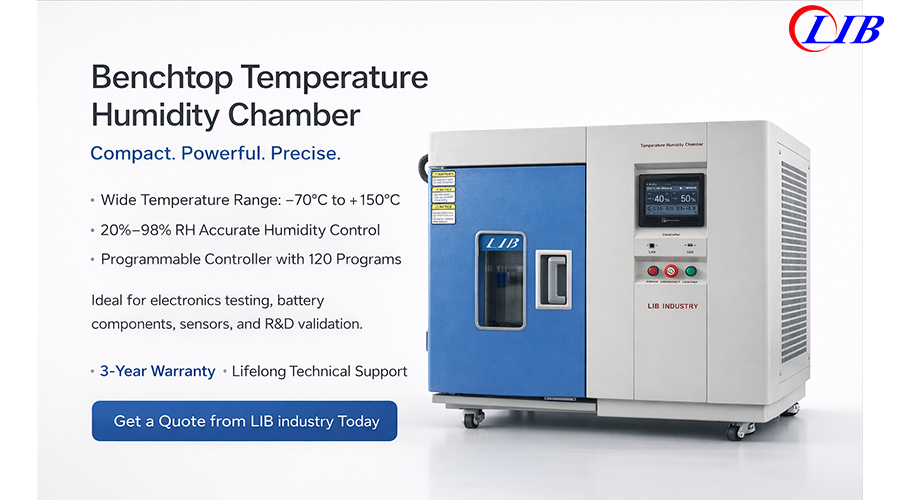
Quick answer: A benchtop test chamber holds battery cells at a steady, repeatable temperature while a separate cycler charges and discharges them. LIB Industry's TH-50 and TH-80 cover -20 °C to +150 °C (versions down to -40 °C and -70 °C are available), with ±0.5 °C fluctuation and ±2.0 °C deviation and a programmable color touch-screen controller. Standard models protect the equipment, not the cell. Abuse, short-circuit or other tests that could cause venting or fire need a purpose-built battery safety chamber.
Why does temperature control matter in battery cell testing?
Cell chemistry responds directly to temperature, so stable conditions are the only way to get comparable data. Cold slows ion movement, which raises internal resistance and lowers usable capacity. Heat speeds up ageing. With temperature held constant, those effects can be separated from every other variable.
Cells tested in an uncontrolled room on different days cannot be compared fairly. A benchtop test chamber removes ambient swings, so differences in the data reflect the cells, not the weather. Stable, recorded setpoints also make results credible for datasheets, customer approval and cross-lab comparison.
How do benchtop test chambers hold stable conditions?
They combine closed-loop control of temperature with a programmable profile, and they let cycler leads pass through the wall.
· Fluctuation and deviation: fluctuation (±0.5 °C) is how stable the temperature stays at one point over time. Deviation (±2.0 °C) is the spread across the working space. Both matter when many cells share the shelves.
· Programmable profiles: holds and ramps are stored on the color LCD touch screen, so every run repeats exactly. Ethernet allows remote monitoring.
· Cycler wiring: a cable port of 50, 100 or 200 mm, sealed with a soft silicone plug, carries power and sense leads to the cycler.
|
Parameter |
TH-50 / TH-80 |
|
Temperature range |
-20 / -40 / -70 °C to +150 °C (versions A / B / C) |
|
Fluctuation |
±0.5 °C |
|
Deviation |
±2.0 °C |
|
Heating rate |
3 °C/min |
|
Cooling rate |
1 °C/min |
|
Controller |
Programmable color LCD touch screen, Ethernet |
|
Cable port |
50 / 100 / 200 mm, soft silicone plug |
|
Interior |
SUS304 stainless steel |
|
Insulation and seals |
Polyurethane foam with insulation cotton, double-layer silicone door seals |
|
Access |
Viewing window, interior lighting, two standard shelves (custom sizes available) |
|
|
|

Which temperature version should you choose?
Choose by your lowest test setpoint, then add a safety margin.
|
Test need |
Version |
Lowest temperature |
|
Mild cold, ambient and elevated tests |
A |
-20 °C |
|
Cold storage and low-temperature cycling |
B |
-40 °C |
|
Extreme cold characterization |
C |
-70 °C |
|
|
|
|


Datasheet values are often measured near room temperature, while 45 °C or 60 °C is common for accelerated ageing. Confirm the exact setpoints your standard or customer requires. Examples include IEC 61960 and IEC 62660-1.
What tests can you run?
The three most common programs are performance mapping, thermal cycling and storage ageing.
· Capacity and resistance trends: run the same charge-discharge profile at several temperatures and plot capacity against temperature. Measuring resistance at each step shows how fast performance falls off in cold or heat.
· Thermal cycling: moving cells between low and high setpoints checks mechanical and electrical stability. With a 1 °C/min cooling rate and 3 °C/min heating rate, benchtop test chambers suit slow cycling, not sudden shock.
· Storage and ageing: holding charged cells at high temperature for weeks speeds up calendar ageing. Programmable profiles allow unattended runs. Check capacity retention at regular intervals.
Soak before measuring. A cell core reaches thermal equilibrium more slowly than the surrounding air. Allow a soak period and confirm with a thermocouple on the cell surface. Heavier cells need longer.
What do the built-in protections cover?
They protect the equipment itself. They are not battery safety design.
|
Protection |
Guards against |
|
Over-temperature |
Excess temperature in the test space |
|
Over-current |
Electrical overload |
|
Refrigerant high-pressure |
Refrigeration circuit faults |
|
Earth leakage |
Electrical leakage hazards |
|
Water shortage, humidifier dry-combustion |
Faults in humidity-equipped models |
How do you select a benchtop test chamber for battery testing?
Match interior volume to your cells, fixtures and cable bundles, and leave room for airflow.
|
Model |
Interior (mm) |
Overall (mm) |
|
TH-50 |
320 × 350 × 450 |
820 × 1160 × 950 [confirm] |
|
TH-80 |
400 × 400 × 500 |
900 × 1210 × 1000 [confirm] |
Check before you order:
1. Setpoints: lowest and highest temperatures, ramp rates and hold times against the published specification.
2. Uniformity: if several cells share the shelves, ask for a loaded temperature survey.
3. Wiring: cable port size for your cycler leads and sense wires.
4. Footprint: overall size against your bench or lab space.
5. Support: training, warranty, spare parts and calibration.
What are the safety limits?
A standard benchtop test chamber has no gas detection, pressure relief or explosion-proof construction. Cells that could vent, leak or fail violently need purpose-built equipment.
· Protect the cell: fit a sensor on the cell and use cycler channels that cut off on voltage, current and temperature.
· Protect people: follow your lab's cell-handling rules and install the unit in a well-ventilated area.
· Tell us early: if your tests could be hazardous, send your cell type, capacity and test method before ordering. Our engineers will advise whether a standard model, a custom configuration or a different system fits.

Case study: Apple repeat order of TH-80A benchtop chambers in Seattle
In December 2023, Apple placed a repeat order for two TH-80A benchtop temperature humidity test chambers, installed at its Seattle, USA office. In March 2024, LIB engineers visited Apple's laboratory. Apple staff praised LIB's quality and service.
Why buy from LIB Industry?
· Tested before shipment: every unit runs 72 hours continuously before leaving the factory.
· Certified and inspected: CE, RoHS, ISO 9001 and ISO 17025 calibration, with inspection by SGS and TÜV.
· 3-year (36-month) warranty: if a unit cannot be repaired within the warranty period, we replace it with a new one. Lifetime technical support and maintenance guidance afterwards.
· Global service: local support in the US, UK, Canada and Malaysia, with 24/7 English support, remote troubleshooting, spare parts and on-site service when necessary.
· One-stop project service: solution design, customization, delivery, installation and training.
Not sure which version fits your cells? Send your temperature range, cell type and sample size, and our engineers will recommend a configuration.
FAQ
Which temperature version suits battery cell testing?
Choose by your lowest setpoint. Version A reaches -20 °C, B reaches -40 °C and C reaches -70 °C, all up to +150 °C. Send your test conditions to LIB Industry engineers for a recommendation.
Can I connect a battery cycler to a benchtop test chamber?
Yes. Cycler leads pass through the cable port, available in 50, 100 or 200 mm diameters with a soft silicone plug. Confirm wiring details with us before ordering.
What is the difference between fluctuation and deviation?
Fluctuation is how stable the temperature is at one point over time (±0.5 °C). Deviation is the spread across the working space (±2.0 °C).
Is it suitable for abuse or short-circuit tests?
No. Built-in protections guard the equipment itself. Tests that could cause venting or fire need a purpose-built battery safety chamber. Describe your cell type and test method to us before ordering.
How long should cells soak before measurement?
Long enough for the cell core to reach equilibrium, which takes longer than the air. Confirm with a thermocouple on the cell surface. Heavier cells need longer.
Does LIB offer temperature humidity versions?
Yes. LIB's benchtop range includes temperature humidity models such as the TH-80A. Send your requirements and we will advise on the right model.
Contact LIB Industry
LIB Industry is a benchtop test chamber manufacturer providing turn-key environmental testing solutions, from design through installation and training. For a tailored recommendation, email ellen@lib-industry.com with your temperature range, cell type and sample size.