How Do You Choose the Right Industrial Thermal Shock Chamber?
Choosing an industrial thermal shock chamber is not simply a matter of selecting the widest advertised temperature range. Engineers need to match the chamber's temperature range, recovery time, basket transfer speed, loading capacity, and safety system with the applicable testing standard and specimen requirements.
For demanding applications, a suitable chamber may need to operate between approximately -70°C and +200°C or wider, recover between temperature zones within 5 minutes, and maintain temperature fluctuation around ±0.5°C. Basket construction is equally important when heavy or large specimens must be transferred rapidly between hot and cold zones.
A careful procurement process helps ensure that the chamber delivers repeatable test results while remaining reliable during long-term operation.
What Should Engineers Know Before Buying an Industrial Thermal Shock Chamber?
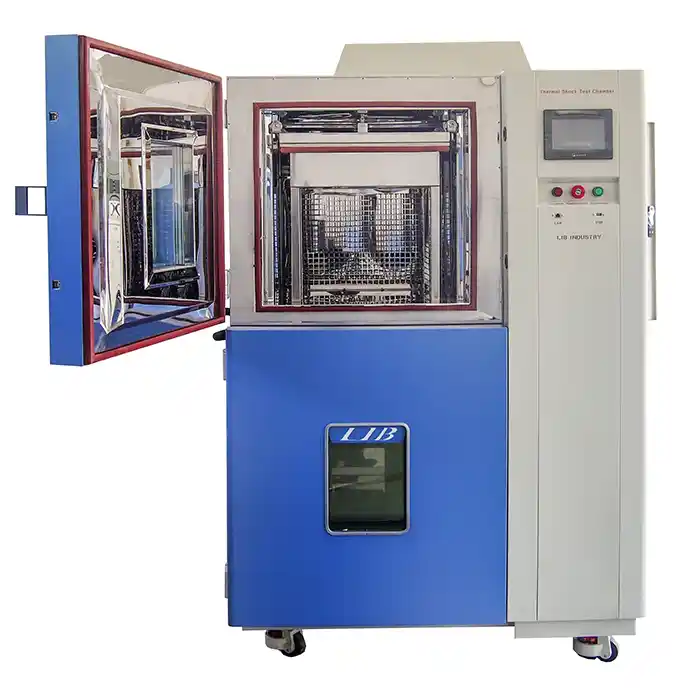 Thermal shock testing is mechanically different from conventional temperature cycling. Instead of gradually ramping the specimen between temperatures, a thermal shock chamber rapidly transfers it between hot and cold zones.
Thermal Shock vs. Temperature Cycling
A thermal shock chamber uses a basket transfer system to move specimens quickly between hot and cold compartments. The sudden temperature change creates thermal stress that can reveal micro-cracks, material separation, sealing failures, and other weaknesses caused by differences in thermal expansion.
This makes thermal shock testing useful for applications where products may experience abrupt environmental changes during transportation, operation, or storage.
Typical Applications
Industrial thermal shock chambers are widely used for:
- Electronic components and semiconductors
- Automotive components and connectors
- Aerospace and avionics equipment
- Materials and coatings
- Consumer electronics
- Electrical and electromechanical products
The appropriate chamber configuration depends on the specimen dimensions, weight, test temperature, and required number of cycles.
Consider Total Cost of Ownership
The purchase price is only one part of the equipment cost. Engineers should also consider compressor quality, refrigerant type, energy consumption, maintenance requirements, spare parts availability, and after-sales support.
A lower initial price may become more expensive if slow recovery, frequent maintenance, or unreliable refrigeration extends testing time or causes repeated test interruptions.
Which Specifications Matter Most When Selecting a Thermal Shock Chamber?
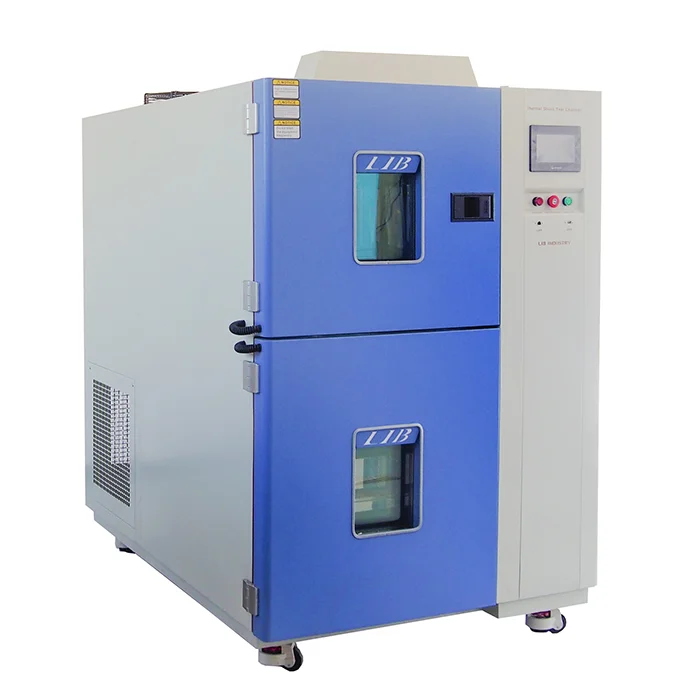 The most important specifications should be evaluated against the actual test procedure rather than compared independently.
Temperature Range and Recovery Time
The chamber should reach both temperature extremes required by the applicable standard with sufficient operating margin.
For demanding industrial applications, configurations may provide ranges such as -75°C to +220°C. Recovery between hot and cold zones is also critical. A recovery time of less than 5 minutes helps maintain test efficiency, especially when hundreds of cycles are required.
A chamber operating continuously at the limits of its rated range may experience longer recovery times and reduced stability. Therefore, selecting adequate temperature capacity is preferable to choosing a system that only reaches the required limits under ideal conditions.
Temperature Fluctuation and Deviation
Temperature stability directly affects test repeatability. A typical target for industrial thermal shock testing is around ±0.5°C fluctuation, while the required temperature deviation depends on the equipment specification and applicable test method.
For sensitive electronic components, stable temperature conditions are particularly important because small differences between cycles can affect failure analysis and comparison between test batches.
Basket Capacity and Mechanical Design
The basket must be designed around the actual specimen weight and dimensions. Typical industrial applications may involve loads of approximately 20–60 kg, although larger custom configurations may be required.
The basket rail and transfer mechanism should provide smooth, reliable movement between the hot and cold zones without damaging specimens during rapid transfer.
Before ordering, confirm:
- Maximum specimen weight
- Basket dimensions
- Available working volume
- Transfer distance
- Basket material and construction
- Fixture requirements
Which Thermal Shock Standards Should the Chamber Support?
The required chamber performance depends on the testing standard and product category.
| Testing Standard | Temperature Extremes | Typical Application |
|---|---|---|
| MIL-STD-883 Method 1010 | -65°C to +150°C | Microelectronics and semiconductors |
| JESD22-A106 | -55°C to +125°C | Solid-state device qualification |
| IEC 60068-2-14 | Varies by test method | General environmental testing |
| MIL-STD-202 Method 107 | -65°C to +200°C | Electronic component reliability |
These temperature values should be treated as examples of test requirements rather than universal chamber settings. Engineers should confirm the exact procedure, dwell time, transfer requirements, and cycle count specified by the applicable standard before selecting the equipment.
Match the Chamber to the Test Procedure
Start with the standard or internal test specification and work backward to the equipment requirements.
Consider:
- Required hot and cold temperatures
- Exposure or dwell time
- Transfer time
- Recovery time
- Number of cycles
- Specimen size and weight
- Required fixtures and basket configuration
Choosing a chamber with additional temperature capacity can provide useful performance margin and reduce the risk of operating continuously at the limits of the equipment.
Two-Zone or Three-Zone Thermal Shock Chamber?
The chamber configuration should match the required test method.
|
|
|
Two-Zone Configuration
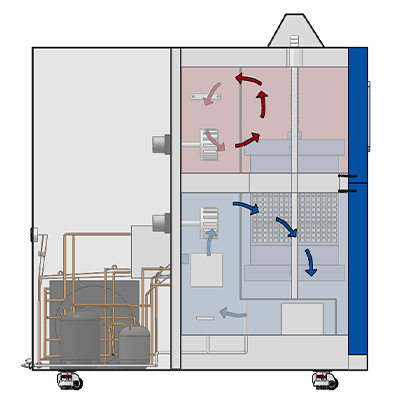
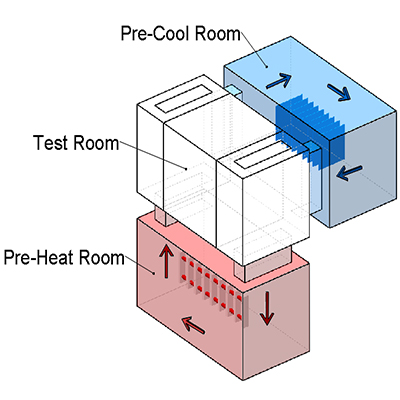
A two-zone thermal shock chamber transfers specimens directly between hot and cold chambers. This configuration is suitable for many conventional thermal shock procedures where rapid temperature transitions are required.
Three-Zone Configuration
A three-zone system adds an ambient-temperature zone between the hot and cold zones. This can be useful for procedures that require intermediate exposure or specific transfer sequences involving ambient conditions.
Benchtop vs. Floor-Standing
Compact benchtop thermal shock chambers are suitable for smaller components and laboratories with limited space.
Floor-standing industrial chambers provide greater internal capacity and loading capability for larger automotive, aerospace, and electronic components.
The choice should be based on specimen size, loading requirements, available laboratory space, and expected future testing needs.
What Safety Features Should an Industrial Thermal Shock Chamber Have?
Safety protection is important when a chamber operates continuously at extreme temperatures and high electrical loads.
A properly configured system should include protection such as:
- Over-temperature protection
- Over-current protection
- Refrigerant high-pressure protection
- Earth leakage protection
- Emergency shutdown functions where required
- Appropriate electrical and refrigeration protection
These systems help protect the equipment, specimens, and operators during abnormal operating conditions, particularly during long-duration or unattended testing.
For specialized applications, the required safety configuration should be discussed with the supplier based on the chamber design and test conditions.
How Can You Evaluate Thermal Shock Chamber Quality?
Specifications alone do not fully indicate whether a chamber will perform reliably over years of operation.

Refrigeration System and Compressor
The compressor and refrigeration system have a direct impact on low-temperature performance, recovery speed, energy consumption, and maintenance requirements.
When comparing suppliers, ask for the compressor brand, refrigeration configuration, refrigerant type, and documented performance data rather than comparing temperature range alone.
Manufacturing Quality and Calibration
Temperature sensors, heating systems, refrigeration components, insulation, and airflow design all contribute to temperature stability.
Ask the supplier for relevant calibration documentation, performance data, and test records before purchase. This provides more useful evidence than a basic specification sheet.
Custom Engineering Capability
Standard models are suitable for many applications, but unusual specimen sizes or loading requirements may require customized solutions.
Customization may include:
- Chamber dimensions
- Basket size
- Basket loading capacity
- Fixture design
- Shelf configuration
- Transfer mechanism
- Temperature range
- Control programs
A supplier with engineering and manufacturing capabilities can adapt the chamber to the actual testing process rather than forcing the specimen into a standard configuration.
Industrial Thermal Shock Chamber Procurement Checklist
Before placing an order, engineers should confirm the following:
| Checklist Item | What to Verify |
|---|---|
| Temperature range | Required hot/cold temperatures plus operating margin |
| Recovery time | Documented recovery performance |
| Temperature stability | Fluctuation and deviation values |
| Basket capacity | Specimen weight and dimensions |
| Transfer mechanism | Reliable rapid movement between zones |
| Safety system | Over-temperature, over-current, pressure, leakage protection |
| Compressor | Brand and refrigeration configuration |
| Refrigerant | Refrigerant type and environmental requirements |
| Documentation | Specifications, calibration and performance data |
| Installation | Installation and commissioning scope |
| Training | Operator training included or available |
| Warranty | Warranty period and after-sales support |
Request Documentation Before Ordering
Ask the supplier for a complete technical specification, relevant calibration documentation, and sample performance data where available.
For applications with demanding cycle times, it is particularly useful to verify actual recovery performance rather than relying only on the stated temperature range.
Confirm Installation and Training
Thermal shock chambers involve refrigeration, electrical systems, temperature control, and mechanical transfer mechanisms. Professional installation and commissioning can help ensure that the equipment is correctly configured before testing begins.
Confirm whether installation, commissioning, operator training, and technical support are included in the quotation.
LIB Industry Industrial Thermal Shock Chamber Solutions
LIB Industry provides thermal shock chambers for electronics, automotive, aerospace, materials, and other reliability testing applications.
The TS series can provide temperature ranges up to approximately -75°C to +220°C, with rapid transfer between temperature zones and recovery within approximately 5 minutes, depending on the model and test conditions.
Temperature control can achieve approximately ±0.5°C fluctuation, while programmable controllers allow engineers to define temperature setpoints, dwell times, transfer sequences, and cycle counts.
LIB Industry also provides application-specific configurations for different specimen sizes, loading requirements, and basket designs.
Safety and Protection
LIB Industry thermal shock chambers incorporate safety systems including over-temperature, over-current, refrigerant high-pressure, and earth leakage protection. Additional safety configurations can be discussed according to the application and test requirements.
3-Year Warranty & Lifetime Support
LIB Industry provides a 3-year warranty, lifetime technical support, and 24/7 English after-sales service. If the chamber cannot be repaired during the warranty period, LIB Industry provides a replacement according to the warranty terms.
Turn-Key Project Support
From design and production to installation, commissioning, and training, LIB Industry provides complete project support from one supplier.
Related Products for Environmental Reliability Testing
Thermal shock testing is often combined with other environmental reliability tests. Depending on the application, the following equipment can complement an industrial thermal shock chamber.
|
 |
|
|
Temperature Cycling ChamberUsed for controlled repeated temperature transitions with programmable ramp rates. It is suitable when the test requires gradual temperature changes rather than rapid basket transfer. |
Temperature & Humidity ChamberUsed to evaluate product performance under controlled temperature and humidity conditions, including environmental aging, moisture resistance, and reliability conditioning. |
High-Temperature Industry OvenUsed for thermal processing, aging, drying, and high-temperature material testing where humidity control or rapid thermal shock transfer is not required. |


FAQ
What temperature range should I choose for a thermal shock chamber?
The required range depends on the applicable standard and test procedure. Industrial applications may require approximately -70°C to +200°C, while some configurations provide a wider range such as -75°C to +220°C.
How fast should a thermal shock chamber recover?
A recovery time of less than 5 minutes is a useful benchmark for demanding industrial applications. The actual requirement should be evaluated according to the test procedure, specimen load, and chamber configuration.
What is the difference between thermal shock and temperature cycling?
Thermal shock rapidly transfers a specimen between hot and cold zones, while temperature cycling normally changes temperature according to a controlled ramp rate. Thermal shock therefore creates a more abrupt thermal transition.
What safety protection is important?
At minimum, industrial systems should include appropriate over-temperature, over-current, refrigerant high-pressure, and earth leakage protection. Additional protection may be required depending on the application.
Can the basket and chamber be customized?
Yes. Basket dimensions, loading capacity, fixtures, chamber dimensions, and other configurations can be customized according to specimen requirements and the testing procedure.
Choose a Thermal Shock Chamber Based on Your Test Requirements
The right industrial thermal shock chamber should be selected according to temperature range, recovery time, transfer requirements, specimen loading, safety protection, and applicable standards rather than price or advertised temperature range alone.
LIB Industry provides standard and customized thermal shock chamber solutions for different industrial reliability testing applications.
Contact LIB Industry to discuss your testing requirements and request a detailed quotation.