How Dust Chambers Ensure Smart Lock Functionality?
Smart locks deployed at residential entry doors, commercial access gates, and outdoor security perimeters face severe environmental exposure. Unlike traditional mechanical locks, smart locks integrate delicate micro-gear trains, motorized actuators, biometric fingerprint sensors, touch keypads, wireless communication modules, and PCB circuitry inside a compact enclosure.
When exposed to airborne windblown dust, construction grit, and fine soil particles, these entry hardware systems face mechanical jamming, accelerated gear mesh wear, keypad unresponsiveness, and PCB short circuits. To verify that smart locks fulfill their security claims and maintain long-term functionality, hardware manufacturers rely on an IP Dust Test Chamber.
This comprehensive technical guide explores dust ingress failure modes in smart lock mechanics and electronics, international testing standards (IEC 60529 IP5X/IP6X, ISO 20653), specialized equipment features, post-test diagnostic workflows, and turnkey testing solutions from LIB Industry.
Dust Ingress Degradation Mechanisms in Smart Lock Components
Smart locks contain multiple external openings—including keypad bezels, biometric sensor borders, emergency keyways, and battery compartment seams—that serve as entry pathways for fine airborne particulate matter.
|
Entry Pathway |
Ingress Risk |
Resulting Failure |
|
Keypad & Biometric Gaps |
Fine talc gets under membranes & optical lenses |
Unresponsive keys & false touch triggers |
|
Deadbolt & Latch Seams |
Abrasive grit enters gear meshes & slides |
Actuator jamming & accelerated gear wear |
|
Battery Seams |
Dust mixes with moisture |
Battery terminal corrosion / power loss |
1. Mechanical Actuator & Deadbolt Jamming
Motorized smart locks utilize compact metal or plastic gear trains to throw and retract deadbolts. When fine mineral particles enter the gear mesh, they act as an abrasive compound, accelerating wear and increasing sliding friction. Over time, this friction overloads the drive motor, causing motor stalling, high battery drain, or complete deadbolt jamming.
2. Keypad & Biometric Sensor Interface Degradation
Touch keypads and silicone rubber buttons rely on clean mechanical contact membranes. Dust accumulation beneath membrane keys changes tactile feedback, causes sticking buttons, or registers false touch inputs. On optical or capacitive fingerprint sensors, fine surface dust scatters light and blocks capacitive transfer, leading to high false rejection rates (FRR).
3. Circuit Board Short Circuits & Battery Contact Corrosion
Conductive or hygroscopic dust settling on un-conformal-coated PCB traces and connector pins creates parasitic resistance bridges. When combined with ambient humidity, dust forms an acidic or conductive film across battery terminals, accelerating contact corrosion and inducing intermittent power loss.
Smart Lock Dust Failure Matrix
|
Component Assembly |
Primary Ingress Stressor |
Degradation Mechanism |
Critical Failure Metric |
|
Deadbolt & Latch Mechanism |
Coarse grit & mineral dust (>75 µm) |
Friction buildup in sliding tracks and gear teeth |
Actuator motor stall / increased throwing torque |
|
Keypad & Touch Panel |
Fine airborne dust (<75 µm) |
Dust buildup under button membranes and bezels |
Unresponsive keys, stuck buttons, false triggers |
|
Biometric Reader |
Fine surface particulate settlement |
Scratched optical window, signal attenuation |
Fingerprint False Rejection Rate (FRR) increase |
|
Internal Controller PCB |
Conductive / hygroscopic particulate |
Electrical bridging across high-density IC pins |
Intermittent system reboot, standby power drain |
|
Battery Terminal Contacts |
Dust-moisture film accumulation |
Surface contact oxidation and contact resistance rise |
Terminal voltage drop, premature battery warning |
Industry Standards for Smart Lock Ingress Protection
To validate outdoor durability and support marketing claims, smart lock manufacturers certify hardware against international Ingress Protection (IP) standards.
|
IEC 60529 IP5X — Dust Protected |
IEC 60529 IP6X — Dust Tight |
|
Limited ingress permitted. Function must not be impaired. |
Zero dust ingress permitted. Verified by internal inspection. |
|
|
|

Both standards sit alongside ISO 20653 / SAE J575, the automotive-grade ingress protection protocols often referenced for outdoor and roadway-adjacent hardware.
1. IEC 60529 IP5X: Dust-Protected Standard
• Requirement: Dust ingress is not entirely prevented, but dust must not enter in quantities sufficient to interfere with the safe and satisfactory operation of the equipment or impair safety.
• Verification: Following chamber exposure, the smart lock is tested for mechanical throwing, keypad responsiveness, and electrical functionality.
2. IEC 60529 IP6X: Dust-Tight Standard
• Requirement: Complete exclusion of dust particles under negative pressure vacuum conditions.
• Verification: The lock enclosure is opened during post-test teardown inspection; zero dust accumulation may be visible inside the sealed electronic and mechanical compartments.
Standard Testing Parameter Comparison
|
Standard / Rating |
Target Ingress Level |
Dust Medium |
Concentration |
Vacuum Extraction |
Test Duration |
|
IEC 60529 IP5X |
Dust Protected (limited ingress) |
Dry talcum powder (<75 µm) |
2 kg/m³ |
Optional / Category 2 |
8 Hours |
|
IEC 60529 IP6X |
Dust Tight (zero ingress) |
Dry talcum powder (<75 µm) |
2 kg/m³ |
Required (20 mbar drawdown, max 80x vol) |
2 to 8 Hours |
|
ISO 20653 IP6KX |
Roadway / Automotive Grade |
Arizona dust / Portland cement |
2 kg/m³ to 5 kg/m³ |
Required (pneumatic draw) |
Multi-stage cycling |
Specialized Dust Test Chamber Features & Simulation Subsystems
Simulating years of outdoor dust exposure in an 8-hour test cycle requires specialized powder management, heating, and circulation subsystems inside the chamber.
|
Subsystem |
Function |
|
Funnel-Bottom Recirculation |
Prevents powder clumping in corners |
|
Integrated Dehumidification Heaters |
Keeps talc dry & fluid |
|
Precision Mesh Sieves |
Maintains particle suspension <75 µm |
|
Vacuum Drawdown System |
Simulates indoor/outdoor pressure delta |
1. Funnel-Shaped Workspace & Air Circulation
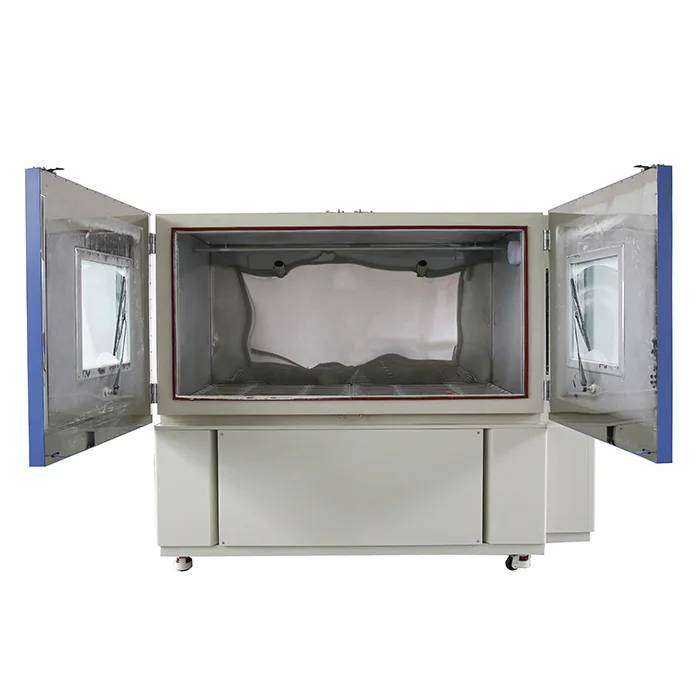
The chamber interior features a steep funnel-bottom collector. High-velocity circulation blowers pull settled talcum powder from the bottom and inject it through top and side distribution nozzles, maintaining a continuous, uniform dust cloud (2 kg/m³) across the smart lock test zone.
2. Powder Dehumidification Heating System
Talcum powder readily absorbs ambient moisture, causing clumping that ruins particle size distribution. Built-in chamber wall heating jackets maintain internal air temperatures between +35°C and +50°C, keeping the powder completely dry and fluid throughout long test runs.
3. Calibrated Mesh Particle Filtering
Internal calibrated wire mesh sieves filter recirculated powder before re-injection, guaranteeing that only fine particles smaller than 75 µm remain suspended in the workspace airflow.
4. Vacuum-Assisted Ingress Drawdown
For IP6X testing, a vacuum line connects to the smart lock interior. By pulling negative pressure (up to 2 kPa / 20 mbar below ambient), air is drawn toward seal seams and keypads, aggressively testing gasket compression under pressure differentials.
Standardized Step-by-Step Dust Testing Workflow
.webp "blog-1-1") A disciplined testing sequence ensures repeatable results and provides documented compliance records for certification bodies.
A disciplined testing sequence ensures repeatable results and provides documented compliance records for certification bodies.
1. Pre-Test Visual Inspection & Baseline Electrical Checklist
2. Specimen Mounting & Optional Vacuum Line Installation
3. Chamber Pre-Heating & Powder Fluidity Verification
4. Execute Programmed Dust Agitation Cycle (8 Hours)
5. In-Situ / Immediate Post-Exposure Operational Functional Check
6. Post-Test Teardown Inspection for Internal Particulates
Diagnostic Evaluation Sequence
1. Baseline Functional Verification: Record initial motor operating current during deadbolt throwing, key press sensitivity, biometric response speed, and wireless signal strength.
2. Chamber Loading & Cable Pass-Through: Mount the smart lock in its real-world door mounting orientation. Connect power and control lines through the chamber's sealed access port to perform functional actuation cycles during testing.
3. Execution of Dust Exposure: Run the dust blower for 8 continuous hours (or programmatic pulse cycles) at a concentration of 2 kg/m³.
4. Post-Exposure Teardown Inspection: Wipe external dust off the lock housing. Carefully disassemble the enclosure and inspect internal PCB compartments, gear housings, and battery slots under direct light. Document any particulate presence with macro photography.
LIB Engineering Expertise & Turnkey Testing Solutions
Hardware manufacturers require an environmental testing equipment partner that combines precision engineering with comprehensive global support.
About LIB Industry
Established as a dedicated manufacturer of environmental test equipment, Xi'an LIB Environmental Simulation Industry supplies standard and custom test chambers to clients across 56+ countries. LIB provides complete turnkey testing solutions—from custom fixture engineering and gas/dust integration to delivery, installation, calibration, and operator training.
• Comprehensive Product Range: LIB manufactures dust test chambers (IP5X/IP6X), rain spray test chambers (IPX1 to IPX9K), temperature/humidity chambers, salt spray cabinets, and xenon weathering chambers.
• Certified Quality Standards: All LIB equipment is manufactured under ISO 9001 quality management systems, holds CE certification, and is validated through TUV and SGS third-party calibration standardizations.
|
3-Year Warranty & Lifetime Support Guarantee LIB Industry backs every dust test chamber with a 3-Year Complete Factory Warranty and Lifetime Technical Support & Service. LIB provides rapid spare parts dispatch, remote video technical assistance, and scheduled annual maintenance services to ensure uninterrupted laboratory operation. |
| urntable (mm) |
600 |
|
|
Turntable loads |
20kgs Max |
|
|
Turntable Rotation Speed |
0~7r/min (Adjustable) |
|
|
Internal Diameter of IPX5 Nozzle |
6.3 mm |
|
|
Internal Diameter of IPX6 Nozzle |
12.5 mm |
|
|
Water Flow Rate IPX5/ IPX6 |
12.5L/min ±5% / 100L/min ±5% |
|
|
Controller |
Programmable color LCD touch screen controller |
|
|
Ethernet connection, PC Link, USB |
||
|
Build-in Water Tank(mm) |
370*375*950 |
|
|
View Window Size(mm) |
475*475 |

 |
 |
|
| Test Area | LAN and USB | Controller |

Key Technical Features of LIB IP Dust Chambers (DI Series)
• Wide Volume Range: Available in standard 800L, 1,000L, 1,500L, and 2,000L capacities, as well as custom walk-in configurations for large gate hardware.
• Automated Vacuum System: Integrated vacuum pump, digital pressure gauge, airflow meter, and pressure regulator support turn-key IP6X negative pressure testing.
• Programmable Touchscreen PLC: 7-inch color touchscreen controller allows users to program blow timing, vibration intervals, heating temperature, and vacuum drawdown parameters.
• Corrosion-Resistant SUS304 Interior: Smooth Grade 304 stainless steel interior walls with sloped funnel bottoms ensure easy cleaning and powder recovery.
Related LIB Environmental Test Solutions
Smart locks installed outdoors face multi-factor environmental exposure. LIB Industry provides a complete portfolio of complementary environmental testing equipment:
Product Matrix Comparison
|
Equipment Series |
Primary Qualification Function |
Applicable Standards |
Key Test Parameter |
|
LIB Dust Chamber (DI Series) |
Dust Ingress Protection (IP5X / IP6X) |
IEC 60529, ISO 20653, SAE J575 |
2 kg/m³ talcum powder suspension / vacuum draw |
|
LIB Water Chamber (IP Series) |
Water Ingress Protection (IPX1 to IPX9K) |
IEC 60529, ISO 20653, DIN 40050-9 |
Drip, oscillating spray nozzles, 100 bar high-pressure jets |
|
LIB Salt Spray Chamber |
Corrosion resistance of metallic hardware |
ASTM B117, ISO 9227, JIS Z 2371 |
5% NaCl atomized salt fog at +35°C |
|
LIB Temp/Humidity Chamber (TH) |
Environmental thermal & moisture stability |
IEC 60068-2-1/2/30, MIL-STD-810H |
−70°C to +150°C, 10% to 98% RH cycling |
Real-World Customer Case Study
Project Background
A leading manufacturer of commercial smart access hardware experienced customer returns due to keypad unresponsiveness and elevated deadbolt motor current in outdoor units installed near coastal construction zones.
LIB Field Implementation Workflow
1. Delivery & Position Setup of LIB DI-1000 Dust Chamber in QA Lab
2. Connection of Automated Vacuum Extraction & Pressure Line
3. Execution of 8-Hour IEC 60529 IP6X Vacuum Drawdown Test
4. Disassembly Inspection & Identification of Keypad Gasket Gap
5. Seal Redesign Verification & Activation of 3-Year Warranty
Testing Outcome
Testing the smart lock inside the LIB DI-1000 Dust Test Chamber under IP6X negative pressure revealed that fine particulate matter entered around the rubber keypad bezel seam. Engineers redesigned the inner silicone gasket compression rib, resulting in complete dust exclusion during follow-up testing and eliminating field returns.
|
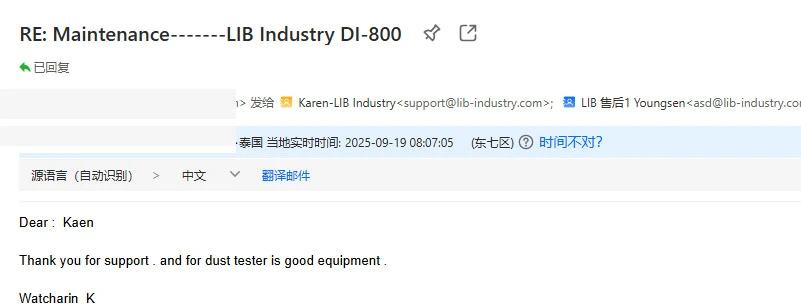
"LIB's dust test chamber was instrumental in identifying our keypad seal vulnerability. The automated vacuum drawdown system simplified our IP6X compliance testing, and having a 3-Year Warranty with lifetime service support gives our laboratory complete peace of mind." |
Frequently Asked Questions (FAQs)
Q1: How much talcum powder is required for standard IEC 60529 IP5X/IP6X testing?
According to IEC 60529, the concentration of dry talcum powder inside the test chamber must be maintained at 2 kg per cubic meter of chamber workspace volume. The powder must be capable of passing through a square-mesh sieve with a nominal wire diameter of 50 µm and a free space between wires of 75 µm.
Q2: What is the primary difference between IP5X and IP6X ratings for smart locks?
IP5X is "dust-protected"—it allows a small, harmless amount of dust to enter provided it does not impair mechanical or electrical function. IP6X is "dust-tight"—it requires absolute exclusion of dust under negative pressure conditions, verified by opening the lock after testing to confirm zero internal dust presence.
Q3: Why is internal chamber heating necessary during a dust test?
Talcum powder absorbs ambient humidity, causing particles to clump together. Clumped powder cannot stay suspended in air or pass through fine 75 µm gaps. Internal chamber heating keeps the powder dry, fluid, and free-flowing throughout the 8-hour test cycle.
Q4: Does LIB Industry offer customization for smart lock mounting fixtures?
Yes. LIB Industry designs custom mounting brackets, cable pass-through ports, and multi-specimen racking systems inside the chamber, allowing engineers to test multiple smart lock assemblies simultaneously in their real-world door mounting orientations.
Q5: What is included in LIB Industry's warranty and service package?
LIB Industry provides a 3-Year Complete Factory Warranty covering all structural, mechanical, and electrical components, paired with Lifetime Technical Support & Service. Support includes video diagnostic assistance, software updates, spare parts support, and annual calibration services.
Upgrade Your Smart Lock Reliability Testing with LIB Industry
Validating ingress protection through standardized dust chamber testing is essential for ensuring smart lock durability, satisfying IP certification requirements, and preventing costly field failures. Partnering with LIB Industry equips your development laboratory with reliable testing systems backed by comprehensive engineering support.
Ready to Configure Your Dust Test Chamber?
Contact LIB Industry today to consult with an environmental testing specialist, request detailed technical specifications, or receive a customized quotation tailored to your security hardware program.
Email: ellen@lib-industry.com
Services Provided: Free Technical Consultation, Custom Chamber Engineering, On-Site Installation, Certified Calibration, 3-Year Factory Warranty, Lifetime Technical Support & Service.