How to Select a Climatic Test Chamber for Building Material Durability? (ASTM C666, Standards & Guide)
Building materials such as concrete, structural masonry, protective facade coatings, composite panels, and joint sealants are engineered to endure 30 to 50+ years of continuous environmental exposure. In real-world service, these materials face intense solar heating, sub-zero freezing cycles, heavy rainfall, and prolonged high-humidity condensation. Over time, these combined stressors induce concrete scaling, micro-cracking, loss of dynamic elasticity, coating blistering, and composite delamination.
To verify long-term durability before commercial deployment, material engineers and testing laboratories rely on a Climatic Test Chamber. By compressing decades of weathering into weeks of controlled, repeatable exposure, a climatic chamber allows researchers to evaluate material responses to extreme thermal gradients and moisture saturation.
This comprehensive technical guide explores degradation physics in construction materials, key international standards (ASTM C666, ASTM D2247, ISO 6270), equipment selection criteria, and turnkey solutions from LIB Industry.
Temperature & Moisture Degradation Mechanisms in Construction Materials
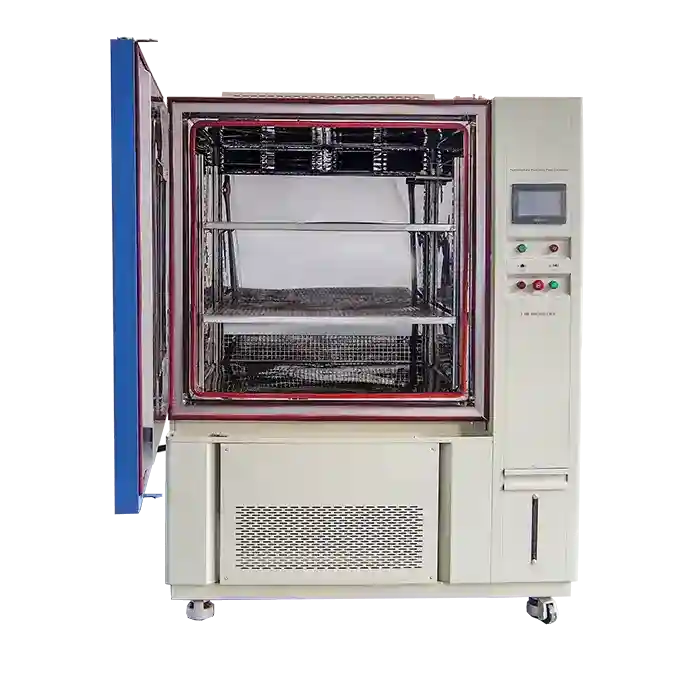 Structural and facade materials degrade through distinct chemical and mechanical pathways when exposed to moisture and thermal cycling. Understanding these mechanisms is critical for designing accurate accelerated testing profiles.
Environmental Stress Pathways on Building Materials
| Stressor | Mechanism | Resulting Failure Mode |
|---|---|---|
| Freezing Cycles | Water expands ~9% in volume within the porous matrix | Concrete scaling & micro-cracking |
| Continuous Humidity | Water vapor diffuses into the coating interface | Coating blistering & adhesion loss |
| Thermal Gradient | CTE mismatch between bonded materials causes shear stress | Composite & joint delamination |
1. Freeze-Thaw Hydraulic Pressure in Porous Concrete
When water enters the capillary pores and micro-fissures of concrete or masonry, cooling below $0^\circ\text{C}$ causes the liquid water to transition into ice, expanding by approximately $9%$ in volume. This volumetric expansion creates intense internal hydraulic pressure within the cement matrix.
Repeated freeze-thaw cycles cause progressive scaling of the surface layer and internal micro-cracking, severely reducing the material's Relative Dynamic Modulus of Elasticity.
2. High-Humidity Condensation & Coating Adhesion Loss
Protective coatings applied to exterior facades must resist moisture penetration. Exposure to continuous $100%\text{ RH}$ high-humidity environments forces water vapor molecules through the coating film. Moisture accumulation at the substrate-coating interface weakens chemical bonding, leading to blistering, softening, discoloration, and eventual peeling.
3. Thermal Expansion Mismatch (CTE) in Composites
Layered building components—such as aluminum composite panels (ACP), fiber-cement cladding, and insulated glass units—combine materials with vastly different Coefficients of Thermal Expansion ($\text{CTE}$). The expansion or contraction of a material under a temperature differential Δ T is governed by:
ΔL=L0⋅α⋅ΔT
Where L0 is the initial length and α is the coefficient of thermal expansion. When bonded materials with unequal $\alpha$ values undergo thermal cycling, high shear stresses develop along the adhesive interface, eventually causing warping, joint rupture, and delamination.
Degradation Summary Matrix
| Material Category | Primary Environmental Stressor | Physical Failure Mode | Critical Diagnostic Metric |
|---|---|---|---|
| Concrete & Masonry | Rapid Freeze-Thaw Cycling (Sub-Zero to Thaw) | Surface scaling, internal matrix micro-cracking | Relative Dynamic Modulus of Elasticity (ASTM C666) |
| Protective Coatings | High-Humidity Condensation (100% RH100\%\text{ RH} 100% RH) | Blistering, film softening, adhesion loss | Blister Rating & Cross-Hatch Adhesion Test |
| Composite Cladding | Extreme Thermal Cycling (ΔT>100∘C\Delta T > 100^\circ\text{C} ΔT>100∘C) | Interfacial shear stress, warping, delamination | Tensile Bond Strength & Visual Inspection |
| Joint Sealants | Cyclic Thermal Expansion/Contraction | Cohesive failure, adhesive joint separation | Elongation Recovery & Modulus Retaining |
Key Takeaway: Testing building materials under single static conditions fails to uncover synergistic damage. Combined temperature and humidity cycling inside a specialized chamber is essential for revealing real-world degradation.
International Qualification Standards & Testing Protocols
Adherence to recognized international standards ensures that laboratory test data correlates with field performance and satisfies regulatory, architectural, and insurance requirements.
Building Material Testing Standards Overview
| Standard | Focus | Key Conditions |
|---|---|---|
| ASTM C666 | Rapid Freeze-Thaw Resistance of Concrete | 2 to 5 hours per cycle |
| ASTM D2247 | Water Resistance of Coatings | Continuous 100% RH at +38°C |
| ASTM C1262 / ISO 6270 / EN 12390 | Masonry Freeze-Thaw & Condensation Exposure | Combined protocols building on C666/D2247 conditions |
1. ASTM C666: Resistance of Concrete to Rapid Freezing and Thawing
ASTM C666 is the baseline standard for evaluating concrete durability. It defines two primary procedures:
- Procedure A: Rapid freezing and thawing in water.
- Procedure B: Rapid freezing in air and thawing in water.
The test alternates concrete beam specimens between $+4^\circ\text{C}$ and $-18^\circ\text{C}$ in cycles lasting 2 to 5 hours. Testing continues for 300 cycles or until the specimen's dynamic modulus drops below $60%$ of its initial value.
2. ASTM D2247: Testing Water Resistance of Coatings in 100% Relative Humidity
ASTM D2247 establishes a standard practice for evaluating the water resistance of exterior coatings under continuous condensation conditions. Coated specimens are maintained at 38°C ±2°C in an environment with 100% relative humidity, allowing condensate to remain on the surface throughout the test. After the specified exposure period, the coating is examined for blistering, adhesion loss, corrosion, discoloration, and other moisture-induced defects.
International Standards Parameter Comparison
| Standard | Primary Application | Temperature | Humidity / Water Condition | Typical Test Requirements & Evaluation |
|---|---|---|---|---|
| ASTM C666 | Structural concrete, bridge decks, pavements | -18°C to +4°C | Specimens fully submerged or water-saturated | Typically 300 freeze-thaw cycles. Evaluate Relative Dynamic Modulus of Elasticity (RDME), mass loss, and visible cracking. A common acceptance criterion is ≥60% RDME retention after the specified cycles. |
| ASTM D2247 | Exterior paints, coatings, and protective finishes | 38°C ±2°C | 100% RH (continuous condensation) | Exposure duration commonly ranges from 250 to 1000 hours depending on product requirements. Assess blistering, adhesion, corrosion, discoloration, and coating failure. |
| ASTM C1262 | Dry-cast concrete masonry units | -18°C to +24°C | Water or saline solution immersion between cycles | Evaluate cumulative weight loss, cracking, scaling, and material deterioration after the specified number of freeze-thaw cycles. |
| ISO 6270 | Paints, varnishes, and coated metal substrates | 40°C ±3°C | 100% RH (constant or cyclic condensation) | Assess coating resistance to moisture by evaluating blistering (ISO 4628-2), rusting, loss of adhesion, discoloration, and surface defects after defined exposure periods. |
 |
||||
Critical Chamber Subsystem Requirements
To meet these strict standards, a Climatic Test Chamber for construction materials must include specialized subsystems:
- Automated Water Purification & Recycling System: Mineral-rich tap water clogs humidification boilers and deposits scale on concrete test specimens, altering test physics. Integrated deionization purification systems maintain water conductivity below $10\ \mu\text{S/cm}$.
- High-Velocity Uniform Airflow: Dense loads of concrete specimens or large composite panels create significant thermal mass. High-capacity centrifugal circulation blowers ensure uniform air distribution across all test racks, preventing local hot or cold spots.
- Instrument Access Ports: Integrated cable access ports permit passage of internal strain gauges, thermocouple wires, and ultrasonic transducers for real-time monitoring of specimen stress during thermal cycling.
Equipment Selection Guide: Reach-In Chambers vs. Walk-In Climatic Rooms
Selecting the correct climatic chamber capacity depends on specimen geometry, total mass loading, and required testing throughput.
Chamber Configuration Overview
| Configuration | Volume | Best Suited For |
|---|---|---|
| Box / Reach-In Chamber | 800L – 3,000L | Standard ASTM C666 beams, paint & coating test panels, sealant & adhesive joints |
| Walk-In Climatic Test Room | Custom, >10 m³ | Full-scale facade wall panels, structural precast concrete, large-batch QC & R&D work |
Feature Comparison Matrix
| Selection Parameter | Reach-In Climatic Chamber | Walk-In Environmental Test Room |
|---|---|---|
| Internal Volume Range | 800 Liters to 3,000 Liters | 10 m³ to 100+ m³ (Customizable) |
| Primary Test Specimens | Standard concrete prisms (100 × 100 × 400 mm), paint panels, sealants | Full-scale curtain wall assemblies, precast concrete blocks, structural panels |
| Temperature Range | -86°C to +150°C | -70°C to +95°C |
| Humidity Range | 10% RH to 98% RH (±2.5% RH) | 20% RH to 95% RH |
| Ramp Rate Capability | 3°C/min to 15°C/min (Configurable) | 1°C/min to 5°C/min |
| Specimen Loading Method | Heavy-duty stainless steel sliding shelves | Floor-level entry ramp for forklift or pallet jack loading |
LIB Engineering Expertise & Turnkey Testing Solutions
Engineers and lab directors require an environmental equipment partner that provides proven manufacturing expertise and comprehensive global service.
About LIB Industry
Established in 2012, Xi'an LIB Environmental Simulation Industry is a specialized designer, manufacturer, and global supplier of environmental test chambers. LIB delivers complete turnkey testing solutions—from custom structural engineering and manufacturing to international shipping, on-site installation, operator training, and calibration.
- Extensive Product Portfolio: LIB engineers over 97 environmental chamber configurations, including climatic temperature/humidity chambers, rapid freeze-thaw systems, xenon arc and UV weathering chambers, rain/spray chambers, and walk-in environmental rooms.
- Complete Turnkey Integration: LIB manages every phase of equipment installation, providing custom access ports, specimen racking, and automated water purification systems.
- Industry-Leading Support: All LIB environmental chambers include a 3-Year Complete Warranty and Lifetime Technical Support & Service, ensuring operational continuity for your laboratory.
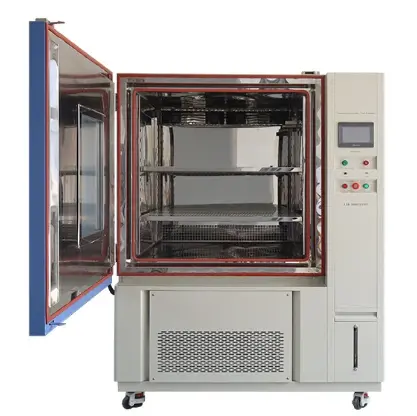
Core Technical Features of LIB Climatic Test Chambers
 |
 |
|
|
|
|
|
|
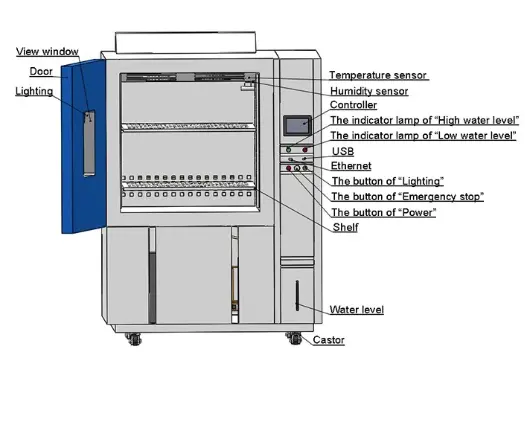
| Robust Workroom | Cable Hole | Temperature and Humidity Sensor | PID controller | |


LIB Climatic Test Chambers are engineered specifically for high-mass construction materials testing:
- Ultra-Low Temperature Capability: High-performance cascade refrigeration systems utilizing French TECUMSEH/Bizter compressors achieve temperatures as low as $-86^\circ\text{C}$, accommodating extreme freeze-thaw and arctic weathering protocols.
- Precision Humidity Control: Water boilers paired with electronic humidity sensors maintain stability within $\pm 2.5%\text{ RH}$ across a $10%\text{ RH}$ to $98%\text{ RH}$ operating range.
- Heavy-Duty Stainless Steel Interior: Grade 304 stainless steel interior walls resist corrosion from salt spray residue, moist concrete runoff, and chemical leaching.
- Automated Water Purification & Recycling: Built-in filtration continuously purifies humidification water, enabling long, unattended testing cycles without mineral accumulation.
- Programmable Touchscreen PLC: Intelligent controllers with Ethernet/USB export allow multi-step programming for continuous freeze-thaw and temperature-humidity profiling.
Real-World Customer Case Study & Field Verification
Project Background
A major infrastructure testing laboratory was contracted to qualify new high-durability precast concrete mixes and exterior silicone coatings for a coastal bridge and skyscraper project. The client required strict compliance verification under ASTM C666 (Procedure A) and ASTM D2247.
The Solution
LIB Industry custom-engineered and installed a 2,000L Heavy-Duty Climatic Test Chamber featuring reinforced floor loading grids, high-capacity cooling compressors capable of rapid $-40^\circ\text{C}$ to $+100^\circ\text{C}$ thermal cycling, and an integrated water purification system.
LIB Field Implementation Workflow
| Step | Task |
|---|---|
| 1 | On-Site Unpacking & Positioning in Materials Testing Lab |
| 2 | Facility Utility Connections (3-Phase Power & Pure Water Supply) |
| 3 | Multi-Point Temperature Mapping & Humidity Stability Check |
| 4 | Hands-on Training for Lab Technicians on ASTM C666 Programming |
| 5 | Final Sign-off & 3-Year Warranty Activation |
During commissioning, LIB field service engineers calibrated the chamber's temperature uniformity across a dense load of 24 concrete beam specimens, ensuring temperature variance remained strictly within $\pm 0.5^\circ\text{C}$.
Customer Feedback: "LIB's climatic chamber allowed us to run 300 continuous ASTM C666 freeze-thaw cycles completely unattended. The automated water recycling system eliminated scale buildup on our concrete samples, and the programmable touchscreen made cycle tracking effortless. LIB's team provided excellent installation and technical support."
Frequently Asked Questions (FAQs)
Q1: What temperature range is required for concrete freeze-thaw testing under ASTM C666?
ASTM C666 requires specimens to undergo rapid freeze-thaw cycling between +4°C and -18°C while remaining fully saturated with water. A climatic chamber used for this test must provide stable temperature transitions and repeatable cycling performance. LIB Industry Climatic Chambers offer temperature ranges down to -40°C or -70°C, making them suitable for ASTM C666 testing as well as more demanding research applications.
Q2: Can one climatic chamber perform both concrete and coating durability tests?
Yes. A climatic chamber with a wide temperature range and precise humidity control can support multiple construction material tests. For example, the same LIB Industry Climatic Chamber can perform ASTM C666 freeze-thaw testing for concrete and ASTM D2247 or ISO 6270 condensation tests for paints and protective coatings. This allows laboratories to maximize equipment utilization while reducing investment costs.
Q3: Why should purified water be used for humidity testing?
Humidity generation systems perform best when supplied with purified or deionized water. Minerals found in tap water can accumulate on humidifiers, sensors, heaters, and test specimens, reducing humidity accuracy and increasing maintenance requirements. Using water with a conductivity below 10 μS/cm helps maintain stable chamber performance and improves the consistency of long-term test results.
Q4: How is freeze-thaw damage in concrete evaluated?
After completing the required number of freeze-thaw cycles, concrete specimens are typically evaluated by measuring the Relative Dynamic Modulus of Elasticity (RDME), mass loss, and visible surface deterioration such as scaling or cracking. These measurements help determine how well the material retains its mechanical integrity after repeated freeze-thaw exposure.
Q5: What humidity accuracy is recommended for ASTM D2247 coating tests?
ASTM D2247 requires specimens to be exposed to continuous condensation at 38°C ±2°C in a 100% RH environment. Stable chamber control is essential because fluctuations in temperature directly affect condensation formation on the coating surface. A climatic chamber capable of maintaining humidity within approximately ±2.5% RH provides reliable and repeatable conditions for evaluating blistering, adhesion, corrosion, and other moisture-related coating failures.
Related Products from LIB Industry
A full construction material durability program often requires more than freeze-thaw and humidity cycling alone. LIB Industry offers complementary environmental test equipment to complete a broader qualification test flow:
| Product | Typical Use Case | Related Standard |
|---|---|---|
| Rapid Freeze-Thaw System | Dedicated high-throughput freeze-thaw testing for concrete beams and precast units at production scale | ASTM C666 / ASTM C1262 |
| Xenon Arc Weathering Chamber | Simulates full-spectrum sunlight to evaluate facade coating fading, chalking, and UV degradation | ASTM G155 / ISO 4892-2 |
| UV Weathering Test Chamber | Simulates UV-A/UV-B exposure for sealants, coatings, and polymer building components | ASTM G154 |
| Rain & Spray Test Chamber | Evaluates water penetration resistance of facade systems, window assemblies, and roofing membranes | ASTM E331 / AAMA 501 |
| Salt Spray Test Chamber | Assesses corrosion resistance of structural steel, rebar, fasteners, and metal cladding, especially for coastal projects | ASTM B117 |
| Walk-In Environmental Test Room | Combines temperature, humidity, and structural loading for full-scale wall assemblies or precast panels | ASTM C666 / ISO 6270 (combined sequence testing) |
Recommendation: Facade and coating manufacturers often pair the Climatic Test Chamber with a Xenon Arc or UV Weathering Chamber and a Salt Spray Chamber to build a complete accelerated aging profile — combining thermal/humidity cycling, solar UV degradation, and corrosion resistance in one qualification program.
Contact LIB Industry to discuss a combined equipment package tailored to your full building material qualification sequence.
Upgrade Your Construction Materials Testing with LIB Industry
Investing in a high-precision Climatic Test Chamber enables construction material manufacturers, civil engineering labs, and certification bodies to verify material durability, satisfy ASTM/ISO standards, and prevent costly field failures. Partnering with LIB Industry ensures access to robust equipment, custom engineering, and reliable global support.
Ready to Optimize Your Materials Laboratory?
Contact LIB Industry today to discuss your testing specifications, request technical datasheets, or receive a customized quotation tailored to your building material testing program.
- Email: ellen@lib-industry.com
- Services Provided: Free Technical Consultation, Custom Chamber Engineering, On-Site Installation, Certified Calibration, 3-Year Warranty, Lifetime Technical Support.