How to Choose a Reliable Thermal Shock Chamber Manufacturer for Your Testing Program?
Choosing a reliable thermal shock chamber manufacturer requires more than comparing temperature ranges, chamber volumes, or purchase prices. Thermal shock testing repeatedly exposes products to rapid transitions between extreme hot and cold conditions, placing demanding requirements on the refrigeration system, basket transfer mechanism, temperature recovery, control accuracy, and mechanical durability.
A dependable manufacturer should be able to demonstrate proven thermal shock equipment experience, stable refrigeration and transfer performance, documented calibration and quality control, applicable standards knowledge, customization capability, and long-term after-sales support.
This guide explains what to check before purchasing a thermal shock test chamber, how to compare thermal shock and temperature cycling equipment, which standards to consider, how to evaluate manufacturers step by step, and how LIB Industry provides complete thermal shock testing solutions from design and manufacturing to installation and lifetime service.
What Makes a Reliable Thermal Shock Chamber Manufacturer?
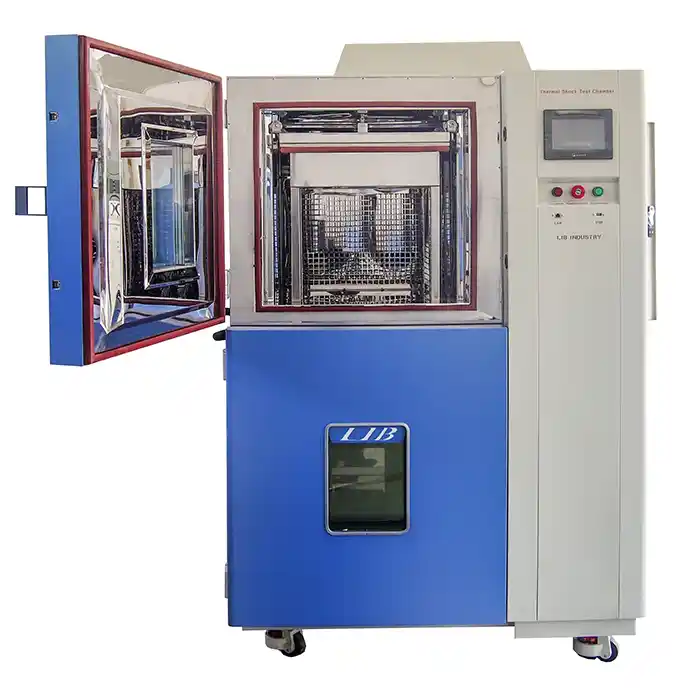
Proven Thermal Shock Chamber Manufacturing Experience
Thermal shock chambers are technically different from conventional temperature and humidity chambers. A standard environmental chamber normally changes temperature according to a programmed heating and cooling profile. A thermal shock chamber typically uses separate hot and cold zones and rapidly transfers the test basket between them.
This requires specialized engineering in high-performance refrigeration, hot/cold zone temperature control, rapid basket transfer mechanisms, thermal insulation, temperature recovery, mechanical positioning and repeatability, and long-term cycling reliability.
When evaluating manufacturers, ask about their specific experience with thermal shock testing equipment, rather than relying only on general environmental chamber manufacturing history.
Stable Temperature Recovery and Transfer Performance
Temperature recovery is one of the most important technical factors in thermal shock testing. After the test basket moves between zones, the chamber needs to quickly return toward the required temperature — slow or inconsistent recovery can increase test duration and affect repeatability.
Buyers should compare: hot/cold-zone temperature range, basket transfer time, temperature recovery time, temperature fluctuation and deviation, number of programmable cycles, and maximum specimen load. Actual performance data under defined test conditions is more useful than nominal temperature specifications alone.
Consistent Manufacturing and Calibration
A reliable manufacturer should have documented quality-control procedures covering component inspection, assembly, refrigeration testing, electrical testing, controller verification, and final performance inspection.
Buyers can request calibration certificates, factory test reports, temperature mapping data, inspection records, equipment serial numbers, and applicable quality certificates — these provide stronger evidence of manufacturing consistency than marketing claims alone.
Transparent Technical Communication
A trustworthy manufacturer should explain both the capabilities and limitations of its equipment. Chamber performance can be affected by specimen size, material, loading weight, temperature range, and facility conditions. A manufacturer that asks detailed technical questions before recommending a model is generally better positioned to provide an appropriate solution than one that recommends a standard model based on chamber volume alone.
What Technical Capabilities Should You Check in a Thermal Shock Chamber Manufacturer?
| Capability | Why It Matters | What to Verify |
|---|---|---|
| Refrigeration system | Determines low-temperature performance and recovery | Compressor brand, refrigeration architecture, refrigerant |
| Basket transfer system | Determines rapid temperature transition | Transfer mechanism, transfer time, repeatability |
| Temperature recovery | Influences cycle duration and consistency | Recovery data under specified load |
| Controller | Controls test profiles and cycles | Programming, data logging, Ethernet |
| Calibration | Confirms measurement accuracy | Calibration certificate and traceability |
| Customization | Supports special testing requirements | Previous customized projects |
| After-sales service | Reduces equipment downtime | Warranty, service response, spare parts |
Refrigeration System and Compressor Quality
Repeated transitions to low temperatures place significant demands on compressors, heat exchangers, valves, insulation, and control components. When comparing suppliers, ask which compressor brand and refrigerant is used, what refrigeration architecture and low-temperature range are provided, how the system performs during repeated cycling, and what preventive maintenance is required.
LIB Industry thermal shock chambers use established refrigeration components, including TECUMSEH compressors, to support stable low-temperature operation and repeated thermal cycling.
Basket Transfer Mechanism
The basket transfer mechanism is a defining feature of thermal shock equipment. During testing, the specimen basket repeatedly moves between hot and cold zones, so the mechanism must provide reliable movement, accurate positioning, consistent transfer performance, and appropriate safety protection.
A manufacturer should be able to explain the transfer method, transfer speed, maximum specimen weight, basket dimensions, mechanical positioning, and safety protection. This is one reason why experience with conventional temperature chambers does not automatically demonstrate expertise in thermal shock chamber manufacturing.
Controller and Data Logging
Modern thermal shock chambers should provide programmable temperature profiles, automatic cycle programming, alarm management, real-time temperature monitoring, test data recording, Ethernet communication, test history, and automatic operation — particularly useful for laboratories running hundreds or thousands of cycles with limited operator intervention.
Custom Thermal Shock Chamber Engineering
Not every reliability testing program can be completed using a standard chamber. Customers may require larger test baskets, special specimen fixtures, non-standard chamber dimensions, customized temperature ranges, additional sensors, special communication interfaces, customized test profiles, or higher specimen loading capacity.
A manufacturer with genuine custom engineering capability can better support specialized applications in automotive, electronics, aerospace, semiconductor, new energy, materials, and research laboratories.
Which Standards Should a Thermal Shock Chamber Manufacturer Support?
The applicable test standard should be identified before selecting equipment, since different procedures specify different temperature ranges, exposure times, transfer conditions, and cycle requirements.
IEC 60068-2-14 — environmental test methods for change of temperature, widely used for electrical and electronic products.
MIL-STD-883 Method 1011 — thermal shock testing for microelectronic and semiconductor applications.
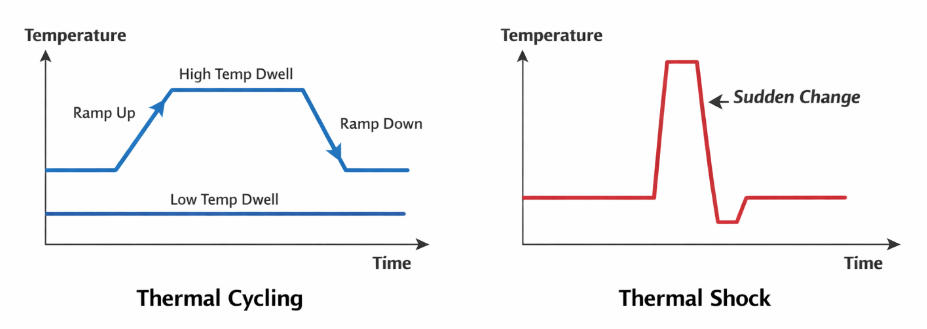
JEDEC JESD22-A104 (Temperature Cycling) and JESD22-A106 (Thermal Shock) — these two should not be treated as identical: temperature cycling generally involves programmed temperature changes, while thermal shock testing requires rapid transitions between temperature zones.
A manufacturer familiar with the applicable standards can help configure temperature limits, exposure time, transfer conditions, cycle count, alarm limits, and data recording — reducing equipment configuration and validation work before actual qualification testing.
Thermal Shock Chamber vs Temperature Cycling Chamber: What Is the Difference?
| Feature | Thermal Shock Chamber | Temperature Cycling Chamber |
|---|---|---|
| Temperature transition | Very rapid | Controlled/programmed |
| Chamber structure | Usually hot and cold zones | Usually one test zone |
| Specimen transfer | Hot/cold zone transfer | Usually no basket transfer |
| Main purpose | Thermal shock resistance | Temperature cycling/reliability |
| Key selection factor | Transfer and recovery performance | Heating/cooling rate and stability |
|
|
|
|
 |
||


A temperature cycling chamber is not automatically a substitute for a thermal shock chamber. If the applicable test procedure requires rapid transfer between hot and cold temperature zones, a dedicated thermal shock chamber is generally more appropriate.
How to Evaluate a Thermal Shock Chamber Manufacturer Before Buying?
Define your testing requirements — temperature range, specimen dimensions/weight, number of cycles, applicable standard, data recording needs, and installation environment.
Compare technical specifications beyond chamber volume or minimum temperature: fluctuation, deviation, transfer time, recovery time, loading capacity, refrigeration system, controller, safety protection, power requirements.
Verify certifications and quality documentation — ISO 9001, CE compliance, calibration certificates, factory test reports, inspection records — and check them whenever possible.
Request calibration and performance data from a comparable unit to confirm published specifications match actual performance.
Check manufacturing capability — production facilities, assembly areas, refrigeration testing, quality inspection, factory acceptance testing.
Confirm after-sales service — warranty period, spare parts availability, technical support, installation service, training, remote troubleshooting, response time.
Common Mistakes When Choosing a Thermal Shock Chamber Manufacturer
Choosing the lowest purchase price — lower-priced equipment may use lower-grade refrigeration components or limited spare-parts support. Compare total cost of ownership: purchase price, energy consumption, maintenance, spare parts, calibration, downtime, and technical service.
Comparing only the temperature range — a chamber rated at -70°C is not necessarily equivalent to another rated at -70°C; recovery time, specimen load, transfer speed, and stability also matter.
Ignoring specimen loading — a chamber may reach its rated temperature under no-load conditions but behave differently under a heavy load. Always provide actual specimen dimensions, material, quantity, and weight before selecting a model.
Treating thermal shock and temperature cycling as the same test — always begin with the applicable test standard before deciding between the two.
Ignoring after-sales support — thermal shock chambers combine refrigeration, electrical controls, sensors, mechanical transfer systems, and safety devices, so reliable technical support significantly reduces downtime.
LIB Industry Thermal Shock Chamber Solutions
LIB Industry provides thermal shock testing equipment designed for rapid temperature transition and reliability testing applications. The lineup covers interior volumes ranging from approximately 22 L to 505 L and loading capacities of up to 60 kg, with temperature coverage from approximately -75°C to +220°C, depending on the model.
Key features include rapid hot/cold zone transfer, programmable thermal shock cycles, TECUMSEH refrigeration components, a programmable touchscreen controller, Ethernet communication, temperature monitoring, multiple safety protection functions, calibration and factory testing, and customized chamber configurations.
Thermal Shock Chamber Selection Guide
| Selection Factor | Small Chamber | Medium Chamber | Large Chamber |
|---|---|---|---|
| Typical application | Electronic components | Automotive/electronic assemblies | Larger components and assemblies |
| Test volume | Small | Medium | Large |
| Specimen loading | Light | Medium | Higher |
| Laboratory footprint | Compact | Moderate | Larger |
| Typical users | R&D laboratories | Reliability laboratories | Industrial testing facilities |
LIB Industry recommends selecting the model according to specimen dimensions, weight, temperature requirements, applicable standard, cycle profile, and installation conditions rather than choosing a chamber based on volume alone.
How Does LIB Industry Support Thermal Shock Chamber Projects?
LIB Industry supports the complete project process: Research → Design → Production → Factory Testing → Delivery → Installation → Commissioning → Training → After-Sales Service.
Before shipment, equipment undergoes factory inspection and performance testing to verify temperature control, refrigeration operation, basket transfer, controller operation, and safety systems. Installation and commissioning support is provided according to the customer's facility conditions.
Operator training can cover equipment operation, test-program creation, safety procedures, routine maintenance, alarm handling, and basic troubleshooting.
LIB Industry backs its equipment with a Three-Year Warranty & Lifetime Service, providing ongoing technical support, maintenance assistance, troubleshooting guidance, and spare-parts support throughout the equipment lifecycle.
Why Choose LIB Industry as Your Thermal Shock Chamber Manufacturer?
Choosing a thermal shock chamber manufacturer is ultimately a decision about long-term testing reliability. LIB Industry combines environmental testing equipment manufacturing experience with thermal shock system engineering, factory testing, customization, installation, training, and long-term technical service.
Engineering-focused design — developed around refrigeration performance, rapid temperature transition, basket transfer, and control stability.
Customized testing solutions — special temperature ranges, specimen dimensions, loading requirements, fixtures, and test procedures when standard equipment doesn't fully meet the application.
Documented quality control — ISO 9001-certified manufacturing processes and factory inspection procedures.
Complete project support — from technical consultation and equipment selection to delivery, installation, training, and after-sales service.
Frequently Asked Questions About Thermal Shock Chamber Manufacturers
What should I look for in a thermal shock chamber manufacturer? Proven thermal shock equipment experience, reliable refrigeration engineering, stable basket transfer performance, documented calibration, applicable standards knowledge, customization capability, and responsive after-sales service.
How important is temperature recovery time? It's important because it affects test cycle duration and repeatability, but it should be evaluated together with specimen load and temperature range rather than as an isolated specification.
How should I compare thermal shock chamber manufacturers? Based on technical capability, actual performance data, calibration documentation, certifications, manufacturing experience, customization capability, customer projects, warranty, and after-sales service — rather than purchase price alone.
What warranty does LIB Industry provide for thermal shock chambers? A three-year warranty and lifetime service, including ongoing technical support, maintenance assistance, troubleshooting guidance, and spare-parts service.
Conclusion: How Do You Choose the Right Thermal Shock Chamber Manufacturer?
Before purchasing, evaluate the manufacturer's thermal shock equipment experience, refrigeration system quality, basket transfer mechanism, temperature recovery performance, calibration and quality-control procedures, standards compliance capability, custom engineering capability, manufacturing transparency, customer project experience, and after-sales/spare-parts support.
A structured evaluation process helps engineers and purchasing teams select equipment that can provide stable and repeatable performance throughout long-term reliability testing.
Looking for a reliable thermal shock chamber manufacturer, supplier, or factory?
LIB Industry provides thermal shock testing solutions for electronics, automotive components, aerospace products, semiconductor devices, new-energy equipment, materials, and research applications, backed by a Three-Year Warranty & Lifetime Service.
Contact LIB Industry at ellen@lib-industry.com to discuss your temperature range, specimen size, loading requirements, applicable standards, and testing program.