Thermal Shock Test Chamber Price: How Much Does a Thermal Shock Chamber Cost?
The price of a thermal shock test chamber can vary significantly depending on temperature range, chamber volume, transfer speed, loading capacity, testing standards, and customization requirements. Published market data indicates that mid-to-high capacity systems may start around $50,000, while larger or highly specialized systems can reach $100,000 or more.
However, the purchase price is only part of the investment. Refrigeration performance, recovery time, installation requirements, energy consumption, maintenance, calibration, and after-sales support can all affect the total cost of ownership.
This guide explains how much a thermal shock test chamber costs, what determines the price, how to compare supplier quotations, and how to select a configuration that fits your testing requirements and budget.
What Factors Affect Thermal Shock Test Chamber Price?
Several technical factors have a direct influence on the price of a thermal shock chamber.
| Key Factor | Price Impact | Why It Matters |
|---|---|---|
| Temperature Range | High | Wider temperature ranges require more powerful heating and refrigeration systems |
| Transfer Speed | High | Fast basket transfer requires stronger thermal conditioning capability |
| Chamber Volume | High | Larger chambers require more insulation, structural strength, and cooling capacity |
| Load Capacity | Medium–High | Heavy specimens require reinforced baskets and transfer mechanisms |
| Testing Standards | Medium–High | Special compliance requirements may require additional engineering and documentation |
| Customization | Variable | Non-standard dimensions and testing functions increase engineering and manufacturing costs |
Temperature Range
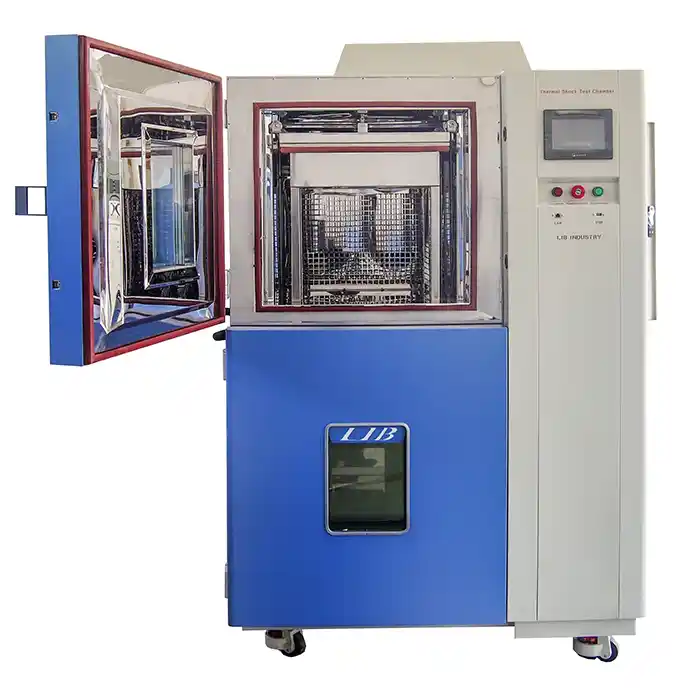
Temperature range is one of the most important cost factors. A chamber designed for moderate temperature cycling generally requires less refrigeration and heating capacity than a system designed for severe thermal shock conditions.
For example, a chamber covering temperatures close to -75°C to +220°C requires advanced refrigeration, heating components, insulation, and control systems. The wider the temperature range, the greater the engineering requirements tend to be.
Transfer Speed and Recovery Time
Thermal shock testing requires specimens to move rapidly between hot and cold zones. After transfer, the chamber must restore the required temperature within the specified recovery time.
Faster recovery generally requires greater heating and cooling capacity. Therefore, buyers should not compare chambers only by their temperature range. Transfer time and recovery performance should also be included in the quotation and technical specification.
Chamber Volume and Load Capacity
Larger thermal shock chambers require stronger structures, more insulation materials, and greater refrigeration capacity.
Loading capacity also affects cost. A chamber designed for lightweight laboratory specimens has different mechanical requirements from a system capable of handling 50 kg or 60 kg loads.
The right chamber size should therefore match the actual specimen dimensions and test load rather than simply choosing the largest available model.
How Much Does a Thermal Shock Test Chamber Cost?
As a general budgeting reference, mid-to-high capacity thermal shock test chambers are commonly associated with a starting range of approximately $50,000, while large or specialized systems may cost $100,000 or more.
The actual quotation can vary substantially because two chambers with similar external dimensions may have very different refrigeration systems, transfer mechanisms, temperature ranges, recovery requirements, and customization levels.
A useful way to approach the budget is to consider the equipment according to its intended application:
| Chamber Type | Typical Application | Budget Consideration |
|---|---|---|
| Small / Tabletop | R&D and small specimens | Lower equipment investment |
| Medium Capacity | Product qualification and reliability testing | Medium investment |
| Large Capacity | Larger products or higher specimen loads | Higher investment |
| Customized System | Special dimensions, loads, temperatures, or testing requirements | Custom quotation |
Instead of asking only “How much does a thermal shock chamber cost?”, procurement teams should provide the supplier with the required temperature range, specimen size, specimen weight, transfer requirements, and applicable standards. These details make the quotation much more meaningful.
What Is Included in the Total Cost of a Thermal Shock Chamber?
The purchase quotation is not necessarily the total cost of owning a thermal shock test chamber.
| Cost Category | What It Covers | Budget Impact |
|---|---|---|
| Equipment | Chamber, refrigeration, controller, transfer system | Main investment |
| Installation | Electrical supply, ventilation, positioning and commissioning | Initial facility cost |
| Calibration | Temperature performance verification | Periodic cost |
| Maintenance | Sensors, seals, filters, refrigerant and other service items | Recurring cost |
| Energy | Compressor and heater electricity consumption | Long-term operating cost |
| Compliance | Testing, documentation and special requirements | Project-dependent |
| Service | Technical support and spare parts | Long-term operating cost |
Facility and Installation Costs
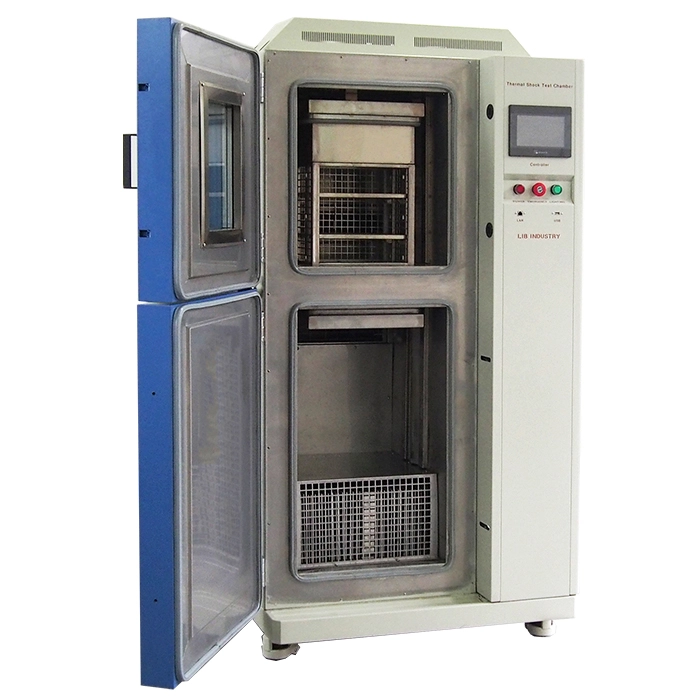
Thermal shock chambers can place significant demands on electrical supply and facility ventilation, particularly when advanced refrigeration systems are used.
Before purchasing, buyers should confirm the manufacturer's facility requirements, including electrical capacity, installation space, ventilation, and other environmental conditions. Including these requirements in the initial budget can prevent unexpected installation costs.
Maintenance and Operating Costs
Routine maintenance can include sensor calibration, gasket replacement, filter replacement, refrigerant-related service, and other components depending on the equipment configuration.
Energy consumption should also be considered because refrigeration and heating systems operate repeatedly during thermal shock cycles.
For long-term procurement decisions, evaluating the total cost of ownership (TCO) over several years provides a more useful comparison than looking only at the initial purchase price.
How Should You Compare Thermal Shock Chamber Prices From Different Suppliers?
A fair price comparison requires more than putting two quotations side by side.
Before comparing suppliers, confirm that the proposed chambers have comparable technical specifications.
| Specification to Compare | Why It Matters |
|---|---|
| Temperature Range | Determines the severity of the thermal shock test |
| Transfer Time | Affects the actual thermal shock process |
| Recovery Time | Influences testing efficiency |
| Temperature Uniformity | Supports consistent test conditions |
| Temperature Fluctuation | Affects test stability |
| Chamber Volume | Determines specimen capacity |
| Loading Capacity | Determines whether the chamber can handle the test specimens |
| Refrigeration System | Influences cooling performance and operating reliability |
| Controller | Determines programming and data management capabilities |
| Warranty | Reduces long-term procurement risk |
| Spare Parts & Service | Affects maintenance and equipment downtime |
| Customization | Determines how closely the equipment matches the application |
For example, two suppliers may offer chambers at similar prices, but one may provide a faster recovery time, stronger refrigeration architecture, longer warranty, or better customization capability.
The best-value thermal shock chamber is not necessarily the cheapest chamber. It is the chamber that meets the required testing performance with a reasonable total cost of ownership.
LIB Industry Thermal Shock Test Chambers: What Do You Get?
LIB Industry provides thermal shock test chambers designed for reliability and environmental testing programs with different chamber sizes, temperature requirements, and specimen loads.
The available configuration covers 22L to 505L internal volumes, loading capacities of up to 60 kg, and temperature coverage from -75°C to +220°C. The systems are designed to support efficient thermal shock testing with recovery times of approximately five minutes following basket transfer.
Key LIB Thermal Shock Chamber Features
| LIB Feature | Customer Benefit | |
|---|---|---|
| 22L–505L capacity | Supports different specimen sizes and testing scales |
|
| Up to 60 kg loading capacity | Suitable for heavier test specimens | |
| Up to -75°C to +220°C | Supports demanding thermal shock programs | |
| Approximately 5-minute recovery | Helps improve test cycle efficiency | |
| French TECUMSEH compressors | Supports stable refrigeration performance | |
| Environmentally friendly refrigerant | Supports modern environmental requirements | |
| Programmable touchscreen controller | Simplifies test setup and operation | |
| Ethernet connectivity | Facilitates data management and long-term testing |

LIB Industry also provides customized equipment according to specific testing and budget requirements. The service covers research, design, production, commissioning, delivery, installation, and training, providing a coordinated solution from equipment selection through implementation.
Which Thermal Shock Chamber Configuration Fits Your Needs?
The best configuration depends on the products being tested rather than simply the available budget.
For Small Laboratory Testing
For small components, materials, and R&D programs, a compact thermal shock chamber can provide the required thermal cycling capability without the additional investment associated with large-capacity equipment.
For Product Qualification and Reliability Testing
For production qualification and reliability testing, buyers should pay particular attention to recovery time, cycle efficiency, temperature stability, and long-term operating reliability.
For Heavy or Large Specimens
When specimens are large or heavy, chamber volume and loading capacity become critical selection factors. A larger chamber with an appropriately reinforced transfer mechanism may be more suitable than a compact unit.
For Severe Thermal Shock Testing
For demanding applications requiring extreme temperature conditions, the refrigeration system, heating capacity, insulation, transfer mechanism, and recovery performance should all be evaluated together.
Before requesting a quotation, prepare these five parameters:
Temperature range + specimen size + specimen weight + transfer/recovery requirement + testing standard
Providing these details allows the manufacturer to recommend a more accurate configuration and price.
Thermal Shock Test Chamber Price FAQ
How much does a thermal shock test chamber cost?
A reasonable initial budget for a mid-to-high capacity thermal shock chamber may start around $50,000, while larger or specialized systems can reach $100,000 or more. The final price depends on temperature range, chamber volume, transfer speed, loading capacity, compliance requirements, and customization.
Does a wider temperature range increase the price?
Generally, yes. A wider range requires more advanced heating and refrigeration capabilities, particularly when the chamber must operate at extremely low and high temperatures.
Is a larger thermal shock chamber always more expensive?
Generally, larger chambers cost more because they require greater structural strength, insulation, refrigeration capacity, and loading capability. However, the final price also depends on the temperature range and other technical specifications.
Should I choose the cheapest thermal shock chamber?
Not necessarily. A lower purchase price can result in higher long-term costs if the equipment has greater energy consumption, frequent maintenance requirements, limited spare-part availability, or insufficient technical support.
What should I provide when requesting a thermal shock chamber quotation?
At minimum, provide the required temperature range, specimen dimensions, specimen weight, chamber capacity, transfer or recovery requirements, applicable testing standards, and any special functions or customization requirements.
Get a Thermal Shock Test Chamber Quote From LIB Industry
The price of a thermal shock test chamber depends on much more than chamber size. Temperature range, transfer speed, recovery performance, loading capacity, refrigeration architecture, compliance requirements, installation, and after-sales support can all influence the final investment.
For this reason, buyers should compare thermal shock chambers based on technical performance and total cost of ownership, rather than selecting a supplier solely according to the lowest initial quotation.
LIB Industry can recommend a suitable thermal shock test chamber based on your testing requirements, specimen size, temperature range, load capacity, and budget.
Tell us your testing requirements to get a customized thermal shock chamber solution and quotation.
Email: ellen@lib-industry.com


