What Makes a Reliable Solar Simulation Chamber Factory
A trustworthy factory for solar simulation chambers has accurate temperature and humidity control, a correctly classified sun simulator, and consistent production that lasts through thousands of approval rounds for photovoltaic modules. Solar simulation chambers mimic the AM1.5 spectrum of light along with the temperature cycling, humidity freeze, and damp heat conditions needed by IEC 61215 and IEC 61730. This lets manufacturers test for power loss, encapsulant delamination, and hotspot formation all at the same time. Choosing a plant that doesn't have a lot of technical knowledge can lead to quality data that certification bodies won't accept, light classification that isn't consistent, and temperature consistency that you can't rely on. Aside from the numbers on the datasheet, factories that consistently produce reliable test results are often distinguished from those that don't by things like how well they calibrate, how they handle panels, and how they source parts over an extended period of time. This article talks about how solar simulation chambers work, which specs really matter, and how to check out a company before buying equipment for your PV reliability lab.
What Is a Solar Simulation Chamber and How Does It Work?
.webp "blog-1-1")
Combining Light, Temperature, and Humidity in One System
Reproducing the AM1.5 Reference Spectrum
Solar simulation chambers use the AM1.5G spectrum to show normal sunlight on Earth at one sun strength. A properly classified model fits this reference across specific color bands, which makes sure that power readings are based on real solar exposure and not an approximation of a light source.
Supporting Combined Qualification Sequences
Modern chambers make it possible for thermal cycling, damp heat, and humidity freeze protocols to run in the same enclosure that is used for irradiance testing. This speeds up the qualification process because specimens used to have to be moved between several different pieces of equipment.
Sample Handling Design Affects Testing Efficiency
Technicians can load full-size modules into solar simulation chambers and route power or sensor connections without affecting chamber seals thanks to adjustable stainless steel shelves and standardized cable access ports. This is a practical feature that is just as important as the temperature specs.
Key Specifications to Evaluate in a Solar Simulation Chamber Factory
| Specification | Why It Matters | Typical Range |
|---|---|---|
| Simulator classification | Determines measurement accuracy and repeatability | Class A to Class AAA per IEC 60904-9 |
| Temperature range | Must cover thermal cycling and damp heat extremes | -60°C to +100°C or wider |
| Humidity control | Supports damp heat and humidity freeze protocols | 20% to 98% RH |
| Panel capacity | Determines testing throughput per batch | 4 to 12 full-size panels |
Simulator Classification Drives Measurement Confidence
A Class AAA rating from IEC 60904-9 means that solar simulation chambers perform at a Class A level for spectral match, spatial non-uniformity, and temporal instability all at the same time. This gives labs the highest level of confidence in their power measurements that can be repeated.
Temperature Range Must Match Qualification Protocols
For damp heat tests, the temperature must be kept near 85°C for a long time, while thermal cycling methods change the temperature between -40°C and +85°C. The rated range of a chamber should be far enough from both ends to leave room for faster internal test programs.
Humidity Accuracy Affects Damp Heat Repeatability
Keeping the difference in humidity within about ±2.5% RH during long damp heat runs in solar simulation chambers stops drift that could cause different degradation results for identical module samples tested from the same batch.
Why Choose a Professional Solar Simulation Chamber Manufacturer?
Engineering Depth Reduces Qualification Risk
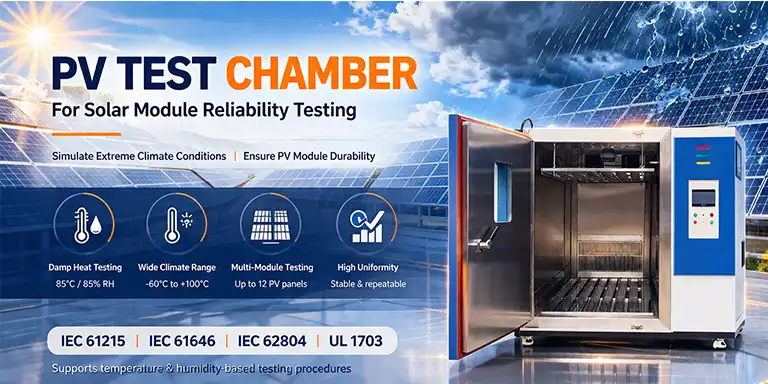
When light, heat, and humidity are mixed in a chamber, solar simulation chambers put uniformity and control stability to the test. Manufacturers with a lot of experience making this kind of tool make systems that keep their classification and range even after years of continuous testing.
Certification Alignment Saves Validation Time
If a maker knows what the requirements are for IEC 61215, IEC 61730, and UL 1703, they can set up customizable test routines that directly match these standards. This saves time and effort during setup before a lab starts running real approval runs.
Responsive Support Protects Testing Schedules
Manufacturers who offer solar simulation chambers with quick technical support and spare parts help keep these schedules moving along instead of stopping while the chamber is being fixed, which is especially important for PV qualification programs that often have test sequences lasting for weeks at a time.
|
|
|


How to Evaluate a Solar Simulation Chamber Supplier Before Purchasing
Reviewing Manufacturing Track Record
It is important for buyers to find out how long a seller has been making combined solar training equipment, since getting correct irradiance and precise environmental control at the same time is very different from just doing environmental chamber engineering.
Requesting Third-Party Quality Certifications
Proof of ISO 9001 quality management, CE approval, and independent testing confirmation for solar simulation chambers gives buyers faith that the manufacturer's claims will hold up in real-life situations, not just on datasheets.
Confirming Panel Capacity and Customization Options
For efficient batch testing, full-size units up to 1 m by 2 m need enough room inside and the ability to hold multiple panels. Buyers should make sure that a provider can meet their needs for panel size and testing rate.
Solar Simulation Chamber Manufacturing Process and Quality Assurance
Precision Component Selection and Assembly
Reliable factories choose stainless steel for the inside, calibrated sensors, and tested simulator parts before putting the whole thing together. This makes sure that the finished chamber meets the required temperature, humidity, and irradiance levels from the first time it is used until it is decommissioned.
Multi-Stage Calibration and Testing
Before being sent out, solar simulation chambers are calibrated to make sure that the allowed changes in temperature, humidity, and simulator classification all fall within the acceptable ranges. This way, any problems with the setup or parts are found before the equipment gets to the customer's lab.
Ongoing Quality Management Standards
When a factory has ISO 9001 quality management, CE certification, and third-party testing from reputable groups, they make sure that the manufacturing standards stay the same from one production run to the next. This is better than letting quality vary from batch to batch.
Frequently Asked Questions About Solar Simulation Chamber Manufacturers
What does it mean for a solar model to be Class AAA?
What range of temperatures should a chamber for solar simulation have?
It is recommended that chambers be able to handle both damp heat tests close to 85°C and temperature cycling between -40°C and +85°C. Many manufacturers offer wider temperature ranges, like -60°C to +100°C, so that you can test in more situations.
How many solar panels can a normal room test at the same time?
Full-size modules up to 1 m by 2 m can usually fit four to twelve panels per batch in chambers that were made for that purpose. This means that laboratories can do qualification runs quickly instead of testing each module separately.
Conclusion
A dependable factory for solar simulation chambers provides accurate Class AAA light along with stable temperature and humidity control. This is backed by manufacturing uniformity that maintains classification over years of ongoing PV qualification testing. By looking at the simulator's classification, temperature and humidity ranges, panel capacity, and the history of the manufacturer's certifications, you can tell the difference between reliable equipment and rooms that are prone to changing specs and giving inconsistent results. Putting money into a properly designed chamber saves both certification timelines and long-term trust in data on module durability.
Looking for a reliable company to make, supply, or factory a solar simulation chamber for your photovoltaic reliability lab? Email ellen@lib-industry.com to talk to LIB Industry about complete outdoor testing options that are made to fit your PV qualification and certification testing needs.