How to Choose a Weatherometer for Polymer Durability Testing?
A weatherometer helps manufacturers evaluate how outdoor exposure affects polymer parts, including fading, cracking, chalking, gloss loss, and reduced mechanical strength. By controlling light, temperature, humidity, and water spray, it allows laboratories to compare material formulations under repeatable conditions without waiting years for natural weathering.
However, different materials and test standards may require different light sources. A xenon weathering test chamber simulates a broader portion of the solar spectrum, while a UV test chamber focuses on ultraviolet-related degradation. Choosing the right equipment depends on the material, expected service environment, and applicable test standard.
Why Are Weatherometers Essential for Polymer Durability Testing?
 Outdoor polymer products, such as automotive trim, window frames, roofing membranes, and plastic housings, are exposed to sunlight, heat, moisture, and rain. Over time, these conditions can change their appearance and performance.
Shorter Material Development Cycles
Natural weathering can take months or years to reveal weaknesses. Laboratory weathering tests provide controlled conditions for comparing materials and formulations in a shorter period. Manufacturers can use the results to screen candidate materials and evaluate protective coatings before outdoor application.
Accelerated laboratory testing does not provide an exact conversion between test hours and years of outdoor service. Results should be interpreted alongside the applicable test standard and, where appropriate, natural exposure data.
What Does Weathering Testing Measure?
Depending on the material and test procedure, evaluations may include:
- Color change and yellowing
- Gloss retention and surface chalking
- Cracking, brittleness, and other visible damage
- Changes in tensile strength or other mechanical properties
The test method should match the material and the degradation risks relevant to its intended application.
What Factors Affect Outdoor Polymer Durability?
A suitable weatherometer reproduces the environmental stresses relevant to the selected test method.
Light and UV radiation: Can cause fading, yellowing, embrittlement, and changes in surface properties.
Temperature: Can accelerate chemical reactions and affect material degradation.
Humidity and moisture: May contribute to swelling, hydrolysis, and other moisture-related damage.
Water spray: Can simulate rain exposure, washing, and temperature changes caused by wetting.
A xenon weathering chamber can combine light exposure with controlled temperature, humidity, and spray cycles. The available conditions depend on the chamber configuration and test procedure.
Xenon Weathering Test Chamber vs. UV Test Chamber: Which Should You Choose?
Both xenon weathering test chambers and UV test chambers evaluate material degradation, but their light sources and testing capabilities differ. A xenon chamber simulates a broader portion of the solar spectrum, while a fluorescent UV chamber focuses on ultraviolet radiation.
| Comparison | Xenon Weathering Test Chamber | UV Test Chamber |
|---|---|---|
|
|
|
|
| Light source | Xenon arc lamp with suitable optical filters | Fluorescent UV lamps |
| Main testing focus | Weathering under a broader simulated solar spectrum | Degradation caused mainly by ultraviolet radiation |
| Light simulation | Can reproduce UV and portions of visible and infrared radiation, depending on filters | Concentrates on selected UV wavelengths |
| Typical applications | Plastics, automotive components, coatings, and materials requiring broader sunlight simulation | Plastics, coatings, rubber, and materials where UV-related degradation is the main concern |
| Environmental conditions | Can combine irradiation with controlled temperature, humidity, and water spray, depending on configuration | Commonly combines UV exposure with temperature control and condensation or water spray, depending on configuration |
| Commonly referenced standards | ASTM G155, ISO 4892-2 | ASTM G154, ISO 4892-3 |
| LIB industry model | XL-S-750 | UV-SI-260 |
| Irradiation source | 1 × 4500 W water-cooled xenon arc lamp | 8 × 40 W fluorescent UV lamps |
| Wavelength range | 300–400 nm; listed measurement/control wavelengths: 340 nm or 420 nm | 290–400 nm |
| Irradiance range | 35–150 W/m² | 0.3–20 W/m² |
| Chamber temperature | Ambient to 100°C, ±2°C | Ambient to 90°C, ±2°C |
| Black panel temperature | 35–85°C, ±2°C | 35–80°C |
| Humidity | 50–98% RH | ≥95% RH |
| Specimen capacity | 42 pieces | 56 pieces |
|
|
|


Which Weathering Test Chamber Should You Choose?
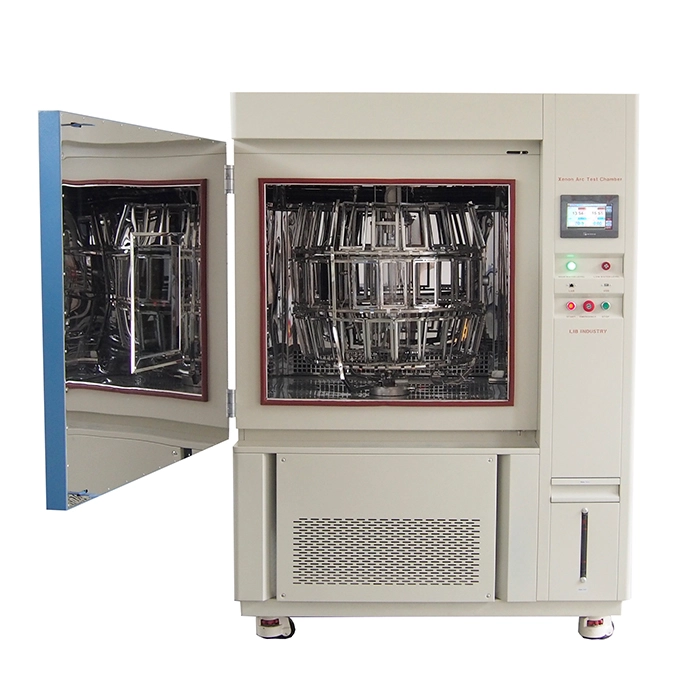
Choose the LIB industry XL-S-750 Xenon Weathering Test Chamber for tests requiring xenon-arc exposure and a broader simulation of sunlight. It features a 4500 W xenon lamp, a 35–150 W/m² irradiance range, and a 42-specimen capacity.
Choose the LIB industry UV-SI-260 UV Test Chamber for tests focused on UV degradation using fluorescent UV lamps. It features eight 40 W lamps, an irradiance control range of 0.3–20 W/m², and a 56-specimen capacity.
The final choice depends on your material, test standard, and required exposure conditions. Contact LIB industry for equipment recommendations and pricing.
How to Select a Weatherometer for Different Polymer Parts
After identifying the appropriate light source, check the specimen dimensions, capacity, and operating conditions.
Specimen Size and Capacity
The XL-S-750 accommodates 42 specimens and uses a rotating specimen holder. Its listed holder size is 95 × 200 mm, making it suitable for many flat specimens, such as plaques and thin material samples.
The UV-SI-260 accommodates up to 56 specimens, with a listed holder size of 75 × 150 mm. For larger three-dimensional parts, profiles, or housings, confirm the usable test space and holder arrangement before ordering. A customized fixture or a different chamber configuration may be necessary.
Confirm the Required Operating Conditions
Before selecting a model, verify the required irradiance, wavelength, temperature, humidity, and water spray or condensation cycle. These conditions should follow the applicable standard rather than a general default.
For xenon testing, the filter system is important because different filters can represent different exposure environments, such as outdoor sunlight or sunlight filtered through window glass.
For fluorescent UV testing, confirm the required lamp type, UV wavelength, temperature conditions, and moisture cycle. Do not assume that the same test cycle can be used for both xenon and UV chambers.
Customer Case: EDF Cable Testing to EN 50483-6
In April 2023, Électricité de France (EDF) contacted LIB industry for a test solution based on EN 50483-6, the European standard for environmental testing of low-voltage aerial bundled cable accessories. The standard evaluates resistance to solar radiation, humidity, water spray, temperature extremes, and corrosive environments.

Test Procedure and Key Parameters
Under the climatic aging Method 1 described in EN 50483-6:2009, specimens undergo a repeated weekly cycle combining irradiation and environmental conditioning:
-
Phase A – Irradiation: UV exposure at low relative humidity, without water spray, at a chamber temperature of 70°C ± 2°C or 55°C ± 2°C, as specified by the test procedure.
-
Phase B – Irradiation and water spray: 23 hours of exposure at 55°C ± 2°C, with 69 spray cycles; relative humidity is 60% RH ± 10%.
-
Phase C – Irradiation and water spray: 23 hours of exposure at the temperature specified for Phase A, with low relative humidity and 69 spray cycles.
-
Phase D – Humid heat and temperature cycling: 46 hours without irradiation, at 95% RH ± 5%, with four temperature cycles between 55°C and -25°C.
The method specifies an average radiation energy level of approximately 4.3 mW/cm² ± 15% over the 300–400 nm wavelength range. Test conditions must be followed as a complete sequence because changes to individual parameters can affect the results. <Cite refs={["turn572430search1","turn752240view1"]}/>
LIB industry Equipment Solution
After reviewing EDF's requirements, LIB industry recommended the XL-S-750C Low-Temperature Xenon Test Chamber. The chamber meets the customer's specified irradiation requirements and can reach -40°C, providing additional low-temperature capability for the requested test conditions.
This project demonstrates LIB industry's ability to match environmental testing equipment to demanding standards-based requirements for a major European electricity utility.
How Should You Maintain and Calibrate a Weatherometer?
Regular maintenance helps keep exposure conditions consistent and results comparable.
Check sensors and irradiance measurement: Follow the calibration schedule for the radiometer and temperature sensors. Keep calibration records and investigate unexpected changes in readings.
Maintain lamps and filters: Track lamp operating hours and replace lamps or filters according to the manufacturer's recommendations and the applicable procedure.
Inspect the water and spray system: Keep the water supply, nozzles, and drainage system clean to help maintain repeatable spray conditions.
Keep operating records: Record test parameters, exposure time, maintenance activities, and calibration status.
The XL-S-750 includes a UV radiometer with a listed tolerance of ±5%, a SUS304 stainless steel interior, an automatic water supply and purification system, and a mechanical compression refrigeration system. The UV-SI-260 also features automatic water supply and water purification, a SUS304 stainless steel interior, and a programmable touchscreen controller with Ethernet connectivity.
Confirm the maintenance requirements and supplied functions for the specific configuration.
What Should You Confirm With a Weatherometer Supplier?
Before ordering, prepare a checklist covering:
Test standard: Exact standard and edition, required cycle, and acceptance criteria.
Light source: Xenon arc or fluorescent UV, required filters, irradiance, and control wavelength.
Specimens: Dimensions, quantity, holder arrangement, and whether custom fixtures are needed.
Environmental conditions: Temperature, humidity, spray or condensation, and exposure duration.
Calibration and documentation: Available calibration records, measurement capabilities, and supporting documentation.
Installation and service: Site utilities, delivery access, installation, operator training, warranty, and long-term technical support.
LIB industry offers customized environmental testing equipment and project support. Its services include installation and commissioning, operator training, a 3-year warranty, and lifetime technical service support. For large or customized systems, confirm the scope of delivery and on-site work in the quotation.
Request a Weatherometer Solution From LIB industry
LIB industry provides weathering test equipment and customized testing solutions for different specimen sizes and laboratory needs. Contact the team with your material type, applicable standard, specimen dimensions, and required test conditions to discuss a suitable configuration.
Email: inquiry@libtestchamber.com
With a 3-year warranty and lifetime technical service support, LIB industry can also assist with installation, commissioning, and operator training according to the agreed project scope.
Related Testing Equipment
|
|
|
|
|
Xenon Weathering Test Chamber Designed for testing materials under controlled xenon-arc exposure. Suitable for applications where the specified procedure requires a broader simulated solar spectrum. |
UV Test Chamber Used for fluorescent UV exposure tests that focus on UV-related degradation. Select the lamp type, temperature conditions, and moisture cycle according to the applicable standard. |
Temperature and Humidity Test Chamber Evaluates material and component performance under controlled temperature and humidity conditions when light exposure is not part of the required test procedure. |


FAQ
Is a xenon weathering test chamber better than a UV test chamber?
Neither is universally better. Xenon chambers simulate a broader portion of the solar spectrum, while fluorescent UV chambers focus on UV-related degradation. Choose the chamber required by your test standard and application.
Can a UV test chamber replace a xenon weathering test chamber?
Not when the specified procedure requires xenon-arc exposure. The two light sources produce different exposure conditions, so confirm the required method before choosing a substitute.
Which standards are commonly used for xenon weathering tests?
ASTM G155 and ISO 4892-2 are common references for xenon-arc exposure. For fluorescent UV exposure, ASTM G154 and ISO 4892-3 are commonly referenced. Confirm the exact procedure and edition required for your material.
Can accelerated weathering predict the exact outdoor service life of a polymer?
Not by itself. Accelerated weathering is useful for comparing materials under controlled conditions, but test duration does not translate directly into a fixed number of outdoor years. Field exposure data may also be needed.