Solar Simulation Chamber Models: Specifications, Applications & Buying Guide
Different types of solar simulation chambers vary significantly in light source, chamber size, environmental control, and testing capability. Available configurations range from compact benchtop systems for small samples and components to large walk-in chambers designed for full-size photovoltaic modules.
Selecting the right solar simulation chamber requires more than comparing chamber volume. Laboratories should consider specimen dimensions, sample capacity, temperature and humidity requirements, irradiance classification, applicable testing standards, and expected testing throughput.
This guide compares the major solar simulation chamber configurations, explains their applications, and provides practical criteria for selecting the right system for PV, automotive, and material testing.
1. Types of Solar Simulation Chambers
Benchtop Solar Simulation Chambers for Small-Scale Testing
Benchtop solar simulation chambers typically range from 50L to 100L and are designed for small material samples, solar cells, components, and test coupons.
Their compact design makes them suitable for R&D laboratories, universities, and facilities with limited floor space. They are particularly useful when the testing program focuses on material screening, component evaluation, or preliminary product development rather than full-size assemblies.
Typical applications include:
Material screening
Solar cell testing
Component testing
R&D programs
University and laboratory research
Floor Stand Solar Simulation Chambers for Mid-Volume Testing
Floor stand configurations typically range from 225L to 500L, providing more sample capacity while requiring less space than a large walk-in system.
They are suitable for manufacturers and testing laboratories that need to evaluate multiple samples or larger components in regular testing programs.
This configuration provides a practical balance between chamber capacity, laboratory space, and testing throughput.
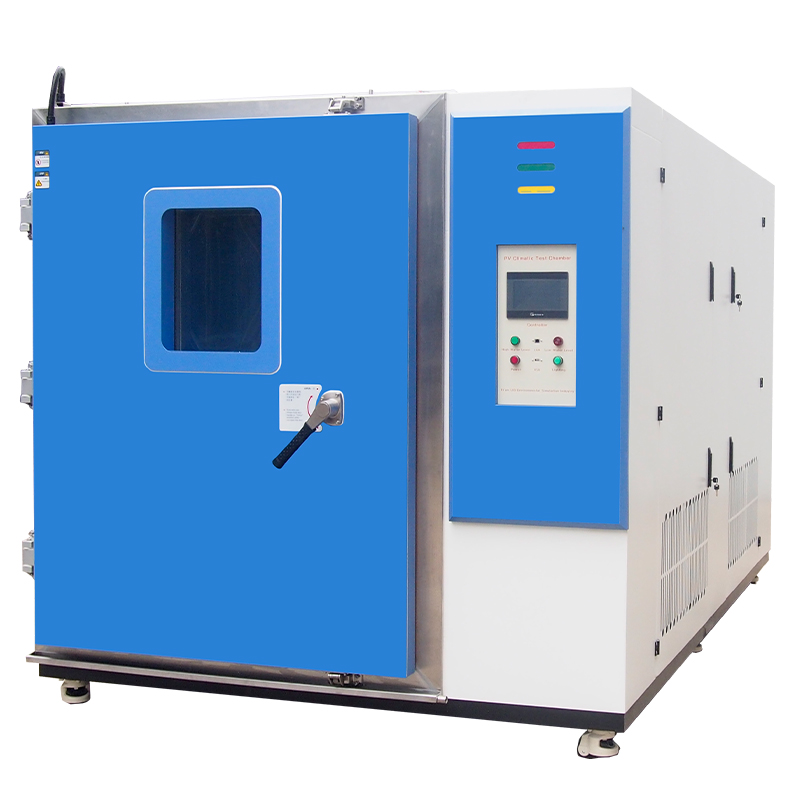
Walk-In Solar Simulation Chambers for Full-Size PV Modules
Walk-in solar simulation chambers typically range from 1000L to 1500L or larger and can be configured for full-size photovoltaic modules.
Depending on the chamber dimensions and fixture arrangement, selected configurations can accommodate approximately 4–12 PV panels. These systems are particularly suitable for PV manufacturers, certification laboratories, and high-volume qualification programs.
For full-size modules, internal dimensions and fixture layout are often more important than nominal chamber volume alone.
2. Solar Simulation Chamber Specifications Comparison
The most suitable chamber depends on the relationship between sample size, environmental requirements, and testing volume.
| Specification | Benchtop | Floor Stand | Walk-In |
|---|---|---|---|
| Typical volume | 50L–100L | 225L–500L | 1000L–1500L+ |
| Temperature range | -20°C to +150°C | -40°C to +150°C | -60°C to +100°C |
| Typical sample capacity | Small samples and coupons | Multiple samples | 4–12 full-size panels |
| Best suited for | R&D and component testing | Material and mid-volume testing | Full-size PV and high-volume qualification |
Temperature and Humidity Control
Temperature and humidity requirements vary according to the test program.
Larger, application-specific systems can provide wider temperature ranges and tighter environmental control. Selected configurations can provide humidity control with deviations around ±2.5% RH, depending on the system and testing requirements.
Buyers should define the required environmental profile before selecting a chamber, particularly when the equipment will be used for multiple testing programs.
Temperature Change Rate
Temperature change rate affects testing efficiency when repeated thermal transitions are required.
Selected chamber configurations can provide temperature change rates between approximately 1°C and 3.4°C per minute. The appropriate rate should be determined by the required test procedure rather than simply selecting the fastest available system.
Controller and Programming Capability
Controller capability becomes increasingly important when laboratories run multiple testing profiles.
Larger application-specific chambers can support more than 100 stored programs and multiple language interfaces. This allows users to manage different test profiles and reduce repeated setup work.
3. Solar Simulation Chambers for PV Testing
Supporting IEC 61215 Qualification Programs
PV manufacturers may require controlled environmental conditions for qualification and reliability testing under IEC 61215.
Depending on the specific test sequence, PV qualification can involve thermal cycling, damp heat, humidity-freeze, and other environmental exposures. Solar simulation capability may also be required for controlled irradiance and solar exposure-related evaluations.
Therefore, buyers should identify the exact IEC 61215 test sequence before selecting equipment and determine whether the system needs solar simulation, temperature control, humidity control, or a combination of these functions.
Supporting IEC 61730 and Regional Requirements
PV manufacturers may also need to consider IEC 61730 and other regional or customer-specific requirements.
The equipment configuration should be selected according to the actual test conditions, module dimensions, irradiance requirements, and documentation requirements of the intended testing program.
Improving PV Testing Throughput
For manufacturers running frequent qualification batches, chamber capacity directly affects productivity.
A system capable of testing multiple full-size modules in one cycle can reduce the number of test cycles required. Selected LIB Industry configurations can accommodate approximately 4–12 full-size PV modules, depending on chamber dimensions and fixture arrangement.
4. Solar Simulation Chambers for Automotive and Material Testing
Automotive Exterior Material Testing
Automotive paints, plastics, coatings, and other exterior materials may require accelerated exposure under controlled irradiance, temperature, moisture, and water spray conditions.
SAE J2527 is an important reference for automotive accelerated exposure testing using controlled irradiance xenon-arc equipment, while ASTM G155 provides guidance for xenon-arc exposure testing.
For these applications, buyers should evaluate irradiance stability, exposure uniformity, temperature control, moisture or water spray capability, and specimen positioning.
How Automotive Testing Differs from PV Testing
Although both applications can involve simulated solar exposure, their testing objectives are different.
PV testing focuses more heavily on module reliability and performance-related characteristics, while automotive material testing may evaluate:
Color change
Fading
Gloss loss
Cracking
Surface degradation
Coating durability
A chamber configured for one application should therefore not automatically be assumed to meet the requirements of another.
Multi-Application Testing
Some solar simulation chamber platforms can be configured for multiple applications using adjustable irradiance settings, interchangeable fixtures, and application-specific environmental controls.
This flexibility can be useful for laboratories serving both material and PV testing programs.
5. How to Choose the Right Solar Simulation Chamber
Match Chamber Size to Specimen Dimensions
The first consideration should be the size and number of specimens.
Small material coupons and components generally do not require a large walk-in system. Full-size PV modules, however, require sufficient internal dimensions and suitable fixtures.
Choosing equipment according to actual specimen dimensions helps avoid both insufficient capacity and unnecessary investment.
Confirm the Required Standard
Before comparing manufacturers, identify the exact standards and test procedures required.
Depending on the application, these may include:
IEC 61215 for terrestrial PV module qualification
IEC 61730 for PV module safety qualification
SAE J2527 for automotive exterior material exposure
ASTM G155 for xenon-arc exposure testing
The equipment should then be configured around the required test conditions.
Evaluate Environmental and Irradiance Requirements
Buyers should confirm:
Temperature range
Humidity range
Temperature uniformity
Humidity control accuracy
Irradiance level
Irradiance uniformity
Light source and spectral requirements
Exposure cycle requirements
Water spray or moisture requirements
These parameters can have a greater impact on suitability than chamber volume alone.
Consider Testing Throughput
A larger chamber is not always the better choice.
Laboratories performing occasional R&D testing may benefit from a compact system, while manufacturers running frequent PV qualification batches may need higher sample capacity to improve throughput.
The right configuration should match the laboratory's actual testing workload and expected future demand.
Consider Customization
Standard chamber sizes may not accommodate every PV module, specimen, or specialized fixture.
Before purchasing, ask whether the manufacturer can customize:
Internal chamber dimensions
Panel fixtures
Sample racks
Sample capacity
Irradiance configuration
Temperature and humidity range
Controller functions
Safety protection
Customization is particularly useful for manufacturers with large or non-standard specimens.
6. LIB Industry Solar Simulation Chamber Solutions
LIB Industry provides benchtop, floor stand, and walk-in solar simulation chamber configurations from approximately 50L to 1500L+, allowing laboratories to select equipment according to specimen size, testing volume, and application requirements.
Depending on the selected configuration, systems can combine solar simulation with controlled temperature and humidity conditions across ranges extending from approximately -60°C to +100°C.

Configurations for Different Testing Requirements
| LIB Industry Configuration | Typical Capacity | Recommended Application |
|---|---|---|
| Benchtop | 50L–100L | Small samples, components and R&D |
| Floor Stand | 225L–500L | Material and mid-volume testing |
| Walk-In | 1000L–1500L+ | Full-size PV modules and high-volume qualification |
This range allows LIB Industry to provide a configuration based on the customer's actual sample dimensions and testing volume rather than forcing every application into one standard chamber size.
Class A and Class AAA Solar Simulation
LIB Industry systems can be configured with Class A or Class AAA solar simulation according to the required application.
The solar simulation system can be selected according to the required irradiance performance, spectral characteristics, and testing procedure.
For standards-based testing, the final configuration should always be matched to the customer's specific test requirements.
4–12 Full-Size PV Module Capacity
For high-volume PV testing, selected LIB Industry configurations can accommodate approximately 4–12 full-size PV modules, depending on module dimensions, chamber size, and fixture arrangement.
This capacity can reduce the number of individual test cycles required for batch qualification and improve equipment utilization.
Programmable Testing and Customized Design
LIB Industry systems can be configured with programmable controllers supporting up to 120 stored programs and multiple language interfaces.
For applications that require non-standard chamber dimensions or specialized fixtures, LIB Industry can customize the system according to:
Chamber dimensions
Sample capacity
Panel fixtures
Temperature range
Humidity range
Solar simulation requirements
Controller functions
Safety requirements
This approach allows the equipment to be designed around the customer's testing workflow.
Complete Project and After-Sales Support
LIB Industry provides support covering research, design, production, commissioning, delivery, installation, and training.
The company also provides a Three-Year Warranty & Lifetime Service policy, giving customers long-term technical and after-sales support beyond initial equipment delivery.
For laboratories purchasing customized or large-capacity systems, this complete project support can simplify installation, commissioning, and operator training.
7. Solar Simulation Chamber Buying Checklist
Before requesting a quotation, buyers should prepare:
Product or material to be tested
Specimen dimensions
Number of specimens or PV modules per cycle
Required testing standards
Temperature range
Humidity range
Irradiance classification
Required light source
Water spray or moisture requirements
Expected testing frequency
Required chamber capacity
Standard or customized chamber requirements
Providing these details allows the manufacturer to recommend a more accurate chamber configuration and quotation.
Conclusion
Choosing the right solar simulation chamber requires matching chamber size, sample capacity, environmental control, irradiance performance, and applicable standards with the actual testing program.
Benchtop systems are suitable for small-scale R&D, floor stand systems provide a balance between capacity and footprint, and walk-in chambers are better suited to full-size PV modules and high-volume qualification programs.
For laboratories and manufacturers that require customized capacity, environmental control, solar simulation, or specialized fixtures, LIB Industry provides configurations from 50L benchtop systems to 1500L+ walk-in chambers, supported by engineering, installation, training, and long-term service.
Contact LIB Industry to discuss your specimen dimensions, testing standards, environmental requirements, and testing capacity, and receive a customized solar simulation chamber recommendation.
FAQ
Can one solar simulation chamber be used for both PV and automotive material testing?
Some configurations can support multiple applications through adjustable irradiance settings, interchangeable fixtures, and application-specific environmental controls. The final configuration should be checked against the exact requirements of the applicable test standards.
What size solar simulation chamber is needed for full-size PV module testing?
Full-size PV modules generally require a larger floor-standing or walk-in configuration. Selected LIB Industry systems from approximately 1000L to 1500L+ can be configured for full-size modules, with some configurations accommodating approximately 4–12 panels.
What is the difference between a solar simulation chamber and a standard environmental chamber?
A solar simulation chamber incorporates controlled artificial solar radiation or irradiance together with environmental control features required by the application. A standard environmental chamber primarily provides controlled temperature and humidity.
What standards can solar simulation chambers support?
The applicable standards depend on the equipment configuration and testing application. PV programs may involve IEC 61215 and IEC 61730, while automotive material exposure programs may involve SAE J2527 and ASTM G155.
Can LIB Industry customize the chamber size?
Yes. LIB Industry can consider customized chamber dimensions, fixtures, sample capacity, environmental ranges, controller functions, and other configuration requirements according to the testing application.
How many PV modules can a LIB Industry chamber test at one time?
Selected configurations can accommodate approximately 4–12 full-size PV modules, depending on chamber dimensions, module size, and fixture arrangement.
Does LIB Industry provide installation and training?
Yes. LIB Industry provides project support covering design, production, commissioning, delivery, installation, and training.
What warranty does LIB Industry provide?
LIB Industry provides a Three-Year Warranty & Lifetime Service policy for its equipment.