Temperature Cycling Chamber Manufacturer for Battery Testing: How to Choose the Right Chamber
Battery cells, modules, and packs experience repeated temperature changes during transportation, charging, storage, and real-world operation. A temperature cycling chamber allows manufacturers to reproduce these thermal stresses under controlled laboratory conditions and evaluate potential failures before products reach the market.
A general environmental chamber is not always sufficient for battery testing. Temperature range, heating and cooling rate, programmable cycling, chamber volume, safety protection, and data logging all need to match the intended test application — and the actual, under-load performance matters more than any single headline spec.
This guide explains the key requirements for battery temperature cycling chambers, the specifications buyers should compare, and how LIB Industry provides customized solutions for lithium-ion battery testing.
What Is a Temperature Cycling Chamber for Battery Testing?
A battery temperature cycling chamber exposes cells, modules, or packs to controlled changes between high and low temperatures, reproducing the thermal stresses batteries experience during transportation, charging, storage, and operation. Repeated exposure can reveal seal degradation, material fatigue, connection failures, changes in internal resistance, and other temperature-related reliability issues.
A programmable profile lets engineers define high/low limits, heating and cooling rates, dwell times, cycle count, transition times, and recording intervals — making it possible to compare battery performance before and after controlled thermal exposure.
Temperature cycling vs. thermal shock: the two are related but not identical. Cycling generally uses programmed transitions with defined dwell periods; thermal shock emphasizes rapid transfer between substantially different temperature environments. The right configuration depends on the applicable standard, so buyers should specify the exact test profile rather than choosing equipment based on the word "cycling" or "shock" alone.
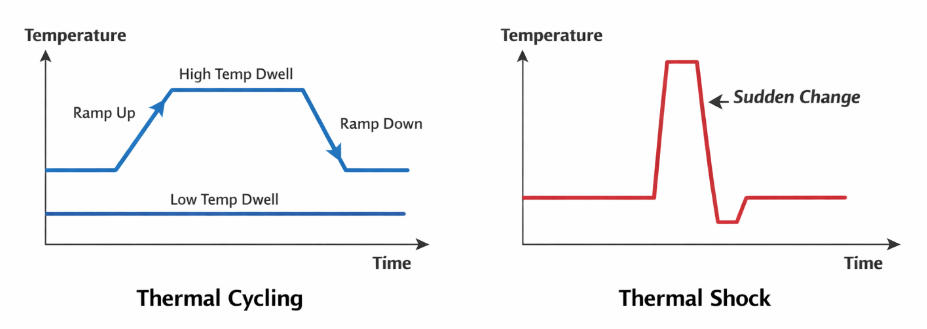
Why ramp rate matters most: a chamber can have an impressive temperature range and still be unsuitable if it can't change temperature fast enough. Battery qualification procedures often require controlled transitions within specified time windows, which depends on heating capacity, refrigeration capacity, airflow design, and control response under actual test load — not an empty chamber.
What Temperature Cycling Tests Are Used for Batteries?
_1773978265973.jpg "blog-1-1") Requirements vary by battery type, application, and target market. Common standards include UN 38.3, the IEC 62660 series, the IEC 62133 series, and automotive or national battery testing standards.
Requirements vary by battery type, application, and target market. Common standards include UN 38.3, the IEC 62660 series, the IEC 62133 series, and automotive or national battery testing standards.
UN 38.3 T2 Thermal Test
UN 38.3 includes a thermal test evaluating lithium cells and batteries under repeated exposure to elevated and low temperatures — particularly important for manufacturers shipping lithium batteries internationally. A suitable chamber needs appropriate high/low temperature capability, programmable multi-cycle profiles, reliable control, suitable transition performance, and continuous recording. The exact profile should follow the current UN Manual of Tests and Criteria and the customer's certification procedure.
IEC 62660 Series for Automotive Lithium-Ion Cells
IEC 62660 addresses performance, reliability, and safety testing of secondary lithium-ion cells used in electric road vehicles. Automotive profiles can be demanding and long-duration, so equipment selection needs to consider chamber capacity, cycle repeatability, and data acquisition — not just temperature accuracy. Depending on the testing stage, the chamber may need to accommodate individual cells, modules, or larger assemblies.
IEC 62133 Series for Portable Battery Applications
IEC 62133 covers safety requirements for portable sealed secondary cells and batteries. Manufacturers working to this standard may need controlled temperature exposure as part of a broader safety qualification program, so the chamber should accurately execute the required sequence and record test data. Because standards and editions change, always confirm chamber configuration against the exact edition in use.
Other Battery and Automotive Testing Standards
Manufacturers may also work with GB/T battery standards, ISO automotive environmental requirements, SAE-related battery safety procedures, or customer-specific qualification protocols. A flexible programmable controller allows one chamber to support multiple test programs.
Key Specifications of a Battery Temperature Cycling Chamber
| Specification | What to Check | Why It Matters |
|---|---|---|
| Temperature range | Required high and low limits | Determines which battery tests can be performed |
| Ramp rate | Heating and cooling rate under load | Ensures the chamber can reproduce the required profile |
| Chamber volume | 100L–3000L or customized | Must accommodate the sample and fixtures |
| Temperature stability | Actual fluctuation and uniformity | Supports repeatable test results |
| Controller | Programmable multi-step profiles | Allows complex cycling sequences |
| Data logging | Ethernet / PC monitoring | Provides test traceability |
| Safety protection | Over-temperature, emergency shutdown, pressure relief, application-specific protection | Reduces risk during battery testing |
| Customization | Fixtures, dimensions, ports, safety systems | Allows adaptation to different battery formats |
A few of these deserve extra detail:
Temperature range — battery applications can require substantially different low-temperature limits, such as -20°C, -40°C, -60°C, or -70°C. Choose the range based on the actual test standard and battery application, not simply the widest option available.
Chamber volume — testing can range from individual cells (compact chambers, R&D-scale) to modules and full packs (larger volumes, higher throughput). LIB Industry's standard range runs roughly 100L to 3000L, with custom dimensions available.
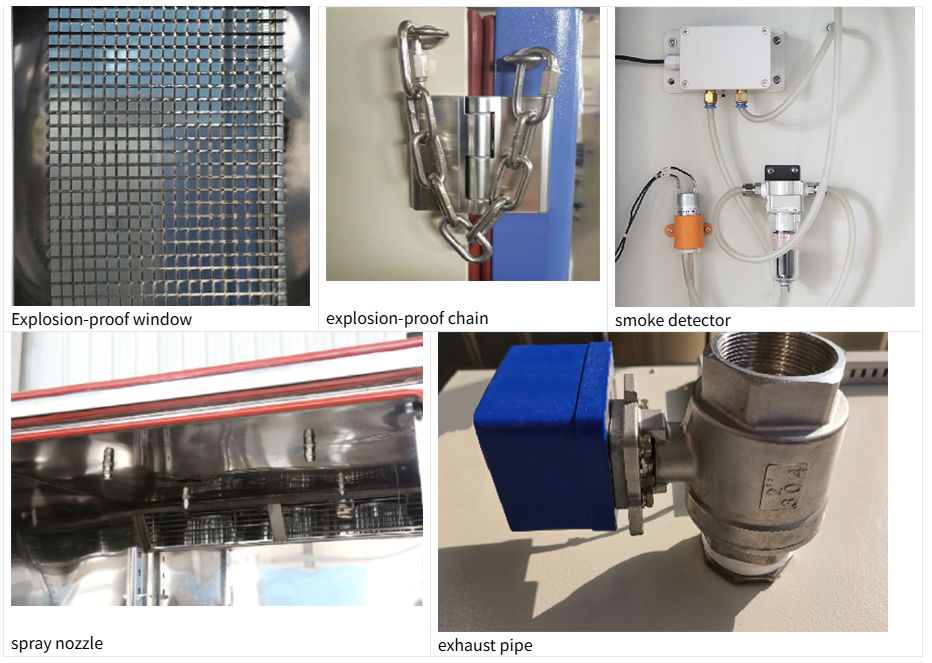
Battery safety protection — battery testing carries risks not present in conventional environmental testing. Depending on chemistry, sample size, and test energy, relevant configurations can include independent over-temperature protection, emergency shutdown, circuit protection, pressure relief, exhaust/ventilation provisions, fire detection or suppression options, observation windows, electrical feedthroughs for external monitoring, and customized safety interlocks. The exact configuration should follow the customer's risk assessment.
Why Battery Testing Needs a Specialized Chamber
A standard temperature and humidity chamber can control temperature, but battery testing raises additional considerations:
Detecting thermal-related degradation — repeated exposure can accelerate mechanisms not visible in short-term testing, including cell sealing performance, housing durability, electrical connection reliability, material expansion/contraction, internal resistance changes, and thermal fatigue. Catching these during development helps manufacturers improve designs before mass production.
Compressing time into data — instead of waiting years for natural temperature variation, engineers can expose samples to defined thermal profiles and analyze performance change over repeated cycles, supporting development, reliability assessment, and design improvement.
Matching sample size — cell-level testing may only need a compact chamber, while module and pack testing typically needs larger working space, higher load capacity, additional cable ports, external battery monitoring, customized fixtures, and enhanced safety protection. A manufacturer with engineering customization capability can adapt to this better than an off-the-shelf chamber.
Matching the Chamber to the Application
| Application | Typical Consideration | Recommended Configuration Focus |
|---|---|---|
| Battery cells | Compact samples, high throughput | 100L–500L, precise control, programmable cycling |
| Battery modules | Larger physical dimensions | 500L–1500L, cable ports, customized fixtures |
| EV battery packs | Large and heavy samples | 1000L–3000L or customized, enhanced safety |
| Transport qualification | UN 38.3-related thermal testing | Appropriate high/low range, programmable cycling |
| R&D reliability testing | Flexible test profiles | Programmable controller and data logging |
| Customer-specific qualification | Non-standard temperature profiles | Customized ramp rates, fixtures, and safety systems |
Chamber size shouldn't be selected on nominal battery dimensions alone — factor in fixture space, airflow clearance, electrical connections, instrumentation, and future testing needs.
LIB Industry Battery Temperature Cycling Chamber Solutions
LIB Industry provides temperature cycling chambers for battery cells, modules, packs, and other products requiring controlled thermal cycling.
The standard product range covers approximately 100L to 3000L, with customized configurations available for specialized applications.
 |
Model |
TR5-100 |
TR5-225 |
TR5-500 |
TR5-800 |
TR5-1000 |
|
Internal Dimension (mm) |
400*500*500 |
500*600*750 |
700*800*900 |
800*1000*1000 |
1000*1000*1000 |
|
|
Overall Dimension (mm) |
900*1050*1620 |
1000*1140*1870 |
1200*1340*2020 |
1300*1540*2120 |
1500*1540*2140 |
|
|
Interior Volume |
100L |
225L |
500L |
800L |
1000L |
|
|
Heat load |
1000W |
|||||
|
Temperature Range |
A : -20℃ ~ +150 ℃ B : -40℃ ~ +150 ℃ C: -70℃ ~ +150 ℃ |
|||||
|
Temperature Fluctuation |
± 0.5 ℃ |
|||||
|
Temperature Deviation |
± 2.0 ℃ |
|||||
|
Cooling Rate |
10℃/min (15℃/min) |
|||||
|
Heating Rate |
10℃/min (15℃/min) |
|||||
|
Controller |
Programmable color LCD touch screen controller, Multi-language interface, Ethernet , USB |
|||||
|
Cooling System |
Mechanical compression refrigeration system |
|||||
|
Exterior Material |
Steel Plate with protective coating |
|||||
|
Interior Material |
SUS304 stainless steel |
|||||
|
|
|
|
|
|
| Robust Workroom | Cable Hole | Temperature and Humidity Sensor | PID controller | |


Wide Temperature Range
Depending on the model, temperature ranges can extend to:
-20°C, -40°C, -60°C, or -70°C
This provides flexibility for different battery reliability and qualification programs.
Fast Temperature Change
LIB Industry chambers can be configured with heating and cooling rates of approximately:
5°C/min, 10°C/min, or 15°C/min
The final ramp performance is determined by chamber model, temperature range, test load, and other configuration factors.
Stable Temperature Control
Ceramic-core nichrome heating systems provide responsive temperature control, while refrigeration systems are designed to maintain stable performance during repeated thermal cycling.
Temperature accuracy can reach approximately ±0.5°C, depending on the model and operating conditions.
Battery Safety Configuration
For battery applications, LIB Industry can provide customized safety configurations based on the battery chemistry, sample size, energy level, and testing procedure.
Possible options include independent protection systems, emergency shutdown, pressure relief, ventilation, fire-related protection, electrical interlocks, and customized monitoring interfaces.
Data Logging and Communication
Ethernet connectivity and PC-linked monitoring allow engineers to record chamber temperature and review test conditions throughout a test program.
For specialized projects, communication and monitoring functions can be customized to integrate with the customer's battery test system.
Customized Chamber Design
Not every battery testing program can be handled by a standard chamber.
LIB Industry supports customized solutions for:
Non-standard chamber dimensions
Battery modules and packs
Special temperature ranges
Higher temperature ramp rates
Customized cable ports
External battery monitoring
Special safety configurations
Customer-specific test profiles
Why Choose LIB Industry as Your Temperature Cycling Chamber Manufacturer?
LIB Industry provides environmental simulation equipment for customers in automotive, new energy, electronics, aerospace, materials, and research applications. For battery testing projects, support spans the full equipment lifecycle:
Research & Design — engineering recommendations based on battery type, test profile, sample dimensions, and applicable standards.
Manufacturing — in-house production and quality control under an ISO 9001 quality management system.
Testing & Commissioning — equipment performance verification before shipment and commissioning support after installation.
Global Delivery & Installation — international delivery and installation support across markets.
Technical Training — operator training covering equipment operation, test programming, safety functions, and routine maintenance.
Three-Year Warranty & Lifetime Service — LIB Industry provides a three-year warranty and lifetime service for its environmental test chambers; after the warranty period, customers can continue receiving technical and maintenance support, with replacement parts charged according to actual requirements.
This combination of engineering capability, customization, and long-term service helps battery manufacturers build a reliable testing program rather than simply buying a standard chamber.
Related Products from LIB Industry
Battery qualification programs rarely rely on temperature cycling alone. Labs often pair it with the following LIB Industry chambers to cover other stresses in the same test plan:
|
|
|
|
| Thermal Shock Test Chamber — for the rapid, extreme-transition testing distinct from programmed cycling (see the cycling-vs-shock distinction above), using either two-zone basket transfer or three-zone air-to-air designs depending on the required transition speed. | Vibration Test Chamber — reproduces the mechanical shock and vibration stresses batteries encounter during transport and vehicle operation, commonly run alongside UN 38.3 and IEC 62660 thermal sequences as part of the same qualification program. | UV Aging Test Chamber — for the plastic housings, enclosures, and labels on battery packs and modules that will see outdoor sun exposure; simulates UV-driven yellowing, chalking, and embrittlement of casing materials independent of the cell's own thermal performance. |


Combining these with a temperature cycling chamber lets a lab cover thermal, mechanical, and light-driven stresses under one supplier relationship.
FAQ
What temperature range is required for UN 38.3 T2 testing? UN 38.3 T2 includes exposure to both elevated and low temperatures, with the applicable profile defined by the current UN Manual of Tests and Criteria. The chamber should reach the required limits and execute the specified transition and dwell sequence accurately.
Can a temperature cycling chamber test battery modules and packs? Yes. Larger chambers can be configured for modules and packs; evaluate chamber volume, load capacity, cable connections, fixtures, airflow, and safety protection against the specific assembly.
Can LIB Industry customize a battery temperature cycling chamber? Yes — dimensions, temperature range, ramp rate, cable ports, fixtures, safety systems, monitoring functions, and other configurations can all be customized to your battery testing requirements.
Need a temperature cycling chamber for battery testing? Tell LIB Industry your battery type, test standard, temperature range, chamber volume, and required ramp rate — our engineering team can recommend a suitable configuration for cell, module, or pack testing.
Contact LIB Industry at ellen@lib-industry.com to discuss your battery testing requirements and customized temperature cycling chamber solution.