Thermal Cycling Test Chamber Price: Cost Factors, Tiers and RFQ Checklist
Quick answer: Thermal cycling test chamber price is quoted per configuration, not per catalog list. It depends mainly on three factors: interior volume (100L to 3,000L), temperature range (-20°C to +150°C, or down to -70°C), and ramp rate (5, 10 or 15°C/min). The refrigeration system is the largest cost driver, and going below -40°C, which requires a cascade design, is the biggest single price step. To get a price you can compare, send your specimen, test profile and site details, and ask for an itemized quote.
How Is Thermal Cycling Test Chamber Price Determined?
Price is set by configuration: volume, lowest temperature and ramp rate decide the tier, and options and service scope adjust it. Because every temperature cycling chamber is built around a specimen, a profile and a governing standard, suppliers usually quote per project. The tiers below show how specification moves a quote from lower to higher.
|
Tier |
Typical Spec |
Relative Price Level |
|
Entry |
100L–225L, -20°C to +150°C, 5°C/min |
Lowest |
|
Mid-range |
500L–800L, -40°C to +150°C, 5–10°C/min |
Moderate |
|
High-performance |
1000L+, -70°C to +150°C (cascade), 10–15°C/min |
Highest |
|
Custom |
Up to 3,000L, non-standard dimensions or ports |
Quoted per project |
A single total is not enough to judge a quote. A usable quote also states temperature fluctuation (±0.5°C), deviation (±2.0°C), heat load, ramp measurement conditions, warranty terms and delivery scope.
Not sure which tier fits? Send your test profile to LIB Industry and our engineers will recommend a configuration and quote.
Which Specifications Have the Biggest Impact on Pricing?
The refrigeration system, temperature range and ramp rate drive price the most, in that order.
|
Price Driver |
Typical Effect on Quotation |
What to Ask the Supplier |
|
Lowest temperature |
Large step-up below -40°C |
Single-stage or cascade? |
|
Ramp rate |
Rises with faster rates |
Average or linear? Loaded or empty? |
|
Volume |
Grows with cubic capacity |
Usable space or gross space? |
|
Controller |
Moderate |
Data export, remote access? |
|
Warranty and service |
Varies |
Duration, response time, spares? |
Refrigeration System
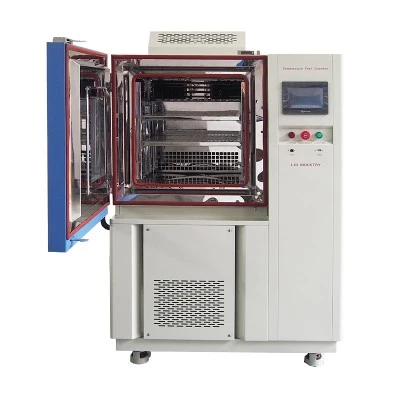
Cooling hardware usually accounts for most of the cost of an environmental test chamber. A single-stage system is generally sufficient from -20°C to -40°C, while temperatures down to -70°C need a cascade system. The compressor brand also matters. The TR5 series uses a French Tecumseh compressor paired with an electronic expansion valve, which fine-tunes refrigerant flow and helps reduce power consumption.
Control Accuracy and Uniformity
Tighter uniformity requires better airflow design, more precise sensors and finer tuning, all of which add cost. The TR5 series is verified with Class A PT100 platinum resistance sensors, with ±0.5°C fluctuation and ±2.0°C deviation. Ask for tighter values only if your standard actually requires them.
Build Quality and Materials
Polyurethane foam insulation, a coated steel exterior and a double-layer silicone door seal affect both durability and energy use. Thinner insulation lowers the purchase price but increases frosting and electricity consumption. Ask each supplier to document insulation and door-seal types.
How Do Temperature Range and Ramp Rate Affect Price?
 A wider range and a faster ramp both force the refrigeration and heating systems to work harder, so two thermal cycling chambers of the same size can differ greatly in price.
Choose the Right Lowest Temperature
· Range A: -20°C to +150°C
· Range B: -40°C to +150°C
· Range C: -70°C to +150°C
Many electronics and automotive tests do not go below -40°C, so paying for -70°C may be unnecessary. Battery and aerospace applications may genuinely need it. Buying too little range usually costs more later, when the unit has to be replaced or retrofitted.
Understand Ramp Rate Claims
Ramp rate claims are often misread:
· Average vs. linear: 10°C/min as an average between two temperatures is not the same as a rate that stays constant throughout.
· Loaded vs. empty: An empty unit ramps faster than one carrying specimens.
· Temperature band: Ask over which temperature interval the rate is calculated.
The standard TR5 configuration is specified at 5°C/min, and 10°C/min and 15°C/min are available as customized options. Ask the supplier to state measurement conditions in writing and to provide a ramp curve for the rate you order. Performance is commonly verified per IEC 60068-3-5.
Balance Speed Against Compressor Life
Faster ramping means more frequent heater and compressor switching. Electronic expansion valves reduce wear from this cycling, and better heater design shortens heat-up time. If a rapid temperature change chamber will run daily, weigh expected service life against the premium for high ramp rates.
How Do Size and Configuration Change Cost?
Cost rises with interior volume, but not in a straight line. A larger temperature cycle test chamber costs more to buy and run, since the compressor must cool more air even when the workspace is partly empty. Leave space between specimens so air can circulate, because overcrowded shelves cause uneven temperatures.
|
Model |
Interior Volume |
Internal Dimensions (mm) |
Overall Dimensions (mm) |
|
TR5-100 |
100L |
400 × 500 × 500 |
900 × 1050 × 1620 |
|
TR5-225 |
225L |
500 × 600 × 750 |
1000 × 1140 × 1870 |
|
TR5-500 |
500L |
700 × 800 × 900 |
1200 × 1340 × 2020 |
|
TR5-800 |
800L |
800 × 1000 × 1000 |
1300 × 1540 × 2120 |
|
TR5-1000 |
1000L |
1000 × 1000 × 1000 |
1500 × 1540 × 2140 |
Standard vs. custom: The standard setup includes two shelves and one 50 mm cable port. Extra ports, shelves or specimen racks cost more. Custom builds up to 3,000L are available, with fully non-standard interior dimensions.
Total cost of ownership: Purchase price is only part of the budget. Over its service life, a programmable temperature chamber consumes energy, needs maintenance and occupies floor space, and these often outweigh the price gap between models. A slightly more expensive, energy-efficient unit is usually cheaper overall.
Which Optional Features Should Be Included in the Quote?
Decide on humidity, data logging and safety options before ordering, because retrofitting costs more.
· Humidity control: Pure temperature cycling does not need it, but some test plans combine temperature and humidity stress. A temperature humidity chamber configuration raises the price, yet adding the humidity system at order time costs less than retrofitting.
· Data logging and remote monitoring: The color LCD touch controller supports Ethernet and PC connection and can be customized. Confirm that software licenses are included and that exported data fits your quality system.
· Safety package: Standard protection covers over-temperature, over-current, high refrigerant pressure and earth leakage. Door locks and alarms are advisable for valuable or hazardous specimens. Anti-condensation control keeps specimen surfaces dry during rapid transitions.
What Hidden Costs Sit Behind a Thermal Cycling Chamber Price?
Installation, energy, maintenance and downtime often add more than buyers expect.
· Installation, commissioning and training: Freight, rigging, utility hookup and operator training may be listed separately or missing entirely. LIB Industry handles order, delivery, installation and staff training together. Ask every supplier for an itemized list of what is included.
· Energy, maintenance and calibration: A compressor-based unit running continuously uses significant power. Sensors and fans need regular upkeep. Ask for an estimated annual running cost, a maintenance plan and a recommended spare-parts list.
· Warranty and downtime: Ask what is excluded, how fast the supplier responds, and who pays shipping. LIB Industry offers a 3-year warranty with lifetime service, and will send a replacement unit if a fault cannot be repaired during the warranty period. Downtime usually costs more than the repair itself.
RFQ Checklist: What to Send Suppliers
1. Specimen: type, weight, material, dimensions, and heat dissipation while running.
2. Racks and wiring: number of shelves, racks and cable routes.
3. Profile: low and high temperatures, dwell times, ramp rate, number of cycles.
4. Standard: for example IEC 60068-2-14, JEDEC JESD22-A104, MIL-STD-883 or GB/T 2423.22.
5. Ramp conditions: average or linear, loaded or empty, measurement band.
6. Site: floor space, door width, ceiling height, power supply, cooling method.
7. Scope: installation, commissioning, training, warranty and spare parts.
A 200-cycle program at 10°C/min demands more from the compressor than 50 cycles at 5°C/min, and this should be reflected in the quote. Small doorways can also add cost, so give exact access dimensions.
How to Compare Thermal Cycling Test Chamber Quotes
Put every quote on the same sheet so gaps become visible. Low quotes with empty rows are often missing items you will pay for later.
|
Comparison Item |
What a Complete Answer Looks Like |
|
Temperature range and tolerance |
-40°C to +150°C, ±0.5°C fluctuation, ±2.0°C deviation |
|
Ramp rate and test condition |
10°C/min average, loaded, stated temperature band |
|
Compressor and valve brand |
Tecumseh, electronic expansion valve |
|
Options included |
Humidity? Extra ports? Software? |
|
Warranty and service |
3 years, response time in hours, spares list |
|
Delivery, installation, training |
Included or itemized |
Check certifications and service reach. Look for ISO 9001, CE marking and third-party verification. LIB Industry is verified by SGS and TÜV, with service centers in Malaysia, Canada, the UK and the US, and 29 dealers worldwide. Ask every supplier for written response times.
Verify performance before payment. Request a test report showing the actual ramp curve and uniformity, and make sure the contract defines a clear remedy if results fall short.
Conclusion
A fair thermal cycling test chamber price starts with a clear request. Confirm that the specimen, profile, standard and site conditions match your needs, then send the same sheet to every supplier. Look beyond the headline number to the refrigeration design, control accuracy, options, warranty and service reach. Buyers who document these points avoid surprises, speed up approval and end up with a temperature cycling chamber that fits the test plan for years.
FAQ
How much does a thermal cycling test chamber cost?
There is no single list price, because each unit is configured to the test. Cost rises with volume, a lower minimum temperature (cascade below -40°C) and a faster ramp rate. Send your specimen and profile to LIB Industry for an itemized quote.
What does the quoted price usually include?
Usually the main unit, shelves, controller and one cable port. Installation, training, extra ports and software are often listed separately, so compare quotes line by line.
Does a faster ramp rate always cost more?
Usually yes, because faster rates need larger heaters and stronger refrigeration. The standard TR5 runs at 5°C/min, and 10°C/min or 15°C/min can be customized. Confirm whether the rate is average or linear, and loaded or empty.
Is a cascade system necessary below -40°C?
Generally yes. Reaching -70°C needs cascade refrigeration, while -20°C to -40°C can often be met with a simpler single-stage design.
What is the difference between a thermal cycling chamber and a thermal shock chamber?
A thermal cycling chamber changes temperature gradually at a controlled ramp rate in one workspace. A thermal shock chamber moves specimens between hot and cold zones within seconds. Choose based on what your standard specifies.
How do I avoid hidden costs after purchase?
Get installation, training, spare parts, calibration and warranty exclusions in writing, and ask for estimated annual energy and maintenance cost.
Get a Thermal Cycling Test Chamber Quote
LIB Industry supports environmental testing from test planning and equipment build to installation and operator training. Send your specimen details and test profile to ellen@lib-industry.com.