Thermal Cycling Test Chamber Price for Automotive Electronics: What Drives the Cost
Quick answer: The price of a thermal cycling test chamber for automotive electronics depends on four things: the cold limit your validation plan needs (-40 °C is common, -70 °C is available), the ramp rate the chamber can hold with a powered load, the interior volume for control units and harnesses, and the service package that comes with it. LIB’s TR5 series covers 100 L to 1000 L, with 2000 L and 3000 L models for larger assemblies.
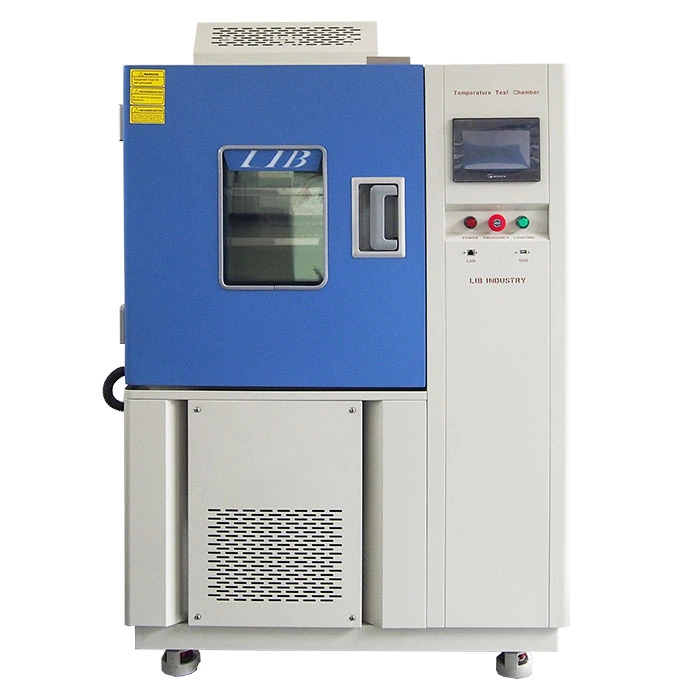
What determines the price of a thermal cycling chamber?
Automotive electronics are cycled hard and often, so the chamber must hold its performance over thousands of cycles. Solder, silicon, copper and plastics expand at different rates (CTE mismatch), so repeated heating and cooling stresses joints and can cause micro-cracks, broken solder joints and seal failures. A chamber that finds these flaws before parts reach a vehicle is worth paying for.
A quotation normally covers the chamber body and insulation, heating, refrigeration, airflow and the controller. The TR5 series uses a French Tecumseh compressor, nichrome heaters and a centrifugal fan. The most expensive components vary the most between suppliers, so ask for brands in writing.
Which specifications change the price most?
Cold limit, ramp rate and volume move the price most; accuracy, refrigeration design and ports matter less but still count.
|
Specification |
Effect on price |
What to decide |
|
Lowest temperature |
Rises sharply below -40 °C |
Range options: -20, -40 or -70 °C up to +150 °C. Most automotive plans stop at -40 °C, so buy deeper cold only if a customer requires it |
|
Ramp rate |
Rises with speed |
Options of [5 / 10 / 15] °C/min. |
|
Interior volume |
Rises with size |
100–1000 L standard, 2000 L and 3000 L for battery packs and large assemblies |
|
Accuracy and uniformity |
Moderate |
Class A PT100 sensors. Confirm fluctuation and deviation across the whole working space, not one point |
|
Refrigeration design |
Moderate |
Electronic expansion valves control flow better than mechanical ones and can cut energy use by more than 20% [confirm figure] |
|
Cable ports |
Low to moderate |
Standard: one 50 mm port with plug, two shelves. Extra or larger ports are a cost line |
|
|
|
|


Powered specimens: control units give off heat while running, and the chamber must absorb it. The TR5 handles up to 1000 W of specimen heat load [confirm test conditions]. If your load is higher, say so in the enquiry, not after delivery.
Condensation control: moisture on a powered board can cause short circuits. Confirm that the anti-condensation control is part of the base price, not an extra.
Which standards drive the requirements?
Check the soak, ramp and limit values your standard requires before you choose a model.
|
Standard |
Relevance |
|
ISO 16750-4 |
Climatic loads on electrical and electronic equipment in road vehicles |
|
AEC-Q100 |
Stress qualification for integrated circuits, which references JEDEC JESD22-A104 temperature cycling |
|
IEC 60068-2-14 |
Basic environmental test method for change of temperature |
Tighter requirements cost more, so name the standard in your enquiry.
TR5 models and dimensions
Choose the interior volume by adding the fixture size to the airflow space. An oversized chamber wastes energy, and an overcrowded one cycles less evenly.
|
Model |
Volume |
Internal size (mm) |
Overall size (mm) |
|
TR5-100 |
100 L |
400 × 500 × 500 |
900 × 1050 × 1620 |
|
TR5-225 |
225 L |
500 × 600 × 750 |
1000 × 1140 × 1870 |
|
TR5-500 |
500 L |
700 × 800 × 900 |
1200 × 1340 × 2020 |
|
TR5-800 |
800 L |
800 × 1000 × 1000 |
1300 × 1540 × 2120 |
|
TR5-1000 |
1000 L |
1000 × 1000 × 1000 |
1500 × 1540 × 2140 |
The 2000 L and 3000 L models are for battery packs and whole panels.
Reading ramp-rate claims: average and linear rates are not the same, and a full chamber ramps slower than an empty one. Ask every supplier how the figure was measured and with what load. A faster ramp shortens each cycle and raises weekly throughput, so a higher price can pay back through shorter validation time.
Which options are worth adding?
Order options with the chamber, because retrofits cost more.
· Humidity system: pure thermal cycling does not need water, but some automotive programs add humidity for combined stress.
· Data logging and remote access: the color LCD touch controller has Ethernet and a PC link for remote monitoring and report export. Check file formats and software rights.
· Independent over-temperature limiter: built-in protections include over-current, over-temperature, high-pressure refrigerant and earth leakage, plus door alarms and an emergency stop. A separate limiter is cheap insurance for valuable samples.
What does it cost to own a chamber?
The purchase price is only the start. Count energy, calibration, spares and downtime.
· Energy: refrigeration runs for long periods. Good insulation (polyurethane foam), efficient expansion valves and tight door seals reduce the load.
· Calibration and spares: auditors will want calibration records, so budget for annual calibration. Ask for a recommended spare parts list and maintenance schedule.
· Downtime and warranty: a chamber that stops mid-validation delays your program. LIB offers a 3-year (36-month) warranty and lifetime technical support. If the unit cannot be repaired within the warranty period, LIB replaces it with a new one. Ask every supplier for the full warranty terms and response times in writing.
How do you compare suppliers fairly?
Put range, ramp conditions, volume, components, options, warranty and service scope side by side on one sheet.
1. Certifications and inspection: ISO 9001 and CE marking, with inspection by SGS and TÜV. Ask for certificate numbers and verify them with the issuing body.
2. Customization: can they supply custom sizes, ports and controls? Ask for drawings and similar projects.
3. Service reach: local support in the US, UK, Canada and Malaysia, plus 24/7 English support to reduce downtime.
4. Acceptance test: ask for a ramp curve and component check before final payment.
LIB engineers support customers from service points in the US, UK, Canada and Malaysia, so help is close to your lab.
What to include in your quote request
Send the following to get an accurate quotation: temperature range and ramp rate (and how it is measured), specimen size, weight and heat dissipation, number of cable ports, standard or test profile, options, and destination country.
Not sure which model or ramp rate fits your plan? Send us your test profile and our engineers will recommend a configuration.
FAQ
What affects the thermal cycling chamber price most?
Cold limit, ramp rate, interior volume and refrigeration design. Extra cable ports, humidity control and a higher specimen heat load also raise the price.
Do I need -70 °C capability for automotive testing?
Usually not. A -40 °C range covers most automotive plans. Choose -70 °C only when your standard or customer requires it, because it costs considerably more.
How can I compare quotes from different suppliers?
Compare range, ramp conditions, volume, key components, options, warranty and service scope on one sheet. Ask each supplier to show the ramp rate measured under your load conditions before you pay.
Can the chamber handle powered control units?
Yes. The TR5 absorbs up to 1000 W of specimen heat load. Tell us your expected dissipation when you request a quote.
What is the difference between thermal cycling and thermal shock?
Thermal cycling changes temperature at a controlled ramp rate inside one chamber. Thermal shock moves specimens between hot and cold zones for a near-instant change. Your standard decides which one you need.
Why buy from LIB Industry?
· Tested before shipment: every unit runs 72 hours continuously before leaving the factory.
· Certified and inspected: CE, RoHS, ISO 9001 and ISO 17025 calibration, with inspection by SGS and TÜV.
· 3-year (36-month) warranty: if the unit cannot be repaired within the warranty period, we replace it with a new one. Lifetime technical support and maintenance guidance afterwards.
· Global service: local support in the US, UK, Canada and Malaysia, with 24/7 English support, remote troubleshooting, spare parts and on-site service when necessary.
· One-stop project service: solution design, customization, delivery, installation and training.
Contact LIB Industry
LIB Industry designs, builds, installs and commissions environmental test equipment, and trains your team to operate it. For a tailored quotation, send your specimen details, test profile and destination country to ellen@lib-industry.com.