Weatherometer for Automotive Coatings: Xenon Arc Testing Guide
Quick answer: A weatherometer is a xenon arc test chamber that reproduces the three main outdoor stressors on automotive coatings: sunlight, heat and moisture. A water-cooled xenon arc lamp supplies full-spectrum light, black panel temperature and humidity are controlled in closed loops, and a water spray simulates rain and dew. Fading, gloss loss, chalking and cracking that take years to appear on an outdoor rack can show up in days to weeks. The standards most used for automotive coatings are ISO 16474-2, ASTM G155 and SAE J2527.
Why do automotive coatings need accelerated weathering tests?
A car body faces sun, heat and water every day, so a coating must be validated against all three before production. UV and visible light break chemical bonds in the binder, heat speeds up the reactions, and moisture adds stress. The result is fading, chalking, gloss loss, cracking and delamination, usually starting in the clearcoat, which takes the full UV load.
Outdoor racks give the most realistic data but take years and vary with season and location. A weatherometer gives a repeatable test in days to weeks, so weak formulations are screened out before field trials.
How does a xenon arc weatherometer work?
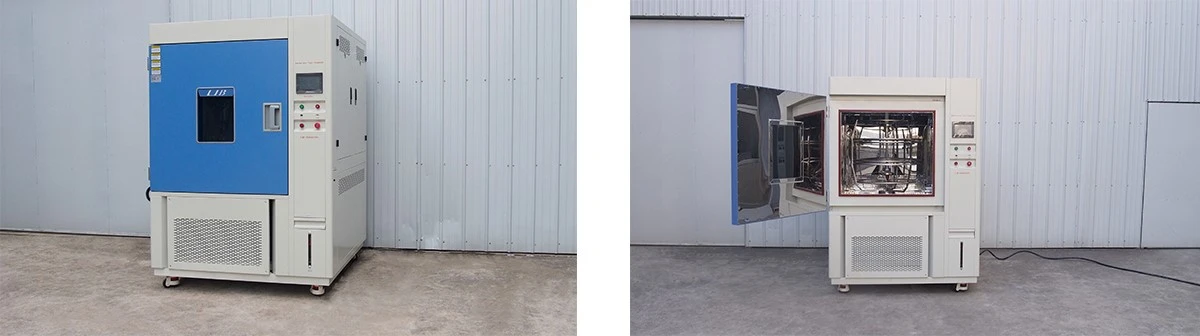
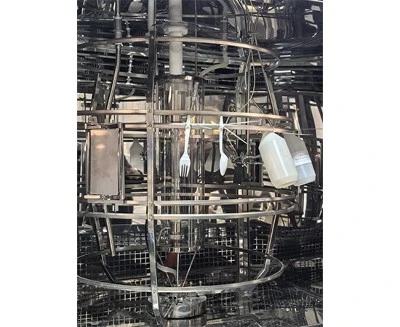
A xenon arc lamp supplies the full solar spectrum, black panel temperature and humidity are controlled in closed loops, and water spray simulates rain and dew. A rotating holder gives every specimen equal exposure, and a UV radiometer tracks the dose. Black panel temperature matters because a dark, sun-exposed surface runs far hotter than the surrounding air.
XL-S-750 specifications
| Parameter | XL-S-750 |
|---|---|
| Chamber type | Rotating holder |
| Irradiation source | 1 × 4500 W water-cooled xenon arc lamp |
| Irradiance range | 35–150 W/m² |
| Bandwidth measurement | 300–400 nm (control at 340 nm or 420 nm) |
| Chamber temperature | Ambient to 100 °C, ±2 °C |
| Black panel temperature | 35–85 °C, ±2 °C |
| Humidity range / deviation | 50–98% RH / ±5% RH |
| Water spray cycle | 1–9999 h 59 min, adjustable |
| Specimen holder size / capacity | 95 × 200 mm / 42 pcs |
| Radiometer | UV radiometer, tolerance ±5% |
| Filter options | Daylight, Window and Extended UV filters |
| Controller | Programmable color LCD touch screen |
| Water supply | Automatic supply with water purification |
| Cooling system | Mechanical compression refrigeration |
| Internal dimensions | 950 × 950 × 850 mm |
| Overall dimensions | 1400 × 1400 × 1950 mm |
|
|
|

Which standards apply to automotive coating tests?
ISO 16474-2, ASTM G155 and SAE J2527 are the most common, and your customer or OEM specification decides which one governs.
| Standard | Scope | Typical use |
|---|---|---|
| ISO 16474-2 | Paints and varnishes: exposure to laboratory light sources, Part 2: xenon-arc lamps | Coating manufacturers, general paint testing |
| ASTM G155 | Operating xenon arc light apparatus for exposure of non-metallic materials | Coatings, plastics and other non-metallic materials |
| SAE J2527 | Performance-based accelerated exposure of automotive exterior materials using a controlled-irradiance xenon arc apparatus | Automotive exterior coatings and trim |
ISO 4892-2 covers xenon arc exposure of plastics, while ISO 16474-2 covers paints and varnishes, so check which one your specification cites.
SAE J2527 defines a repeating cycle of light, spray and dark/humid phases. Get the full cycle from your customer and confirm the chamber can run every step. The XL-S-750 irradiance, black panel temperature and humidity ranges cover the windows typically used in these cycles. Send us your specification and our engineers will confirm each step.
The XL-S-750 supports Daylight, Window and Extended UV filters: Daylight for exterior coatings, Window for interior materials behind glass, and Extended UV for faster screening. Confirm the filter and temperature sensor type (black panel or black standard) your method requires.
What does a typical test cycle look like?
Most cycles alternate light, spray and dark/humid phases. The example below is illustrative only. Follow your governing standard or OEM specification.
| Phase | Light | Spray | Black panel temp. | Humidity |
|---|---|---|---|---|
| Light | On | Off | Elevated (e.g. 60–70 °C) | Moderate (e.g. 50% RH) |
| Light + spray | On | On | Elevated | Wet surface |
| Dark + humidity | Off | Optional | Lower (e.g. 35–40 °C) | High (e.g. 95% RH) |
|
|
|
|||


How do you evaluate results?
Measure colour, gloss and surface condition at fixed intervals, using the same method and location each time, and compare with an unexposed control panel stored in the dark. Track radiant exposure (for example kJ/m² at 340 nm), not just hours, so results can be compared across chambers.
| Property | Typical instrument | What a change suggests |
|---|---|---|
| Color | Spectrophotometer (ASTM D2244 for colour difference) | Pigment or binder degradation |
| Gloss | Gloss meter (ASTM D523, specular gloss) | Surface erosion of the clearcoat |
| Surface | Visual inspection, microscope | Cracking, chalking, blistering |
| Adhesion | Adhesion test | Risk of delamination |
Accelerated vs. outdoor exposure: how well do they correlate?
Accelerated tests approximate outdoor ageing but do not replace it. Cycle, climate and coating chemistry all affect the correlation, and there is no universal “X hours equals one year” conversion. Use the chamber to screen, rank and quality-control formulations, then confirm key ones on outdoor racks.
Xenon arc vs. fluorescent UV: which should you choose?
Xenon arc reproduces the full solar spectrum, while fluorescent UV lamps cover only the UV region. Xenon is generally preferred for colour and appearance changes because pigments respond to visible light as well as UV. Fluorescent UV suits fast, lower-cost UV durability screening.
| Parameter | Xenon arc (XL-S-750) | Fluorescent UV |
|---|---|---|
| Light source | 4500 W xenon arc lamp | UVA-340 / UVB-313 lamps |
| Spectrum | Full solar (UV, visible, IR) | UV only |
| Irradiance | 35–150 W/m², 340 or 420 nm | One UV wavelength, typically 340 nm |
| Moisture | 50–98% RH + water spray | Condensation |
| Standards | ISO 16474-2, ASTM G155, SAE J2527 | ASTM G154, ISO 16474-3 |
| Best for | Colour change, OEM cycles | Fast UV screening, QC |
|
|
|
|
|
|
|


Xenon values are for the XL-S-750. Fluorescent UV values are typical for the technology, so confirm them against the data sheet of the specific UV chamber.
LIB Industry supplies both. The XL-S-750 xenon chamber covers full-spectrum exposure with Daylight, Window and Extended UV filter options, and the LIB UV test chamber uses UVA-340 and UVB-313 fluorescent lamps for UV durability screening. If you are unsure which suits your specification, send it to our engineers and they will recommend one.
How to choose a weatherometer for automotive coatings
Match the chamber to the standards and cycles you must run. Check:
Standards: ISO 16474-2, ASTM G155, SAE J2527 or your OEM specification
Light: irradiance range, control wavelength (340 or 420 nm) and filter type
Temperature and humidity: black panel range and RH for both light and dark phases
Spray and capacity: spray options, specimen size and number
Control: radiometer, calibration and programmable cycles
The LIB XL-S-750 covers these with a 4500 W water-cooled xenon arc lamp, 35–150 W/m² irradiance, BPT up to 85 °C, 50–98% RH, a programmable spray cycle, a 42-specimen rotating holder and Daylight, Window and Extended UV filters. It is compatible with a range of international standards across multiple industries.
Not sure which cycle your OEM requires? Send us your coating specification and test method. Our engineers will check chamber compatibility and recommend a configuration.
FAQ
How do weatherometers test automotive coatings without waiting years outdoors?
They intensify sunlight with a xenon arc lamp, control heat and humidity, and add water spray. Panels age far faster than on an outdoor rack, revealing fading, gloss loss and cracking within days or weeks.
Which measurements show coating damage most clearly?
Colour change, gloss retention and visual surface inspection are the usual indicators. Spectrophotometers and gloss meters give numbers, while microscopes reveal cracking, chalking and blistering before they become obvious.
Do chamber results match real outdoor exposure?
Accelerated tests approximate outdoor ageing but cannot copy it exactly. Laboratories use them for screening and ranking, then confirm important formulations on outdoor exposure racks. There is no fixed conversion between xenon arc hours and years outdoors, because it depends on the cycle, irradiance, material and climate.
Is ISO 16474-2 the same as ISO 4892-2?
No. Both cover xenon arc exposure, but ISO 16474-2 applies to paints and varnishes, while ISO 4892-2 applies to plastics.
Can the XL-S-750 run SAE J2527?
Its irradiance, black panel temperature and humidity ranges cover the parameter windows commonly used in automotive exterior cycles. Because each OEM and each edition can differ, send us your specification and we will confirm each step before you order.
Which filters does the XL-S-750 support?
It supports Daylight, Window and Extended UV filters, so one chamber can cover outdoor, behind-glass and accelerated screening exposures. Tell us your method and we will confirm the right filter set.
Why buy a weatherometer from LIB Industry?
Tested before shipment: every unit runs 72 hours continuously before it leaves the factory.
Certified: CE, RoHS, ISO 9001 and ISO 17025 calibration.
3-year (36-month) warranty: lifetime technical support and maintenance guidance afterwards.
24/7 English support: remote troubleshooting, spare parts and on-site service when necessary.
One-stop project service: solution design, customization, delivery, installation and training.
Contact LIB Industry
LIB Industry designs, builds, installs and commissions environmental test equipment, and trains your team to operate it. To get a tailored quotation, send your coating specification, test method, specimen size and quantity, and destination country to ellen@lib-industry.com.