What Affects Solar Simulation Chamber Manufacturing Costs?
The cost of a solar simulation chamber depends on more than the solar simulator itself. Light source technology, IEC 60904-9 classification, chamber size, temperature and humidity control, sample capacity, and customization all influence the final price.
A compact system for small samples can cost considerably less than a large environmental chamber designed for multiple full-size PV modules. The difference comes from the optical system, refrigeration capacity, structural materials, control technology, and engineering required to maintain stable test conditions.
For buyers, the goal should not simply be to find the lowest solar simulation chamber price. A better approach is to identify which specifications are essential for the required test program and which options can be simplified without affecting test quality. This guide explains the major cost drivers and what buyers should consider when selecting a solar simulation chamber manufacturer.
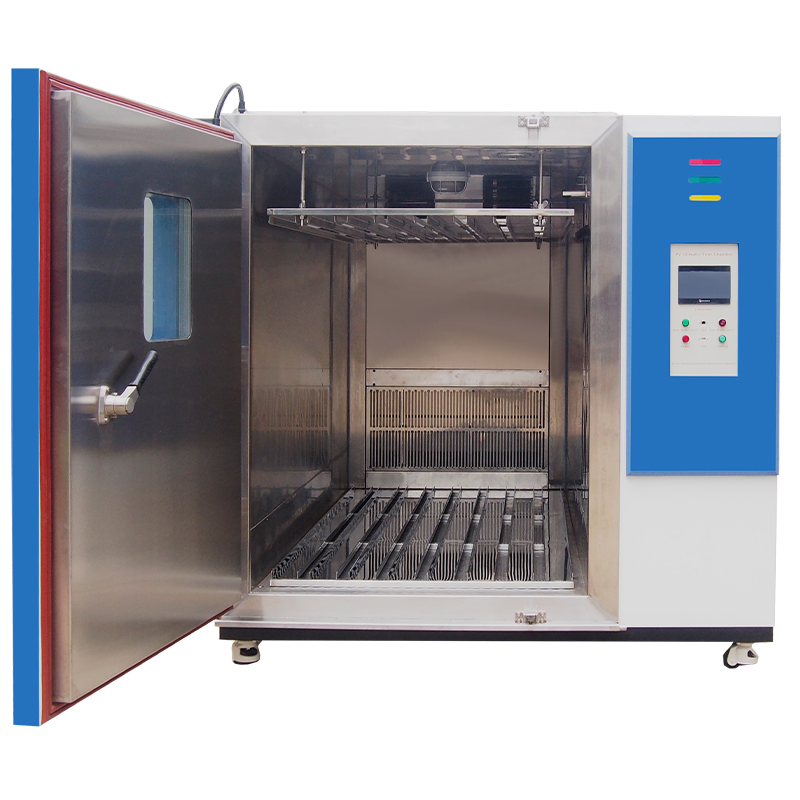
What Determines Solar Simulation Chamber Cost?
Light Source Technology
The light source establishes an important part of the equipment cost.
Xenon arc lamps are widely used for solar simulation because they can provide high-intensity illumination with a broad spectral output. However, lamps have a limited operating life and require periodic replacement, creating an ongoing maintenance cost.
LED-based systems can require a higher initial investment, particularly when precise spectral control is needed. Their longer operating life and lower routine maintenance requirements may provide advantages for laboratories with frequent testing.
The most cost-effective option depends on the required spectrum, irradiance, operating hours, and applicable test standard rather than the purchase price alone.
Solar Simulator Classification
For photovoltaic applications, IEC 60904-9 evaluates solar simulator performance according to spectral match, irradiance non-uniformity, and temporal instability.
Higher performance requirements require more precise optical components, measurement systems, calibration, and control. As a result, a higher classification can significantly increase manufacturing cost.
Buyers should therefore specify the required classification instead of simply requesting the highest available performance. The appropriate level should be based on the test procedure and qualification requirements.
Chamber Size and Environmental Control
A solar simulator integrated into an environmental chamber is more complex than a standalone light source.
Increasing chamber volume requires more insulation, structural materials, heating capacity, refrigeration capacity, and airflow management. Large chambers must also maintain consistent environmental and irradiance conditions across a much larger test area.
This is why a benchtop system and a full-size PV module testing chamber can have substantially different manufacturing costs even when they use similar solar simulation technology.
Key Factors That Influence Manufacturing Costs
| Cost Driver | What It Affects | Impact |
|---|---|---|
| Light source | Optical system and maintenance | High |
| Classification | Optical precision and calibration | High |
| Chamber volume | Structure and thermal capacity | Moderate–High |
| Panel capacity | Fixtures and airflow | Moderate |
| Temperature range | Heating and refrigeration | Moderate–High |
| Humidity control | Humidification and sensing | Moderate |
| Control system | Programming and data functions | Moderate |
| Customization | Engineering and production time | Moderate–High |
These factors should be evaluated together. A large chamber does not necessarily require the highest simulator classification, while a high-performance solar simulator does not always require a large environmental chamber.
How Specifications Affect Solar Simulation Chamber Price
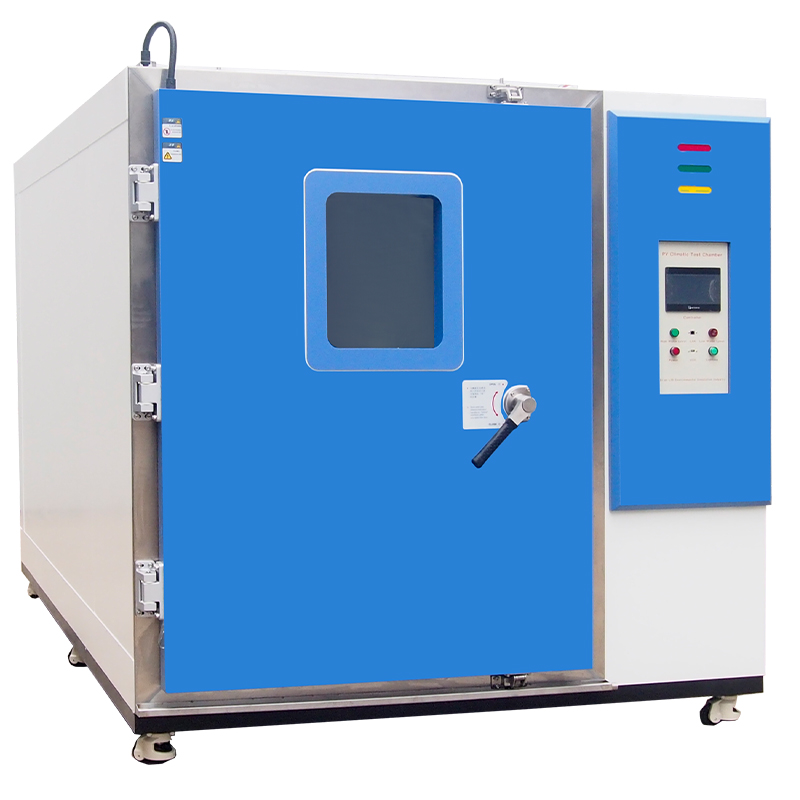
Temperature Range
A wider temperature range requires more capable thermal control hardware.
For example, a system operating from -60°C to +100°C requires substantially more refrigeration and heating capacity than one designed for a narrower range. Extreme low-temperature operation can also require more advanced refrigeration configurations.
Buyers should select a temperature range based on their actual test procedures rather than automatically choosing the widest specification.
Humidity Control
Humidity requirements influence the humidification, dehumidification, sensing, and control systems.
Precise humidity control is particularly important for environmental tests such as damp heat testing. Tighter tolerances generally require more sophisticated sensors and control systems.
The most economical configuration is one that meets the required test conditions without adding unnecessary environmental performance.
Temperature Change Rate
Rapid temperature changes require greater heating and cooling capacity.
A chamber designed for fast cycling may need larger compressors, heaters, heat exchangers, and more advanced control algorithms than a system intended for gradual transitions.
If rapid ramping is not part of the required test sequence, a moderate rate can reduce equipment complexity and cost.
Sample Capacity
The number and size of modules being tested also affect the mechanical design.
A single-sample system can use relatively simple fixtures. Testing several full-size PV modules simultaneously requires reinforced structures, adjustable mounting systems, and sufficient airflow around each sample.
For this reason, buyers should determine the required number of modules before requesting a quotation.
Standard vs. Customized Solar Simulation Chambers
Standard Configurations
Standard systems generally offer better cost efficiency because the manufacturer can use established dimensions, components, control architecture, and production processes.
They are suitable for laboratories with conventional sample dimensions and standard testing requirements. Standardized equipment can also reduce engineering time and simplify future maintenance.
Customized Configurations
Customization may be necessary when customers require unusual sample dimensions, larger module capacity, special fixtures, specific environmental conditions, or integration with existing laboratory systems.
A customized design requires additional engineering, component selection, manufacturing, testing, and commissioning. However, customization can provide better value when it directly solves a testing requirement.
The key is to distinguish between necessary customization and specifications that simply increase the purchase price without improving test capability.
How to Reduce Costs Without Sacrificing Test Quality
Cost reduction does not necessarily mean choosing cheaper components. It often means selecting specifications more carefully.
Match the classification to the test requirement.
Do not automatically select the highest solar simulator classification if the applicable test does not require it.
Size the chamber around the samples.
An oversized chamber increases structural, thermal, and electrical requirements.
Avoid unnecessary environmental ranges.
Specify the temperature and humidity conditions required by the actual test program.
Use standard fixtures where possible.
Adjustable standard fixtures can reduce engineering costs when custom structures are not necessary.
Consider total cost of ownership.
Lamp replacement, calibration, energy consumption, spare parts, maintenance, and expected service life can have a significant effect on the long-term cost of the equipment.
How to Choose a Solar Simulation Chamber Manufacturer
Choosing the right manufacturer is just as important as choosing the right specification.
A reliable solar simulation chamber manufacturer should be able to explain how the optical system, environmental control system, chamber structure, and test requirements work together. Buyers should also look beyond the initial quotation and evaluate manufacturing capability, testing procedures, installation support, warranty coverage, and after-sales service.
Before comparing quotations, ask the manufacturer:
Which solar simulator classification is provided?
How is irradiance performance verified?
Which test standards can the system support?
What temperature and humidity ranges are available?
How many modules can be tested simultaneously?
What calibration and maintenance are required?
What warranty and technical support are included?
Can the chamber be customized for future testing requirements?
A manufacturer that can provide clear answers to these questions is generally better positioned to deliver a system that matches the actual testing program.
How to Request an Accurate Solar Simulation Chamber Quote
To receive a meaningful quotation, buyers should provide the manufacturer with:
Required test standards
Solar simulator classification
Irradiance requirement
Light source preference
Module or sample dimensions
Number of samples tested simultaneously
Temperature range
Humidity range
Temperature change rate
Required test cycles and duration
Available installation space
Electrical requirements
Special fixtures or data interfaces
With these details, a manufacturer can configure the optical, thermal, mechanical, and control systems according to the application instead of quoting an unnecessarily oversized system.
LIB Industry: Solar Simulation Chamber Manufacturer
LIB Industry provides solar simulation chambers for photovoltaic module testing and environmental qualification. The systems can combine solar simulation with controlled temperature and humidity conditions, allowing laboratories to perform solar irradiance and environmental testing within an integrated system.
Depending on the application, LIB Industry can provide Class A or Class AAA solar simulator options, temperature control, humidity control, and configurations for different sample sizes and module capacities.
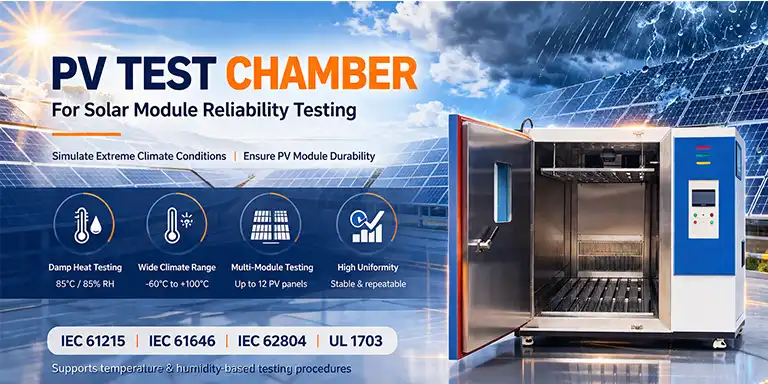
The equipment can be configured according to requirements related to IEC 60904-9, IEC 61215, and IEC 61730, with the exact performance and test configuration determined by the customer's test procedure.
As a solar simulation chamber manufacturer, LIB Industry can customize:
Chamber dimensions
Module capacity
Solar simulator configuration
Temperature and humidity range
Sample fixtures
Control and data-recording functions
Electrical and installation requirements
This approach allows customers to avoid paying for unnecessary specifications while still obtaining the performance required for their testing program.
|
|
|
|
|
Xenon Arc Weathering Test Chamber Material & PV durability |
UV Weathering Test Chamber
|
Temperature & Humidity Test Chamber Environmental aging |


3-Year Warranty & Lifetime Service
Equipment cost should also be evaluated from a long-term service perspective.
LIB Industry provides a 3-year warranty and lifetime service, helping customers reduce the risk associated with long-term equipment ownership. Technical support covers equipment operation, troubleshooting, maintenance, and service requirements throughout the equipment's working life.
For laboratories investing in high-value environmental testing equipment, this type of long-term support can be an important part of the overall purchasing decision—not simply an additional service.
FAQ
How much does a solar simulation chamber cost?
There is no single standard price. Cost depends on the light source, classification, chamber size, environmental control, sample capacity, and customization. A manufacturer can provide a more accurate quotation after reviewing the required test conditions.
What is the difference between Class A and Class AAA?
IEC 60904-9 evaluates spectral match, irradiance non-uniformity, and temporal instability separately. The term "Class AAA" is commonly used to describe an A-level result across these three characteristics, but buyers should confirm the exact classification and verification method provided by the manufacturer.
Does chamber size affect the price?
Yes. Larger chambers require more structural materials, insulation, heating and cooling capacity, airflow management, and larger sample fixtures. The impact becomes more significant when multiple full-size PV modules are tested simultaneously.
Is xenon or LED better for solar simulation?
Neither is universally better. Xenon can provide a broad spectral output but requires periodic lamp replacement. LED systems can offer longer operating life and lower routine maintenance. The appropriate choice depends on the application, test standard, spectrum, irradiance, and operating frequency.
Can LIB Industry customize a solar simulation chamber?
Yes. LIB Industry can customize chamber dimensions, module capacity, solar simulator configuration, environmental conditions, fixtures, control functions, and installation requirements according to the customer's testing needs.
Request a Solar Simulation Chamber Quote
The right solar simulation chamber is not necessarily the most expensive configuration. It is the system that provides the required irradiance performance, environmental conditions, sample capacity, and test control without unnecessary specifications.
If you are comparing solar simulation chamber manufacturers or planning a PV module testing project, LIB Industry can help define the appropriate configuration based on your test standards, sample dimensions, environmental requirements, and budget.
Contact LIB Industry at ellen@lib-industry.com to discuss your requirements and request a customized solar simulation chamber quotation.