What Should You Check Before You Buy an Accelerated Weathering Tester?
An accelerated weathering test chamber will sit in a lab and run for years, so a wrong choice doesn't just cost the purchase price — it costs every batch of inconsistent data that comes out of it afterward. This article walks through what an accelerated weathering test chamber actually does, the standards it needs to meet, the specifications that matter most, and how to evaluate a supplier like LIB Industry before you commit to an order for coatings, plastics, or polymer durability testing.
The Problem: Why Getting This Purchase Wrong Is Expensive
An accelerated weathering test chamber puts paints, plastics, and polymers through controlled cycles of UV radiation, wetness, and temperature, compressing months or years of outdoor sun and rain exposure into a few weeks of lab time, following the cycles defined in ASTM G155 or ISO 4892. If the light source is undersized, the irradiance control is loose, or the supplier isn't reliable for lamp replacement and service, the result is inconsistent data that undermines an entire quality assurance program — often discovered only after the equipment is already installed and running a multi-year test schedule.
Before comparing quotes, buyers should confirm four things: the light source technology (xenon arc vs. fluorescent UV), the irradiance and black-panel temperature control, the sample capacity for current and future workload, and compliance with the exact ASTM G155 or ISO 4892 cycle their materials require. Beyond the spec sheet, lamp replacement cost, water recycling design, and the supplier's service track record are what determine whether the test chamber keeps producing reliable, comparable data for the years it stays in operation.
Technical Fundamentals That Shape a Purchase Decision
Xenon arc technology reproduces full-spectrum sunlight. Xenon arc lamps output the full range of solar wavelengths — UV, visible, and infrared — making them a closer match to real outdoor exposure than fluorescent UV-only sources when testing for fading, chalking, or cracking.
Accelerated results compare materials; they don't predict exact service life. ASTM G155 states that accelerated weathering methods don't map directly to real-world exposure time. Results are best used to compare material performance or confirm compliance, not to predict a product's exact lifespan.
Standards compliance shapes equipment requirements. ASTM G155 defines fourteen distinct test cycles, and different end-use applications call for different exposure cycles, filter types, and light levels. A buyer should confirm the test chamber under consideration is flexible enough for their material scope rather than assuming one fixed setup covers everything.
Lamp lifespan drives long-term operating cost. Xenon lamps have a rated service life of roughly 1,600 hours, after which radiation and spectral output begin to drift. Budgeting for lamp replacement up front keeps multi-year testing programs from being surprised by mid-program costs.
Key Technical Specifications for Procurement
| Specification | Why It Matters | Typical Range |
|---|---|---|
| Irradiance control | Determines compliance with narrowband or broadband cycles | 0.35–1.5 W/m²/nm at 340nm |
| Black panel temperature | Simulates the surface heating a specimen experiences outdoors | 35–85°C ±2°C |
| Humidity range | Supports condensation and rain-simulation cycles | 30–98% RH |
| Sample capacity | Affects testing throughput per batch | Up to 40+ specimens |
Irradiance control determines standard compliance. ASTM G155 cycles call for control points such as 340nm or 420nm narrowband tracking, or 300–400nm wideband measurement. A test chamber with built-in light monitors and PID control keeps exposure consistent over long test periods, which is what makes results comparable batch to batch.
Black panel temperature reflects real surface heating. A black panel sensor measures the surface temperature a dark-colored specimen would actually reach in direct sunlight — a more useful predictor of coating or polymer breakdown than chamber air temperature alone.
Filter selection should match the testing objective. Daylight filters simulate direct sun exposure, while window-glass filters simulate light passing through glass. A test chamber with interchangeable filter options lets one unit cover several different testing scenarios instead of requiring a separate machine for each.
Weathering Test Chamber Comparison: Xenon Arc vs. Fluorescent UV vs. Basic Bench Unit
| Feature | Fluorescent UV Test Chamber | Basic Bench Xenon Unit | Full-Spectrum Xenon Arc Test Chamber (LIB Industry) |
|---|---|---|---|
| Light spectrum | UV only | Partial xenon spectrum, limited filter options | Full solar spectrum (UV, visible, IR) |
| Standard alignment | Suited to UV-focused specs only | Basic ASTM G155 / ISO 4892 coverage | Full ASTM G155 / ISO 4892 cycle coverage |
| Filter flexibility | Minimal | Fixed or single filter | Interchangeable daylight and window-glass filters |
| Black panel temperature control | Often absent or approximate | Basic control | PID-controlled, ±2°C accuracy |
| Best for | Screening-level UV-only testing | Small labs with limited budget | Coatings, plastics, and polymer programs needing full-spectrum, standards-traceable data |
The LIB Industry Accelerated Weathering Test Chamber
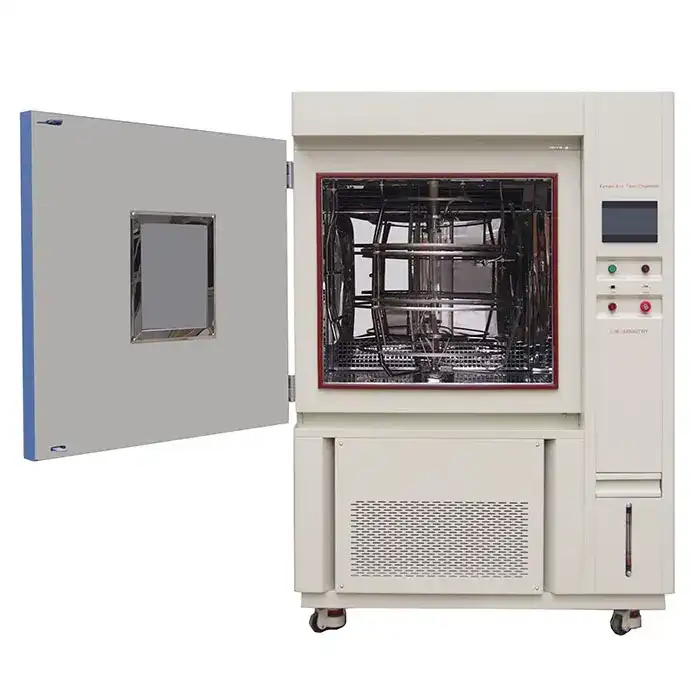
LIB Industry builds its accelerated weathering test chamber around the same full-spectrum xenon arc technology and standards traceability covered above, packaged as a ready-to-run system rather than a set of components a lab has to configure on its own.
| Capability | Performance |
|---|---|
| Light source | Air-cooled or water-cooled xenon arc lamp, full solar spectrum |
| Irradiance control | 0.35–1.5 W/m²/nm at 340nm, PID-controlled with continuous monitoring |
| Black panel temperature | 35–85°C, ±2°C accuracy, independent of chamber air temperature |
| Humidity range | 30–98% RH, supports condensation and rain-simulation cycles |
| Sample capacity | Up to 40+ specimens, rotating specimen rack for even exposure |
| Filter options | Daylight and window-glass filters, field-interchangeable |
| Standards coverage | ASTM G155, ISO 4892, and related coatings/plastics/automotive cycles |
| Water system | Closed-loop recycling to reduce continuous water consumption during spray cycles |
| Data & connectivity | Touchscreen control, cycle logging, Ethernet/Wi-Fi data export for compliance records |
|
|
|

A rotating specimen rack keeps every sample moving through the same irradiance zone rather than leaving edge positions under- or over-exposed, and the closed-loop water system is sized to offset the running cost concerns raised earlier around continuous spray cycles. The filter set, sample rack, and control profiles can be configured around a specific material program — coatings, plastics, or textiles — rather than requiring a separate machine per material type.
LIB Industry Recommended Equipment
|
 |
|
|
| LIB Industry Salt Spray Test Chamber — for corrosion-resistance testing on coated metals and components, often used alongside weathering data to build a fuller durability picture. | LIB Industry Temperature & Humidity Test Chamber — for damp-heat and condensation testing on materials and assemblies outside the scope of light-driven weathering cycles. | LIB Industry UV Test Chamber — a lower-cost, UV-focused option for screening-level testing before committing to full-spectrum xenon arc evaluation. |


How to Evaluate a Weathering Test Chamber Supplier
Step 1 — Define testing standards and material scope. Confirm the quality program follows ASTM G155 or ISO 4892, and identify whether testing covers paints, plastics, fabrics, or a mix — this determines which cycle and filter combination the test chamber needs to support.
Step 2 — Request detailed technical documentation. Compare full specification sheets — irradiance range, temperature accuracy, humidity accuracy, and sample capacity — against actual testing needs before ordering, to avoid mismatches that only surface after installation.
Step 3 — Compare total cost of operation, not just sticker price. Replacement lamp cost, water use, and energy efficiency accumulate over a test chamber's service life and should factor into the purchase decision alongside the initial quote.
Step 4 — Review manufacturing experience and track record. Check how long a supplier has built aging/weathering equipment and whether their test chambers have a proven history in comparable industries such as paints, building materials, or automotive.
Step 5 — Request third-party quality certifications. ISO 9001 quality management, CE certification, and independent testing approval from recognized bodies such as SGS or TÜV give buyers confidence that stated specs hold up in real-world operation.
Step 6 — Confirm after-sales support and lamp availability. Since xenon lamps have a fixed usable life, verify lamp availability, warranty terms, and response time for technical support to avoid extended downtime during long-term testing programs.
Common Purchasing Mistakes to Avoid
Overlooking water consumption and filtration design — continuous water-spray cycles use significant water, and a poorly designed recovery/filtration system can push running costs well above budget.
Underestimating sample capacity needs — sizing a test chamber only for current workload often forces a costly upgrade or slower batch testing once a program grows.
Ignoring data logging and connectivity requirements — without Ethernet/Wi-Fi connectivity and automated data export, labs may lack the documentation needed for compliance reporting and cross-lab comparison.
Where Accelerated Weathering Test Chambers Are Used
Coatings and paints. Automotive, architectural, and aerospace coatings go through rapid weathering to evaluate color retention, gloss loss, and wear before release, helping manufacturers optimize formulations and predict real-world performance ahead of mass production.
Plastics and polymer development. Outdoor plastic components need stability testing for mechanical properties, color stability, and surface integrity under simulated long-term exposure.
Textiles and composite materials. The same UV, moisture, and heat cycling used for paints and plastics applies to fabrics, laminates, and composite parts exposed to sunlight outdoors or inside vehicles.
FAQs
What rules does an accelerated weathering test chamber need to follow? Check whether the equipment follows ASTM G155 and ISO 4892. These standards define the xenon arc exposure cycles, filter types, and irradiance measurement methods most commonly used for testing coatings, plastics, and polymers.
Can rapid aging results tell you how long a product will actually last? Not exactly. ASTM G155 states there is no direct correlation between accelerated exposure time and real-world service life, so results are better used for comparing products and confirming compliance than for predicting an exact lifespan.
Does black panel temperature matter more than chamber air temperature? Yes, for material durability purposes. A black panel sensor measures the real surface temperature a dark-colored specimen reaches under simulated sunlight, which reflects thermal stress more accurately than air temperature alone.
How often do xenon lamps need to be replaced? Typically around every 1,600 hours of use, after which radiation and spectral output begin to drift — budgeting for replacement lamps in advance avoids surprise costs in multi-year testing programs.
What should I ask a supplier before buying a weathering test chamber? Ask for full specification sheets, third-party certifications (ISO 9001, CE, SGS/TÜV testing), lamp availability and warranty terms, and references from customers in a similar industry before placing an order.
Get a Testing Solution From LIB Industry
Buying an accelerated weathering test chamber means matching irradiance control, black panel temperature accuracy, and sample capacity to your specific ASTM G155 or ISO 4892 testing needs — and confirming the supplier understands the engineering requirements and stands behind the equipment after the sale. A well-specified test chamber, built with accurate PID control, consistent specimen exposure, and efficient water recycling, keeps quality assurance data consistent and comparable for years of testing.
Every LIB Industry test chamber ships with a three-year warranty, and customers continue to receive lifetime technical support — maintenance guidance, spare-parts assistance, and after-sales service — for as long as the equipment stays in operation.
Contact LIB Industry today at ellen@lib-industry.com to discuss a turnkey accelerated weathering testing solution built around your coatings, plastics, or polymer program.