Where to Buy Benchtop Test Chambers for Laboratory Testing?
Laboratories can buy benchtop test chambers directly from the manufacturer, through authorized distributors, or from general lab-equipment resellers. Manufacturers offer design control and customization. Distributors offer local stock and support. Whichever route you choose, look for a supplier that backs its specifications with documents, runs an acceptance test on your own sample, and supports the chamber after delivery. This guide explains how to compare suppliers, which certificates to request, and what to ask before you order.
What Makes a Benchtop Test Chamber Supplier Reliable?
A chamber stays in service for years, so you will deal with the supplier for a long time. Check these points before any payment is made.
Manufacturer, Distributor or Reseller
A manufacturer controls both production and sales, so it can answer technical questions and modify a standard model. A distributor or agent gives you a local contact and a shorter supply chain. A reseller may carry several brands but usually passes technical questions back to the original maker. For each source, ask who handles warranty repairs and who commissions the unit.
| Source | Strength | Point to verify |
|---|---|---|
| Manufacturer | Design control, customization | Export experience and local support |
| Distributor or agent | Local contact, faster service | Authorization and spare-part stock |
| Reseller | Convenience, multiple brands | Who handles warranty repair |
|
|
|


Signs of a Dependable Supplier
- Clear answers to technical questions
- Complete, consistent specifications
- Documented performance data
- References from similar laboratories
- A visible service network
LIB Industry, for example, offers a turnkey service covering design, production, delivery, installation and training.
Warning Signs
- Figures that differ between the quotation and the datasheet
- No sensor brand, uniformity data or warranty wording
- Pressure to pay before the specifications are confirmed
- Slow or vague replies during quotation, which often predict slow service later
How to Compare Benchtop Test Chamber Manufacturers
 Compare like with like. Send every supplier the same requirements and judge how they respond.
Build a Requirements Sheet
Record the sample size and weight, load per run, ramp and dwell profile, test standard or protocol, data-logging needs, and the destination country. A shared sheet turns scattered brochures into directly comparable quotes.
Compare Components and Build
Do not stop at the headline numbers. LIB, for example, lists a SUS304 stainless steel interior, polyurethane foam insulation, a mechanical compression refrigeration system, a programmable color touchscreen controller, and an observation window with interior lighting. Its marketing material also mentions Vaisala humidity sensors. Ask every supplier for the same level of detail on sensors, blowers and controls.
Compare Models and Dimensions
The published LIB benchtop models show the level of detail a lab should expect:
| Model | Internal size (mm) | Overall size (mm) | Volume | Heat load |
|---|---|---|---|---|
| TH-50 | 320×350×450 | 820×1160×950 | 50 L | 1000 W |
| TH-80 | 400×400×500 | 900×1210×1000 | 80 L | 1000 W |
Which Certifications Should Suppliers Provide?
Ask for copies of the documents rather than relying on website claims.
Quality Management and Product Marking
LIB states that it manages quality under ISO 9001 and that its products are tested by third parties such as SGS and TÜV and carry the CE mark. Request the ISO 9001 certificate, confirm that its scope covers environmental chambers, and check the expiry date.
Calibration and Traceability
Test results are only as reliable as the instruments behind them. Confirm that the temperature and humidity sensors come with calibration certificates traceable to national standards, ideally issued by an ISO/IEC 17025 accredited laboratory. Ask for the unit's original factory test record. Many labs use IEC 60068-3-5 as a guide for confirming chamber performance.
Documents Worth Requesting
Declaration of conformity
Operating manual
Factory acceptance test (FAT) report
Electrical safety documentation
A supplier that can send these quickly is usually well organized. If they are hard to find, look more closely.
How to Evaluate Chamber Specifications and Performance
A specification sheet is a starting point. What matters most is how the chamber performs with your load and your test profile.
Read the Core Numbers
According to LIB's published data, its benchtop chambers come in three temperature classes: Class A from -20 °C, Class B from -40 °C and Class C from -70 °C. All classes reach +150 °C, with humidity from 20% to 98% RH. Stated performance is ±0.5 °C temperature fluctuation, ±2.0 °C uniformity and ±2.5% RH humidity deviation. The cooling rate is 1 °C/min and the heating rate is 3 °C/min, which suits steady temperature change rather than rapid cycling.
Resolve Conflicting Figures
Quotes, brochures and datasheets sometimes disagree, for example on the lowest temperature or the humidity floor. Ask the supplier to confirm every parameter in writing and give you one final value for each. Then treat the signed specification as the reference for acceptance.
Verify With Your Own Load
Ask for performance data with a real load, not an empty chamber. Request stability results at your setpoints and ramp-rate results. A confirmation run with your own sample or a reference load, signed off by both sides, settles any doubt.
| Parameter | Question for the supplier |
|---|---|
| Range | Is every required setpoint reachable under load? |
| Uniformity | What are the measurement points and results? |
| Ramp rate | How was it measured, and with what load? |
| Humidity | Is the lowest required point stable? |
| Sensors | Which brand, and is calibration certified? |
What Supplier Services Matter After Purchase?
The deal does not end at delivery. The chamber keeps running for years.
Warranty and Service Terms
LIB states that it provides lifetime service through a global support network available around the clock. Whatever the supplier claims, read the contract to see what the warranty covers, which parts are included and how fast the supplier must respond. Written commitments and spare-parts lists are worth more than general promises.
Installation, Training and Documentation
Check whether the price includes installation, user training and documentation. Good training covers programming, water handling, alarms and routine maintenance. It also reduces unnecessary test runs in the first months.
Local Support and Spare Parts
Find out where the nearest service technician is and how long parts take to arrive. Remote help through Ethernet or USB data transfer is useful, but repairs still need a technician on site. Local presence cuts downtime significantly.
Case Example: Repeat Order From a Apple Seattle Laboratory
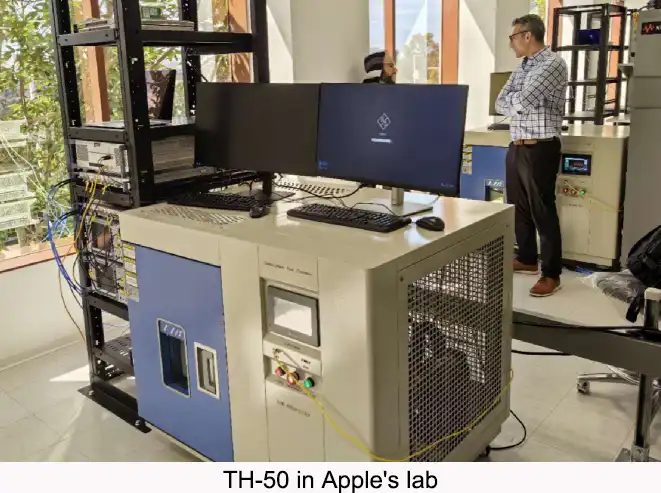
In December 2023, Apple placed a repeat order for two LIB TH-80A benchtop temperature humidity test chambers, installed at its Seattle, USA office. In March 2024, LIB engineers visited the laboratory, and Apple staff gave positive feedback on LIB's product quality and service. A repeat purchase of this kind shows what a buyer should look for: consistent quality across orders and support that continues after installation.
Questions to Ask Before Ordering
A short written list prevents most disputes after delivery.
Technical Questions
Which sensors does the chamber use, and which brand?
How uniform are temperature and humidity with the load inside?
What happens during a power or water failure?
Does it include protection against dry-burn, over-temperature, over-current, high refrigerant pressure, water shortage and earth leakage? LIB lists these as standard.
Commercial Questions
What is the delivery time, and who handles freight, customs and unloading?
What are the payment terms?
Are training, setup help and spare parts included?
Can the warranty be transferred?
Compare total cost, not just the first quoted price.
Site and Sample Questions
Can the bench carry the weight?
Is there enough clearance for airflow?
Does the power supply match the unit?
Do any samples, such as lithium-ion batteries, need extra safety measures? LIB mentions battery-safe options but does not publish the details, so ask for them in writing.
Buying Routes for Overseas Laboratories
Buying from another country adds steps that domestic buyers rarely consider.
Direct Purchase From a Factory
Buying from the maker may allow customization and more accurate pricing. LIB's R&D team says it can adapt standard designs to specific test needs, and it offers both standard and custom models. Confirm lead time, packing and shipping terms before you order.
Working Through Local Agents
An agent can support you in your own language and speed up site visits. LIB says it has service centers and agents in 29 countries, including the US, Canada, Malaysia and the UK. Check that the agent in your country is authorized and stocks the wear parts you need.
Plan the Timeline
Allow time for specification review, quotation, contract negotiation, production, shipping, installation and acceptance. Prepare the bench, power supply and water supply before the chamber arrives so commissioning can start right away.
Conclusion
Benchtop test chambers can be bought from the manufacturer, a distributor or a reseller. Choose a supplier that explains its quality system, confirms specifications in writing and supports the chamber after delivery. Send identical requirements to every candidate, ask for certificates and test records, verify performance with your own load, and read the warranty terms carefully. A purchase based on documents rather than promises protects both your budget and your data quality for years.
Ready to compare suppliers? LIB Industry is a factory and supplier of environmental test equipment. Send your sample details and test protocol to ellen@lib-industry.com for a clear quotation.
FAQ
Is it better to buy from a manufacturer or a distributor?
Manufacturers offer design control and customization. Distributors offer local support. Choose the source that can prove its claims with certificates, specifications and nearby service.
Which documents should a supplier provide?
Proof of the quality system, a declaration of conformity, sensor calibration certificates, a factory test report, written instructions and written warranty terms. Quick delivery of these documents is a sign of an organized supplier.
How can I verify performance before final payment?
Run an acceptance test with your own sample or a known reference load. Have the supplier sign off the results for ramp rate, uniformity and humidity stability, and tie the final payment to that run.