Benchtop Test Chambers: What Should Buyers Check Before Ordering?
Quick answer: Before ordering a benchtop test chamber, check five things: the temperature and humidity window against your test standards, the usable volume against your largest specimen, the controller and data functions, the built-in safety features, and the supplier’s calibration, warranty and support terms. Write down your exact test conditions first, for example 40 °C / 93% RH or 85 °C / 85% RH, then compare them with the published specification. This guide uses the LIB Industry TH-50 and TH-80 as examples.
How do you define your test requirements first?
List every setpoint, dwell time and cycle count your lab plans to use, including the unusual ones. A unit bought only for damp heat may fall short once cold storage or cycling is added to the plan.
Sample type: electronic parts, polymers, coatings and pharmaceutical samples stress a test chamber in different ways. Packaged samples can load the humidifier heavily. Tell the supplier the sample size, weight and packaging early.
Future work: ask which other standards the unit could support later, and whether custom sizes or other temperature versions are possible.
| Test | Typical conditions | Typical use |
|---|---|---|
| Damp heat (IEC 60068-2-78) | 40 °C / 93% RH | Electronics, components, materials |
| High-temperature, high-humidity | 85 °C / 85% RH | Reliability and ageing of electronic parts |
| Cold and dry heat (IEC 60068-2-1 / -2) | Low or high temperature | Storage and operating limits |
| ICH Q1A(R2) | 25 °C / 60%, 30 °C / 65%, 40 °C / 75% RH | Pharmaceutical and supplement stability |
Check your own standard for the current edition and exact conditions.
What temperature and humidity performance should you check?
The unit must meet or exceed the conditions in your standard, with margin, at every test point.
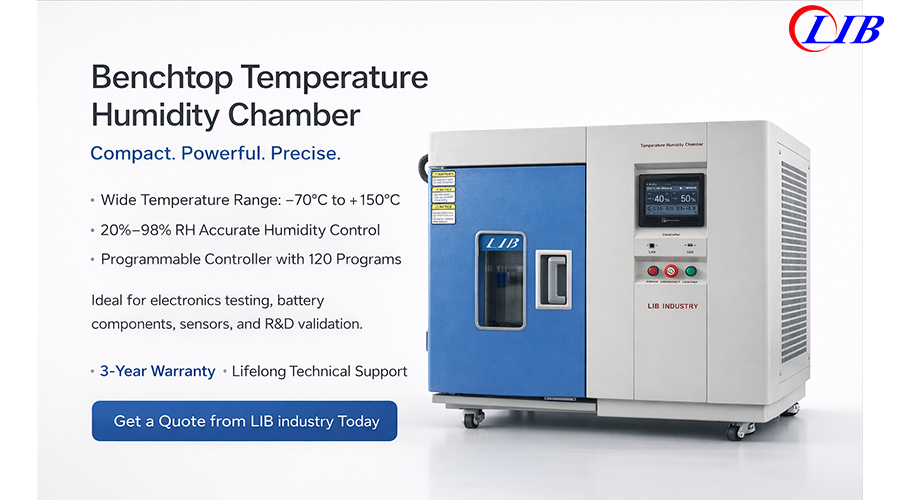
Temperature version: the TH-50 and TH-80 come in three versions, up to +150 °C. Version A (-20 °C) covers damp heat and shelf-life work. Versions B (-40 °C) and C (-70 °C) add cold storage and low-temperature cycling.
Stability figures: fluctuation (±0.5 °C) is how steady the temperature stays at one point over time. Deviation (±2.0 °C, and ±2.5% RH for humidity) is the spread across the working space.
Humidity window: humidity control only works within a range of temperatures, so 20% to 98% RH is not available at every temperature. Ask for the temperature-humidity operating chart and confirm that each of your test points sits comfortably inside it.
| Parameter | TH-50 / TH-80 |
|---|---|
| Temperature range | -20 / -40 / -70 °C to +150 °C (versions A / B / C) |
| Humidity range | 20% to 98% RH |
| Fluctuation / deviation | ±0.5 °C / ±2.0 °C |
| Humidity deviation | ±2.5% RH |
| Cable port | 50 mm standard; 100 or 200 mm optional |
| Shelves | Two standard; custom sizes available |
|
|
|


How do you check size and installation?
Match interior volume to your largest specimen, then check that the overall footprint fits your lab.
| Model | Interior (mm) | Volume | Overall (mm) |
|---|---|---|---|
| TH-50 | 320 × 350 × 450 | 50 L | 820 × 1160 × 950 |
| TH-80 | 400 × 400 × 500 | 80 L | 900 × 1210 × 1000 |
Volume: leave space around the largest piece. Crowded samples restrict airflow and distort readings near the walls.
Footprint: the refrigeration system takes room, so the overall size is larger than the interior. Check the dimensions against your door, lift and bench or stand.
Utilities: cooling uses a mechanical compression refrigeration system. Check the electrical supply, airflow clearance and water supply for the humidifier. Choose a larger cable port for big sensor bundles.
What controller and data functions do you need?
Look for reusable profiles, remote access and traceable records.
Programmable profiles: the color LCD touch screen stores temperature and humidity profiles, so runs repeat without retyping. The interface supports English, French, Spanish, German and Russian, which helps multilingual labs.
Connectivity: Ethernet allows remote monitoring of long runs. Check that the connection method fits your network policy.
Data and traceability: quality systems usually need a record of every run. Ask how data is saved, exported and time-stamped, and whether the format works with your audit process.
Which safety features and build quality matter?
Built-in protections guard the equipment and the lab, and the build decides how long the unit lasts in humid conditions.
| Protection | Guards against |
|---|---|
| Over-temperature | Excess temperature in the test space |
| Over-current | Electrical overload |
| Refrigerant high-pressure | Refrigeration circuit faults |
| Earth leakage | Electrical leakage hazards |
| Water shortage, humidifier dry-combustion | Heating element running without water |
The interior is SUS304 stainless steel, which resists rust in damp conditions and is easy to clean. Polyurethane foam with insulation cotton keeps heat in and helps hold humidity steady, and a double-layer heat-resistant silicone door seal does the same.
Ask the supplier which certificates they can provide for your region, and how they check each unit before shipment. Written final-test records show how seriously a maker treats quality control.
What should you confirm about calibration, warranty and support?
A cheaper unit stops being cheaper if a small part leaves it idle for weeks.
Calibration: ask whether a calibration report is included, where sensors were placed and how often to recalibrate. The IEC 60068-3 series gives guidance on confirming chamber performance.
Warranty and spares: check the warranty length, what it covers and how fast humidifier parts and seals can be replaced.
Delivery and training: ask who unpacks and installs the unit, and whether operators are trained to program it and perform routine maintenance.
What should you ask a supplier before you sign?
 Full technical documents: a specification sheet, wiring information and a manual. Vague brochures without numbers deserve follow-up questions.
A reasoned recommendation: send your test conditions and ask engineers to choose a model. A good recommendation comes with reasons, not just a price.
Total cost: include energy, water, calibration, consumables and downtime. Over several years, differences in service and reliability usually outweigh small differences in purchase price.
Case study: Apple orders from LIB Industry, 2019 to 2023
Apple has bought from LIB Industry twice: waterproof testing equipment in 2019 and benchtop temperature humidity test chambers in 2023.
On September 5, 2019, Apple first consulted LIB about the [R9K-1200] IPX9K test equipment for waterproof testing of electronic products. The purchase order followed on October 6, 2019, and Apple gave good feedback on the fast production and delivery.
In December 2023, Apple placed a repeat order for two [TH-80A benchtop temperature humidity test chambers], installed at its Seattle, USA office. In March 2024, LIB engineers visited Apple’s laboratory, and Apple staff praised LIB’s quality and service.
Why buy from LIB Industry?
Tested before shipment: every unit runs 72 hours continuously.
Certified and inspected: CE, RoHS, ISO 9001 and ISO 17025 calibration, with inspection by SGS and TÜV.
3-year (36-month) warranty: if a unit cannot be repaired within the warranty period, we replace it with a new one. Lifetime technical support afterwards.
Global service: local support in the US, UK, Canada and Malaysia, with 24/7 English support and on-site service when necessary.
One-stop project service: solution design, customization, delivery, installation and training.
Not sure which version fits your tests? Send your test conditions and sample sizes, and our engineers will recommend a model.
FAQ
Which temperature version should I choose?
Version A (-20 °C) covers damp heat and shelf-life tests. For cold storage or low-temperature cycling, choose version B (-40 °C) or C (-70 °C). Send your test conditions to LIB engineers for a recommendation.
How accurate is the humidity control?
The TH-50 and TH-80 specify ±0.5 °C temperature fluctuation, ±2.0 °C deviation and ±2.5% RH humidity deviation over 20% to 98% RH. Ask for the humidity operating chart to confirm your test points.
Can the size be customized?
Yes. Standard models are 50 L and 80 L, and other sizes can be made to order. Cable ports of 50, 100 or 200 mm are available. Share your specimen size so the layout works.
Can I run 85 °C / 85% RH in a benchtop test chamber?
It depends on the humidity operating window of the model. Ask for the temperature-humidity chart and check that 85 °C / 85% RH falls inside it before you order.
Contact LIB Industry
LIB Industry is a benchtop humidity chamber manufacturer providing turn-key environmental testing solutions, from design through installation and training. Email ellen@lib-industry.com with your test conditions and sample sizes.