Custom vs. Standard Composite Polymerization Ovens: How to Choose
Key Takeaways
Choose standard when your part fits a catalogue chamber and you need the oven soon. Standard LIB models usually ship in 7–15 days.
Choose custom when geometry, load weight, line layout or hazard rules fall outside the catalogue. Examples: parts over 1000 mm, very heavy tooling, flammable-vapor cures.
Many projects fit the middle path: a standard chamber with configured shelves, cart loading or ATEX options.
Chamber size cannot be changed after build, so plan for future parts before you order.
About LIB Industry Composite Polymerization Ovens
LIB Industry's polymerization ovens are programmable curing ovens for composite materials, available in five chamber sizes from 100 L to 1000 L and three temperature classes up to 900 °C. They are used to cure, post-cure, dry and bake carbon fiber and fiberglass parts, and they can be customized for oversize or special-process loads.
Standard range
|
Model |
Internal size (mm) |
Volume |
|---|---|---|
|
O-100 |
400×500×500 |
100 L |
|
O-225 |
500×600×750 |
225 L |
|
O-500 |
700×800×900 |
500 L |
|
O-800 |
800×1000×1000 |
800 L |
|
O-1000 |
1000×1000×1000 |
1000 L |
|
Class |
Range |
|---|---|
|
A |
Ambient to +250 °C |
|
B |
Ambient to +400 °C |
|
C |
Ambient to +900 °C |
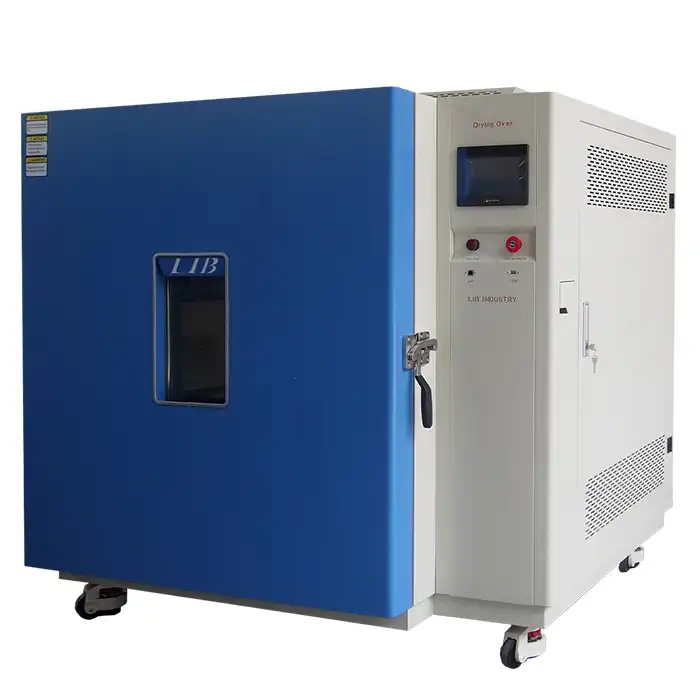
Key specifications
Control: ±0.5 °C temperature fluctuation, ±2.0 °C deviation, 6 °C/min heating rate.
Controller: PID color LCD touch screen with Ethernet, USB and an optional PC link.
Construction: SUS304 stainless steel interior, coated steel exterior, polyurethane foam insulation (refractory brick for the highest class).
Power: 380 V, 50 Hz.
Quality and support: 72-hour continuous test before shipping, CE and RoHS compliance, calibration to ISO/IEC 17025 available, 36-month warranty, then lifetime technical support and 24/7 English remote support.
Service scope: design, customization, delivery, installation, commissioning and operator training.
Standard, Configured or Custom?
|
Route |
What it is |
Strength |
Trade-off |
|---|---|---|---|
|
Standard |
A catalogue model, built as published |
Fast quotation, repeatable build, common spares |
Fixed dimensions |
|
Configured standard |
A catalogue chamber with selected options |
Targeted fixes at modest effort |
Limited by the base chamber |
|
Fully custom |
Designed around your part and line |
Exact fit |
More engineering time and lead time |
Configured options include: heavy-duty shelves, custom shelf spacing (adjustable in 25 mm steps), floor-level cart loading and ATEX-compliant builds.
When a Standard Oven Is Enough
Standard ovens suit test batches, small production runs and repeat parts that fit a catalogue chamber with airflow clearance. Operators who learn one unit can run the next without retraining, and a common platform simplifies spares.
Standard has limits. Shelves are rated at 50 kg standard or 200 kg heavy-duty, so confirm that your heaviest tooling load fits. Total load capacity can reach up to 2000 kg, depending on the model. The largest chamber is 1000 mm in each direction, so longer parts need another route. A cure that releases flammable vapors may need extra safety equipment.
When You Need a Custom Oven
Oversize or unusual parts. If your largest part exceeds 1000 mm, or you load long tubes, wide panels or tool carts, a custom chamber is usually needed. Measure the part and the clearance around it for airflow.
Heavy tooling and special loading. Very heavy tools may need reinforced floors, rails or cart systems, especially when the load approaches the model's rated capacity (up to 2000 kg, depending on the model). Raise these early, since changing a finished oven is costly.
Hazard and regulatory needs. NFPA 86 covers fire and explosion hazards in ovens and furnaces, and the ATEX Directive 2014/34/EU covers equipment for potentially explosive atmospheres. A formal risk assessment tells you whether your process needs explosion-protected equipment.
Case study: a 6-meter oven for long steel tubing
An oilfield-equipment customer needed to heat steel casing (170 mm outer diameter) with a heavy tool installed inside. Wires and hydraulic lines ran out of the casing ends for live monitoring, and the load was long and heavy. No catalogue model could take it.
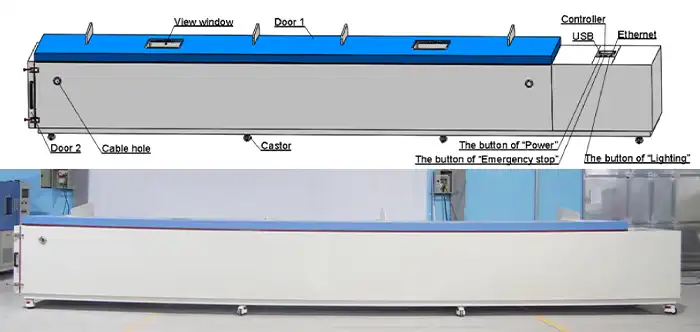
LIB designed a single 6-meter oven rated from ambient to 300 °C, with a top-opening door and a removable side door for placing the casing and connecting the lines. The customer approved the design and placed the purchase order within about a month of the first inquiry. In January 2024 the customer returned to discuss a second, similar oven with adjusted parameters.
Takeaway: when the part, load and feed-through needs are unusual, a custom design can be the only workable option, and it works best when those details are stated in the first inquiry.
Integrating an Oven Into Your Line
 Layout and material flow. Decide where parts arrive from and go to afterward. Door side, cart height and surrounding space affect daily use. Floor-level cart loading helps lines that move tooling on wheels. Share a floor plan with your supplier before approval.
Controls and data. Ethernet, USB and the optional PC link allow connection to existing monitoring systems. Define what you need, such as recipe transfer or alarm output, so both sides share the same expectations.
Utilities. Check floor loading, power capacity and exhaust routing. The oven's exhaust port has adjustable flow, but you still need ducting to a safe discharge point. Get utility connection costs before ordering.
Choosing: A Fit-Check Worksheet
Write down your largest part, heaviest load, highest temperature, required ramp rate, solvent release, line layout and delivery date. If every item fits the catalogue, a standard oven saves time and money. If one does not, you have a case for custom or configured.
|
Factor |
Favors standard |
Favors custom |
|---|---|---|
|
Delivery deadline |
Tight |
Flexible |
|
Part geometry |
Fits catalogue sizes |
Outside catalogue |
|
Process risk |
Familiar cure |
Hazardous or unusual |
|
Future growth |
Same parts |
New part families |
Plan for future parts. Ovens last many years. If upcoming programs bring larger or heavier parts, choose a chamber with headroom and adjustable shelves. Record your assumptions so engineers understand the decision later.
Acceptance, Delivery and Support
Acceptance test. Whichever route you choose, agree in writing on a pre-shipment test: a standard load, multi-point temperature readings, and pass criteria matching the specification (±0.5 °C fluctuation, ±2.0 °C deviation). Tie a payment milestone to passing.
Delivery and installation. Request dates for drawings, manufacture, factory testing and shipping. Custom builds take longer than the 7–15 days quoted for standard models. State in the contract who handles unloading, utility connection and start-up.
Training and service. Ask for an operator training plan, a spare parts list and a named service contact. Clear answers before the sale predict responsive support afterward.
FAQ
Is a standard oven enough for carbon fiber parts? Usually, yes, if your cure temperature falls within the oven's class and the part fits with airflow clearance. Confirm uniformity and load ratings for your resin system and tooling.
How much longer does a custom oven take? Custom work adds design approval and manufacturing steps, so it takes longer than the 7–15 days for standard models. Ask for a milestone schedule covering drawings, build, factory test and shipping.
Can I start with a standard oven and upgrade later? Some features can be added later, such as shelves or cart access. Chamber size cannot change after build, so choose it with future parts in mind.
Do I need ATEX certification? Only if your process creates a potentially explosive atmosphere. A formal hazard assessment decides this, so complete it before ordering.
Can LIB build ovens for oversize parts? Yes. LIB has built a 6-meter oven for long steel tubing with a removable side door and feed-through access. Send your part dimensions and weight for a design proposal.
Get a Tailored Recommendation
Not sure whether a standard or custom oven fits? As a composite polymerization oven manufacturer and environmental test chamber factory, LIB Industry designs, builds, installs and supports composite curing ovens, temperature humidity chambers, rapid temperature change chambers, thermal shock chambers and vibration test chambers. Send your part dimensions, load weight, cure schedule and site details to ellen@lib-industry.com, and our engineers will recommend a standard model or a custom curing oven design.