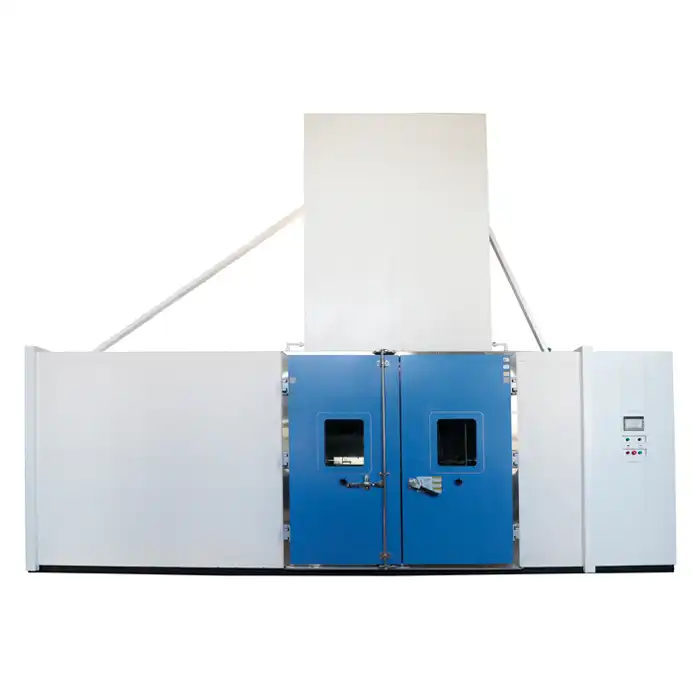
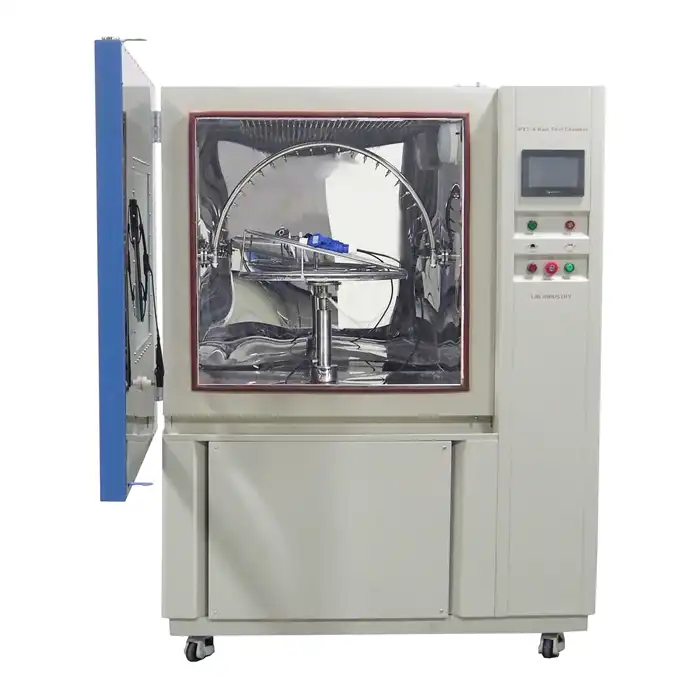
Dust Test Chamber Buying Guide for IP5X and IP6X Verification
Quick answer: A dust test chamber for IP5X and IP6X verification must circulate talcum powder around the specimen at a controlled concentration, hold the enclosure at a defined pressure condition where the test category requires it, and repeat results from run to run. Compare working volume against your largest product, the powder circulation and vacuum arrangement, the sealing of the unit itself and the manufacturer's documents. LIB's DI series (DI-800, DI-1000, DI-1500, DI-2000) offers 800 L to 2000 L of working space with a vacuum system, programmable touch-screen control and IEC 60529 coverage.
What do IP5X and IP6X really require?
IEC 60529 classifies protection against solid objects and water, and its first digit covers dust.
| Code | Meaning | Typical evaluation |
|---|---|---|
| IP5X | Dust-protected | Dust may enter, but not enough to interfere with operation or impair safety |
| IP6X | Dust-tight | No dust ingress during the specified test |
IP6X is stricter, so sealing at joints, gaskets, cable entries and connectors decides the result. The standard also distinguishes enclosures with and without a pressure difference caused by thermal cycling or breathing, and the procedure differs accordingly. Always confirm the test category, dust material, concentration and duration in the current edition of IEC 60529, or in the product standard that cites it. Those details drive your choice of dust test chamber.
How do you match capacity to your products and throughput?
Capacity mistakes are the most common reason a dust test chamber is replaced early.
Size for the largest product: choose working volume from the biggest specimen you expect over the next several years, including fixtures and any cables or hoses passing through the wall. Allow clearance on all sides so dust circulates freely.
Match duration to throughput: exposure runs for hours per specimen depending on the procedure. A lab with many variants benefits from easy cleaning and powder handling that shortens turnaround.
Plan fixtures and orientation: products are often tested in more than one orientation. Ask how specimens are supported, whether holders can be customized, and whether door opening and shelf position suit heavy automotive assemblies or small devices.
| Product type | Capacity consideration |
|---|---|
| Small electronics | Compact unit, easy fixture changes |
| Automotive control units and sensors | Medium volume, connector access |
| Large industrial enclosures | Large working space, loading method |
|
|
|
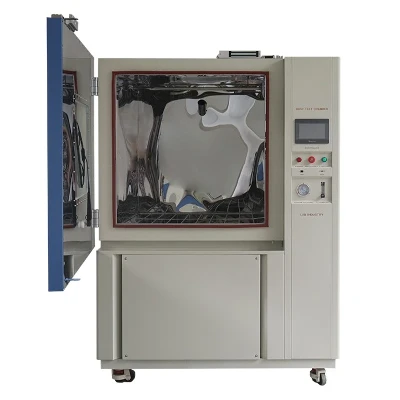
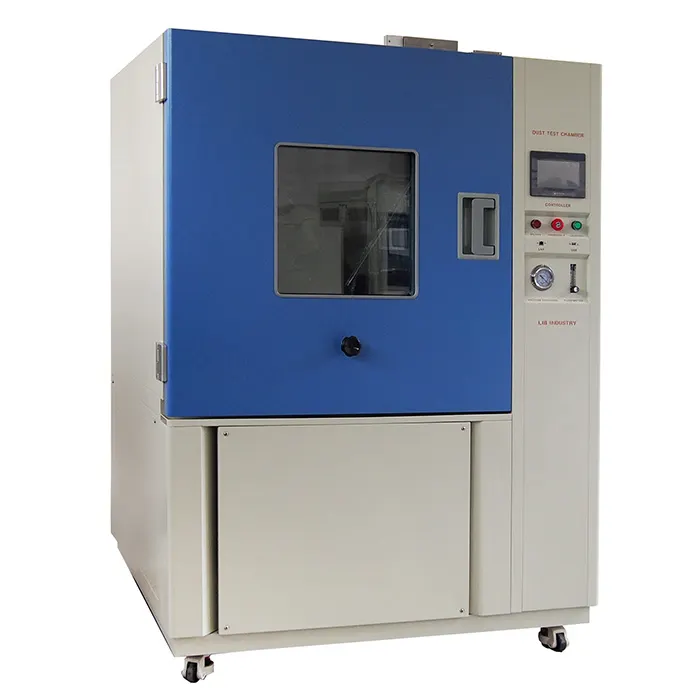
 Which circulation, concentration and vacuum specs should you compare?
Datasheets look alike until the circulation and vacuum details are read side by side.
Dust circulation: a blower keeps powder suspended so every face of the specimen sees comparable exposure. Ask how airflow is generated, how dust distribution is verified, and what prevents powder from settling in dead zones.
Concentration control: the procedure sets powder quantity and conditions. Check that the unit can hold the required concentration and that operators can confirm it.
Vacuum capability: where the test needs a pressure difference inside the enclosure, the pump must reach and hold the specified level with a way to measure it. Request pump capacity, gauge accuracy and hose connection details in writing.
How does sealing and construction protect your results?
A leaking dust test chamber, a worn door gasket or a poor filter can distort a run and cast doubt on the verdict.
Door and gasket: powder escaping through the door contaminates the lab and alters in-chamber concentration. Look for robust seals, secure latching and an observation window that stays usable during exposure.
Interior: smooth surfaces and rounded corners make cleaning easier and reduce cross-contamination. Dust collection and filtration simplify preparation for the next test and protect operators.
Control and monitoring: programmable control, clear displays and the ability to review test duration support documented results.
How do you assess a manufacturer?
A dust test chamber is only as reliable as the maker behind it.
Engineering and customization: does the maker design in-house and tailor size, fixtures and ports to your products?
Documents: request calibration records and factory inspection reports.
After-sales terms: get warranty, spare-part and remote-support commitments in writing.
What should you plan for installation, powder handling and training?
Many dust test problems start after delivery, during setup and daily operation.
Installation: check room dimensions, access routes, power supply, vacuum connections and exhaust or filtration needs before ordering, and allow service clearance.
Powder handling: fine powder is a respiratory irritant, so operators need suitable protective equipment and a clean-up routine. Store powder dry and follow the procedure for reuse and replacement.
Training: train operators on loading, parameter setting, post-test inspection and cleaning. Written work instructions keep results consistent between shifts.
How do you source a dust test chamber from an overseas supplier?
Cross-border purchases reward preparation.
| Check | Question to ask |
|---|---|
| Standard fit | Which IEC 60529 category does the unit support? |
| Documents | Are calibration certificates and CE documents supplied? |
| Shipping | Who handles freight, packing and customs paperwork? |
| Power | Is voltage and frequency configured for your country? |
| Service | How are spare parts and remote support delivered? |
Send product dimensions, target IP code, test procedure and any special fixtures with your inquiry, so the quote fits your lab. Confirm Incoterms, packing for sea or air freight, installation and commissioning responsibilities, and spare-part lead times in writing.
LIB Industry DI series: dust test chambers for IP5X and IP6X
The LIB DI series covers IP5X and IP6X testing with working volumes from 800 L to 2000 L, a vacuum system for the specimen and a programmable color touch-screen controller.
| Parameter | DI-800 | DI-1000 | DI-1500 | DI-2000 |
|---|---|---|---|---|
| Internal size (mm) | 800 × 1000 × 1000 | 1000 × 1000 × 1000 | 1000 × 1500 × 1000 | [confirm: 1200 × 1800 × 1200] |
| Overall size (mm) | 1040 × 1450 × 1960 | 1200 × 1450 × 1960 [confirm] | 1250 × 1900 × 1960 | [confirm: 1500 × 2200 × 2160] |
| Temperature range | Ambient to +50 °C | |||
| Wire diameter / gap | 50 µm / 75 µm | |||
| Talcum powder | 2–4 kg/m³ [confirm] | |||
| Test time | 0–99 h 59 min | |||
| Controller | Color touch screen, 99 programs × 99 sections, Ethernet, PC link | |||
| Specimen power outlet | Dust-proof socket, AC 220 V 16 A | |||
| Shelf load | 50 kg | |||
| Interior | SUS304 stainless steel |
Features that matter in daily use:
Powder circulation: a motor and blower blow dust through the test area, it falls into a funnel and is recirculated by a pump. A heater keeps the powder dry.
Vacuum system for specimen: a vacuum pump with pressure gauge, air filter, pressure regulator and connecting tube. Adjust the vacuum value on the control panel.
Visibility: a large viewing window with a manual wiper and internal illumination, so you can observe samples during the test.
Mobility: four castors with brakes.
Safety: earth leakage, short circuit, over-temperature, motor overheating and over-current protection, plus a power-failure memory function on the controller.
Standards: IEC 60529 (IP5X / IP6X), with ISO 20653 and IEC 60068-2-68 coverage [confirm per model].
Customization: special sizes, fixtures and ports are available. Standard configuration includes a sample shelf, dust wiper and talcum powder [confirm quantity].
Typical users include electronics, electrical appliances, lighting, communication equipment, automotive and industrial makers. For water ingress, pair it with an IPX water spray test chamber.
Case study: DI-800 at TUV Thailand
TUV Thailand chose the LIB DI-800 dust test chamber for IEC 60529 laboratory testing.
On March 11, 2015, we learned that TUV Thailand wanted to purchase a dust test chamber that complies with IEC 60529. After discussing the requirements with their team, we confirmed that the LIB DI-800 met them. The unit is used for laboratory testing. Shortly after receiving the product, the customer wrote to us by email, expressing his approval of the product and his hope for future cooperation.
Why buy from LIB Industry?
Tested before shipment: every unit runs 72 hours at the factory.
Certified and inspected: CE, RoHS, ISO 9001 and ISO 17025 calibration, with inspection by SGS and TÜV.
3-year (36-month) warranty: if a unit cannot be repaired within the warranty period, we replace it with a new one. Lifetime free technical support afterwards.
Global service: local support in the US, UK, Canada and Malaysia, with 24/7 remote video assistance and 48-hour spare parts express via DHL or FedEx.
One-stop project service: solution design, customization, delivery, installation and training. Tailored quote within 24 hours.
Not sure which size fits your products? Send your specimen size and target IP code, and our engineers will recommend a model.
FAQ
What is the difference between IP5X and IP6X?
IP5X is dust-protected: limited dust may enter, but not enough to impair operation or safety. IP6X is dust-tight: no dust ingress during the specified test. IP6X places stricter demands on seals.
How large should my dust test chamber be?
Size the working space to your largest specimen plus fixtures, with clearance on all sides for dust circulation. Consider future products, door access and loading method. LIB DI series volumes run from 800 L to 2000 L.
Does a dust test chamber need a vacuum system?
It depends on the test category. Where a pressure difference inside the enclosure is required, the pump must reach and hold the specified level. LIB DI series units include a vacuum system for the specimen, adjustable on the control panel.
Which documents should I request from a supplier?
Calibration certificates, a factory inspection report, CE-related documents, manuals, warranty terms and the spare-part policy.
Can a dust test chamber also test water ingress?
No. It covers solid-particle protection only. Water ingress needs separate equipment, such as an IPX water spray test chamber. Many labs use both to verify combined IP ratings.
Contact LIB Industry
LIB Industry is a dust test chamber manufacturer providing turn-key environmental testing solutions, from design through installation and training. Send your specimen size and standard to ellen@lib-industry.com for a tailored quote within 24 hours, or use the quote form: [link].