How Do Thermal Shock Chambers Improve Lithium Battery Reliability?
Lithium batteries can experience rapid temperature changes during transportation, charging, storage, and vehicle operation. These sudden changes can place mechanical and thermal stress on separators, seals, electrode materials, and casings.
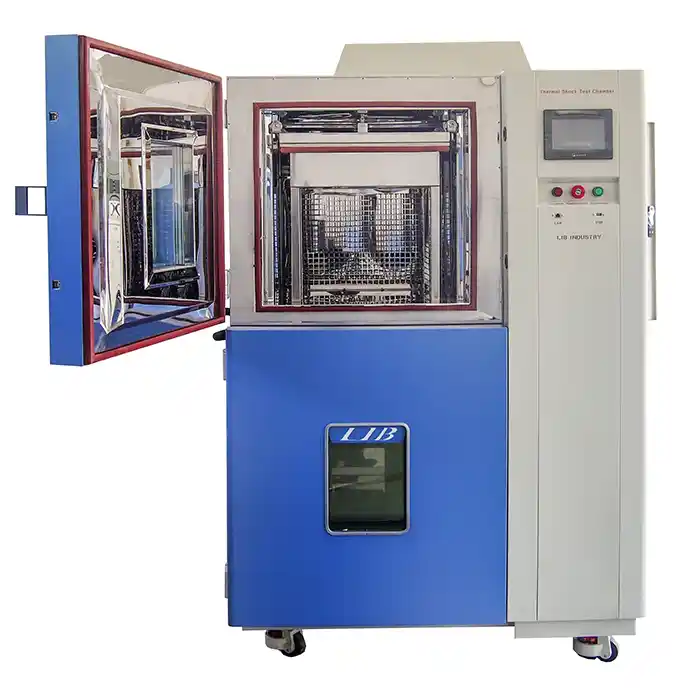
Thermal shock chambers accelerate this process by rapidly transferring battery specimens between hot and cold environments. Unlike gradual temperature cycling, thermal shock testing creates sudden temperature transitions that can reveal weaknesses that may otherwise remain hidden.
For battery manufacturers, this provides valuable reliability data during cell development, module qualification, and EV battery validation.
Need a thermal shock chamber for lithium battery testing? Contact LIB Industry for a customized solution.
Why Do Lithium Batteries Need Thermal Shock Testing?
 Lithium battery components respond differently to rapid temperature changes. Separators, electrode coatings, electrolytes, seals, and housings can expand and contract at different rates, creating mechanical stress inside the cell.
A hidden weakness may not cause a problem during normal operation but can become visible when the battery is exposed to repeated temperature extremes.
Thermal shock testing therefore provides an additional reliability evaluation alongside conventional storage and charge-discharge testing.
How Does a Thermal Shock Chamber Simulate Rapid Temperature Changes?
The key feature of a thermal shock chamber is its ability to move specimens rapidly between separate hot and cold zones.
Rapid Basket Transfer
During testing, battery specimens are loaded into a basket that automatically transfers between the hot and cold compartments. The rapid movement creates a sudden temperature transition rather than the gradual ramp used in a conventional temperature chamber.
Wide Temperature Extremes
Depending on the chamber configuration, thermal shock equipment can reach approximately -75°C to +220°C, providing a wide testing window for demanding battery applications.
Repeatable Temperature Conditions
Consistent temperature control is essential when comparing battery performance across repeated cycles. A chamber with temperature fluctuation around ±0.5°C helps maintain comparable conditions throughout the test program.
What Are the Key Parameters for Battery Thermal Shock Testing?
The required parameters depend on the battery type, applicable test procedure, and validation objective.
| Parameter | Typical Requirement | Why It Matters |
|---|---|---|
| Temperature Extremes | -40°C to +85°C or wider | Covers transport and operating conditions |
| Recovery Time | Within 5 minutes | Supports efficient repeated cycling |
| Temperature Fluctuation | ≤±0.5°C | Improves test consistency |
| Dwell Time | Standard-specific, often 30+ minutes | Allows the battery to approach thermal equilibrium |
Dwell Time and Internal Temperature
The temperature displayed by the chamber does not immediately represent the internal temperature of a battery cell.
Sufficient dwell time is therefore important to allow the cell itself to approach the required temperature before the next transition. The appropriate dwell time should be determined by the applicable test procedure and specimen characteristics.
Cycle Count
Cycle requirements vary according to the testing objective. Transport-related safety evaluations may require a limited number of cycles, while automotive durability programs can involve substantially more repetitions.
Loading Capacity
Cell-level testing can generally be performed in smaller chambers, while battery modules and complete EV packs require larger working spaces and higher loading capacities. For large battery assemblies, walk-in thermal shock configurations may be more appropriate.
Which Standards Are Relevant to Lithium Battery Testing?
 Different standards address different aspects of battery safety, durability, and abuse testing.
UN 38.3
UN 38.3 establishes requirements for the transport testing of lithium cells and batteries. Its test program includes environmental and mechanical evaluations intended to verify that batteries can withstand conditions associated with transportation.
IEC 62660
IEC 62660 covers testing of secondary lithium-ion cells for electric vehicle applications. Its various parts address performance, reliability, and safety characteristics under defined test conditions.
SAE J2464
SAE J2464 provides guidance for abuse testing of rechargeable energy storage systems used in automotive applications. Thermal abuse conditions can be used to evaluate battery safety margins under severe conditions.
The exact thermal shock or temperature cycling procedure should always be determined from the applicable edition of the standard and the specific battery test plan.
How Are Thermal Shock Chambers Used in EV Battery Manufacturing?
Thermal shock testing can be incorporated at several stages of EV battery development.
Cell-Level Qualification
Individual cells can be evaluated before module assembly to identify weaknesses in separators, seals, casing materials, or other components.
Finding defects at this stage can prevent a defective cell from entering an expensive module or pack assembly process.
Module and Pack-Level Validation
Larger chambers can accommodate battery modules and complete assemblies. These tests can evaluate structural integrity and the interaction between battery components and thermal management systems during rapid temperature transitions.
The chamber size should be selected according to the actual dimensions and weight of the battery assembly.
Supporting Global Certification
For manufacturers supplying international automotive markets, well-documented environmental test results can support product qualification and certification activities.
Maintaining consistent records of temperature conditions, dwell times, cycle counts, and test results also improves traceability during product validation.
How Does Thermal Shock Testing Improve Battery Reliability?
Thermal shock testing is most valuable when it is used throughout the product development cycle rather than only as a final qualification test.
Early Design and Material Selection
Testing separator materials, electrolyte systems, seals, and casing designs at an early stage helps engineers identify weak configurations before committing to large-scale tooling and production.
Production Batch Verification
Periodic testing can help detect changes caused by material suppliers, manufacturing processes, or production conditions. This provides an additional method of monitoring consistency between production batches.
Long-Term Reliability Data
Results collected across multiple generations of battery products can help engineers identify recurring failure mechanisms and improve future designs.
Developing or validating lithium batteries?
LIB Industry can help select the appropriate chamber temperature range, working volume, recovery performance, and safety configuration for cell, module, or pack testing.
Why Choose LIB Industry Thermal Shock Chambers for Battery Testing?
LIB Industry manufactures thermal shock chambers for applications requiring rapid and repeatable temperature transitions.
Wide Temperature Range and Fast Recovery
The LIB Industry TS series can operate from -75°C to +220°C and recover to the required temperature condition in approximately five minutes, supporting demanding battery test schedules.
Safety Protection for Battery Testing
The chambers include over-temperature, over-current, refrigerant high-pressure, and earth leakage protection to provide multiple layers of equipment and operator protection.
For lithium battery testing, the chamber configuration and safety requirements should be selected according to the battery chemistry, specimen size, test procedure, and laboratory safety plan.
Programmable Testing
A programmable controller allows operators to configure repeated temperature transitions and test cycles, supporting consistent testing across multiple battery samples.
3-Year Warranty & Lifetime Support
LIB Industry provides a 3-year warranty, lifetime technical support, and 24/7 English after-sales service. If the chamber cannot be repaired during the warranty period, LIB Industry provides a replacement according to the warranty terms.
Turn-Key Project Support
From design and production to installation, commissioning, and training, LIB Industry provides complete project support from one supplier.
Related Battery Environmental Test Chambers
|
|
|
|
|
Temperature & Humidity Test Chamber Suitable for battery aging, storage, and reliability testing under controlled temperature and humidity conditions. |
Thermal Cycling Chamber Designed for repeated temperature changes with controlled heating and cooling rates when gradual temperature transitions are required. |
Walk-in Environmental Test Chamber Provides a larger testing space for battery modules, packs, and other large assemblies that cannot be accommodated by standard chambers. |


FAQ
Why use a thermal shock chamber instead of a standard temperature chamber?
A thermal shock chamber rapidly transfers specimens between hot and cold zones, producing sudden temperature changes. A conventional temperature chamber generally changes temperature at a controlled ramp rate.
What temperature range is suitable for lithium battery thermal shock testing?
The required range depends on the applicable test procedure. A common validation range is around -40°C to +85°C or wider, while LIB Industry TS series chambers can provide -75°C to +220°C for applications requiring more extreme conditions.
Can thermal shock chambers test complete EV battery packs?
Yes, provided the chamber has sufficient working dimensions and load capacity. Large battery packs may require a customized or walk-in thermal shock configuration.
Can LIB Industry customize a battery thermal shock chamber?
Yes. Chamber volume, temperature range, basket capacity, safety configuration, control functions, and other parameters can be customized according to the battery testing requirements.
Conclusion
Thermal shock chambers provide lithium battery manufacturers with a controlled way to evaluate the effects of rapid temperature transitions on cells, modules, and battery packs.
By combining a suitable temperature range, fast recovery, repeatable control, appropriate dwell times, and adequate safety protection, thermal shock testing can reveal weaknesses that gradual temperature testing may not identify.
With a -75°C to +220°C temperature range, approximately five-minute recovery, programmable control, multiple safety protections, and long-term technical support, LIB Industry provides thermal shock testing solutions for lithium battery and EV applications.
Looking for a thermal shock chamber for lithium battery testing? Contact LIB Industry for a customized solution backed by a 3-year warranty and lifetime technical support.