How Do You Choose the Right Solar Simulation Chamber Supplier in China?
Sourcing solar simulation chambers from China can offer cost advantages, customization flexibility, and access to an established photovoltaic manufacturing supply chain. However, choosing the right supplier requires more than comparing prices.
Buyers should verify factory ownership, certifications, solar simulator class, temperature and humidity performance, calibration data, warranty terms, and after-sales support before placing an order. A supplier that can manage design, production, testing, shipping, installation, and training can also significantly reduce the risks of importing large laboratory equipment.
Looking for a reliable solar simulation chamber supplier in China? Contact LIB Industry to discuss your panel size, testing standards, chamber configuration, and project requirements.
Why Source Solar Simulation Chambers From China?
Mature Photovoltaic Supply Chain
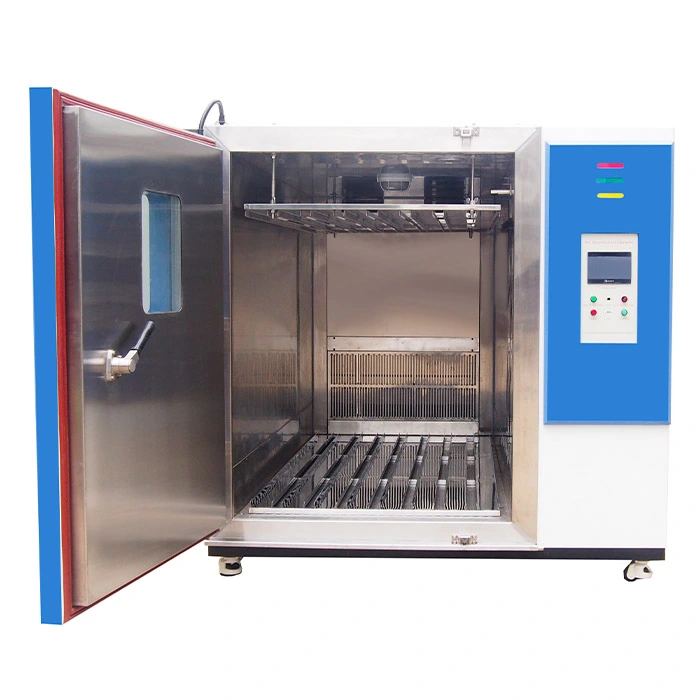
China has a mature photovoltaic manufacturing and testing equipment industry, supported by local suppliers of compressors, refrigerants, controllers, stainless steel structures, and other chamber components.
This supply-chain advantage can help manufacturers reduce lead times for components, replacement parts, and customized configurations.
Competitive Pricing Without Sacrificing Capability
Many Chinese manufacturers offer Class A or Class AAA solar simulation chambers capable of supporting demanding photovoltaic environmental testing applications.
Typical requirements may include 85°C/85%RH damp heat testing and -40°C to +85°C temperature cycling, depending on the applicable test procedure.
However, price should not be the main selection criterion. Buyers should compare the actual component brands, manufacturing capability, calibration procedures, and technical specifications behind the quotation.
Established Export Experience
Experienced environmental chamber manufacturers are familiar with international shipping, electrical configurations, export documentation, packaging, and on-site commissioning.
For overseas laboratories, this experience can reduce delays caused by incorrect voltage configurations, unsuitable packaging, or insufficient installation support.
Planning to import a solar simulation chamber for the first time? Ask LIB Industry to review your installation conditions and export requirements before production begins.
How Can You Find Reliable Solar Simulation Chamber Suppliers in China?
B2B Platforms and Trade Directories
Platforms such as Alibaba, Made-in-China, and Global Sources can help buyers identify potential manufacturers. However, platform ratings alone do not demonstrate engineering capability.
Look for suppliers that provide:
- Detailed technical specifications
- Actual factory information
- Product drawings
- Calibration records
- Test reports
- Installation references
- Clear warranty and service terms
Specific technical information is generally more useful than broad marketing claims.
Industry Exhibitions and Trade Shows
Events such as SNEC PV Power Expo and Intersolar provide opportunities to meet manufacturers directly.
Speaking with technical engineers can also help buyers understand how the solar simulator is calibrated, how uniformity is verified, and how the environmental chamber is configured for specific PV testing procedures.
Referrals From Testing Laboratories
PV testing laboratories and certification organizations that already use imported environmental chambers can provide useful supplier references.
A supplier with proven installations and repeat customers may offer stronger evidence of long-term product reliability than a company with only a large online product catalog.
What Should You Verify Before Choosing a Supplier?
Factory Ownership and Manufacturing Scope
One of the first questions should be whether the company designs and manufactures the chamber itself or purchases finished equipment from another manufacturer.
Ask for:
- Factory photos or video tours
- Welding and assembly areas
- Refrigeration system assembly
- Electrical control panel production
- Quality-control procedures
- Final testing and calibration processes
A live factory tour can provide useful evidence of actual manufacturing capability.
Certification and Test Standard Compliance
A suitable solar simulation chamber should clearly identify the applicable photovoltaic testing standards and provide supporting documentation.
Commonly referenced standards include:
| Standard | Typical Application |
|---|---|
| IEC 61215 | Design qualification and type approval for terrestrial PV modules |
| IEC 61730 | PV module safety qualification |
| UL 1703 | PV module safety requirements where applicable |
| Relevant thermal/environmental test procedures | Thermal cycling, damp heat, humidity freeze and related environmental testing |
Buyers should also request calibration documentation for the solar simulator, including information related to spectral irradiance, irradiance uniformity, and temporal stability where applicable.
Need help matching your required PV standard to a chamber configuration? Send LIB Industry your test standard and module dimensions for a technical recommendation.
What Should You Compare When Evaluating Solar Simulation Chamber Suppliers?
A structured comparison can make differences between suppliers easier to identify.
| Evaluation Criteria | What to Request | Why It Matters |
|---|---|---|
| Certification Compliance | IEC 61215 / IEC 61730 / applicable test reports | Confirms testing capability |
| Solar Simulator Class | Class A or Class AAA documentation | Indicates simulator performance |
| Temperature & Humidity Range | Specification sheet and tolerances | Affects test repeatability |
| Factory Audit | Live or recorded production tour | Verifies manufacturing capability |
| Calibration | Calibration certificates and test records | Supports measurement reliability |
| Warranty & Service | Written warranty and response terms | Reduces long-term risk |
| Customization | Drawings and configuration proposal | Ensures fit with the laboratory |
| Installation | Installation and commissioning scope | Reduces setup problems |
Look Beyond the Spec Sheet
A temperature deviation or recovery value has little meaning without knowing how it was measured.
Ask suppliers:
- Was the chamber empty or loaded?
- What was the test load?
- Where were the sensors positioned?
- How long was the measurement performed?
- Was the solar simulator operating during environmental testing?
- What calibration procedure was used?
A chamber tested under empty conditions may show tighter tolerances than one operating with full-size PV modules.
Request Sample Test Reports
A reliable supplier should be able to provide appropriate sample documentation, such as anonymized thermal cycling curves, damp heat test data, or calibration records.
Actual test data can help buyers evaluate whether the supplier's stated performance is supported by measurable results.
Tie Payment to Inspection Milestones
For large imported equipment, buyers can consider linking payment milestones to stages such as:
- Design approval
- Production completion
- Factory inspection
- Pre-shipment testing
- Installation and commissioning
- Final acceptance
This provides additional control over quality before the equipment is fully paid for and shipped.
Request a pre-shipment inspection package from LIB Industry, including equipment testing and relevant documentation, before your chamber is shipped.
Can Solar Simulation Chambers Be Customized?
Standard configurations do not always match every laboratory. Panel dimensions, test capacity, shelving, floor space, and testing sequences can vary significantly between projects.
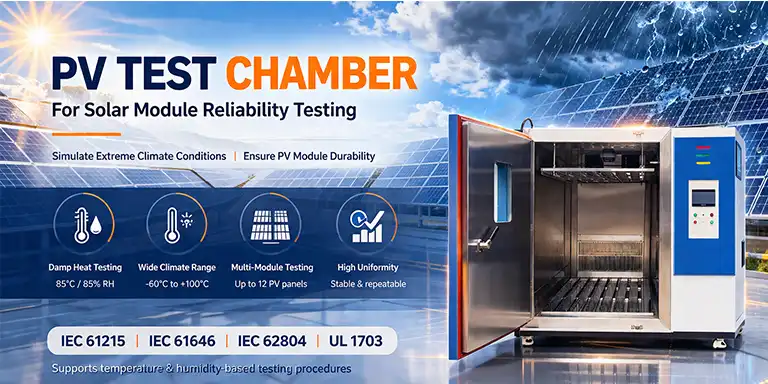
Custom Panel Sizing and Sample Shelving
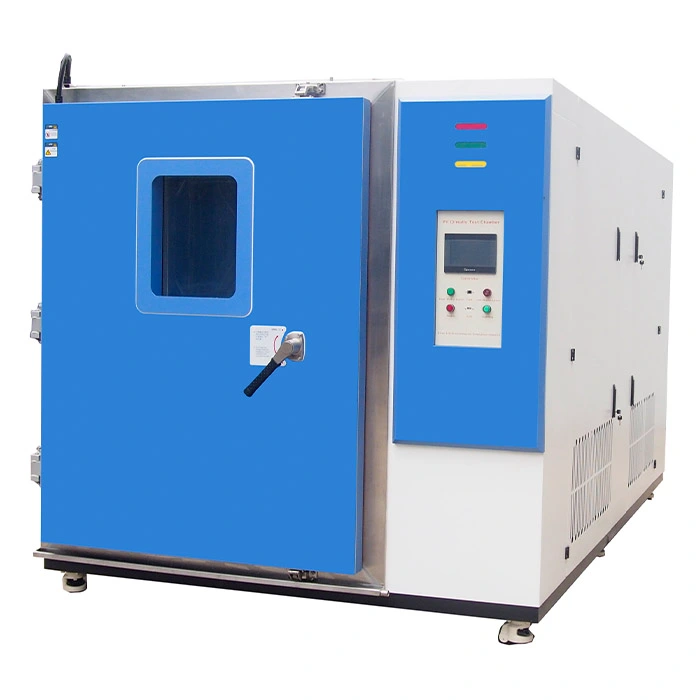
Adjustable stainless-steel shelving can accommodate different PV module dimensions and testing capacities.
For applications involving panels larger than the standard 1 m × 2 m format, buyers should confirm the internal dimensions, door opening, shelving arrangement, and loading method before ordering.
Depending on the configuration, a chamber can be designed for approximately 4–12 panels per cycle.
Integrated Solar Simulator and Environmental Control
A solar simulation chamber can combine a Class A or Class AAA solar simulator with controlled temperature and humidity.
This configuration allows engineers to perform environmental and irradiance-related testing within one integrated system, depending on the applicable procedure.
Controller and Interface Customization
Programmable controllers can support multiple test programs and segmented temperature/humidity profiles. Multilingual interfaces can also be useful for laboratories with international engineering teams.
When requesting customization, buyers should provide module dimensions, quantity, test standards, temperature/humidity requirements, irradiance requirements, and laboratory space.
Have a non-standard PV module size or testing sequence? LIB Industry can develop a customized chamber configuration around your actual test requirements.
What Should You Consider When Shipping a Solar Simulation Chamber From China?
Importing a large environmental chamber involves more than sea freight. Production testing, packaging, customs clearance, electrical compatibility, installation, and commissioning all need to be planned.
| Shipping Stage | Typical Duration | Key Consideration |
|---|---|---|
| Production & Factory Testing | 30–60 days | Confirm pre-shipment inspection |
| Sea Freight | 25–45 days | Check container requirements |
| Customs Clearance | 5–15 days | Prepare HS code and compliance documents |
| Installation & Commissioning | 3–7 days | Confirm engineer or remote support |
Actual delivery time depends on equipment size, destination, shipping method, customs procedures, and project configuration.
Packaging and Container Selection
Large floor-standing or walk-in systems may require special container arrangements, such as flat-rack or open-top containers.
Door dimensions, chamber volume, lifting points, and loading methods should be confirmed before production is completed.
Installation and Operator Training
For overseas laboratories, installation and training support can be particularly important.
Suppliers may provide:
- Installation guidance
- Remote commissioning
- Operator training
- User manuals
- Maintenance instructions
- Spare-parts support
Import Duty and Voltage Compatibility
Before shipment, confirm the local voltage, frequency, and phase configuration.
Customs classification and import requirements should also be checked with the appropriate local customs or logistics professionals before shipping.
LIB Industry Solar Simulation Chamber Solutions
LIB Industry provides environmental testing equipment for photovoltaic and other industrial applications, including customized solar simulation chamber solutions.
The chamber configuration can be developed around:
- PV module dimensions
- Number of specimens
- Class A or Class AAA solar simulation requirements
- Temperature and humidity conditions
- Thermal cycling requirements
- Damp heat requirements
- Humidity freeze testing
- Shelving and loading configuration
- Controller and data-recording requirements
LIB Industry can support the project from design and production through factory testing, shipping, installation, commissioning, and operator training.
Send your PV module dimensions and applicable testing standards to LIB Industry for a customized quotation and technical proposal.
3-Year Warranty & Lifetime Support
LIB Industry provides a 3-year warranty, lifetime technical support, and 24/7 English after-sales service. If the equipment cannot be repaired during the warranty period, LIB Industry provides a replacement according to the warranty terms.
Related Products for PV Testing
A photovoltaic laboratory often requires several environmental testing systems rather than a single chamber. Depending on the testing program, the following equipment can complement a solar simulation chamber.
|
|
|
|
|
Temperature & Humidity Chamber Suitable for controlled temperature and humidity conditioning, damp heat-related testing, and environmental exposure of PV modules and components. |
Thermal Cycling Chamber Designed for repeated temperature changes and useful for evaluating thermal stress, reliability, and durability of photovoltaic modules and other electronic components. |
UV Weathering Test Chamber Used for accelerated UV exposure to evaluate UV resistance, material degradation, encapsulant durability, and surface aging of photovoltaic materials and components. |


Building a complete PV testing laboratory? LIB Industry can help integrate solar simulation, temperature/humidity, thermal cycling, and UV testing equipment according to your testing program.
FAQ
What certifications should a solar simulation chamber meet?
The applicable requirements depend on the PV test program. IEC 61215 and IEC 61730 are important standards for PV module qualification and safety, while other standards may apply depending on the market and certification program.
How long does it take to ship a solar simulation chamber from China?
The source estimates 30–60 days for production and factory testing, followed by approximately 25–45 days of sea freight and 5–15 days for customs clearance. Complete delivery commonly takes around two to four months, depending on the project and destination.
Can a solar simulation chamber be customized for different PV module sizes?
Yes. Internal dimensions, shelving, loading capacity, and testing configuration can be customized for different module sizes and test quantities.
How can I verify whether a Chinese supplier is a real manufacturer?
Request a factory video tour, production photos, equipment drawings, calibration records, sample test reports, and information about the manufacturing and testing process. A factory audit can provide additional verification before placing an order.
Start Your Solar Simulation Chamber Project
Choosing the right Chinese supplier is not simply about finding the lowest quotation. Factory capability, simulator performance, environmental control, calibration, customization, documentation, and after-sales support all affect the long-term value of the equipment.
LIB Industry provides customized environmental testing solutions for photovoltaic applications, with support covering design, manufacturing, factory testing, shipping, installation, commissioning, and training.
Contact LIB Industry to discuss your PV module size, testing standards, simulator class, temperature/humidity requirements, and laboratory configuration.
Email: ellen@lib-industry.com