How Is a Solar Simulation Chamber Manufactured and Quality-Controlled?
Need a solar simulation chamber for IEC 61215 testing? Request a quote in 24 hours.
The production of a solar simulation chamber involves more than assembling a cabinet and installing a light source. Structural fabrication, temperature and humidity control, solar simulator performance, calibration, and final testing all affect the reliability of the test results.
The outer structure is typically constructed from cold-rolled steel, while the interior uses SUS304 stainless steel. Refrigeration, humidity generation, and solar simulator systems are then integrated into the test cavity. Depending on the configuration, the chamber can support controlled temperature conditions from -40°C to +85°C and damp heat testing up to 85°C/85%RH.
For photovoltaic testing, the solar simulator is configured to provide AM1.5 spectral irradiance, with Class A or Class AAA performance available according to the application. Quality control throughout production helps verify insulation sealing, electrical safety, environmental control, and solar simulator performance before shipment.
Overview of Solar Simulation Chamber Manufacturing Process
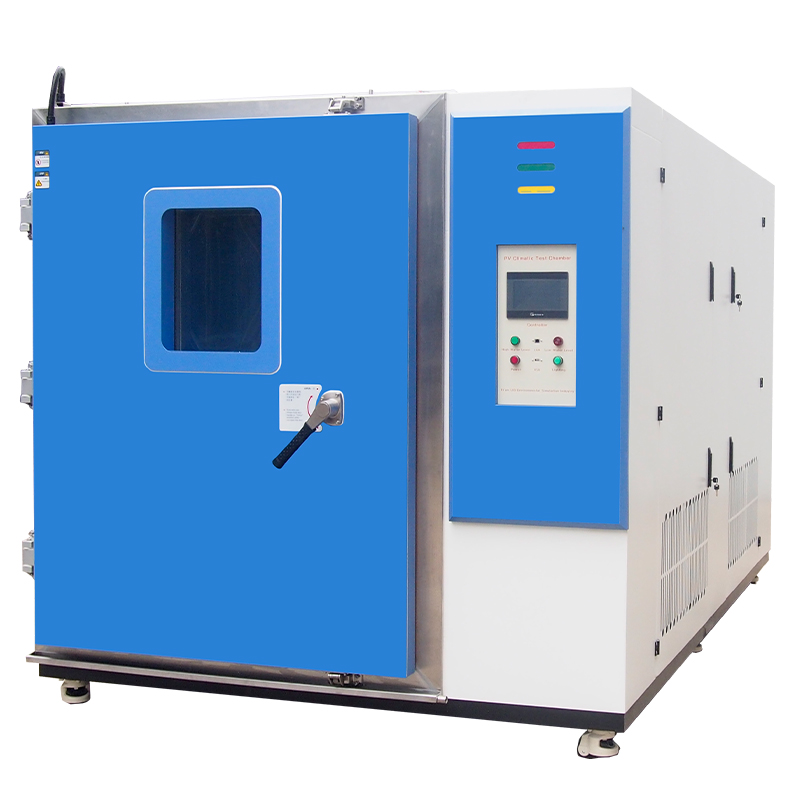 A reliable solar simulation chamber is manufactured through several controlled stages. Structural integrity, environmental control, electrical systems, and calibration are checked before the chamber moves to the next production stage.
Structural Fabrication and Cabinet Assembly
The outer shell and inner test cavity are fabricated from steel panels that are cut, welded, and insulated. SUS304 stainless steel is used for the sample shelves and interior surfaces because it provides good resistance to repeated temperature and humidity exposure.
Cable ports can be configured in 50 mm, 100 mm, or 200 mm sizes and sealed with silicone plugs to help maintain the controlled environment during long-duration tests.
Refrigeration and Humidity System Integration
Compressors, evaporators, and humidity-generation systems are integrated to provide controlled temperature and humidity conditions. Depending on the chamber configuration, temperature ranges can extend from -60°C to +100°C, with humidity control from 20%RH to 98%RH.
Before the cabinet is sealed, refrigerant lines undergo pressure testing to identify potential leaks before the chamber is delivered to the customer.
Solar Simulator Installation and Calibration
Lamp arrays are installed and adjusted to provide uniform AM1.5 spectral irradiance across the test area. Uniform illumination is particularly important for photovoltaic testing because differences in irradiance can affect degradation results between samples positioned at different locations.
Before final assembly, technicians verify spectral match, irradiance uniformity, and temporal stability according to the required Class A or Class AAA performance.
Key Components Used in Solar Simulation Chamber Production
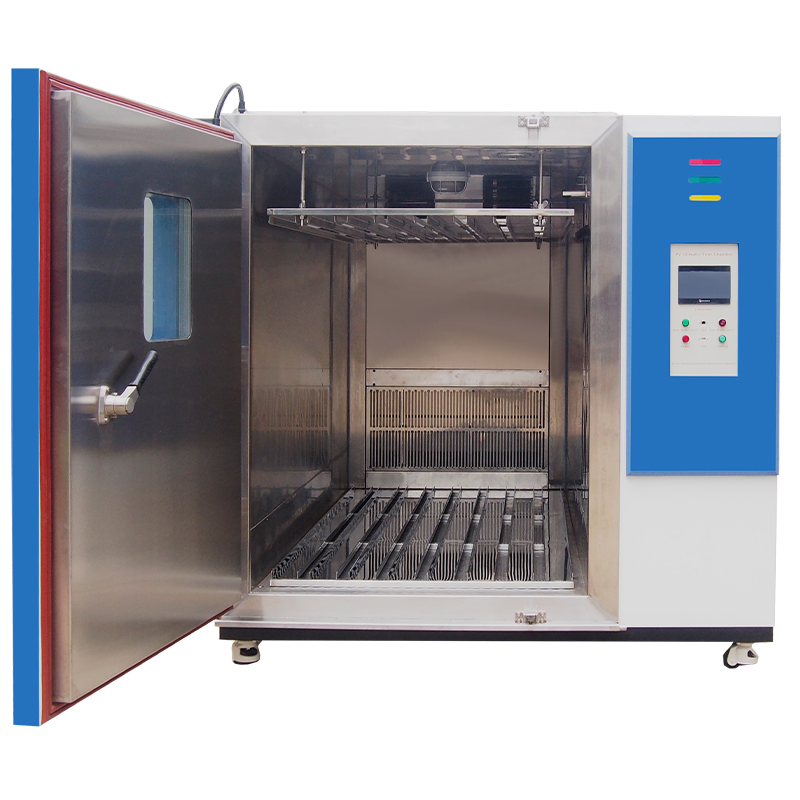 The long-term performance of a solar simulation chamber depends heavily on the quality and integration of its key components.
Solar Simulator Lamp Systems
Xenon or LED lamp arrays are used to generate radiation designed to simulate relevant portions of natural sunlight. Lamp lifespan and spectral consistency can vary, making the lamp system an important consideration when selecting a chamber.
For certification-oriented applications, Class AAA solar simulators provide tighter requirements for spectral match, spatial uniformity, and temporal stability.
Precision Temperature and Humidity Sensors
Platinum resistance thermometers and capacitive humidity sensors provide real-time environmental data to the controller. The temperature control system can maintain changes as small as approximately 0.5°C, while humidity control can achieve around ±2.5%RH, depending on the chamber configuration.
Sensor placement is also important because airflow patterns can create temperature or humidity differences at different positions inside the test cavity.
Programmable Controller Systems
Programmable controllers allow engineers to automate thermal cycling, humidity, and damp heat sequences that may run for several days without continuous manual operation.
Controllers can store up to 120 programs across 100 segments, depending on the configuration, and support data communication for test monitoring and record keeping.
LIB Industry provides solar simulation chambers configured around photovoltaic and material testing requirements, including controlled temperature, humidity, and solar simulator performance.
How Manufacturers Ensure Solar Simulation Accuracy
Solar simulation accuracy depends on regular verification and calibration rather than a single adjustment during production.
Spectral Match Verification
Spectroradiometers measure lamp output across the solar spectrum and compare it with AM1.5 reference values to verify the required spectral match.
If deviations are identified during final testing, technicians can adjust the lamp system or replace relevant filters before the chamber is released.
Irradiance Uniformity Mapping
Irradiance is measured at multiple grid points across the test plane because samples positioned near the edges can receive different exposure from those located near the center.
The uniformity-mapping results are recorded as part of the chamber's technical documentation, allowing customers to review the measured performance of the solar simulator.
Temporal Stability Testing
Lamp output is monitored over time to verify that irradiance remains stable throughout the test cycle. Flickering or output drift can affect long-duration exposure results, particularly when testing photovoltaic modules or materials.
Continuous performance monitoring helps ensure that the solar simulator maintains stable illumination during extended testing.
Quality Control Standards for Solar Simulation Chamber Manufacturing
Quality control checkpoints help verify that the chamber meets its specified environmental and solar simulation performance before shipment.
| QC Stage | Verification Focus | Standard Reference |
|---|---|---|
| Incoming Material Inspection | Steel grade, sensor accuracy, lamp specifications | Internal QC procedures |
| Electrical Safety Testing | Insulation resistance, grounding, leakage current | IEC 61010 general safety |
| Environmental Performance Testing | Temperature/humidity deviation, ramp rate | IEC 61215, IEC 61730 |
| Solar Simulator Calibration | Spectral match, uniformity, temporal stability | IEC 60904-9 classification |
| Pre-Shipment Inspection | Full functional test, packaging review | Manufacturer final sign-off |
Documentation and Traceability
Manufacturers should maintain calibration certificates, component records, and factory test reports for each chamber and link them to the chamber's serial number.
This documentation can be important when laboratories need to demonstrate the validity and traceability of test equipment during certification or third-party audits.
Third-Party Verification Options
Some laboratories may request independent calibration verification from an accredited metrology laboratory before accepting delivery. This provides an additional verification step alongside the manufacturer's factory calibration and test records.
Common Manufacturing Challenges and Quality Solutions
Maintaining stable performance over years of operation presents several engineering challenges.
Lamp Degradation Over Time
Xenon and LED lamps can gradually lose output with use, potentially affecting spectral performance. Manufacturers can address this through scheduled lamp replacement, performance monitoring, and controller alerts that identify output changes before they significantly affect testing.
Temperature Gradient Inside Large Chambers
Large chambers and walk-in configurations can be more difficult to maintain uniformly than smaller benchtop units.
Improved airflow design, circulation fans, and multi-point sensor placement can help reduce temperature gradients across the test cavity.
Humidity Control at Extreme Temperatures
Maintaining precise humidity becomes more challenging near the limits of the operating temperature range. At low temperatures, air holds less moisture, while higher humidity conditions can increase the risk of condensation.
Closed-loop feedback control and appropriate humidity-generation systems help maintain stable conditions throughout demanding solar testing cycles.
How to Select a Solar Simulation Chamber Manufacturer Based on Quality
When selecting a manufacturer, buyers should evaluate production quality and technical documentation alongside price.
Reviewing Factory Quality Certifications
ISO 9001 certification indicates that a manufacturer has established documented quality-management procedures covering production and quality control.
Buyers can also request current certification documents and relevant factory quality records when evaluating suppliers.
Requesting Calibration and Test Reports
Ask for calibration and factory test reports covering key performance parameters such as spectral match, irradiance uniformity, temporal stability, and temperature-humidity deviation.
These records provide more useful information about actual chamber performance than general marketing specifications alone.
Evaluating After-Sales Calibration Support
Solar simulation chambers require periodic verification and recalibration during long-term operation. Before purchasing, confirm whether the manufacturer provides technical assistance, replacement sensors, calibration support, and remote troubleshooting.
LIB Industry provides traceable factory calibration with an ISO 17025-related calibration report where applicable, together with lifetime technical support.
FAQ
What quality standards apply to solar simulation chamber manufacturing?
Manufacturing and testing may reference IEC 61215 and IEC 61730 for photovoltaic environmental testing, IEC 60904-9 for solar simulator classification, and applicable electrical safety requirements, together with internal factory quality procedures.
How often does a solar simulator need recalibration?
Recalibration frequency depends on the lamp type, operating hours, and laboratory requirements. Many laboratories schedule spectral match and uniformity verification periodically to identify lamp degradation before it affects test accuracy.
What causes temperature variation inside larger solar simulation chambers?
Larger internal volumes can experience uneven airflow distribution. Manufacturers address this through airflow design, additional circulation fans, and multi-point sensor placement to reduce temperature gradients.
Related Solar and Environmental Test Chambers
|
|
|
|
| Xenon Arc Weathering Chamber Designed for accelerated weathering and light-exposure testing using xenon-arc radiation, suitable for materials, coatings, plastics, and photovoltaic-related applications. |
UV Accelerated Weathering Test Chamber Provides controlled UV exposure for evaluating material aging and UV resistance under accelerated laboratory conditions. |
Temperature & Humidity Test Chamber Provides controlled temperature and humidity conditions for reliability, aging, and environmental conditioning when solar irradiation is not required. |


Conclusion
Creating a reliable solar simulation chamber requires controlled manufacturing from structural fabrication and environmental system integration through solar simulator installation, calibration, and final testing.
Quality control based on IEC 61215, IEC 61730, and IEC 60904-9 helps verify environmental and solar simulation performance, while calibration records and factory test reports provide important traceability for laboratory use.
Before purchasing a solar simulation chamber, laboratories should review the required solar simulator class, temperature and humidity range, calibration documentation, factory quality controls, and long-term technical support.
LIB Industry provides solar simulation chambers with customized configurations, factory calibration, and long-term technical support for photovoltaic and material testing applications.
For a quotation, send your required solar simulator class, test standard, sample dimensions, temperature/humidity conditions, and test area requirements to ellen@lib-industry.com.


